Tag Archives: insulin pumps

Reservoir Recall, and the FDA Gets Tough.

DSC00940

This is an FYI post, in case you haven’t heard about it yet. If you’re a Medtronic pumper, you will hear about it because Medtronic is sending a letter and FAQ sheet to all their pump users.

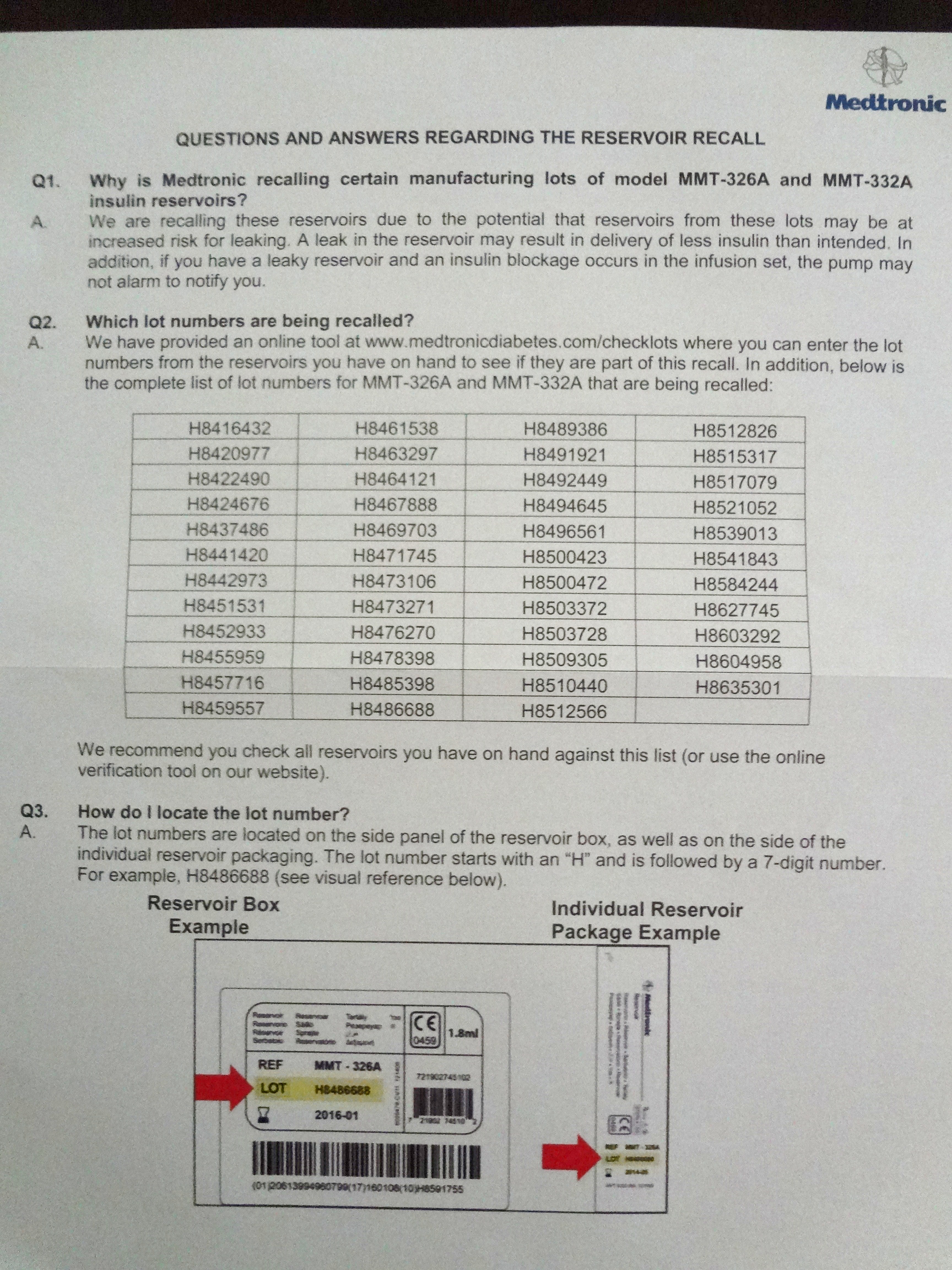
Medtronic Diabetes is voluntarily recalling specific lots of reservoirs for Paradigm insulin pumps. Apparently, the affected reservoirs are at increased risk for leaking. The photo above is part of the FAQ sheet I received that lists the lot numbers that are being recalled.

Now, I know it’s easy to bash a company for making something that is eventually found to be faulty. But I will also give you some facts, according to the recall notice sent to me:

– First of all, this is a voluntary recall. No one made Medtronic recall these reservoirs. I don’t know if there was any kind of communication between them and the FDA, for example, that led to the voluntary recall before a mandatory one. But still, a voluntary recall always happens faster than a mandatory one.

– Medtronic conducted an investigation of the cause of this issue, and found that the reservoirs in question were all manufactured on a specific manufacturing tool that developed “abnormal wear”. They have corrected the issue and put additional testing and inspection in place.

– Med-T has a number to call if you have the recalled reservoirs and need new ones right away: 1-866-450-0890. They will ship the new ones free of charge to you.

Medtronic acknowledges a few cases of diabetic ketoacidosis requiring hospitalization that may have been caused by the faulty reservoirs. I don’t want to belittle these cases, or the patients and their loved ones involved. I also think it would have been nice if I’d have received an e-mail, or a tweet from @MDT_Diabetes. Other than that, what I am saying is that if a product I’m using does need to be recalled, I want the recall to be done like this.
 
 
Also, the FDA has cracked down on companies selling products that claim to help mitigate, treat, or cure diabetes, but as we know, they don’t. This includes “natural” treatments that have undeclared ingredients; dietary supplements that claim to treat, cure, or prevent diabetes; homeopathic over-the-counter meds that claim to help with peripheral neuropathy; and prescription drugs sold by pharmacies without a prescription.

Take a look at these products, and where they’re from. It proves that there are scam artists just about anywhere you go. These products are being pulled from the market by the FDA:

– Diexi by Amrutam Life Care Pvt. Ltd., Surat India.

– Anastasia Diapedic Foot & Leg Treatment by Anastasia Marie Laboratories Inc., Oklahoma City, Okla.

– Exermet GM, Galvus, Nuzide, Triexer and unapproved versions of Januvia, all from
bestcheapmedsonline.com.

– Diaberex by Enhance Nutraceutical.

– Zostrix Diabetic Foot Pain Relief Cream, Zostrix Diabetic Joint & Arthritis Pain Relief Cream and Diabeti-Derm Antifungal Cream, all from Health Care Products, Hi-Tech Pharmacal Co., Amityville, N.Y.

– Sugar Balancer by Health King Enterprises & Balanceuticals Group Inc., Chicago.

– Insupro Forte by INS Bioscience Berhad, HLS International Sdn. Bhd., Easy Pha-max, Selangor Darul Ehsan, Malaysia.

– Diabetic Neuropathy Foot Cream, Diabetic Foot Cream, and Diabetic Hand & Body Cream by The Magni Group, doing business as MagniLife, McKinney, Texas.

– Eradicator by Naturecast Products, Coral Springs, Fla.

– Diabetes Daily Care by Nature’s Health Supply Inc., College Park, Md.

– Glucocil by Neuliven Health, San Diego,Calif.

– Neuragen PN and Neuragen Cream by Origin BioMed Inc., Halifax, Novia Scotia, Canada.

– Nepretin by Nutrient Synergy, Longmont, Colo.

– ProBeta by PharmaTerra Inc., Bellevue, Wash.

For more information, and to stay up-to-date or report on Diabetes drugs or devices, visit FDA MedWatch at www.fda.gov/Safety/MedWatch/default.htm
 
 
Happy Wednesday… Stay safe!


#DSMA June Blog Carnival. #Diabetes Devices.

June’s DSMA Blog Carnival prompts us to think about the many devices we use in our daily lives with diabetes, and asks some great questions:

Regardless of which type of diabetes you have – T1 T2 or T3 – you probably use one or more diabetes devices on a daily basis. For this post, when we refer to devices we mean blood glucose meters, insulin pens or pumps, and all other diabetes medications. This month we’re going to revisit the May 15th chat on Diabetes Devices and really think about what we use. We’d like to know:

How do you select the diabetes devices you use? To others looking into new or replacement devices, what would be your best advice to someone shopping around?

This really brings back some memories for me. If I may, let me give some advice by telling you how not to choose devices.

First, let’s talk about meters. After my diagnosis, I just accepted the first meter that was handed to me, and I used it for about ten years. I mean, they wouldn’t give me something that helps determine how I use insulin and the various ramifications of said usage without it being 100 percent accurate and never failing? Right?

Wrong. It’s not that my meter wasn’t good for its time (it was 1991, after all– only 45 seconds to get my BG!), but I didn’t even think of whether there might be an alternate meter I could use. And if the one I had was still working, why would I need a new one? Then came the day that an endocrinologist asked to see my meter, and she laughed at me when she saw it. She said, “You know, meters have really come a long way since the Mesozoic Era”. I had no idea. It simply didn’t occur to me that things could change, and meters could be even better. From then on, I tried to keep an eye on the latest improvements in meters and test strips, so even if I wasn’t changing meters, I would know if there was a major improvement of some kind that should prompt me to upgrade this very important device. Lesson: Stay current… maybe something better, or at least more useful, is out there.

Now, let’s talk about insulin pumps and infusion sets. When I first decided to start pumping insulin instead of injecting it, I had really only seen or read information on one pump product. So when my endocrinologist (who I had just started seeing six months earlier) said I should read about additional manufacturers of insulin pumps, I took her advice but didn’t really change my opinion about what I wanted.

In the end, I chose the pump that I’m using today for a couple of good reasons, and a few bad reasons. Chief among the bad reasons were the fact that I didn’t really consider the other pumps. I had my mind set on one only, and that’s the one I chose. Also, and this is very important: I didn’t ask anything about any other pump, and I didn’t get any demos or trial runs of any other pumps. This is completely not like me, and I want to kick myself every time I think about it. I should have done trial runs of other pumps. I should have listened to the sales pitches from the other reps (because that’s what you get… sales pitches). I should have asked a lot of questions.

I can’t say that I’m unhappy with my choice of pumps. What I have works very well, and it’s amazingly reliable. Those are big metrics for me. So I’m pretty happy I wound up with the pump I’m using. But I really wish I had done a little more due diligence, so I would be absolutely happy and sure of my choice. Lesson: Be an informed patient and consumer. It can only benefit you in the long run.

These are a couple of examples that I can point to in saying: Don’t make my mistakes. Learn about potentially new meters, medications, and yes, insulin pumps if you’re using one or plan to use one in the near future. Ask a lot of questions. A lot. Here’s an idea: Why not reach out via social media to get feedback on something you’re thinking of? Most of you know how responsive the DOC (Diabetes Online Community) can be, and how we’re very good at giving you the unvarnished truth. Finally, if you can, ask to do a trial run of your potentially new device so you can be even more sure you’re making the right decision.

I can’t guarantee that following this advice will help you land the perfect device to help you manage your diabetes better. But I do know this: More information will help you make the best choice you can make. And who wouldn’t be happy with that?

This post is my June entry in the DSMA Blog Carnival. If you’d like to participate too, you can get all of the information at http://diabetessocmed.com/2013/june-dsma-blog-carnival-3/


Medtronic and Dexcom in a good light.

Tuesday’s post covered a couple of potential issues with devices made by Medtronic and Dexcom. And I seem to remember a similar post that included Medtronic a couple of months ago.

Taken just as they are, these posts might give you the impression that I have a problem with Med-T and Dex. Trust me… I do not have an axe to grind. I really do try to be fair and balanced. Not fair and balanced like a certain news organization here in the States that eggs on congress to repeal the Patient Protection and Affordable Care Act (the house voted against it 37 times already), then champions House Speaker John Boehner when he states that “…creating a better environment for jobs has been and will remain our top focus”. But I digress.

What I’d like to do today is talk about the things that I really like about the Medtronic pump I have, and the Dexcom continuous glucose monitor (CGM) I’m using as part of a clinical trial. M’kay?
 
 
First, Medtronic.

The single best thing I can say about my MiniMed Paradigm® Revel™ insulin pump is that it’s reliable. It has never once failed me. Oh, I’ve gotten a motor error or two now and then, but I was always able to overcome that without too much difficulty. By “without too much difficulty”, I mean within five minutes.

I’ve also dropped my pump several times over the last three and a half years. I’ve scratched it. I’ve let it get dirtier than a medical device should ever be, and it still keeps going. It’s been on bike rides and runs and through airport security more than a few times. No problems here… still pumping.

And when it comes right down to it, what I want most out of a medical device designed to help keep me alive is reliability. My pump has that in spades.
 
 
Now, Dexcom.

There’s a lot to like about the Dexcom G4™ continuous glucose monitor. To begin with, the insertion process is simple, smooth, and often completely painless. For the study I’m participating in, I’m required to wear the sensor on my belly only, so I haven’t had a chance to try it anywhere else. But I really like the fact that I can get the sensor in easily, and that once it’s in I almost never feel it.

Since it’s not integrated with my pump, the Dexcom CGM has its own display device. Much has been written about how 21st century and sexy this little thing is. I mean, it is kinda nice, and it looks a lot like other electronic devices we all carry around every day. But I really dig two things about it. One, it holds a charge for a loooong time (and recharges quickly). And two, the range on the device is pretty good. I’ve gotten into the habit of reminding myself to put it in my pocket every time I stand up now, so I don’t leave it on a table or on my desk at work. But if I’m in a meeting in a big conference room, I can leave it on the conference table and get up to walk around the room without worrying about whether I’ll be out of range. At home, I can sit it on the front steps while I mow the front lawn (I have a small yard, but it’s big enough to be out of range for other CGMs).

Finally, I like the Dexcom Studio™ software used to track all of the data from the CGM. Lots of user-friendly, understandable graphs, charts, and other features that help me understand my glucose trends better. I could go into detail, but if you’re really interested in finding out more about it, you should probably check out the information on the Dexcom website.

I haven’t tried a lot of continuous glucose monitors (just Dexcom and Medtronic), but my impression of the Dexcom G4™ is that it’s the Cadillac of CGMs right now. If you disagree, feel free to let me know why by leaving a comment.
 
 
So you see, it’s not all bad. If you think about where we were twenty years ago, there really has been a lot of hard work done and progress made on insulin pumps and CGMs. I hope that in future years, Medtronic and Dexcom will be able to keep the best features of their current products, and improve and enhance the worst. Our lives, and the quality of our lives, depend on it.


Pumps and CGMs and being a bear.

Oh My! There are a couple of things I want to draw your attention to. I wasn’t quite sure how I was going to write about these things, but fortunately, someone else already has.

These both may seem kind of negative, and I don’t really mean to sound that way. Sometimes, I can be a bear when it comes to problems with things that are intended to help keep us alive. But these issues are what they are, so I’m telling you about them now so you’ll know. As a counter to these points, I will promise you, Medtronic, and you, Dexcom, that I’ll write something good about your products before the end of the week.

– Medtronic has sent a letter to all of their pump users with detailed descriptions of how to properly remove your insulin reservoir from your vial of insulin. Turns out, there’s a wrong way to do it and you may not know. I didn’t. Not following the proper procedure could have serious consequences. Medtronic has the write-up on this issue right here:
http://www.medtronicdiabetes.com/support/product-updates
 
 
– Also, Sara over at Moments of Wonderful experienced an issue with Dexcom™ CGM audible alarms not going off. This is not an “official” Dexcom™ issue, but in light of going low without hearing an alarm at night a couple of months back, I’m wondering about my own unit right now. Read Sara’s post here:
http://momentsofwonderful.com/2013/06/looks-can-be-deceiving/
 
 
And while we’re talking, don’t forget to vote early and often for your favorite posts from around the #DOC for the June Best of the Betes Blogs! All of the details are here:
http://momentsofwonderful.com/best-of-the-betes-blogs/
 
 
See, I did get something positive in there at the end. Toward the end of the week, the shiny side of the Medtronic and Dexcom coins.


The inevitable downslope.

DSC00849

This is why changing infusion sites in the evening worries me a little.

I changed sites last night around 8:30… Great. I was primed and ready for the #DSMA Twitter chat. About halfway through the chat, The Great Spousal Unit brought me a small bowl of strawberry ice cream with fresh strawberries on top. There were more strawberries than ice cream, but when they’re fresh, I don’t mind at all. Now, where was I? Oh yes… the infusion site change.

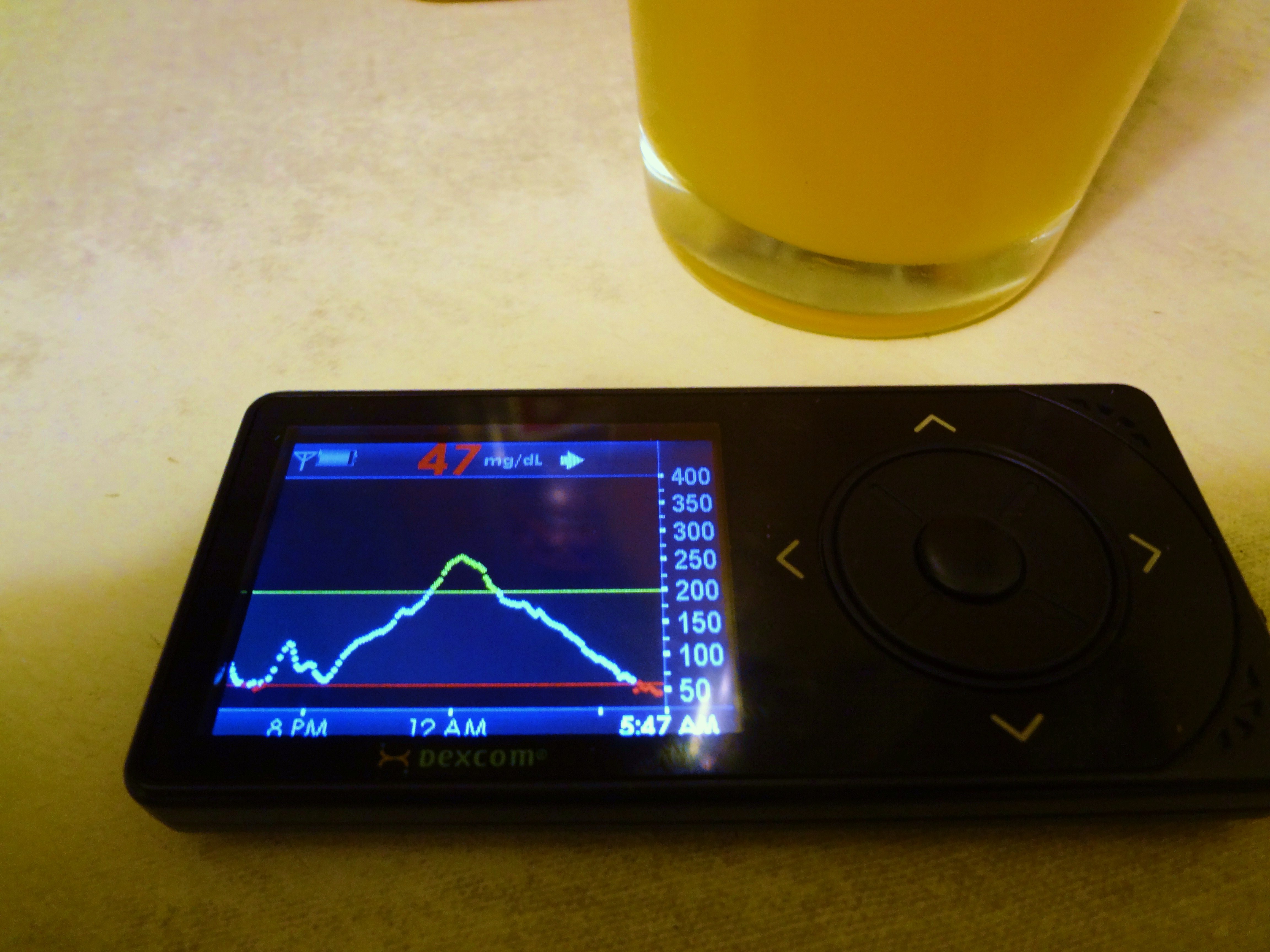
So often after site changes, I’ll have a… What do you call it? A phenomenon? An anomaly? An unexplainable variance in The Force? It seems as though the site isn’t working at all for a while, which is why I got a high alarm around 11:30 while I was fast asleep. I’ve been through this kind of thing before, so I knew better than to do a correction bolus at that time. And my BG just kept on climbing, up into the neighborhood of 250 mg/dL at around midnight.

From that point on, however, I started dropping. Again, this is without a correction bolus. Certainly, the ice cream and strawberries had lost a lot of their oomph by then. But I just kept getting lower and lower until I was awakened by a low alarm at around 5:00 a.m. No big deal, because that’s when I get up for work (if I don’t go to the gym first). But I just don’t understand why, at least half the time I change sites, all of the insulin I’m pumping seems to be worthless until all of a sudden it’s not worthless anymore. And then it makes up for it with a vengeance over the next few hours. I’ve seen others write about this, so I know I’m not a weird statistic. But I don’t have a scientific explanation for it yet.

Just to be sure it was the new site and not the dessert that caused my glucose to skyrocket last night, I may have to try the ice cream and strawberries again this evening. You know, just to be sure.