Tag Archives: diabetes

Another Champion Athlete with Diabetes: Congratulations Janie!

Today I bring you another inspiring example of People With Diabetes getting out and reaching their athletic goals:

Our Champion Athlete, Janie Moore, is in pink, second from the right
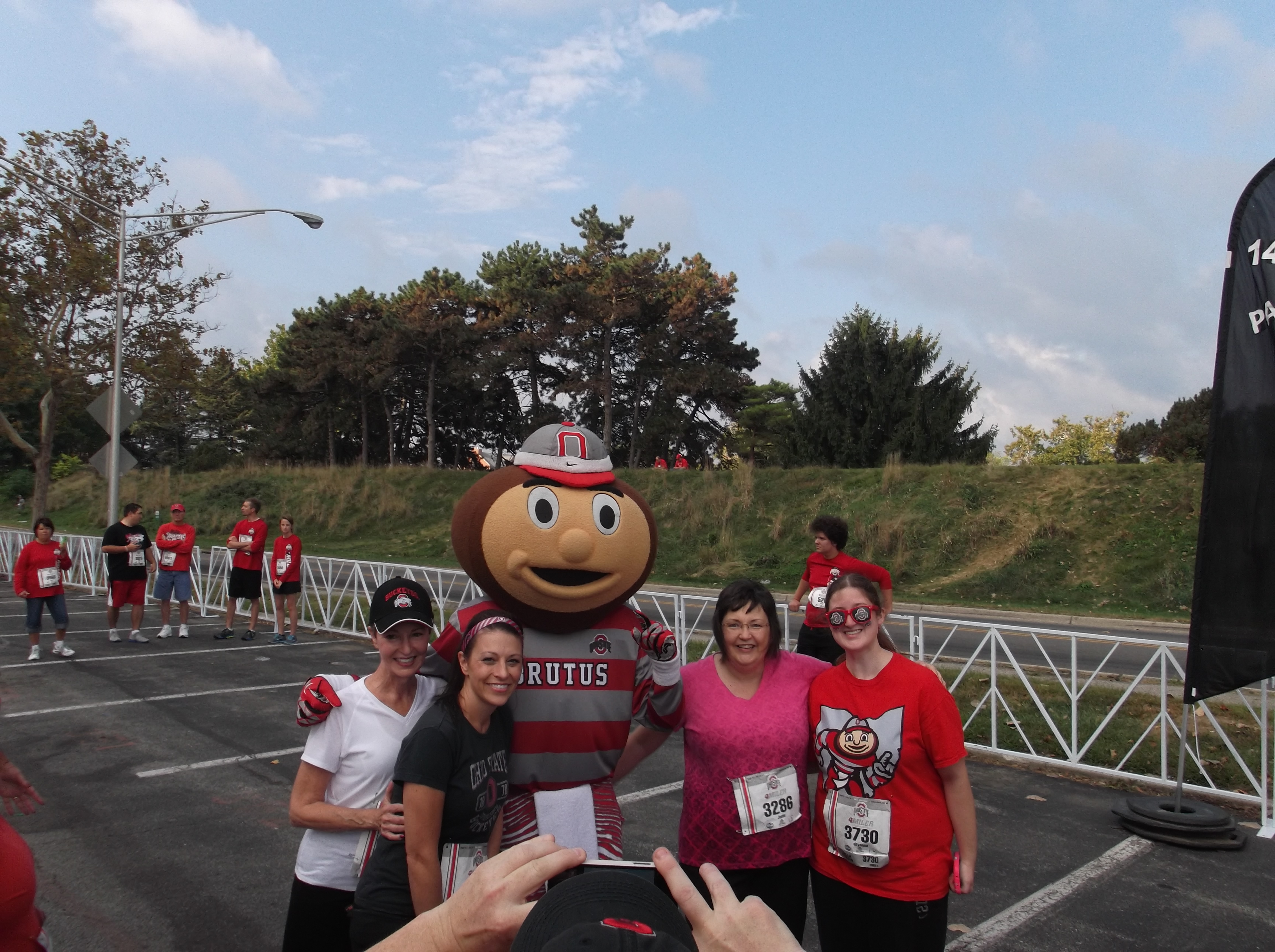
Our Champion Athlete, Janie Moore, is in pink, second from the right

Janie Moore celebrated 40 years with Type 1 Diabetes this past July. Back in April, she started training for a 4 mile marathon in Columbus, Ohio. Like many of us, she was worried about engaging in a prolonged exercise routine, fearing that something bad might happen. Then a friend challenged her with two questions: Why not? and What’s the worst thing that could happen to you?

In Janie’s words:

“After thinking about my answers to those two questions I let down my guard and started training. Wow! If I’d only known then what I know now! That by getting up and moving my body feels better, my insulin works better and emotionally I am so much stronger!”

Guess what? This past weekend, Janie completed the Ohio State 4 miler marathon! I’m going to let Janie tell the story about her day:

“Sunday, Sept. 21, 2014 started early for me. I woke up early so I could eat a healthy breakfast before the 1 1/2 hr. drive to Columbus, Ohio to participate in the Ohio State 4 miler marathon. After working hard for the last 4 months doing walking training, needing to rethink my meal plans, and adjusting my insulin pump settings, only to figure out I was stable/healthy enough to not even wear my pump during exercising I felt like I had already run the race. But, on June 1, 2014 I had set a goal to slowly train and gain 1 mile per month until I was able to finish a 4 mile marathon at the end of September. This may seem like a short distance to some but for me, a person who HATES to exercise, it felt like like I was climbing a mountain!

As I slowly added miles on my elliptical I often felt discouraged. My husband, sons and friends kept encouraging me to continue which was a big help. I’ve often struggled with keeping to myself,not letting others know how I’m feeling. Something else I learned during this experience was to open up and admit my struggles to others. They can’t read our minds but if we tell them we’re having trouble they are there to help and encourage us and it does make a big difference.
Editor’s note: I couldn’t have said it better myself. So great to have cheerleaders!

Back to race day! We arrived early so that I had plenty of time to check my blood sugar, strap on my handy supply waist belt and make any adjustments needed before the start. I met up with several friends then waited…and waited. There were 12,000 people signed up to race. I was classified a walker so of course I was at the back of the line. I finally reached the starting gate 25 minutes after the start whistle. The wind was blowing and it was overcast. A perfect day for a race, all my racing friends kept telling me. During training I had learned that mile 2 was where I needed to recheck my blood sugar to make sure everything was going smoothly. My blood sugar was 108 so I knew I needed a few carbs to keep me up enough to finish without a low. After digging into my trusty supply belt I found a granola bar to eat. On I went eating and walking. I had strategically asked my family to meet me around the 2 1/2- 3 mile mark just in case my 2 mile blood sugar check was running low. Since I was only at 108 I decided to grab a regular 7Up from them and take a couple of swigs before going any further. Mistake! Carbonated pop is not a good choice when you are doing a marathon, trust me. So, I threw the pop in the first trash can I found and pulled out a bottle of instant carb booster from my supply bag. I had put them in there during training but felt I should only use them during an emergency. Well, I thought, a couple of swigs would only help. Mind you, I’m doing all thinking and adjusting as I’m continuing to walk because my pace was going good and I now wanted to best my training time. I finally made it back to the stadium. As I made my way to the famous tunnel I started to get goosebumps. They only allow certain people to go through that tunnel and onto the Ohio State football field and today, I was one of them! I walked down the shaded tunnel onto the sunlit field with tears in my eyes. I had almost reached my goal of finishing on the 50 yard line. I had walked the whole race but according to my sports fanatic son, I was not allowed to step foot into the stadium without running. So, even though my legs were cramping and felt like rubber I started to jog up the sideline of the field. Ok, I must confess, I only made it half way before I had to return to walking but once I turned the corner and started walking up to the 1 yard line I jogged my way to the 50 to finish my very first marathon. Fourteen minutes faster than my training times!
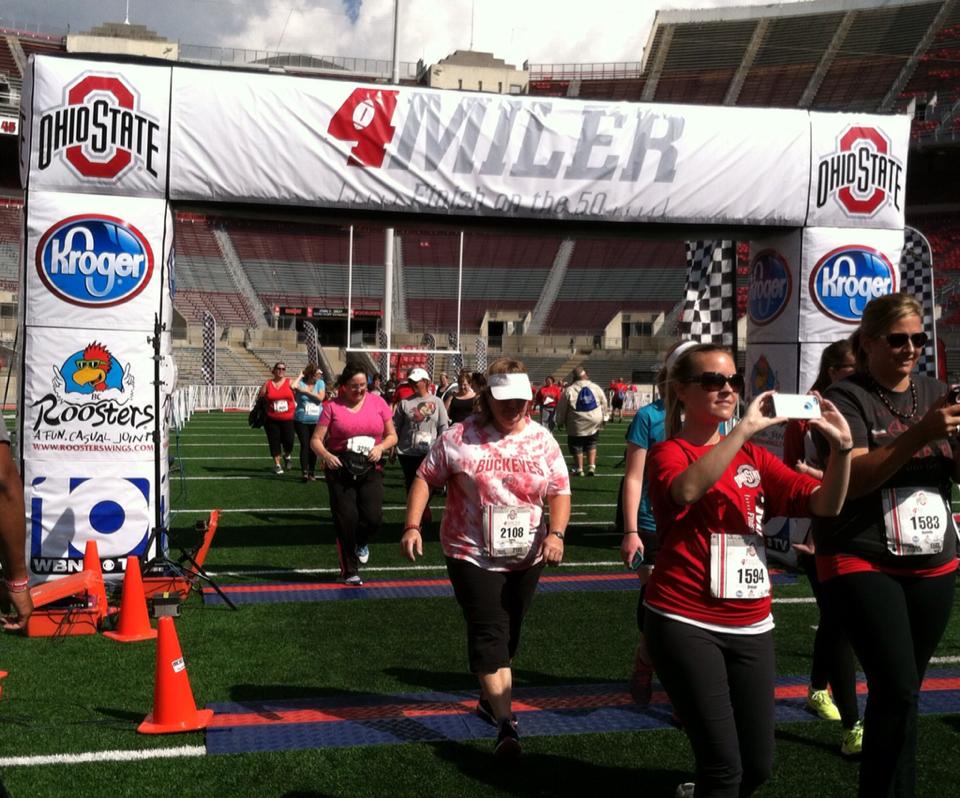
Janie is in pink right there at the finish line.  Yay!

Janie is in pink right there at the finish line. Yay!

After the race I made my way back out of the stadium to collect my medal, find some water, eat a banana and check my blood sugar again. It was 128 by the way. Exercising is a great way to keep your blood sugars down! I met up with my family and friends and we celebrated. I gave my sister, who has overcome many obstacles herself, the honor of presenting me with my Champion Athlete with Diabetes medal. It was a great ending to a great day.
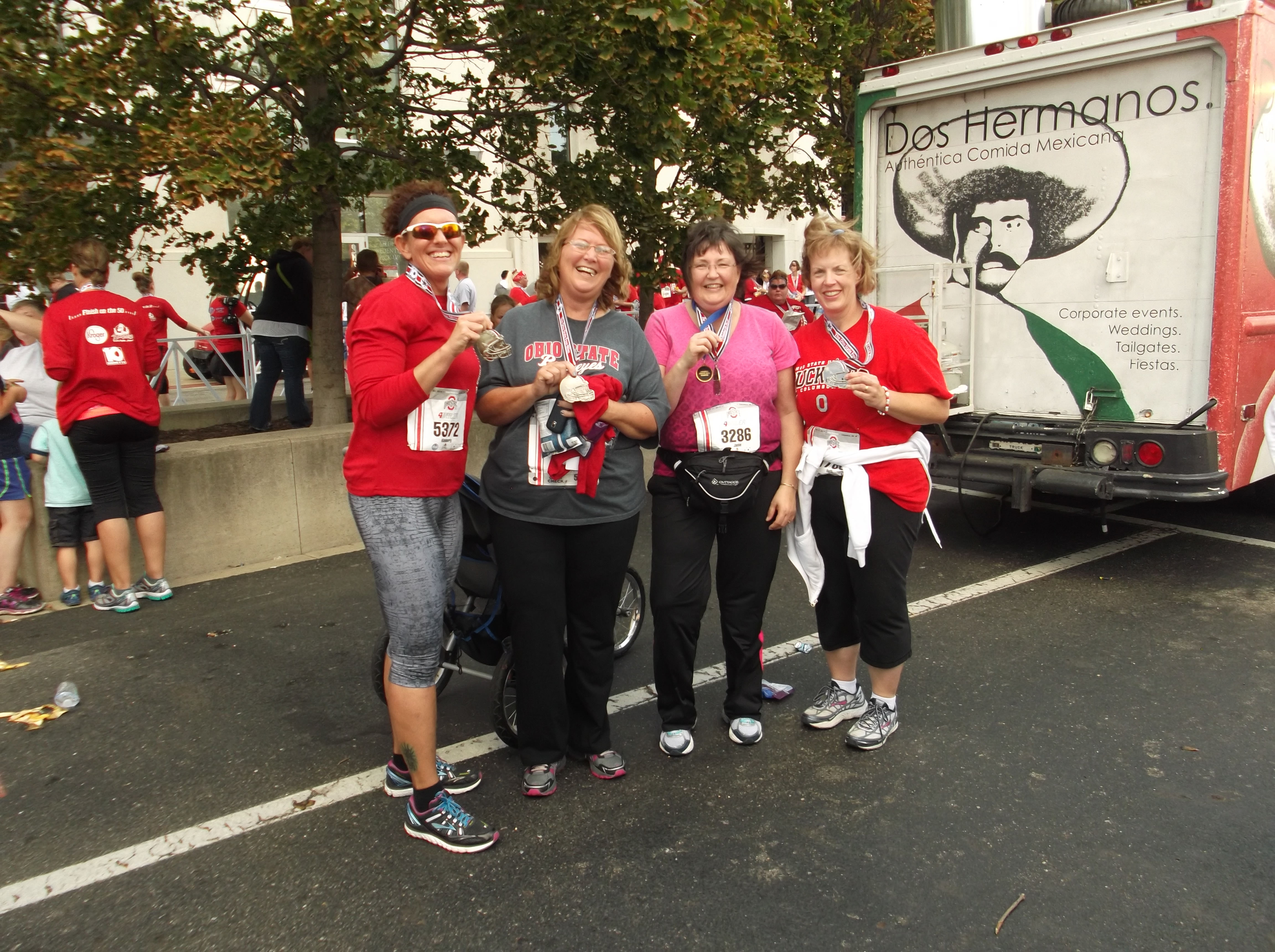
Janie is second from the right, wearing both her medal for finishing the race and her Champion Athletes With Diabetes medal!

Janie is second from the right, wearing both her medal for finishing the race and her Champion Athletes With Diabetes medal!

I’m so proud of myself for the accomplishments I’ve made over the last 4 months. All the days I forced myself to get out of my chair and onto the elliptical or walk on the track were worth it! I still hate to workout but I have learned that my body needs me to exercise in order for it to work its best. And best of all, I feel like I’m in control of my Diabetes instead of it controlling me!”

Congratulations Janie. I’m so glad you made it through your training and reached that goal that meant so much to you. I hope this is just the beginning of a lifetime of exciting athletic endeavors.
 
 
C’mon now… It’s your turn to join the club. We’ve handed out something around 15 medals to athletes like Janie in the past ten months. We’ve got two more medals that we’ve sent out to athletes I haven’t even told you about yet. And we’ve got plenty more left. I’ve said it before: Be an inspiration. Not just for yourself or your loved ones. Do it for the people you haven’t met yet, who will identify with you and be inspired too. Because they will.

To find out more and start the process of minting your medal as a Champion Athlete With Diabetes, click here or on the medal photo in the top left corner of this page.


September DSMA Blog Carnival: Can I get a copy of those notes?

This month’s DSMA Blog Carnival topic goes back to the August 20th Twitter chat, asking a question that I have a difficult time answering:
 
 
Do you request a copy of your medical notes? If so, how often? If not, why?
 
 
I hate to show my ridiculous ignorance on this subject, but the answer is no.

I have never asked for a copy of my medical notes. Ever. I’ve asked for a copy of prescriptions. My endocrinologist sends them in directly to my prescription provider, so if I didn’t ask for a copy, I wouldn’t have a record of what I’ve been prescribed.

But other than the prescriptions, I’ve pretty much let my doctor, nurse practitioner, etc. take the notes and keep them to themselves. To be honest, I’ve never thought about asking for the notes before. It makes sense. I’d like to know what my file looks like. I’d like to know if they make a mistake in a diagnosis or a therapy or a prescription. However, right now, my only reason for asking for a copy of my medical notes is to satisfy my own curiosity.

But the question does make me think of something that’s been at the forefront of my mind lately. I need to start putting together a file full of notes of my own.

I got this idea from a co-worker, who showed me the tablet he uses on a daily basis. On it, he has his elderly mother’s critical medical information. Information like doctor names, addresses, and phone numbers. All of her doctors. If her general practitioner tells her she needs to make an appointment with her podiatrist, he just pulls up the information from the tablet and makes the call right away. He’s also got data on prescriptions, their strength, and how often they need to be taken. This helps when a doctor prescribes one thing, then another doctor prescribes something else that might interact badly with what she’s already taking. If she suddenly finds herself in the emergency room, he has all of her information in one easy-to-read place.

I realize something like this isn’t always well received by medical professionals, but I also know that all of my data is in separate places right now. And having all of my information in one place can’t hurt. I also know that if I were to find myself in a situation where I couldn’t speak for myself, my spouse would want that information at her fingertips. There’s the chance that it could get hacked and stolen and used for nefarious purposes. But I think the benefits of having such a cache of information on an easily-accessible platform would outweigh any potential risks.

So there you have it… A very meek “No” to our question this month. But, as always, the Blog Carnival topic has me thinking about how to better manage my diabetes. And that can only yield positive results in the future.

This post is my September entry in the DSMA Blog Carnival. If you’d like to participate too, you can get all of the information at http://diabetescaf.org/2014/09/september-dsma-blog-carnival-4/


Talking with the FDA.

This post is also published on the Diabetes Advocates website.
Take the Diabetes Advocacy Survey, join us, and become a Diabetes Advocate right now. This post will wait until you come back.

When I first discovered the group of bloggers, reporters, healthcare professionals, and patient advocates that make up the Diabetes Online Community, I remember feeling really good about the support and encouragement I was suddenly finding through the internet.

I did not know much about the U.S. Food and Drug Administration, other than knowing that they had to approve every new drug or device used to help me survive with diabetes. Then I started reading a lot from people who felt that the FDA was holding back progress on these things. How the FDA never took the patient point of view into consideration. How they were a bottleneck, holding back advancement toward better outcomes for us.

Well, I’m not sure if that was entirely true then. But I do know now that it is not true today.

Last year, Strip Safely helped lead a campaign to get more people to comment on FDA draft guidance for glucose meters. We were all encouraged to post comments letting the FDA know how important greater accuracy and post-market inspection is when considering the trustworthiness of new glucose meters and test strips.

We were able to post those comments directly to the FDA because they made it possible to do so, easily, online. As a result of just that one push to comment, the FDA received six hundred comments on this one issue. That’s about six or seven times the number of comments they generally receive on draft guidance. Collectively, and as individuals, the diabetes community spoke and the FDA listened. But that’s not all.

A few weeks ago, I received an e-mail from the Food and Drug Administration about comments I left regarding glucose meters in a point-of-care setting (hospitals, doctor’s offices, etc.). They wanted to speak to me about what I had written them. So we scheduled a time, and I spoke by telephone with Katherine Serrano, Deputy Director of the FDA’s Division of Chemistry and Toxicology Devices.

We talked about some of the things I had written, and she had a few questions for me. The thought of that seems a little intimidating at first. But rather than just a talk between a Deputy Director at FDA and a guy from Baltimore, it was really a conversation between two people discussing an important topic. I tried to give her my passionate best on the subject, and she remained engaged, asking follow-up questions and allowing me to consider her questions carefully before answering, and even letting me e-mail her later with additional feedback. This does not seem like the actions of a group that does not care what we think.

I don’t know how seriously Ms. Serrano or the FDA considers my views on the subject. But there’s no denying the fact that I was given not one, but two chances to deliver a personal plea for the best possible device guidance on point-of-care glucose monitoring. And I was not going to pass on either one of those opportunities.

Because new innovations often take years to get into the hands of the people who need them most, it’s easy to feel like your voice would get lost among the masses, even when you do take the time to respond to something. But what’s the alternative? You, or people you love, are the patients, the ones most affected by any changes to the status quo. The one way to be sure your concerns are part of the public record is to make them public. The one way to help all people with diabetes get the better outcomes they deserve is to insert your voice into the conversation. And if you’re asked for additional perspective, be sure to speak with the passionate desire for the absolute best results that comes with the perspective that only you possess.

We’re counting on you. Allow yourself to be the voice that makes the difference.


Decision 2014: What’s the Snap really like?

DSC01732

It’s been two weeks for me on the Snap insulin pump from Asante. I’m wearing the Snap as part of a free trial offered by Asante to all prospective customers. They’ll give you four weeks on the pump, supplies included, along with a voucher for the insulin cartridges you’ll need during your trial. So far, this is the only company I’ve considered that offered a free trial. Anyway, since it’s been a two weeks, I thought it might be time to give a little more insight. Hopefully, this won’t be too long… but since I’ve been able to check this one out more than any of the others, I probably have a little more to say about it. Here goes:

Set changes: When you’re working with the Snap, you’re working with pre-filled 300 unit insulin cartridges. The infusion set is self-priming too. You don’t have to worry about reservoir fill-ups or air bubbles, and that means you wind up wasting a lot less insulin just hooking yourself up again. Definitely a plus. As a result, you’ll probably spend more time on each cartridge. For that, Asante plans for you to use one specific set (with the primer(?) connector) for your changes including insulin. Then they want you to use a different set (without the connector) after 72 hours if your cartridge isn’t running out of life juice. I’m not sure how all that works, because personally, I’m not about to do a set change after three days, then another one 48 hours later. I just kept the first set in for the normal 5 days (5 ½?) it takes me to go through 300 units. And unless I’m dealing with some serious heat, that doesn’t seem to be too much of a problem. I will add, also, that the simple time savings of having a pre-filled cartridge isn’t that big a deal for me, though it is nice.

Humalog Only Accepted Here: Also, let’s not forget that the cartridges come in Humalog only. I’ve been primarily a Novolog user up to now. This is only my experience, so take it with a grain of salt: In my 2-plus weeks on the Snap, I’ve found that Humalog brings me down from spikey highs, but it does so in a very slow, stairstep kind of way compared to Novolog. As a result, I’m learning to avoid things like potato chips and pizza. I am getting better at managing my diabetes with Humalog, so this isn’t necessarily a deal breaker. Though that’s a good thing, it’s crazy to think I’ll never eat those foods again. If I had a choice between the two, I’d stick with Novolog for now.

Striker! You’re coming in too low! (Bonus points if you know which movie that’s from) One of the issues I found (that I don’t remember being covered in training, but I may have missed it) is that when your BG comes in under 70 mg/dL at the moment you’re sitting down for a meal, you can’t use the smart bolus feature. This happened a couple of times during my trial. My pre-meal check came in at 64 or 60, and I couldn’t enter those numbers using the smart bolus feature. To get around this, I wound up entering my BG number for the smart bolus at 70, then dialing down the insulin amount slightly to get to where I think I would be okay, as long as I ate right away. Also: When you do treat before eating, you do have the ability to enter in the carbs you already had (First Carbs), then the carbs you’re about to eat on a separate screen. It will figure out your bolus accordingly.

As a (somewhat) veteran insulin pumper, this feature drives me crazy. But if I was new to pumping, or a CDE or doctor working with someone new to pumping, I might find this a great safety feature. Again, this isn’t a deal breaker or a deal maker for me. It’s just a quirk of using the Snap, and I thought you should know about it.

DSC01733

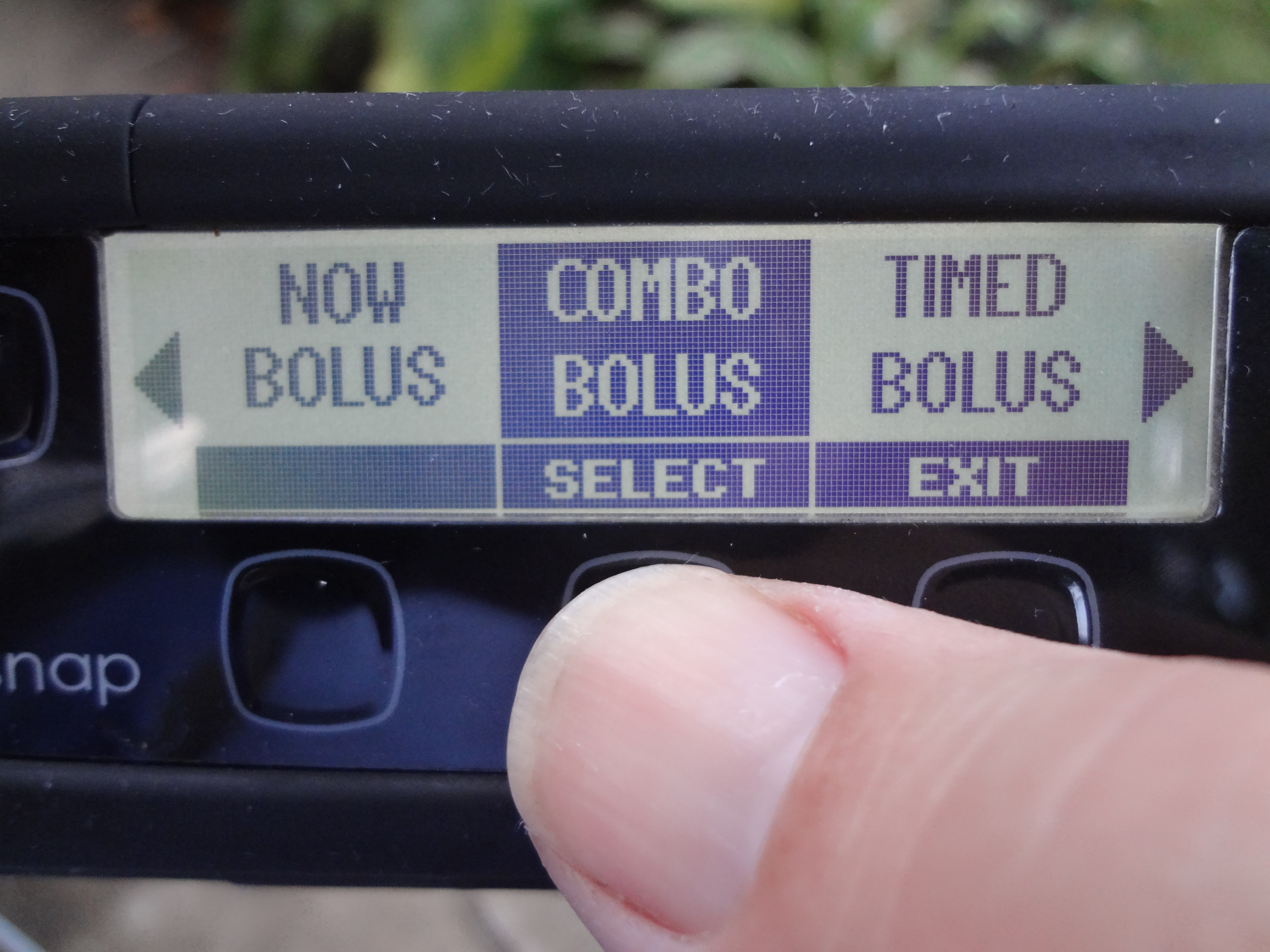
I should also mention that the Snap will deliver boluses three different ways: The Now Bolus, Timed Bolus, and Combo Bolus. The Now Bolus is delivered right away. The Timed Bolus delivers your bolus at a specific amount of time (minimum 30 minutes). And the Combo Bolus is pretty much like the Dual Wave bolus on the Medtronic pumps… delivering a set amount now, and a set amount later, predetermined by the user (in 15 minute increments, which I like).

Beep volume: Love, love love the beep volume on this thing. I also love that it’s adjustable. This is such a simple feature. Why can’t other pumps incorporate this idea?

Additional features: The pump has a flashlight feature on it. That’s nice if you need a light and can’t find one anywhere else. Otherwise, turn the light on. If you’re low, your significant other will forgive you. Sorry… I don’t mean to make light of this feature… it shows that the manufacturer has added something that most People With Diabetes will find helpful.

The Snap also has the ability to create more than one basal profile. Again, I think all pumps should have this feature. When I do a long bike ride, I want to be able to change my basal profile for the entire day, not just perform a temp basal then forget about it once it’s complete.

Bolus delivery is pretty fast. Not sure how big a deal that may be for you (it is not a big deal to me), but I thought I would mention it. On the scale of bolus delivery speed, I’d put the Animas Ping at the top, then the Snap, then Medtronic, and t:slim far behind.

DSC01734

Finding your daily totals and how they translate into 5 day, 10, day, or 14 day averages (14 days is the highest setting) via the Log Book menu item is pretty easy. This is another feature that I don’t remember covering, but it was easy for me to find. Again, I think new pumpers (and their medical teams) may find this helpful.

DSC01747

Ease of use: The Snap is actually a pretty easy pump to use. Not a lot of clicks to get around to what you need. Menu descriptions make sense. If you like the pre-filled cartridge idea, and the self-priming, that’s an added bonus. I could imagine myself using this pump on a daily basis.

Here’s where I will also tell you that the local pump rep has been fantastic, answering questions and calling me a few days after I began to see if I had any follow-up questions or issues.

In a few days, I’ll be sending the pump back to Asante. Not because I’m not satisfied. Rather, because I want a little time to do some additional research and decide what is best for me from both a patient and an economic perspective.

I hope you’ve found this recap helpful. And if there’s anything else you’d like to know, be sure to ask.
 
 
Disclosure: I’ve been on a standard four week trial of the Asante Snap insulin pump. This is the same trial that is available to all users who are considering starting on insulin pump therapy, or are considering a pump change. I was not given anything by Asante, and I was not asked to write about my experiences. In fact, I did not tell them I’m a writer at all. All opinions, as always, are my own.


Hey! You look just like me!

A number of times, I’ve read blog posts from people who have seen someone wearing an insulin pump in public. In many of those instances, the writer can’t quite bring themselves to say something to the person wearing the pump. And I never understood why, until it happened to me too this past weekend.

I got up early Saturday morning to help my best friend get things set up for a flea market his group was sponsoring. It turned out they didn’t really need my help at all, so after 45 minutes or so I stated the obvious: “You don’t really need me now… I’m going to go home. I’ll call you later to see if you need me to help break things down when it’s over”.

I said my goodbyes, and as I walked out and toward my truck, I saw a guy, about my age, with exactly the same pump, in the same color, that I wear.

I stopped in my tracks as he walked by. I couldn’t believe it. I mean, yeah, nearly 30 million people in America live with diabetes. But I thought I was the only one in Baltimore. Okay, I knew I wasn’t the only one here, but sometimes it seems like it. Anyway, I thought hey, this is a perfect opportunity to meet someone else from the pancreatically-challenged part of the population. I should run and grab this guy by the arm and have a long conversation with him!

But before I could catch up with him, I noticed something else. He was enjoying himself. He was enjoying his day. I watched him from a distance, for about five minutes or so, and I realized this is the life that we had hoped for when insulin pumps were brought to market for the first time. Heck, this is what we want when artificial pancreas systems make their way to the market.

We just want to live our otherwise normal lives, in a normal fashion, just like people without diabetes do. Somehow, watching this fella enjoy the flea market, I was able to enjoy knowing he felt like the rest of the people around him.

In this case, I could really appreciate the fact that Diabetes Man, living his life, doing the same things as everyone else around him, was more important to me than getting to talk with someone locally who lives with diabetes 24/7 like I do.

It was a good indication that I need to remember to be grateful for the amazing advancements that have already made our lives better, even while we advocate for even better advancements for the future. As I headed home, my full heart and my big smile were indications that diabetes can and will be lived bigger and better every day by myself and Diabetes Man at the flea market. Nothing will stop us from enjoying life to its fullest.