Tag Archives: advocacy

Advocacy in the 21st Century.

Tuesday and Wednesday this week, over 100 people will attend the second MasterLab, presented by Diabetes Advocates and Diabetes Hands Foundation.
Get the agenda HERE.

They will hear from a number of advocates who have accomplished much, inspiring others and moving our cause forward in a variety of very big ways.

But what about the rest of us?

When I speak to People With Diabetes about diabetes advocacy, they almost universally say “I don’t see myself as an advocate”. They explain this by saying that they’ll never be able to do what so-and-so does, and while they do some things, they don’t really consider those things advocacy.

When people say this, I think they’re wrong.

In many ways, that’s the problem with how we view advocacy in our world: We tend to measure any advocacy we perform against the biggest feats of advocacy we’ve ever witnessed. If it doesn’t measure up to that, it’s not advocacy to us. To me, diabetes advocacy has a much broader definition. If it doesn’t, then I think I may need to get out of the advocacy business altogether.
 
 
Let me ask you:

Do you participate in the Diabetes Online Community? Have you learned anything from what you’ve seen, heard, or read?

Do you go to events where speakers talk about new drugs, new research, new technology? Have you ever read a book and learned something you didn’t know before?

Have you ever helped someone in your life understand better what it’s like to live with diabetes every day?

Have you ever written your elected officials to ask for better care, CGMs for persons on Medicare, or funding for diabetes research?

Have you met in person with another Person With Diabetes and just listened to them tell their story?

Have you shared your story, your successes and failures, with even one person? Even a family member or a significant other?

Have you ever offered a helping hand to someone in need of extra supplies, a replacement bottle of insulin, a spare CGM transmitter, or a shoulder to cry on?

Have you responded, truthfully and honestly, to someone who posted something about diabetes, whether it inspired you or pissed you off?

Have you just lived your life with diabetes the best way you know how?

To me, all of those things are advocacy.
 
 
You know, not all of us can raise thousands of dollars for research all at once. Not all of us can donate that kind of money all at once either. When someone tries to shame or stigmatize us, we can’t always get there first with the most anger. Not all of us can go on television or radio, or even a podcast, and bring our message to the masses.

But we are not helpless, and we are not alone, and we are not insignificant.

What we can do is learn. What we can do is share what we’ve learned. What we can do is support others doing the same, in large and small ways.

Because when we do even the smallest thing to advance our cause, we are advancing our cause. My guess is that you are making a difference.

My plea is that you continue to do so.

Care to share your story of advocacy? Leave me a comment below!



And then there’s the real world.

With the excitement over Diabetes Blog Week, I was brought right back down to earth again with two important pieces of news.

One of these stories you probably know already, and one you may not know about at all:

Asante Solutions, makers of the Snap insulin pump (I did the 30 day trial of the Snap last summer), has closed up shop. They left a message on their website Friday saying that they were no longer in business.

This comes as a shock to many, including me. I was so happy with my trial of the Snap last year that I was ready to sign up with Asante the very minute they were approved to use Novolog cartridges (their product only used cartridges filled with Humalog). It was an easy pump to use, it had all of the regular features you’d expect on a pump, plus a couple of extras including its own flashlight, and those glass-filled cartridges filled with Humalog. No more filling reservoirs doesn’t seem like that big of a deal until you actually don’t have to do it anymore. Now, with such a unique feature, Snap users can only use the pump as long as the insulin they have on hand lasts. Unless someone figures out how to refill the used cartridges, which, I don’t even want to think about right now.

It was a big deal last August when Asante announced a partnership of sorts with Dexcom to integrate the Dex mobile app into the Snap architecture. Now that is all for naught, many previously happy pump users have to go searching again, and through the insurance paperwork gauntlet again, and over 100 employees are out of a job.

If you’re a Snap user, you do have an option to transition to the Animas Vibe system. According to Asante’s going out of business announcement, “Animas is graciously offering a limited time offer to all existing Snap users to transition to the Animas Vibe pump.”

No word yet on what that offer might be. To get on your local rep’s call sheet with Animas, call 877-937-7867, extension 1562.

————————————————————————————————

Let’s talk about something better: The U.S. Food and Drug Administration is seeking our input again!

The FDA has prepared draft guidance on collecting and submitting patient preference information, so FDA can consider the benefit-risk thinking of patients using medical devices like insulin pumps and CGMs.

From the introduction of this document, in FDA’s own words:
 
 
”FDA believes that patients can and should bring their own experiences to bear in helping the Agency to evaluate the risk-benefit profile of certain devices.”
 
 
I’m all for that. Once the draft is finalized, it will become the new standard for how FDA thinks about patient preferences when reviewing the devices we use to help us live better lives.

One thing the draft guidance won’t do: It won’t change review standards for safety and effectiveness, and it won’t create extra burden on sponsors of premarket submissions of devices to FDA.

Still, pretty exciting that we’re being asked for our feedback, that our input will result in edits to existing benefit-risk guidance already in place, and that FDA plans to take it seriously during reviews.

We have until August 17 to leave comments on this guidance, and I, along with some others, are still going over this to try and better understand it (it’s 35 pages long). Hopefully, more information will be forthcoming (he said all officially-sounding).

To get a look at the draft guidance and leave a comment, CLICK HERE.

When was the last time anyone ever asked you to talk about what you like or don’t like about your devices? Asked you what you can live with, and what you can’t? Here’s your chance.

Expect to hear more about this soon.


What you do makes a difference, even if you’re not sure how.

Friday morning, I went down to my local American Red Cross office and donated blood (yes, in the USA, you can live with diabetes and donate blood—see more HERE).

The beginning of these appointments are usually pretty clinical, full of process-related steps that everyone has to go through before they actually stick a needle in your arm and do what you came for. At that point, things tend to open up a bit, because if they didn’t, you’d just be hanging out, you and the phlebotomist, with nothing to do for a while, and that would be kinda boring.

That’s when I try to get the phlebotomist to tell a funny story, or I try to tell one, and that keeps the conversation going while I squeeze on a little foam ball every three to five seconds during the “donation process”.

This time, after telling of my low adventures after the last time I donated, I asked the technician (name withheld) if she liked what she did there at the American Red Cross. I wasn’t prepared for what she said next:

“Oh yeah, I love it. I really do. When I started this job, I just thought I was collecting blood, and that was all. Then, my Mom was injured, and she needed at least a unit of whole blood every day for almost a month. One day, when I was visiting her in the hospital, I saw them hang a unit of blood and it had a sticker on it saying it came from my center. I just broke down and cried. I knew right then that I was making a difference, and I’ve never looked at my job the same way again. I love it.”

Maybe you’re raising money for a diabetes walk, hosting a D-meetup, or agitating elected officials to approve legislation so senior citizens can be covered for continuous glucose monitors under Medicare. If you do those things long enough, they can begin to get monotonous, and you may start to wonder if what you’re doing makes any difference at all.

Well, when you do, remember our technician’s story. And remember, like I’ve said before, if you make a positive impact on just one person’s life, that’s an impact that in most cases would not have been made if it weren’t for you. You make a difference, through the things mentioned above, and just by continuing to live well with diabetes. Even if we don’t get as clear an indication of our difference-making as my friend at the Red Cross.

If enough of us concentrate on helping that one person live better, healthier, happier; then eventually, those individual successes will steamroll into a greater success story than many of us could imagine. Until that day, let me say:
Thank you for making a difference.


More Diabetes UnConference News, and FDA doings too.

I know I’ve written a lot about The Diabetes UnConference, but I need to share this bit of exciting news:

First: There will be another Diabetes UnConference in Las Vegas next year!
Details are still being worked out, but it will be in Las Vegas, and it will be in March 2016. For me, this is very encouraging. There were many people from the western part of the USA who attended this year, and I know at least a couple would not have made the trip had it not been so close. So I’m glad that adults living with diabetes in Nevada, Arizona, California, Utah, and other western states will have something relatively close to go to. But that’s not all….

Second: There will be an East Coast version of the Diabetes UnConference in the Fall of 2016!
Again, it’s still in the planning stages, and there isn’t much to tell yet, but for all of you who can’t quite make the trip to Vegas next year, know that there will be an East Coast UnConference in the fall. More to come on that development. But wait… that’s not all…

Third: Both editions of the 2016 Diabetes UnConference will include separate “Adult T3/People without Diabetes” sessions! Some parts of the UnConference will offer opportunities for both People With Diabetes and People Without Diabetes to interact, but there will also be a separate space and special sessions so People Without Diabetes can experience the UnConference too, sharing among their tribe, peer-to-peer (still adults only).

Hard to imagine next year already, but it already looks like it will be great.

——————————————————————————————–

Advocacy Opportunities:

The U.S. Food and Drug Administration (FDA) is holding a couple of public meetings in April.

The first, on April 14, is a meeting of the Endocrinologic and Metabolic Advisory Committee, which will go over outcomes of research on patients using the Type 2 medications Saxagliptin and Alogliptin. The public is welcome to attend, but you must register. To do that, and to get all of the information on this Advisory Committee meeting, CLICK HERE.

Also, one week later on April 21, there will be a public workshop titled “An Interactive Discussion on the Clinical Considerations of Risk in the Postmarket Environment”. This workshop is really a forum to discuss possible risks (or not risks) of devices after they’ve been approved by the FDA. This is not specifically diabetes related, but hey, we wear devices, right? There is also an opportunity for patients (that’s me) to submit comments, and even speak at this public workshop. Looks very interesting to me. Want to attend? CLICK HERE.
 
 
There you have it. Exciting doings in the diabetes world, both in the near future, and next year. Enjoy your weekend!


What makes us different?

Click here to save children – Donate to Spare A Rose, Save a Child

SAR2015
 
Okay, we know what makes us different.

You know what else makes us different?

We Care.

I mean, we care in a very big way. Would you like an example?

image

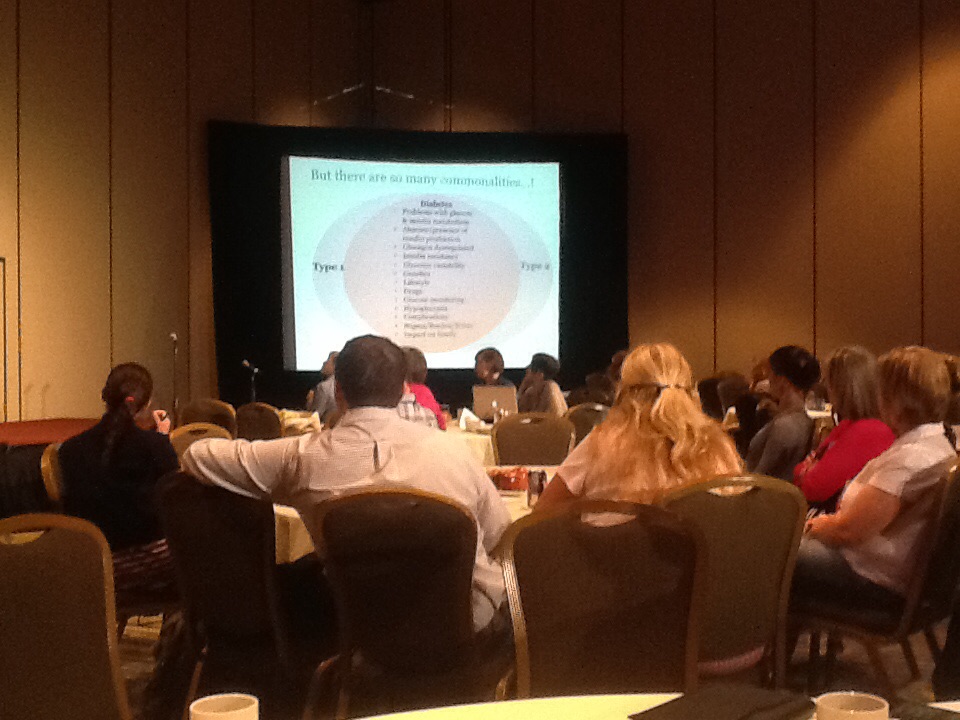
I was cleaning up some old photo files the other day when I came across this one from last year’s MasterLab in Orlando, Florida. It really made me notice something I hadn’t seen before. This was during the joint presentation given by Kelly Close and Adam Brown of diaTribe. First, let me ask you… What do you notice from this photo?

What I notice, other than the marvelous people appearing in it, is how everyone’s attention is either on the slide being presented or on the speaker presenting the slide. This was not in the early hours of the one day advocacy event sponsored by Diabetes Hands Foundation. This was about mid-afternoon, after we had already heard a few inspiring speakers, and after a nice lunch that, under other circumstances, might have made us very sleepy by then.

Yet we were still engaged, still interested in learning how to advocate effectively, how to be better at helping others living with diabetes while pushing the right buttons to amplify our voices.

That photo says to me that the people in that room (50-75 maybe?) were all in.

I’ve seen and heard a lot (including on that day) from people who have said that diabetes doesn’t have a movement yet. How we’ve not been bold enough. How, compared to advocates for better treatment of other diseases, we’re just not doing enough, or we’re not speaking with one voice, or we’re not something.

My opinion: We’re doing just fine. And I care a lot more about the future than I do about the past. Yes, it’s very true that diabetes doesn’t get enough attention from congress, and Big Pharma has us all caught up in that “Can’t live with the price, Can’t live without the medicine” paradigm. I freely admit that we could stand to have a brighter light shown on our disease. More people need to learn more about what we have to live with every day.

But we’re still making progress. We’re able to speak on bigger platforms and with bigger voices now, including crashing an FDA web conference, and being written up in the New York Daily News. Bigger audiences and more influential people are hearing our message.

And let’s not forget that all of us living with diabetes is living with an extremely unique condition. We have a disease that, if everything goes right, allows us to live an otherwise normal-looking life. For many of us, the complications that come with our condition like fries come with a Big Mac don’t show themselves until much later. In some cases, that means additional misguided judging by people who just can’t comprehend how doing a great job managing diabetes doesn’t always keep us safe from problems later. Or now.

When someone is diagnosed with cancer, or ALS, for example, the symptoms show themselves in a very visible way. When someone goes through chemotherapy, or starts to lose their muscle tone due to ALS, it’s very natural to want to help them as much as possible. We see the outward evidence of need. It is right that we do this.

When someone with diabetes goes through a difficult hypoglycemic episode, you know what we do? We treat and then we keep on going. Maybe it’s the idea of the word “normal”. We always want to be normal… when we’re high we want to be normal, when we’re low we want to be normal. When we’re normal? Not one living soul notices us.

So to get back to the photo, here’s the point: The people in that picture understand how absolutely sinister this condition can be. Whether we see the outward signs or not. Whether we see the outward signs now or later. They get it. What’s more, they care. And they are all doing something about it. Do you hear me? We are all doing what we can to make our voices heard.

We are all doing what we can. We have all made improvements and strengthened our advocacy, especially over the last few years. Our advocacy efforts and our fundraising efforts are sometimes dwarfed by those linked with other diseases. But we are not dormant. We are building. Things are happening. We are challenging decision-makers and we are saving lives. And it’s my opinion that most, if not all, of what we have achieved to this point has been due to the tireless efforts of people who, in addition to having diabetes in their lives every day, find time to raise children and work a regular job too.

After 24 years, I know where we’ve been. I know where we are now. What makes us different? Diabetes is as old as the ages. Large scale diabetes advocacy is just getting started. We have a lot to learn.

We have a lot to be proud of too.