Category Archives: Random Glucose

Checking In.

Hi… how are you? I’m doing well now, thanks.

When I started this blog over four years ago, one of my goals was to keep sort of a history of my life with diabetes. So every now and then, I sit down and chronicle what’s been going on in my world. Partly for me (it’s my blog, after all); and partly for any family (and you’re family) that may come by, now or later, to find out what was really on my mind back in the spring of 2016. So here’s the latest:

You probably know I’ve been traveling a lot. Las Vegas in March, Northern Virginia a couple of weeks ago, California a few days after that. On the way home from Las Vegas, I had a cough, but I attributed it to the dry climate, and thought I would be better once I got home. Then, on my flight home, I wound up next to someone with a mask on (or off and on) through the flight, who was coughing a lot. A couple of days later, I was real people sick, which turned out to be bronchitis, which I never had before. It was treated, but apparently not enough, because a couple of weeks after that, I came down with something else I never had before: pneumonia. Long story short, a couple of weeks of antibiotics, and I’m back to my old self. Thank goodness, ’cause I felt pretty awful there for a few days. Pneumonia takes no prisoners.

Traditionally, my blood sugar runs high when I travel. Chalk it up to a mixture of food I don’t always eat (and thus have trouble bolusing for), and the fact that I’d rather be high than dangerously low when I’m in a hotel room by myself.

But lately, travel has been no trouble at all. Except for one weird breakfast occurrence in Los Angeles where, after breakfast, I found myself low, then ate the carbs I intentionally ignored over breakfast, then suspended my pump, then ate candy, then ate Skittles (thanks Karen). That kind of low doesn’t happen very often. It must have been the animated conversation.

At home, it’s been a revolving door of sorts. It seems like just when I get home, The Great Spousal Unit is headed somewhere herself. So there has been a fair amount of time at home alone for both of us, though we did travel together for the Friends for Life Falls Church event (and I’m super grateful she decided to come with me/let me drag her down there).

Here in Maryland, it’s finally spring. The azaleas are blooming, I have to mow the grass once a week, and plans are being made for throwing mulch down in multiple beds around the yard. I also put up a new window box for Maureen. She was ecstatic.
WindowBox
I got the vegetable garden started over the weekend (which is a week or two late for me– blame travel and the weather), so in a couple of months at most I should be feasting on home grown lettuce just about every night. I can’t wait.

The BGs at home have been playing nice too, mostly. I just have the feeling that my basal rates are really good right now. My dietary bolus needs have changed a bit over time… does that happen to you too? I don’t even touch half a bagel anymore, let alone a full one. Requires gobs of insulin to bring me back down into range, no matter how much I pre-bolus. Seriously, I’m finding that a donut requires less insulin than a bagel these days. Potatoes don’t seem to require much for me now. Bread, on the other hand, is a nuisance. Pepperidge Farm makes a low carb bread that I found a couple of weeks back though, and it actually tastes like bread and requires far less insulin to cover, so when I’m eating a sandwich or toast, it’s at least a decent option.

Other than that, I must admit to going primarily low carb in the last five or six months. Not crazy low carb, but… you know how People With Diabetes say that over the years, orange juice starts to taste like medicine instead of juice? Well, for me, mindless carbs are starting to look like poison to me. I still eat a little of the poison here and there, but I’m also okay with a salad for dinner and something like quinoa rather than rice. My BGs and my weight have responded positively.

Okay, so that’s a lot of my life right now. How’s it going with you? I’d really like to know. Let’s talk!
 

Something positive.

After so much death and sadness this past week, it feels good to do something positive.

20160116_093929
This is me, in the middle of donating blood last Saturday. This time, I donated double red blood cells. That bag you see hanging off of the machine in the background (the one that looks like it doesn’t belong) contains my plasma. Behind that was another bag that was just starting to collect my red blood cells.

Basically, the machine you see collects my blood, then separates the red blood cells from the plasma. Once it gathers enough red blood cells, it transfers those to the bag for collection. Then the plasma, along with an anti-coagulant, is pumped back into me through the same IV that took the blood out.

Does that sound creepy? Sorry. It’s actually kinda cool to me.

In case you haven’t read what I’ve written on this subject before, allow me to tell you that, if you live in the USA, and you have diabetes, and your diabetes isn’t old enough to have been treated with bovine or pork-based insulin; and you are, in the words of the American Red Cross, “well controlled on insulin or oral medications”, you may be eligible to donate blood. And I encourage you to consider doing so. You never know when it may be needed.

After this past week that included four high profile deaths due to cancer, the death of the Eagles’ Glenn Frey, and countless other deaths and injuries and infections that could have potentially been helped through a donation of my blood, I do consider it a responsibility to donate. If we’re eligible, it’s one of the easiest, most selfless things we can do.

And after a week like the one we’ve just had, it makes me feel like I’m finally doing something positive to push back against the sadness. I think that qualifies as a win-win. What do you think?
 
 
People living with diabetes may be eligible to donate blood in the United States. CLICK HERE For a full list of eligibility criteria.
 

I don’t know from Glycemic Index.

I’ve been trying out those sliced bagel things that I’ve been seeing in my grocery store lately. You know, the ones where the bagel is sliced horizontally into three or four slices, so you don’t have to choose to eat the entire thing at once (which, I admit, I am prone to do). I like a nice bagel in the morning, but in the last year or so, they have been affecting my post-prandial numbers to the degree that the bagel goodness wasn’t a good tradeoff for a mid-morning (or noontime) high BG anymore.

So I’ve been trying out eating about half the bagel for breakfast, instead of the whole thing. And guess what? The numbers still suck. And that’s frustrating. I can still eat a donut occasionally (about twice a year), and it doesn’t affect me this much. I’ll have an occasional pancake, and while I get an initial spike, I can usually bring it down well in advance of my next meal. Other things, like bagels, biscuits, and certain breads, forget about it. Zoom-pow! To the moon!

But it wasn’t always this way. Yes, those products have always caused higher numbers, but not to the degree, and as long lasting, as they do today. I’m not eating these things for every meal, or even every day, or even every week for that matter. But when I do, my blood sugar does not like it very much. Now I’m trying to find out why, and particularly, why now, when this wasn’t as much of a concern as before?

Hey, listen: I don’t know from glycemic index. I’ve been living long enough with diabetes (and been told by too many) that things like donuts and Chinese food are bad for my blood glucose; and celery and carrots and nuts and tree bark are good for my BGs. Unless, of course, it’s that sappy kind of tree bark. Okay, now I just want waffles…

Anyway, it’s not much farther from there where my knowledge of how specific carbohydrates react specifically to my diabetes ends. (It’s okay… I’ll wait a second in case you need to re-read that sentence)

I think I need to educate myself a little more about the Glycemic Index (if that’s what I really need to concentrate on), and how each item in my diet will affect me. Fortunately, I have lots of resources at my disposal: a simple Google search on “Glycemic Index” returned 1,670,000 results. The University of Sydney has a great search tool where you enter a food and it returns the glycemic index and the portion size that resulted in that index number. The American Diabetes Association has a super informational page on GI that, among other things, identifies low glycemic index foods as those with a score 55 or under. Medium GI foods are scored between 56 and 69, and High GI foods come in at 70 or above. The Harvard Medical School has a web page with over 100 food items and their GI numbers, including Raisin Bran and Snickers bars. Which I don’t really eat anymore.

Of course, like everything else having to do with my diabetes, these are great reference tools, but the devil is in the details. Nothing about a glycemic index chart will tell me why I react so poorly to something that I did not have a lot of trouble with before.

I like to kid people and tell them that the only two vices left in my life are salt and alcohol, and while I want to enjoy them for as long as I can, eventually I’ll have to give those up too.

Now it looks like I may have to add bagels to the list.


Throw me a frickin’ bone here…

I was a victim of one of those stupid unexplained, recurring lows the other day.

Near the end of my workday, I had to excuse myself from a meeting and reschedule because I couldn’t focus. I knew something was wrong. A quick glucose check revealed a 47 mg/dL reading.

So immediately, I shut off my pump. I did not have any insulin on board at that time. I ate a fruit cup that was hiding in my desk drawer for just such an occasion, and just for good measure I ate a couple of pieces of candy too. Okay, three pieces.

I performed another check half an hour later (it’s supposed to be 15 minutes, I know, sue me), and I was at 170 mg/dL. This was at the end of my day, and figuring I was at a safe number, I turned my pump back on. I should also note that to err on the safe side, my basal setting between 4:00 p.m. and 6:00 p.m. is significantly below what my basal rate is at any other time of day, because that’s usually when I’m finishing up my day and traveling home.

I made it home, let the dog out, looked at the mail, and then did another BG check. Can you believe it?

52 mg/dL

I made my kicked-up ramen noodle recipe for dinner
, and due to the day’s previous events, I definitely under-bolused. Or so I thought. 2½ hours later? I was at 62 mg/dL.

Sometimes diabetes throws us a curve ball, and we need to try and deal with it the best we can.

It would be nice, however, if diabetes would throw me a frickin’ bone now and then.


What hapens to your blood sugar when you give blood?

Note: This is only my experience while donating blood. Your experience, like your diabetes, may vary.

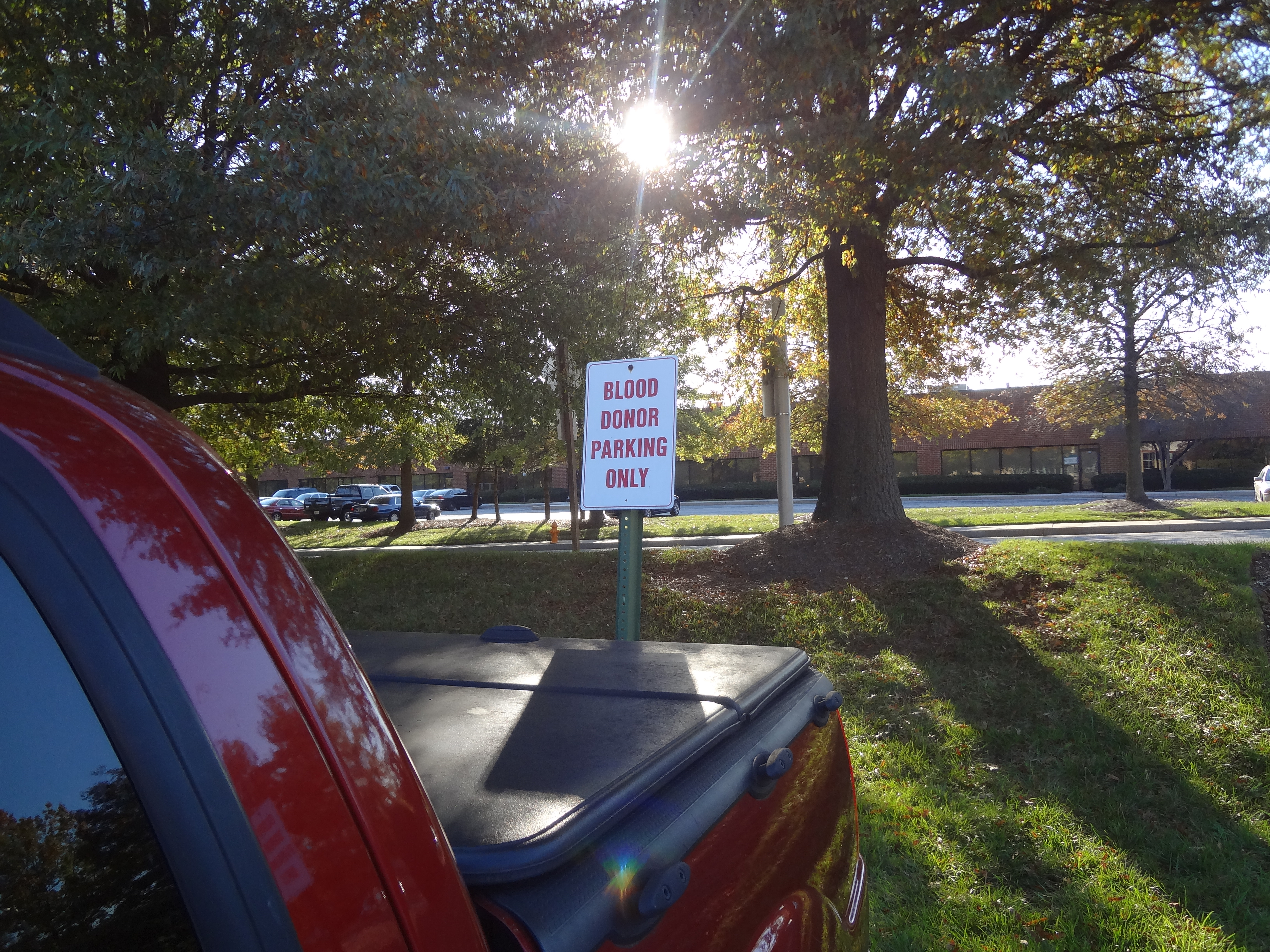
I got up early the Saturday before last, had breakfast, and made my way to the American Red Cross Mt. Hope Donor Center in Baltimore. I had intended to write about the blood donation process; being transparent about what transpires is a good thing.

But… sometimes, your blood sugar numbers just get in the way of your best-laid plans.

Donor-Parking

I arrived at the center about ten minutes early Saturday. I figure, early in, early out. Prior to going in, I checked my BG and it was 156 mg/dL (8.6 mmol/L). I did carry my meter in with me, which you should do too if you decide to donate blood.

Red-Cross

I was not concerned about this number, but I knew my BG would probably come down during the donation process, so as I entered the center I suspended my pump. What if I wound up high later? I didn’t care. In this case, better to be high than to go too low during the donation process.

I went through the initial reading of information, being tested for anemia, and answering questions to make sure I didn’t have any conditions and that I’m not taking any medications that would preclude me from giving blood. Then it was on to the donation.

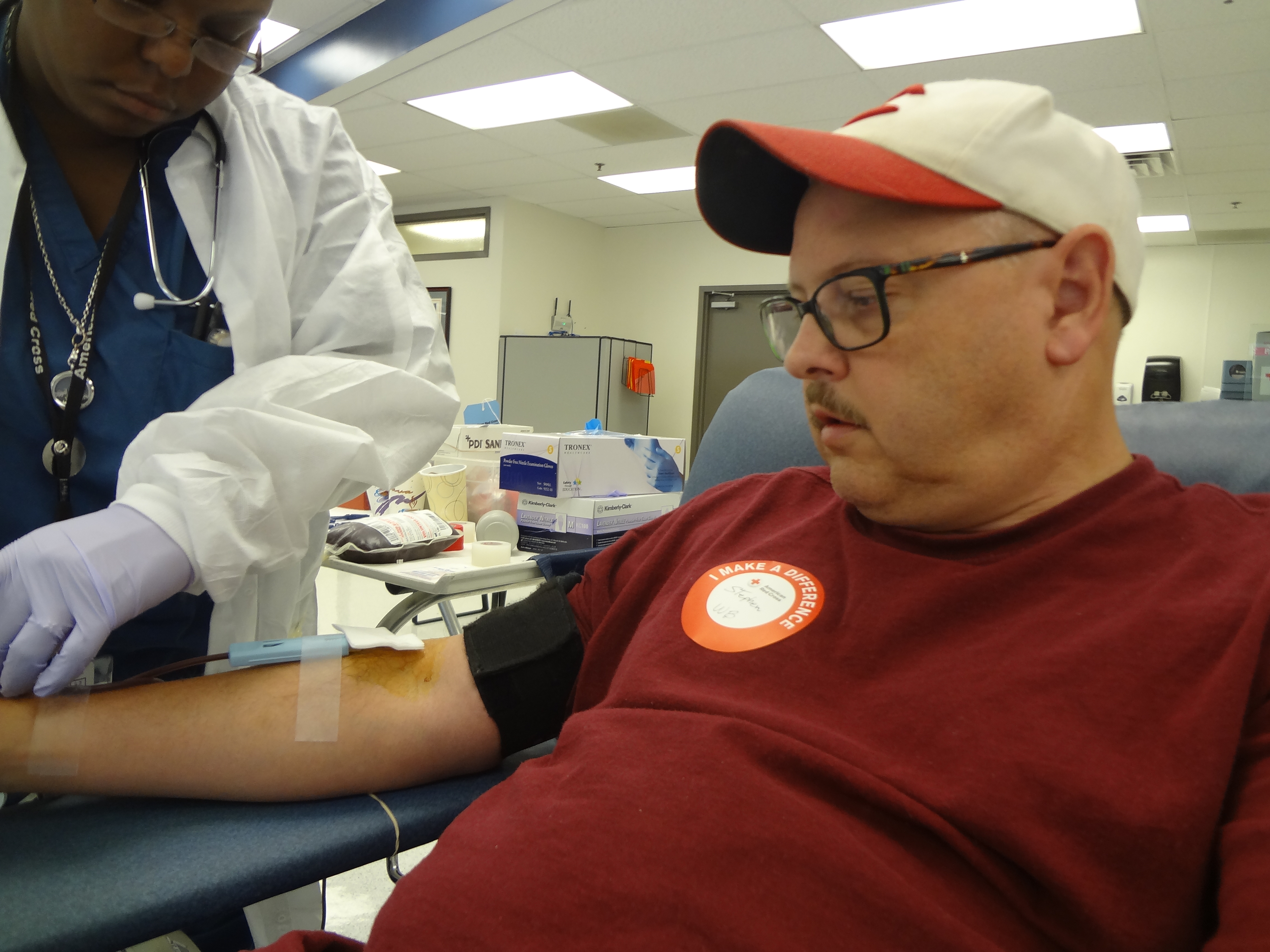
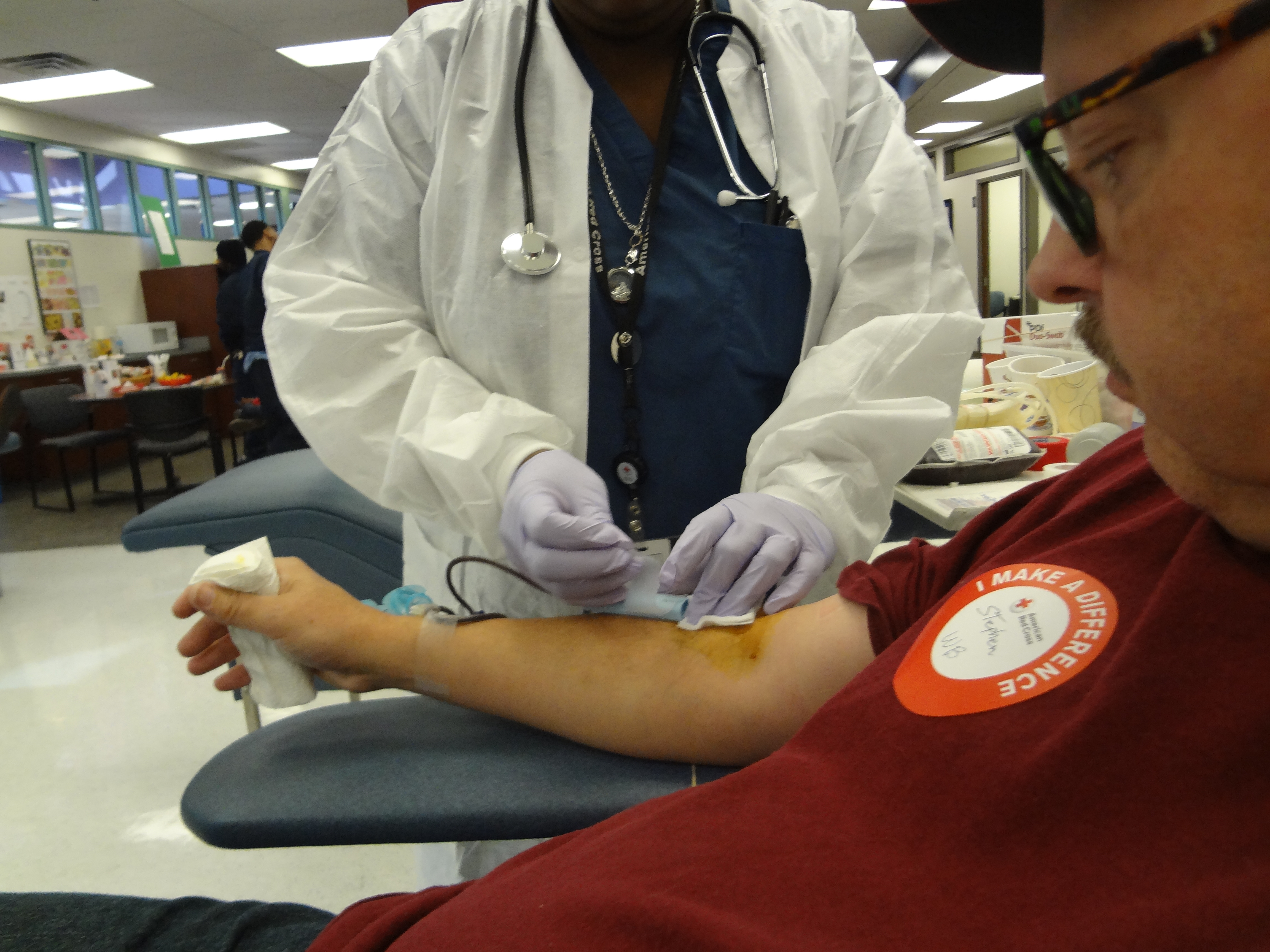
I went through the donation process (see photos), and during this entire time I thought I was okay, but in fact, I was dropping. When the donation process was complete, we’re encouraged to take a moment and have a snack and a little juice, so our blood sugar can recover from the process. I was sure that since my pump had been suspended for about an hour after my BG was 156, I wouldn’t have a problem with that.

DSC01823

DSC01827

I sat down, and the first thing I did was pull my meter out of my pocket and check. Which, if you decide to donate blood, you should do too. What was the result? 50 mg/dL (2.8 mmol/L).

Wow. I had a little juice and a bag of pretzels. Twenty minutes go by, and I’m sure I must be higher. Don’t forget, I haven’t restarted my pump yet. My next check revealed: 59 mg/dL (3.2 mmol/L).

What? I was sure I was going to be okay after this, so I made the huge mistake of driving home. In retrospect, I feel horrible about driving at that point, but I should be honest, and that’s what I did. I drove home. It was about a ten minute drive, and I checked again once I got there: 56 mg/dL (3.1 mmol/L).

I’m now at the “I can’t believe this” stage. I downed a glass of juice and had a slice of bread with peanut butter. I waited another twenty-five minutes to check this time. Finally… at 11:20… 169 mg/dL (9.4 mmol/L). After nearly two hours, I finally started up my pump again.

I guess I always knew that my blood sugar could be affected by donating blood. But this experience was something I did not count on. So next time (and there will be a next time), I’ll be more prepared than ever.

There is currently a desparate need for whole blood and blood platelets for patients of all kinds. If you’re living with diabetes in the USA, you may still be able to donate blood– and save a life. Find all the info at redcrossblood.org, or send me an e-mail using the link in the upper-left corner of this page and I’ll tell you what I know.