Category Archives: Advocacy

This could be a really exciting year.

I know… That headline is the kiss of death. Note that I said this could be an exciting year. And I don’t mean it could be an exciting year for me; I mean it could be an exciting year for all of us, and in diabetes in general.

2015 had its share of great moments. For me, it started with travel to Europe, then to Las Vegas for the initial Diabetes UnConference, then to Jersey City for the HealtheVoices conference. Mid year, I was able to start my own diabetes podcast, and at the end of the year I had a lot of things in the works but nothing I can talk about right now.

2015 had some good and not-so-good moments in the diabetes community. On the plus side, we got Bluetooth-enabled CGMs and the start of inhalable insulin. On the minus side, the abrupt death of Asante and the Snap insulin pump.

So… Why the optimism for 2016? I don’t know… It’s more of a feeling than it is anything else. I will, however, refer you to this wonderful post over at A Sweet Life, in which Melissa Lee talks about the most interesting things to look forward to this year. I think that’s where my optimism started.

There’s also this… April 7, World Health Day 2016, will have a special emphasis on diabetes. According to the World Health Organization’s official website, there are specific reasons for focusing on diabetes. And I’m excited about WHO’s goals for this year, which include increasing awareness about the rise in diabetes, defining a specific, effective, and affordable set of actions; and:

” Launch the first global report on diabetes, which will
describe the burden and consequences of diabetes and advocate
for better health systems to ensure improved surveillance,
enhanced prevention, and more effective management of
diabetes.”

I don’t have to tell you that this is long overdue.

In addition to the recognition by the World Health Organization, we’re also looking at important clinical trials as artificial pancreas research reaches a critical point. We’re nearing the point where the idea of glucagon that requires mixing and several steps before it’s ready to save someone’s life will be a thing of the past. And, oh yeah, it’s also an important election year here in the good old U.S. of A.

I’m truly thrilled about the difference that diabetes advocacy is making too. Diabetes Hands Foundation, Diabetes Community Advocacy Foundation, Diabetes Patient Advocacy Coalition, Spare A Rose, Save A Child. The list goes on and on. Yes, I truly believe that the efforts of these organizations and others have begun and will continue to make a noticeable difference in the lives of people living with this disease, just like they have up to now.

And the Diabetes Online Community is bigger than ever. That means more information, more viewpoints, more interesting ideas. I am happy and excited about the difference that social media has made and will continue to make for all of us too.

While I can’t point to much that’s tangible right now, I have to admit to being really jazzed about what will happen in diabetes in 2016. Let’s hope that everything we hope for comes to pass this year. I look forward to celebrating it with you.
 

Will my pump get hacked? Maybe not. But my phone? Maybe.

Once again, the U.S. Food and Drug Administration is inviting us to a public workshop… this time, in January, to talk about cybersecurity and our diabetes devices.

What? Who would want to hack my insulin pump?
2016Workshop
The truth is, probably no one. But as we know all too well, the world is more complicated than that. Especially lately.

Are you using a CGM? Is it the new Dexcom G5? Is it something else that is using a wireless signal to send data to an insulin pump, a watch, or a smart phone? Ever want to use something like that?

What about uploads? Do you upload data to DiaSend or some other website? Does your provider? Do they download from one of those sites?

Guess what? All of that can be hacked.

That’s what I’m worried about. Now that we have Bluetooth-enabled devices, and we’re able to start to see personal medical information on our phones, how do we protect ourselves? How do we engage both device makers and FDA to better protect us in the event something is compromised?

Let’s face it: maybe the question isn’t “can it be hacked?”; maybe the question should really be “what do we do if my device gets hacked?”.

I’m not in favor of backing up the trolley on innovative ways to view and use our data. But I think it’s smart and altogether appropriate that FDA is bringing people together to talk about it. I don’t want to not have the latest and greatest technology available to help me live a better, healthier life. But I think it makes sense to define protocols for how to react when/if someone gets access to something they’re not supposed to have access to. How do we protect ourselves? It’s a classic “fail to plan, plan to fail” scenario.

Just off the top of my head, I have questions about whether makers will be properly educating users about risks of a data breach, and how safe or vulnerable their device is to attack (while at the same time not scaring the bejeezus out of patients—it’s a fine line). Also, if my phone is hacked, what’s the protocol for how to react? What are the steps we should take in the event of someone hacking our phone and stealing our personal health information?

I know what some of you might be saying: it’s up to the phone maker to deal with that situation. True, in part. But what if a hacker is using the Bluetooth signal coming from my CGM to hack into my phone? If that happens, what is the manufacturer’s plan to address this and limit interruptions or theft of information?

I’m not really worried about someone hacking my diabetes devices. I am really worried about someone hacking my health information, either through an upload site, a smart phone, or by some other means. And really, I’m worried about whether anyone, anywhere, has any plan to deal with that if it happens.
 
 
If you want to know more about this two day public workshop, or register to attend, just click on the image above.
 

Please let me know if Mr. Glassman would be available for an interview.

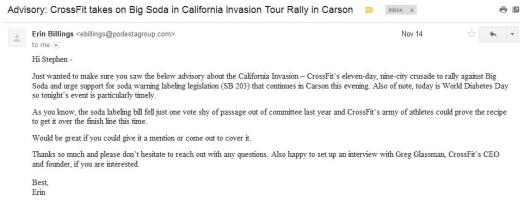
I received an e-mail last week from a PR firm that is handling an account for CrossFit. You know, CrossFit, the company with the CEO that doesn’t seem to really know what causes diabetes. Guess what? No one does, even though it seems that CrossFit’s CEO, Mark Glassman thinks he does.

Anyway, the e-mail was in reference to a California ballot initiative that CrossFit is in favor of. Here’s the text of the e-mail:
CFEmail
It’s not that I don’t care about this ballot issue, because I do sort of, but that’s not what I’d really like to talk about if I were to interview Mr. Glassman. Would I really want to interview Mr. Glassman? The truth is, yes, I’d like to at least have a conversation with him. I’d like to have an honest discussion about the fitness, and diet, and how those things, or lack of those things, from a scientific perspective, do not necessarily cause or reverse diabetes.

So in reply, I sent this e-mail to the PR rep:
 
 
Erin, thank you so much for reaching out regarding this story. You may or may not be aware of this, but Mr. Glassman, CrossFit’s CEO, was especially critical of People With Diabetes in an incident earlier this year. People like me. I don’t think my blog or podcast would be a good place to discuss the ballot initiative mentioned in your e-mail, though I wish you well with it. But I would like to invite Mr. Glassman to my podcast, Diabetes By The Numbers, to talk about CrossFit and diabetes.

My goal is not to ambush Mr. Glassman, but rather have a brief (30 minutes or less) conversation about how a diabetes diagnosis cannot be traced scientifically back to diet or lack of exercise, and how a diabetes diagnosis often makes one an even tougher athlete than they were prior to diagnosis. In addition, I’d like to find some common ground where we can create a dialogue, through which CrossFit and People With Diabetes may connect and be partners for positive change, celebrating what we can do together, rather than just shouting at each other.

If you can’t arrange this, I understand. But considering the fact that I live with diabetes year round, the fact that I write a blog about diabetes, and host a podcast related to diabetes, I think you can understand why I would rather talk on this subject. Please let me know if Mr. Glassman would be available for an interview.

All the best
Stephen Shaul


There are a few reasons why I responded this way. First, we often talk about seizing the opportunity to educate those who may not understand diabetes. If I’m going to be true to that, I’m going to at least ask for the interview.

Second, maybe, not likely but maybe, we can come to some sort of understanding, some sort of mutual respect or even a path by which we can both celebrate athletes who achieve their athletic goals despite diabetes.

Third, I admit… I like the challenge of an interview like this. I’m obviously not a professional, but I like to get out of my comfort zone once in a while with an interview subject. I know something like this wouldn’t be easy, and maybe it would be a disaster. But I’d like to try anyway.

If this ever amounts to anything, I’ll let you know. My guess is it won’t. But that’s not all bad either. Sometimes you just need to ask anyway.
 

It’s a gravatar. Not an insult.

In the end, I decided to publish this post. You have every right to complain about it to me, but please leave my friends alone.

So, it’s been an exciting first week of Diabetes Awareness Month. I’m noticing, and I suspect you’re noticing too, that a lot of people in our online community are either burned out on advocacy, feeling insignificant, or getting digitally slapped around by the passion of someone’s feelings on things as innocuous as a gravatar. Yep I’m going there just this once.

I’ve been watching posts this week, mostly on Facebook, and for me (you must make the decision on what’s right for you), I think it might help to put some things in perspective. Here are a few things I’ve found out about diabetes advocacy, the Diabetes Online Community, and how we treat each other:

First: there are not nearly enough of us.
For all of the wonderful things that have been accomplished in terms of awareness and education about life with diabetes, the fact is that there are a lot of things left undone. Like anything else, there is more than one reason for that. But I think one of the things that gets overlooked is the fact that we cannot do everything by ourselves, and the number of people practicing diabetes advocacy on a regular basis is extremely small. So why would you want to criticize those people for not doing enough, or for being at the forefront of a movement, or for just showing up on Twitter and on podcasts more often than someone else? If those people advocating all the time stopped advocating all the time, who would take their place? Anyone want to step forward? Full Time? Every Day? We should thank our lucky stars that we have someone, anyone advocating for us anytime. Can we thank someone for their advocacy today?

Diabetes Awareness Month is during November. Diabetes, and diabetes advocacy, is year round.
This is what I try to remember when I think about Diabetes Awareness Month and how much I haven’t done so far this November. I know I will try to advocate as best I can, but I try to do that anyway. And if I have a super idea that pops into my head on December 18, am I supposed to sit on it for eleven months so I can reveal it during Diabetes Awareness Month? I don’t think so. I started podcasting in August… I didn’t wait until November just so I could tie a blue circle around the idea.

When I think about diabetes advocacy burnout this time of year, I often wonder if it comes as a result of people doing their best all year and once November rolls around, there’s not much left to give. If that’s the case, I think it’s all right to say “Sorry… all of my great ideas are gone for the year. I’ll get back to you when I come up with something else”. That means less emphasis on November, but let’s face it… we’re not getting a lot of notice this time of year anyway. Other than December and October (for obvious reasons), I don’t know if I could have picked a worse month for Diabetes Awareness Month than November.

Advocacy comes in many shapes and forms. And we forget that.
We do… we forget what we ourselves do that is absolutely diabetes advocacy in action. I’m going to list a few things I’ve done in the last two years that, in my mind, qualify as diabetes advocacy. I’m including the last two years because this year has been pretty sparse, unfortunately. Here’s the list:

– Rode in ADA’s Chesapeake Bay Tour de Cure, raising money for a worthwhile organization
– Promoted various advocacy initiatives started by others, like BigBlueTest and Spare A Rose/Save a Child
– Attended the first Diabetes Advocates MasterLab in Florida a year ago (thanks Diabetes Hands Foundation, who paid my travel and hotel)
Gave away medals to People With Diabetes who achieve their athletic goals
Donated blood three times (in the USA, you can live with diabetes and donate)
Attended an FDA public workshop and spoke during public comments portion
Participated in a clinical trial
– Told my story here, on other web sites, and in interviews
– Started podcasting, interviewing diabetes newsmakers
– Participated in the weekly DSMA Twitter Chat (and moderated a few times too)
– Lived my life with diabetes to the best of my ability for two years

I’m going to guess that your list of advocacy is similar, if not better. Now, that’s not a huge list, and it’s not major in terms of diabetes advocacy. But it’s not nothing either. Like my diabetes, I’m doing the best I can with the time I have and the resources I have. If I need to remind myself of these things, I will because it’s proof that my presence means something. I hope I don’t forget that. More importantly, I hope you don’t forget that either.

If you let it, conflict will take the place of advocacy. And sometimes, people are just too damned sensitive.
Don’t get me wrong: If I’ve done something you’re not happy with, and you want to say something about it, then okay. News flash: Sometimes I’m wrong! It happens. I’ve been lucky in that when it happened, I had people show their displeasure with me in a way that is respectful and caring. It’s still uncomfortable to hear you’re not perfect, but if I want to expect people to be respectful, I must be respectful too.

However… when you focus your energy on one little thing, and you want to translate your feelings over that one thing toward me as a person and decide I suck because of a fucking gravatar… I’m not sure I have any words for that. Except fucking gravatar. Here’s what I mean:

When we take on someone for something they’ve done, or not done, said or not said, posted or not posted, real or imagined– that act, that emotion, is taking the place (and time and resources) of actual advocacy. Time that could be spent contacting our elected officials on important issues, telling our story so others will better know and understand our disease, or helping someone come to grips with their new diagnosis gets cast aside in favor of Being Right. The truth is, Being Right is completely subjective in many cases. And often, there is more than one definition of Being Right. Regardless… individually, we are almost always not the Official Arbiter of Being Right. It would be kind of cool if I was though. Still… in this case, it’s a gravatar, not an insult.

In addition, when you’re engaging in conflict, you’re running the risk of making people feel like they should just walk away from advocacy altogether. In my mind, having one less diabetes advocate is not fair compensation for Being Right. I don’t know about you, but I need every advocate I can get.

This month, I’m not engaging in the T1D Looks Like Me campaign. But I support people who do. I’m not using the #TypeNone hashtag either. But I think it’s a fabulous idea. I live with Type 1 diabetes, and I have many friends who live with other types that are fantastic advocates. I want to continue working to understand them and support them as best I can, while also helping and supporting my T1D friends. I do not run an exclusive club. I don’t believe my Type 1 friends do either.

This November, I’m going to keep on with my life, engage in my own form of advocacy, while supporting as many causes and people as I can along the way. For me, it’s a heck of a lot easier than worrying about Being Right all the time.
 

Let’s face it: We’re already being Shkrelied.

By now, we’ve all heard about Martin Shkreli, the former hedge fund manager who realized he could make more money in the pharmaceutical space and, through his firm Turing Pharmaceuticals, purchased the drug Daraprim. Daraprim is used to treat malaria, and more importantly, helps in treating AIDS patients as well. Prior to Mr. Shkreli’s purchase, Daraprim was selling for around $13.50 per pill. After the purchase, Mr. Shkreli increased the price of Daraprim to $750.00 per pill.

The very idea of doing such a thing, in pricing a drug that patients need, at a certain price simply because there is money to be made, is a very scary proposition for diabetes patients. Kelly Kunik did an excellent job of explaining why HERE.

But the honest truth is, sadly, that this is already happening to People With Diabetes.

I’m not going to call out anyone. I’ve written about costs of drugs and devices HERE and HERE. The truth is that we are already paying a great deal for drugs and devices that keep us healthy and, you know, alive. Unless they’re not great money managers, these companies are making a great deal of profit. They’re certainly generating a lot of revenue. In many cases, they’re generating a lot of revenue for things that haven’t changed much, if at all, for years.

When you’re generating at least over 3.5 billion dollars for your drug in the United States alone, each year, for years at a time, the notion of “We need to price our drug at this level to help fund our development and research” rings hollow. Certainly, research and development must be funded. But if your drug is generating a billion dollars in profit each year in the USA, for example, for ten years, for example, that’s ten billion dollars. If your drug costs a billion, billion and a half to develop, get FDA approval, manufacture, and bring to market, how long does it really take to make enough money on your current drug before you’ve paid the bill for your next drug?

And let’s not forget that sometimes the people making money are the insurance companies who cover our medications or devices. The insulins on my drug provider’s formulary list have changed three times in five years. That is not happening out of patient need. It’s happening out of corporate greed. The drug provider cuts a deal with a drug maker or manufacturer, puts the drug on the formulary list, takes the drug maker they could not cut a deal with off the formulary list, and in each case, take their own slice of the pie.

I haven’t even gotten to the question of generic insulin yet. But each year that goes by with no generics or low cost options for a 95 year old drug, ever increasing prices for existing medications, and no reasonable explanation of why gets me a little bit hotter under the collar. Oh, and by the way, no one in the federal government is stepping up to try and rein in the gouging of patients, even if doing so might actually help save a few dollars for Medicare and Medicaid, and by extension, our federal budget.

I’m grateful for the contributions that device and drug makers have made toward improving our lives with diabetes. That we must pay such a dear premium for these contributions, simply because we’re stuck with a disease we can’t get rid of, should be too high a price to pay in a world in which a great deal of money has already been made on these things.

In the end, it may have been Shkreli’s instant robber baron tendencies that caused such a public uproar, causing him to lower the price of daraprim a bit after the initial announcement. A competitor making a similar drug has lowered their price to just $1.00 per pill, further cutting into his new venture. I fear that large companies with careful, experienced number crunchers and public relations machines may be doing a much more savvy job of getting us to the same point, without many realizing it.

I hate to say it, but when I look at the numbers, it looks to me like People With Diabetes are already being Shkrelied by the companies we rely on for insulin, insulin pumps, and the like. I think it should be okay for us to say so, or at least ask why. And we deserve an honest accounting.