Tag Archives: Meters

#StripSafely Update. And a question.

Safety of the test strips we use, and the meters we plug them into, is a great big deal to everyone living with diabetes. It also means a lot to the people who love me and count on me to be there for them.

So I aligned my views with those in the Diabetes Online Community who also believe that A) The 20 percent +/- factor that’s currently allowed for test strips is NOT NEARLY GOOD ENOUGH, and B) The fact that the FDA has no post-approval mechanism in place to verify the continued accuracy of test strips they approved earlier, or pull them from the market if they’re not, IS NOT OKAY.

As a measure of support, and to help in getting these wrongs righted, I wrote my elected officials in Washington. U.S. Representative Dutch Ruppersberger, D-MD, and U.S. Senators Barbara Mikulski and Ben Cardin, also D-MD, received e-mails from me expressing my concern and asking them to assist.

That was nearly three weeks ago.

But hey– a week ago I received an e-mail response from Senator Mikulski, the longest-serving woman in United States Senate history. I’ll share it right here, but be sure to come back after reading, because I want to ask about something.

Letter

Other than the fact that this was pretty much a form letter, I was actually happy to have received a response at all. Seriously, even if they’re not busy all the time, senators get requests from a seemingly endless stream of attention-grabbers and favor-seekers on a constant basis.

No, what really struck me were the two images at the bottom of the letter. You know, the Facebook and Twitter icons.

So I want to ask: What if a coordinated effort was put together to bombard Facebook and Twitter accounts of U.S. Representatives and U.S. Senators for the #StripSafely cause? It could start with House and Senate committee members responsible for FDA oversight, and perhaps move on to people with oversight of the U.S. Commerce department. Somewhere in there, we could get around to House Speaker John Boehner and Senate Majority Leader Harry Reid.

I don’t know… Maybe it all sounds a little too “Mr. Smith Goes to Washington”. But don’t we believe in our own cause just as much as Jimmy Stewart did in that movie? And I have to ask: Don’t you think that together, we could make some kind of impact? If there are so many people in on the #DSMA Twitter Chats every Wednesday, wouldn’t the same kind of numbers all tweeting or messaging at the same time, about the same thing, to the same people, get an elected official to take notice?

What do you think, Diabetes Online Community? Good idea? Bad idea? Feel free to leave your ideas below.

For more on this important issue, visit the Strip Safely central at www.stripsafely.com


More on #StripSafely.

StripSafely

No doubt you’ve already heard of the Strip Safely campaign. But maybe you’re still asking, “Stephen, what’s it all about? What can I do about it?”. Here’s the lowdown:

At a public meeting back in May, the U.S. Food and Drug Administration (the FDA) acknowledged that there are glucose meters and test strips out there that are no longer as accurate as they were when they were approved by the FDA in the first place. That’s a big deal, no?

What if I also told you that even though the FDA acknowledges this issue, they have no program to perform post-market testing or remove inaccurate test strips from the market? Bigger deal, yes?

Our very lives depend on the accuracy of the numbers that appear on our meter’s display. If we see too low a number… we dose too little insulin and wind up with high glucose, high A1c results, and higher risks for complications later. If we see too high a number… we could dose too much insulin and wind up with severe hypoglycemia, or even death. No pressure, FDA.

So Bennett Dunlap and a few others started the Strip Safely initiative, to shine a light on this issue and encourage everyone affected by it to agitate. Call or write your congressional representatives, senators, and even the FDA. Voice your concern. Help lead the charge for better outcomes through more accurate test strips.

Want to do your part? I thought you would. Visit the Strip Safely site at www.stripsafely.com. There you’ll find a number of great templates you can use to send your own letter or e-mail. There are also links to help you find your elected officials in Washington. You can stay up to date on this issue with the latest updates, and even take the Strip Safely quiz to test your knowledge of test strip accuracy. Or take the quiz and then read about what’s happening… your choice.

For the record, here is a sample of the letters I sent by e-mail to U.S. Representative Dutch Ruppersberger, and U.S. Senators Barbara Mikulski and Ben Cardin of Maryland:

Dear _______,

I’m a constituent who has been living with Type 1 Diabetes for the past 22 years. Because my pancreas doesn’t produce insulin on its own, I receive insulin through my insulin pump 24 hours per day.

How much insulin is administered is based on a number of factors. Most notably, my blood glucose. As you may know, people with diabetes check their glucose levels several times per day as a baseline for determining how much insulin to administer as a result of diet, exercise, stress, and a number of other factors.

I’ve recently learned that the Food and Drug Administration, at a public meeting, acknowledged that some glucose meters and test strips are not as accurate today as they were when they were approved for use in the first place. Furthermore, they have no method to deal with removal or review of potentially inaccurate products from the marketplace once they’re found to be inaccurate.

The issue is simple: If the readings on our meters are inaccurately low, we might wind up not taking enough insulin, which could result in dangerously high blood sugars. If our readings are inaccurately high, we might take too much insulin, which could result in hypoglycemia, insulin shock, and even death.

So we know that not all meters meet the +/- 20% standard set by the FDA in real world conditions. Some manufacturers are now delivering products into the market that put us at increased risk. The lack of an ongoing periodic post market audit of real world strip performance helps these manufacturers risk lives.

What I’m asking you and your fellow representatives/senators to do is to look into implementing a post market program of ongoing random sampling of glucose meters and test strips to insure that all brands consistently deliver the accuracy in the real world that they were approved to do.

Without question, meter and test strip accuracy means the world to myself and my loved ones. We want to know that the number on our glucose monitors is correct.
Because our lives depend on it. Won’t you help? Thanks so much for your consideration of this very important topic.


This is important. I’m going to say it again: Lives are at stake. I encourage you to get involved and help to save lives today.


#DSMA June Blog Carnival. #Diabetes Devices.

June’s DSMA Blog Carnival prompts us to think about the many devices we use in our daily lives with diabetes, and asks some great questions:

Regardless of which type of diabetes you have – T1 T2 or T3 – you probably use one or more diabetes devices on a daily basis. For this post, when we refer to devices we mean blood glucose meters, insulin pens or pumps, and all other diabetes medications. This month we’re going to revisit the May 15th chat on Diabetes Devices and really think about what we use. We’d like to know:

How do you select the diabetes devices you use? To others looking into new or replacement devices, what would be your best advice to someone shopping around?

This really brings back some memories for me. If I may, let me give some advice by telling you how not to choose devices.

First, let’s talk about meters. After my diagnosis, I just accepted the first meter that was handed to me, and I used it for about ten years. I mean, they wouldn’t give me something that helps determine how I use insulin and the various ramifications of said usage without it being 100 percent accurate and never failing? Right?

Wrong. It’s not that my meter wasn’t good for its time (it was 1991, after all– only 45 seconds to get my BG!), but I didn’t even think of whether there might be an alternate meter I could use. And if the one I had was still working, why would I need a new one? Then came the day that an endocrinologist asked to see my meter, and she laughed at me when she saw it. She said, “You know, meters have really come a long way since the Mesozoic Era”. I had no idea. It simply didn’t occur to me that things could change, and meters could be even better. From then on, I tried to keep an eye on the latest improvements in meters and test strips, so even if I wasn’t changing meters, I would know if there was a major improvement of some kind that should prompt me to upgrade this very important device. Lesson: Stay current… maybe something better, or at least more useful, is out there.

Now, let’s talk about insulin pumps and infusion sets. When I first decided to start pumping insulin instead of injecting it, I had really only seen or read information on one pump product. So when my endocrinologist (who I had just started seeing six months earlier) said I should read about additional manufacturers of insulin pumps, I took her advice but didn’t really change my opinion about what I wanted.

In the end, I chose the pump that I’m using today for a couple of good reasons, and a few bad reasons. Chief among the bad reasons were the fact that I didn’t really consider the other pumps. I had my mind set on one only, and that’s the one I chose. Also, and this is very important: I didn’t ask anything about any other pump, and I didn’t get any demos or trial runs of any other pumps. This is completely not like me, and I want to kick myself every time I think about it. I should have done trial runs of other pumps. I should have listened to the sales pitches from the other reps (because that’s what you get… sales pitches). I should have asked a lot of questions.

I can’t say that I’m unhappy with my choice of pumps. What I have works very well, and it’s amazingly reliable. Those are big metrics for me. So I’m pretty happy I wound up with the pump I’m using. But I really wish I had done a little more due diligence, so I would be absolutely happy and sure of my choice. Lesson: Be an informed patient and consumer. It can only benefit you in the long run.

These are a couple of examples that I can point to in saying: Don’t make my mistakes. Learn about potentially new meters, medications, and yes, insulin pumps if you’re using one or plan to use one in the near future. Ask a lot of questions. A lot. Here’s an idea: Why not reach out via social media to get feedback on something you’re thinking of? Most of you know how responsive the DOC (Diabetes Online Community) can be, and how we’re very good at giving you the unvarnished truth. Finally, if you can, ask to do a trial run of your potentially new device so you can be even more sure you’re making the right decision.

I can’t guarantee that following this advice will help you land the perfect device to help you manage your diabetes better. But I do know this: More information will help you make the best choice you can make. And who wouldn’t be happy with that?

This post is my June entry in the DSMA Blog Carnival. If you’d like to participate too, you can get all of the information at http://diabetessocmed.com/2013/june-dsma-blog-carnival-3/


A whole lotta stuff.

It’s no secret that all of us diabetes-folk accumulate a lot of… stuff.

I wonder… are we the hoarders of the patient world?

I mean, we have tons of things that we rely on each day. Think about it:
 
 
For blood glucose management:
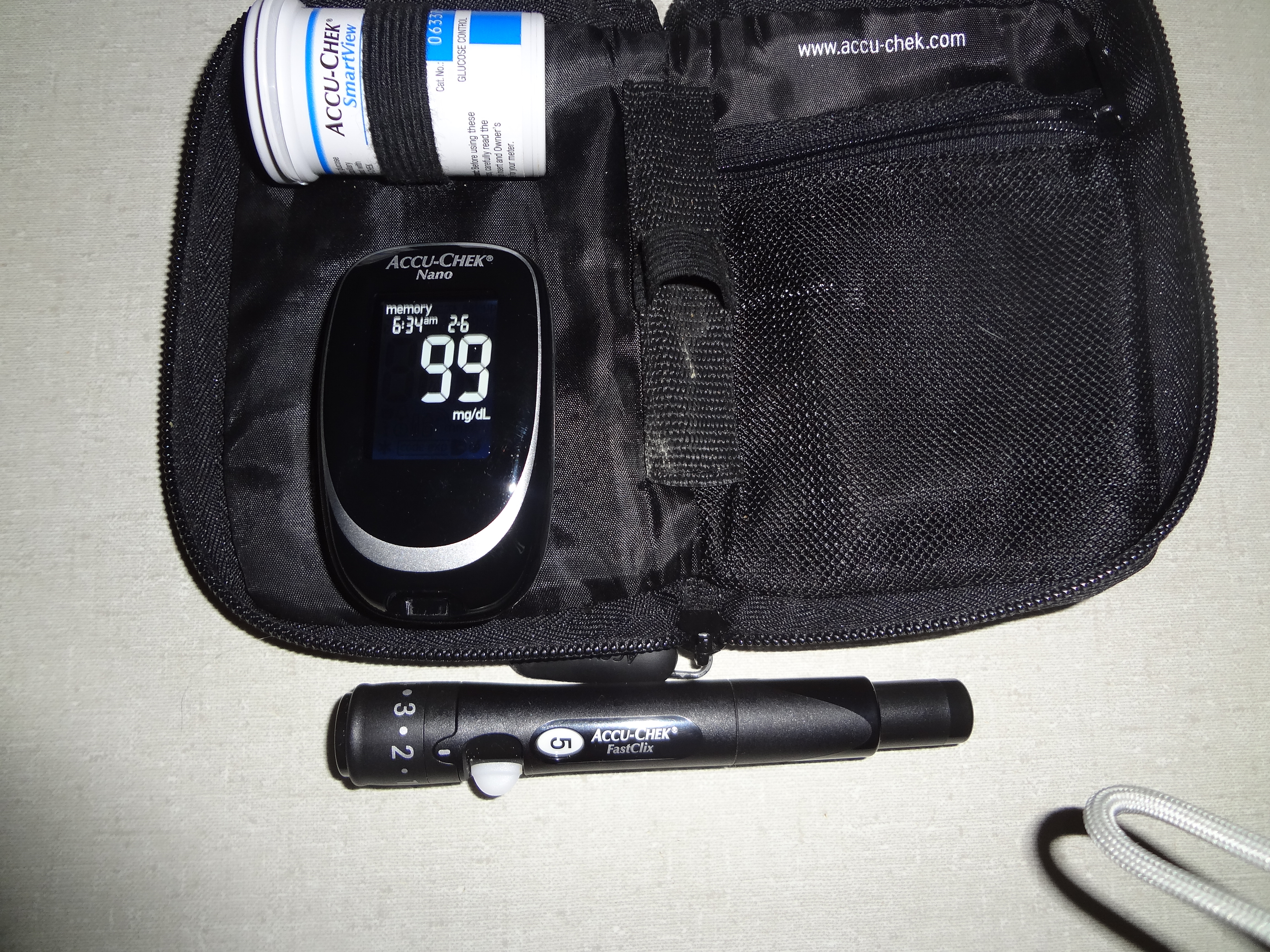
– Meters
– Test Strips
– Continuous Glucose Monitors (CGMs)
– If you’re wearing a Dexcom™, a CGM receiver
– How about a backup meter?
– Backup test strips? You know, the ones you really hoard because your insurance company doesn’t think you need backup?
– Throw a couple of extra meters in there (at least), because you know you never get rid of the old ones the second you get a new one

For insulin delivery:
– Insulin (of course)
– Syringes
– Or Pen needles
– Or a pump
– Or all of the above
– Infusion sets for your pump
– Reservoirs for your pump

Wow, look at that list! And we’re just getting started.

For treating lows:
– Glucose tabs
– Juice
– Honey (one of my favorites)
– Nutella (not one of my favorites, but to each their own)
– That year old candy from a restaurant that’s always in the bottom of your pocket (or pocketbook)

Some additional extras:
– A Glucagon Kit
– Alcohol Wipes
– All of the stuff you carry your D-stuff in (I’m not talking about the plastic grocery bag crap I carry my stuff in… I mean the cool accessories, like you get here or here.
– Documentation—A medical bracelet or necklace, a card in your wallet, information for schools, doctors, TSA screening agents, etc.
 
 
That’s a lot of things to keep track of, just so we can live our lives with diabetes. That’s it—I live a full, happy life with diabetes (and a lot of diabetes-stuff) along for the ride.

Is there anything I’ve left out? Let me know.


Wordless Wednesday: This is what recovery from a 3:00 a.m. low looks like.

Somehow, I was down in the 30s this morning at 3:00. The remedy: two juice boxes, some peanut butter, and three hours of sleep. This is the result:

DSC00572

Have a great Wednesday!