Tag Archives: diabetes

#MasterLab: What I learned, and what I experienced.

MasterLab

I was fortunate enough to attend the Diabetes Advocates MasterLab in Orlando last week. I was there thanks to a scholarship provided by Diabetes Hands Foundation. My thanks to everyone who made this event possible, and made it possible for me to attend.

MasterLab– A one-day diabetes advocacy workshop– contained a full day’s worth of information, education, encouragement, and real world examples of how advocacy has been successful in both the diabetes world and in other areas.

The major takeaways for me on this day: Our advocacy needs to be bigger. In other words, more people need to be involved. And… I really believe this… All of us… This generation… can have a major impact on making lives better for people living with and affected by diabetes.

There was a lot to take in. Partly because of the content of the workshop, and partly because of the people I encountered during my 42 hours or so in Orlando. If you don’t mind, I’d like to break all this down into a week’s worth of blog posts. Okay?

Okay. The day began, as you might expect, with some opening remarks from Manny Hernandez, President of Diabetes Hands Foundation. Among the first things he shared with us was his dream. Stop me if you’ve heard this, but he shared his dream of thousands upon thousands, type 1s and type 2s, LADAs and others, young and old, parents and siblings, friends and spouses and partners, marching on Washington, advocating for the things that all of us living with diabetes need and deserve as human beings who just happen to have defective pancreases. If you’ve never met Manny, or heard him speak, I’ll just tell you this… he’s a dynamic, charismatic leader. When he speaks, you can feel the passion of his convictions. I’m glad he’s in our corner.
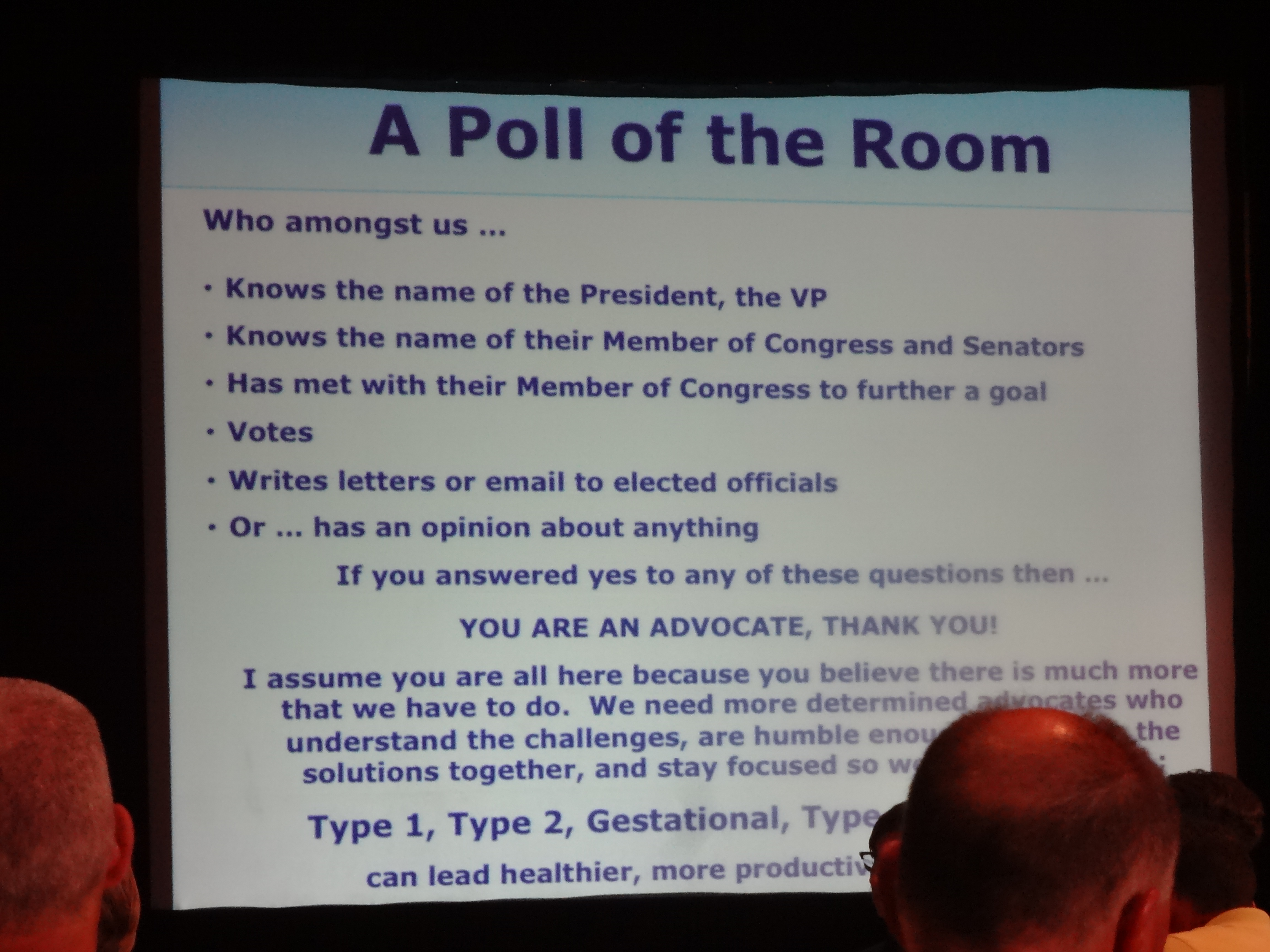
DSC01622

Then it was on to our keynote address, given by Paul Madden, a Senior Director at Project Hope. He helped set the tone for the rest of the day. I wish you could have heard him. Here’s a guy who’s been living with diabetes for forty years, and he’s still a D-advocate of the highest order. A couple of things that resonated with me:

“Everyone here is making a conscious decision to change the landscape of diabetes advocacy”

“We are a quiet, sleeping giant in advocacy”

“If you don’t stretch your limits, you set your limits”

And something I’ve been saying for a while now:
“When I’m healthy, I’m productive, I pay taxes, government doesn’t have to support me with tax revenues”

That last quote: Makes so much sense, doesn’t it? Keeping us healthy, as opposed to just keeping us paying customers, saves the government money.

Then we heard from Stacye Beck, Branch Chief for the Diagnostic Devices branch of the U.S. Food & Drug Administration. She spoke about the role of the FDA in regulating diabetes devices, and in advancing safe innovation in diabetes management. What that statement doesn’t say is that this is a person who actually writes some of the guidance that comes down from the federal agency responsible for assuring the accuracy and safety of our diabetes devices.

So what can she tell us about advocacy? She told us about the six hundred comments that were submitted in response to the open dockets on glucose meter and test strip accuracy. Remember Strip Safely? That.

She told us that those six hundred comments were about six or seven times the number of comments they usually receive on open dockets. Remember what I said earlier about more people needing to be involved? That’s what I mean. Sometimes advocacy doesn’t require getting out and raising a lot of money or doing something loudly public. Sometimes, we just need to see an opportunity and take advantage of the opportunity, right from the comfort of our own laptop or tablet. Simple as that. I learned a lot from this presentation.

Stacye also reminded us that there are three things that we can continue to do for people living with diabetes. You don’t even have to leave home to participate in this kind of advocacy:

– Report adverse events to the manufacturer and the FDA

– Comment on dockets for draft guidances (Strip Safely isn’t our one and only chance to make a positive impact)

– Become informed on the facts (from all perspectives)

After that, there was an interesting panel discussion on the topic “What I Wish Patient Advocacy Looked Like”. I loved this panel, because for the first time since I’ve been attending events like this, I saw a true variety of individuals weighing in on this topic.

From left:  Moderator Mike Swearingen, Stayce Beck (FDA), Christel Aprigliano, Andy Balo (Dexcom), John Agos (Sanofi), Melissa Schooley (Medtronic), Bruce Taylor (Roche)

From left: Moderator Mike Swearingen, Stayce Beck (FDA), Christel Aprigliano, Andy Balo (Dexcom), John Agos (Sanofi), Melissa Schooley (Medtronic), Bruce Taylor (Roche)

As you might expect, each panelist had their own opinion about what works and what doesn’t as far as advocacy is concerned. Each panelist seemed to have their own opinion of what constituted a “movement” in terms of D-advocacy. But all seemed to be saying the same thing: We do not yet have enough people involved in advocacy. I invite you to check out the videos that were recorded for each session once they’re posted. You’ll see what I mean. And you’ll see that people from all sides of diabetes are involved in what happens to us. Why shouldn’t you be involved too? You’re not any less important than they are.

The morning also included an inspiring talk from Michael Manganiello, a founding partner at HCM Strategists, a public policy and advocacy firm headquartered in Washington, D.C. Michael is an HIV survivor, which is inspiring in and of itself. He also was at the forefront of the advocacy movement for AIDS patients in the 80s and 90s. Listening to him speak for five minutes would be awesome. We got to hear him speak for about 25, and it was pure gold.

Michael was direct, to the point. He told us things that reassured us, and challenged us too:

“I feel like today, we’ve been talking too much about the status quo”

“If patients are not part of the solution, there is no solution”

“Leadership is built and grown and nurtured and taught”

Speaking about our relationship with lawmakers and federal policy makers:
“You don’t have a movement. They’re just checking your box”

Ouch. I’m embarrassed to admit that he’s right.

We rounded out the first half of the day with Manny and Bennet Dunlap telling us about how we can do it too. How can we, as patients living with diabetes, and friends, family members, spouses of patients living with diabetes ramp up our advocacy efforts?

One way to do it, right now, is to click right here:
http://diabetesadvocates.org/masterlab/

The Diabetes Action Hub has simple, easy instructions on what you can do right now to be a bigger diabetes advocate than you ever thought possible. You’ll learn about the National Diabetes Clinical Care Commission Act (House Resolution 1074 or the Senate bill 539). Both bills call for a commission of health professionals, agencies, and patients to coordinate disparate federal actions to help people living with diabetes.

I know I often refer to advocating for things like this by saying how important they are. Do you know why? Because they are important. They are all important. Is everything okay in your diabetes world? If not, they are all important.

This seems like a good place to stop for now. More to come on the rest of MasterLab throughout the week.


A Disclosure, an example, and a plea.

Today is a very busy day, so I’m just going to let you know about something important while I have a moment. I give you a disclosure, an example, and a plea.

I’ll be leaving early tomorrow morning, on my way to the Diabetes Advocates MasterLab in Orlando. Like I mentioned earlier, it’s a one-day advocacy workshop, and I’m looking forward to learning something new and getting my big A on.

I have to admit to being a little less than transparent about this trip up to now. I would have mentioned this earlier, but to be honest, I completely forgot about it. I haven’t really had to disclose this kind of thing before.

The truth is I’m going thanks to a scholarship provided by Diabetes Hands Foundation. If not for DHF, I wouldn’t be making this trip. I’m usually the guy helping others make a trip like this. But… a lot of unexpected things have happened here this year, and as a result, there’s very little wiggle room left in the budget. So thanks Diabetes Hands Foundation. I’m grateful, and I’m really pumped about this.
 
 
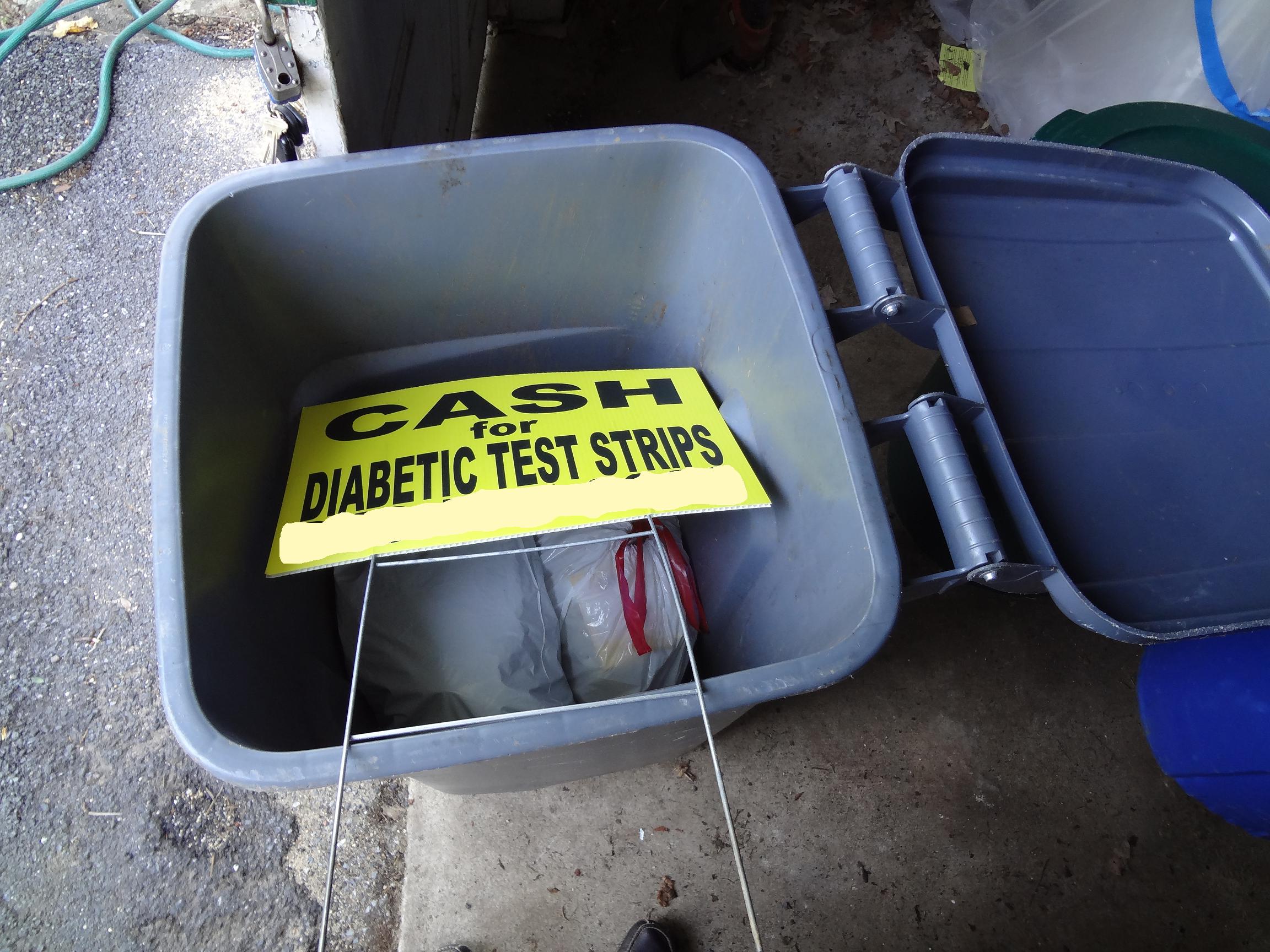
Leading up to the workshop, I performed my own bit of advocacy this weekend. This goes back to a post from early May where I talked about the infestation of those “Cash for Diabetic Test Strips” signs that have been popping up all over Baltimore. After I wrote that, I received a comment from Jeff Mather:

CommentJM

I’ve been thinking about Jeff’s comment. I think about it every time I see one of those signs. So when I was running errands on Saturday and I saw one of those signs, I took matters into my own hands:

Sign

I found two more on Sunday and added them to this one. I’m not sure about the measure of advocacy involved here, but I did manage to make my feelings known about this practice by doing something tangible.

The point here is, we don’t always need to come up with a great idea on our own. Sometimes, all we need to do is pick up on someone else’s idea and do the best we can. I really hope that there are no opportunities for diabetes advocacy where you live. That would mean that your D-world is fantastic and welcoming and helpful. Unfortunately, where the rest of us live, there are plenty of opportunities for advocacy. They aren’t all big, earth-shaking initiatives. But if you think about it, I think you’ll find a place where you can really make a difference.
 
 
You know, there are many (and by many, I mean a LOT) of great organizations that help make lives better for People With Diabetes, bring people together who are living with and affected by diabetes, and provide funding to help bring important innovations to the forefront that help us live longer, healthier lives with diabetes.

I encourage beg you to consider making a contribution to your favorite diabetes organization today. Whether it’s by volunteering, by making it your career, or by giving money, every small seed of support you plant today helps the Diabetes Community grow stronger and better tomorrow, and for many tomorrows to come.
 
 
Thank you. And enjoy your week!


Clinical trial participation: The one helping the many.

This post is appearing today over at the Diabetes Community Advocacy Foundation website.
 
 
Clinical trials… what’s the big deal?

Everyone knows that clinical trials are important.

What about clinical trial participation?

Full disclosure: I’ve participated in three clinical trials in the past year, the last testing an artificial pancreas device. More on what that means to me below.

There’s absolutely no question that research and discoveries that happen as a result of clinical trials is of great importance to all of us living with and affected by diabetes. That means that participants in clinical trials are a vitally important part of the research and development process. Critical clinicals, if you will.

Don’t believe me? Think about the important discoveries that would not have been made available to the general public without the assistance of clinical trial participants. Insulin pumps, continuous glucose monitors, meters and test strips, long-acting and fast-acting insulin. Better syringes, infusion sets, reservoirs, and sensors. None of these could have made it to our D-lives without clinical trial participants who made it their mission to try them first.

Those are just the good ideas that made it through the testing and approval process. What about the bad ideas? If not for clinical trial participants, bad ideas would… well, I don’t want to think about it. Let’s just say that without patients willing to play an active part in discovery, we might not know the good ideas from the bad ideas until it was too late to do anything about it. As one of the doctors on my last clinical trial put it, there is no bad data. All data is good if it helps us get to a great conclusion. Who is the source of that data? Right… patients who participate in clinical trials.

Need another reason to participate? How about the great feeling that comes from taking an active part in making things better for people living with diabetes? Many of us don’t have the resources, the networks of supporters, or the money to take on meaningful advocacy initiatives on our own. But your participation in a clinical trial means that you, just one person, can help make a difference for more people than you’ll ever know, and for a long time to come. Oh, and the money thing: Many entities compensate patients for participation in clinical trials. Don’t expect to get rich. But if you need an extra incentive, there it is.

In addition, patients who participate are screened thoroughly prior to the start of any study. Once the trial is underway, doctors and nurses watch you closely. Partly to see how the research is going, and partly to make sure that you, as a patient, are free from adverse reactions or unintended consequences of whatever is being studied. The goal of testing is never to have the study team watch you get worse. If you don’t feel comfortable participating at any point in a clinical trial, you can always opt out at the very moment it begins to be too much.

I can think of no other form of diabetes advocacy where one person can have such a profound impact on the future for so many people. For me, it’s been exciting and fulfilling. In a way, I feel like a researcher myself. If you’re one of the many patient heroes participating in clinical trials, Bravo. Thanks for moving the needle for all of us. If you’re thinking about participating, or if you’ve already decided to put on the cape and begin participating, here are some links you might find helpful:

The USA’s National Institutes of Health has a complete list of clinical trials taking place all over the USA, and even some outside of my country. To find them, go to www.clinicaltrials.gov and enter “diabetes” into the search box.

In the United Kingdom, the UK Clinical Trials Gateway is a great resource for finding out about trials happening all over Europe. To perform a search and find out more, go to http://www.ukctg.nihr.ac.uk

JDRF has a very helpful web page that lists multiple sources for registering and finding out about clinical trials. Just go to www.jdrf.org/research/clinical-trials/ to find out more.
 
 
If you’ve participated in a clinical trial, or if you are participating in a trial, won’t you leave a comment below?


Can you make a word from this?

This set of letters appeared in the Scrabble Grams puzzle in one of the local free weekly papers this week. Can you make a word from this set of letters?
 
 
Word
 
 
Actually, I think they were looking for the word “bulbous”. But I get where you’re coming from, diabetes-brain.

Don’t forget to bolus for those meals today.


Coming to a website near you soon: Best of the ‘Betes Blogs!

Thanks to a last-minute decision, Happy-Medium.net will be hosting the June Best of the ‘Betes Blogs!

I’m super-excited to host this event, and I’m looking forward to reading the many fantastic blog posts that have sprung up from the Diabetes Online Community this month.

This being June 23rd, you have one more week to get your nominations in!

If you’ve come across a diabetes blog post that moved you this month (and I know you have), make sure you help us recognize the writer. You do not have to be a blog writer to nominate. Also: please, no self-nominations; and please, no nominations from this blog this month.

Nominate your favorite posts in these all-important categories:

– Best use of humor

– Best Vlog

– Best recipe

– Best use of photography

– Best advocacy

– Best reference to a D-celebrity

– Best story of a D-meetup

– Best non-D related post

– Best post by a Type 1

– Best post by a Type 2

– Best post by a Type Awesome

– Best post by a LADA/Type 1.5/Not otherwise specified

– Best story of a D-mistake

– Best motivational post

– Best diabetes art

– Best comment(s)
 
 
You can nominate a post in three ways:

1. Send an e-mail to bestbetesblogs[at]gmail[dot]com. Be sure to include a link to the post you’re nominating.

2. Via Twitter, send a Direct Message to @bestbetesblogs. Be sure to include a link to the post you’re nominating.

3. Go old school and complete the online form located here. Be sure to include a link to the post you’re nominating.
 
 
As concerned members of the Diabetes Community, we all put ourselves out there telling our stories, informing and educating, and advocating for others every day. Let’s help recognize and reward the thought-provoking, life-hacking, inspirational blog posts that have helped make a difference this month.

Then check out this space again for the full list of the Best of the ‘Betes blogs from June. Due to travel and a couple of other things on everyone’s plates, expect to see it on or before July 7th. And in advance, let me say: Thanks for reading, and thanks for nominating your favorites!