Tag Archives: diabetes

March for Health

I’m one of the lucky people in this world who has a Monday through Friday job. Every weekend off. Nevertheless, ten, fifteen years ago, I spent many Saturdays getting up early, getting to the office, and working for four to six (or even eight) hours. I was convinced that there were many things to do, and the quiet Saturday surroundings would help me tackle those without the distractions of the phone or people coming to my desk all the time. It was a lot of extra work for exactly zero reward. It’s a long story about how I got here, but I’m happy to say that I don’t do that anymore.

Instead, this past Saturday, I got up early, drove to the Washington, D.C. suburbs, and caught the Metro into the District. I am even happier to say that this effort was more than worth it.

Photo courtesy of Dirk Gassen


Saturday, April 1st marked zero hour for March for Health, the culmination of a nationwide effort to rally for health care as a human right. In cities large and small, people gathered, signs in hand, purpose in mind, to share their concern that the discussion on health care needs to result in affordable, accessible, equitable care for everyone.

I was a very small part of the D.C. march, which made its way to Upper Senate Park on the grounds of the U.S. Capitol a little after 12:30 Saturday afternoon. I was fortunate enough to speak for about six and a half minutes, trying to help the audience focus on the fact that there are many of us out there living with chronic conditions, and collectively, we are making a difference. The text of my speech is at the bottom of this post.

But first, I want to congratulate march organizers, two of whom were interviewed here last week on the podcast. Many of the march leaders had never put anything like this together before. Wherever they were, they worked extremely hard to gather volunteers, keep everyone informed about places and times, get parade permits, do outreach, and solicit media coverage. When you consider where this movement started in late January, their accomplishments have been astounding. I couldn’t be prouder to have been a part of what they created.

One more thing: I fear we will need more marches, more e-mails, more people speaking about the importance of getting the insurance, care, drugs, therapy, and the rest that all of us living in my country deserve. In that respect, March for Health is just a beginning, but an important beginning, and a clear indication that there are many who are willing to stand up for what’s important to everyone.

Now, the speech. I’m including a couple of extra photos of my own after. If you read this space regularly, you might notice that I plagiarized myself a couple of times here. I started out talking about my diabetes, but tried to bring it around to the fact that everyone lives with or loves someone who lives with a chronic condition like mine. As a unified group, we can affect policy, and even elections. Here we go:

Hello… my name is Stephen Shaul.

I’ve lived with Type 1 diabetes for 26 years. My daily life is an endless stream of glucose checks, math calculations, and insulin injections. I wear an insulin pump and a continuous glucose monitor. I see an endocrinologist, who devises strategies to help me live the best life I can with this disease.

But you know, that doesn’t make me unique in this country. More than 29 million people in the United States live with diabetes. Heck, as chronic conditions go, I’m not even unique in my own family. My spouse lives with A-Fib, my mother lives with COPD, my father is a cancer survivor. One of my brothers in Ohio has five children, one of which lives with Asperger’s Syndrome. In fact, three of his kids have tested somewhere on the autism spectrum.

And that’s the thing. You know, I’ll bet that if we could somehow get all of America into one room and ask the question, do you or a loved one live with what some would call a “pre-existing condition”, just about every hand in the room would go up.

That’s why there was so much resistance to the American Health Care Act. People from every part of the health care spectrum weighed in to say that regardless of their political leanings, they and their loved ones come first. With one loud voice they stood up and said, when it comes to what’s really important, people are always more important than profit.

All over this country, Republicans and Democrats have children living with diabetes. Liberals and Conservatives have spouses and partners who have to manage their rheumatoid arthritis every single day. In every corner of this land, card-carrying members of the GOP, and the party of the New Deal, and Independents too, have parents who need and deserve access to things like flu shots and mammograms.

So when the opposition began to build against AHCA, it wasn’t all based on opposition to repeal and replace. It wasn’t all about policy and tax credits.

Instead, it was opposition to taking away protections for our loved ones, shoving them into high-risk pools that would cover very little, if any, of the drugs, treatment and technology they are afforded today.

It was opposition from people who already pay thousands of dollars per year to stay alive, saying that they shouldn’t have to pay thousands more for premiums, then pay even more on top of that because those premiums wouldn’t cover as much as they’re being covered for today.

It was opposition to, as our Nashville march organizer told me this week, being one lab test result away from being deemed uninsurable.

When the people most dear to you are in danger of losing their protections of access to treatment, insurance, drugs, and therapy, we all understand: the stakes are life and death. What’s been missing from lawmakers is the acknowledgement that those who do want to repeal and replace, and those who don’t want to repeal and replace, all have children, spouses, partners, and parents who need and deserve care. We all have the same needs, and the number one need of all is to keep ourselves and our loved ones alive. The number two need is to stay as healthy as possible without going broke.

So you know what? We’re not unique! There are millions upon millions upon millions of us in this country. Together, we made the phone calls, we sent the e-mails, we attended Congressional town hall meetings. And our efforts worked. Our elected officials responded. They pulled the legislation.

And if we have to, we will do it again!

Now, we’re hearing that the people who work in this building behind me are considering another try at health care reform. As they do, we need to be sure they understand that if they’re talking about doing something different with health care in the USA, the end result MUST BE BETTER for all Americans than the law it seeks to replace. All Americans, including and especially the millions most affected by changes to existing law.

No, we’re not unique… but we’re powerful. We can and we have influenced Congress. We can sway elections.

So… when Congress starts talking about “repeal and replace” again, make sure they know:

It cannot be repeal and deny.

It cannot be repeal and bankrupt.

It cannot be repeal and left for dead.

Last time I checked, people weren’t dying in the streets from Obamacare. Hospitals aren’t going bankrupt due to the Affordable Care Act. As the debate on health care goes on, let’s remember those most dear to us, who might also be living with a chronic condition. For me, that’s my wife. My parents. My nieces and nephews. My friends living with chronic conditions. If their needs aren’t met, my needs aren’t met.

Let’s face it: We’re now talking about cars that can drive themselves and using drones to deliver packages to our homes. Meanwhile, lawmakers have relegated healthcare to a yes you can, no you can’t series of decisions like a political football. Friends, that’s 20th Century thinking in a 21st Century world. And it’s a 19th Century way of thinking when it comes to doing what is best for the people living with chronic conditions like mine.

Let’s remind those who still don’t get it that any new healthcare legislation needs to provide more care. It needs to cost less. It needs to help save more lives. As the debate on health care continues, let’s keep the focus right where it belongs: on American lives.

Thank you.

The beginning of the D.C. March for Health, Lincoln Park, Capitol Hill


Marchers chant their way down East Capitol St NE toward the U.S. Capitol


Diabetes By The Numbers: March for Health (part 2)

How do you do two interviews on the same subject on different days within the same week? It helps if something big happens on one of the days in between interviews.

“Everything in my life, every decision I’ve made throughout my life, has always been framed around, ‘Will I be able to get health insurance?’.”

In part two of my discussions with leaders of the March for Health, the wonderful organizer of the Nashville march, Cara Richardson explains perfectly why, even though the Speaker of the U.S. House of Representatives pulled his “repeal and replace” healthcare legislation from consideration last Friday, there is still a need for a March. She explains exactly why access to care and spreading knowledge of patient’s rights are such an important part of her life.

Trust me… this will be well worth your time.

DBTN

Reference Material – Click below for more information on this topic

Cara Richardson is organizer for the March for Health in Public Square Park, Nashville Tennessee, Saturday, April 1st at 11:00 a.m. To find out all about March for Health Nashville, or to find another city where you can march; or to help support March for Health with a donation, go to:
MarchForHealth.org

March for Health still needs volunteers who can help with everything from e-mails to fundraising to setup & cleanup. To become a March for Health volunteer, email:
volunteer@marchforhealth.org

Cara writes about her life with diabetes at the blog Every Day, Every Hour, Every Minute:
countrygirldiabetic.blogspot.com

Diabetes By The Numbers: March for Health (part 1)

Wow. What a turn of events. Last Thursday, when Leyla Mansour-Cole and I recorded this interview, we were less than 24 hours away from the unexpected move of the Speaker of the House of Representatives pulling the Republican’s “repeal and replace” health care legislation from consideration.

Still, there is a lot left to debate when it comes to health care in America. And that’s why people all over the country will be participating in the March for Health Saturday, April 1. So many of us are affected by the way care, drugs, and medical technology are delivered in this country. That’s a lot of what we’ll be talking about in this episode.

And don’t forget to listen to Wednesday’s companion interview on March for Health with Cara Richardson. Together, these two are the model of what happens when you see an important issue and throw yourself head first into the discussion, making a huge, positive impact.

DBTN

Reference Material – Click below for more information on this topic

Leyla Mansour-Cole is National and Washington, D.C. coordinator for the March for Health, Saturday, April 1st. To find a city where you can march, or to help support March for Health with a donation, go to:
MarchForHealth.org

March for Health still needs volunteers who can help with everything from e-mails to fundraising to setup & cleanup. To become a March for Health volunteer, email:
volunteer@marchforhealth.org

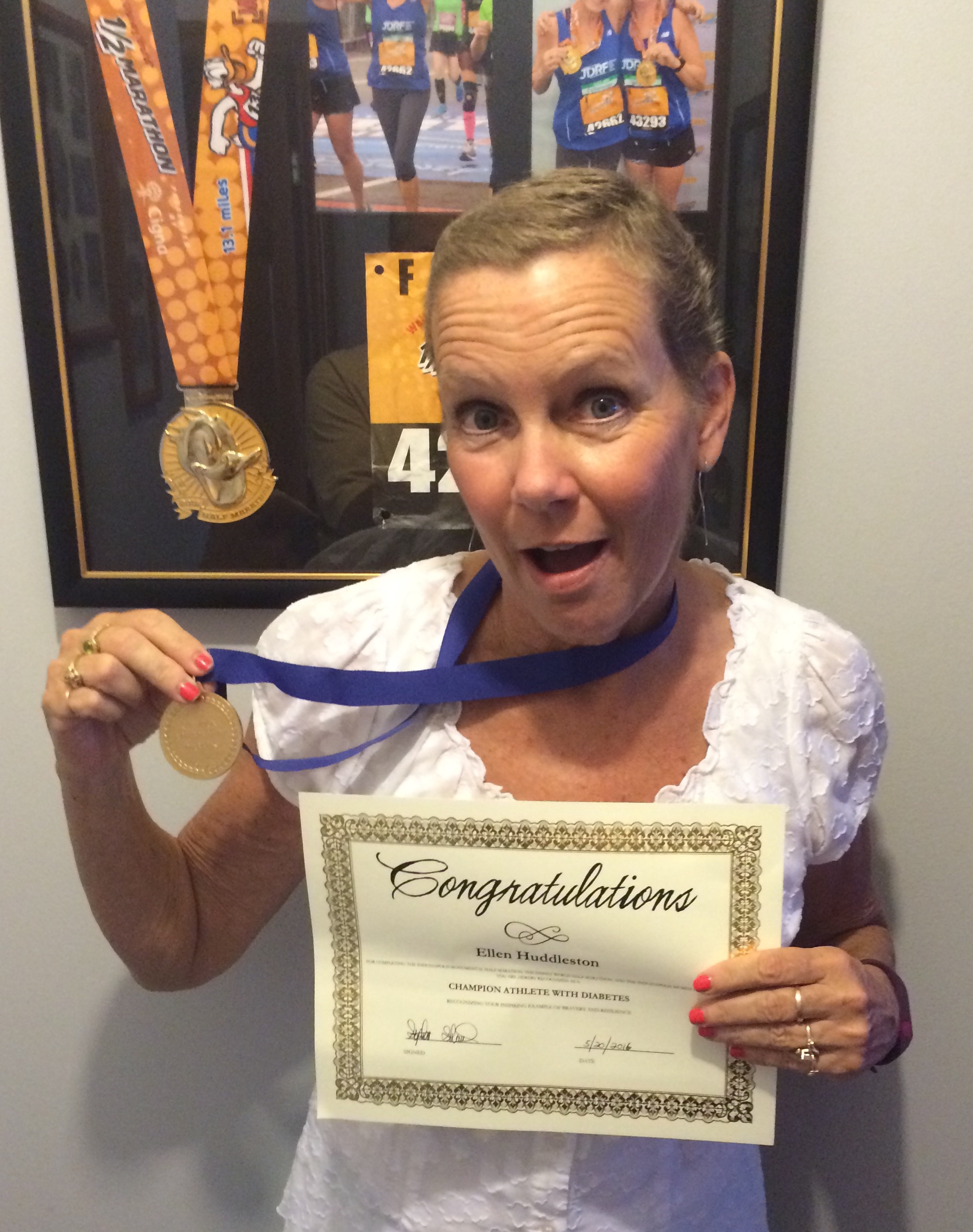
Join the Champion Athletes of 2017.

I was going to start this off by talking about Spring coming up in the USA. But hey, this is the World Wide Web anyway, so I need to fully recognize (recognise?) that Autumn is also on the way.

Regardless, it’s a great time to consider that athletic event you’ve been working toward, or accomplished. Maybe you’ve been committed to a better fitness routine for a while now. Feeling like a Champion? That’s where I’m going with this. Here’s my reminder:

If you, or someone you love, is living with diabetes and working toward or accomplishing an athletic goal, I have a brand spanking new medal for you.

We’ve given over 80 of these away over the past 3+ years, to people in places as close to me as Virginia and Pennsylvania, and places as far away as New Zealand and India.

I am always so happy to read about someone overcoming their fears, gaining confidence, and giving the extra effort to reach that achievement they’ve been working toward. Whether it’s your first run, a milestone bike ride, or literally a mountain you’ve always wanted to climb, your effort should be rewarded.

Here, briefly, are the rules:

1. The athlete receiving the award must be living with diabetes.

2. The athletic event must have taken place in the last six months. For now, we’re going with a pretty loose interpretation of the word “event”. We have medal winners who are runners, ballroom dancers, swimmers, motocross riders, and curlers. If you feel you’ve accomplished something important to you, that’s an event.

3. Send me an e-mail at champswithdiabetes@gmail.com. Tell me your name, name of the athlete (it’s okay if it’s you), and your address (gotta know where to send the medal). Most important, tell me what athletic goal was accomplished, and when. Extra points if you tell me how you felt accomplishing the goal. Full disclosure: I reserve the right to use your testimonial here, on Twitter, and on Facebook. I will not use your name if you don’t want me to. As always, I will never share private information.

4. When you receive your medal, it would be great if you post a photo of it around the athlete’s neck. You can send a Tweet to @ChampsWithD (hashtag: #champdathletes) or post it on the Champion Athletes With Diabetes Facebook Page.

If you meet the above criteria, you qualify for a medal.

So… as you consider signing up for that event this year… as you consider getting those 10,000 steps in every day, or hopping on the bike in the evening, think about what it means. Think about how your efforts are making a difference for you and your loved ones. Consider how great it feels to get a hard won victory over diabetes.

Then go out and make history. Be a Champion Athlete With Diabetes.

Your medal is waiting.

2017 JDRF #TypeOneNation #DC Summit.

I have to admit… when I headed to my fifth JDRF Research Summit in Bethesda, Maryland on Saturday, I just didn’t know if it was going to be worth it. Would I see or hear anything new or different? And how, after writing about it for four years in a row… how in the world would I find a way to write about it again? I mean, I couldn’t even think of an interesting headline to write this time.

But this JDRF event was different. There were several moments that were different from the other four years of this gathering. The TypeOneNation summit has grown up, in more ways than one. It has evolved somewhat. Let me share:

Our day began with several breakout sessions, where kids, teens, and adults went to separate rooms and discussed things that are important to them. Our adult T1D group included a panel comprised of medical professionals, a lawyer, an expert in exercise and living with diabetes, and JDRF’s VP of Advocacy and Policy. It was a full hour-long question and answer session on all of these subjects. Maybe it was familiarity, or maybe it was because it’s been on my mind a lot, but I asked the first question, and for fifteen minutes or so, we had a lively advocacy discussion. Eventually, we did cover all the subjects mentioned above.

But the really interesting thing to me was that there were, by my count, 40 to 50 adults in the room. A year ago, our adult breakout group was maybe 15 to 20. Two years earlier, I think I met one or two adults with diabetes the entire day. In my humble opinion, JDRF still has a long way to go in engaging adults in ways that will help both them and the organization, but there’s no question– JDRF is growing up. Compared to last year’s summit and the year before? Big, positive difference.

Once we were all gathered in the big room for the day, Aaron Kowalski got into where JDRF is on a number of research initiatives that it funds. Aaron is as good as anyone at giving people a comprehensive rundown on the status of artificial pancreas research, who has skin in the game, and where each group is in terms of product and potential approval. I know there were some returnees in attendance, and for those who were only beginning to hear about artificial pancreas a few years ago, Aaron’s talk was a great update.

Continuing on the research front, Dr. Juan Dominguez-Bendala from Diabetes Research Institute in Miami was able to fill us in on where they are with stem cell therapy development. It was very detailed, so I can’t really give it justice here. To be honest, I’m not really jazzed about this kind of research, because I can’t quite see where it will be practical for a long, long time. But what I did like about Dr. Dominguez-Bendala’s presentation was his willingness to address the limitations of stem cell therapy, including ViaCyte, that exist today. I think that helped me recognize that while there’s a lot left to do, DRI has come an awfully long way since they began this kind of research.

And for the first time, the psychosocial impact of living with Type 1 Diabetes was discussed. This presentation was made by three pediatric psychologists, so the discussion was entirely kid-based. There was no patient perspective provided, and though I don’t know how they would have worked that out, I think it would have been great. Also, there were definitely questions from adults looking for resources to help them too. I made sure I followed up with those people individually to let them know about the Diabetes UnConference (Hello Doris and Jenny!).

Finally, it was Brian Herrick with a light, and at times, funny presentation about 25 years of living with Type 1, and his experiences going through artificial pancreas clinical trials, which was a great way to wrap up. After another Q&A session with all of the presenters, the summit was complete, save for an adults-only happy hour at the hotel next door. The main part of the program was over earlier this time, which likely resulted in less glazed over eyes late in the afternoon. Finishing on a lighter note helped everyone feel good as they headed home.

I should also mention that the best part of the day was getting to meet new friends, and spending time with Diabetes UnConference alumni Leyla and Terri.

Leyla is one of the coordinators of the March for Health in Washington, D.C. on April 1st. Time with them was worth the trip in and of itself.

So… while I began my day wondering what would be different, and how I would cover it, as you can see, there was plenty that was noteworthy this time. All in all, a great way to spend a Saturday.

If you are living in the USA, chances are there is a TypeOneNation event near you. To find out more, go to jdrfsummit.org and find out where your free summit will take place.