Tag Archives: diabetes

On the glucagon trail.

We spend a lot of time around here talking about diabetes and keeping our blood glucose levels from getting too high. But we haven’t spent any time, really, talking about the treatment for seriously low blood glucose levels. I’m talking about glucagon.

Today, glucagon as an emergency medication carries the same set of instructions that it has for a long time: A nine step set of procedures (according to Eli Lilly & Co.) that involves using a syringe to inject an inactive ingredient into glucagon, mixing it, and drawing it back into the syringe and injecting it into the hypoglycemic patient.

I guess that sounds a little antiquated, plus a little time-consuming at a time when every second counts. But what can be done about that? Is there anyone out there working on streamlining glucagon delivery?

I met a couple of people back in March who are with a company that is working hard on new ways to make glucagon simpler and easier for anyone who may need it to treat hypoglycemia. Austin, Texas based Xeris Pharmaceuticals is on the front lines in a niche part of the market, working on a couple of projects and getting funding from the National Institutes of Health.

One of those projects is something called the Glucagon Pen (or G-Pen™). Also, they’ve received additional funding recently via a Phase II installment of a Small Business Innovation Research (SBIR) Fast Track grant to advance the company’s room-temperature stable, non-aqueous glucagon formulation for the advancement of a bi-hormonal pump artificial pancreas. You heard that right. Bi-hormonal. Insulin and Glucagon. The total of the grant funding amounts to $1.05 million.

Today I’ll be sharing a brief interview with a company representative, and information on some of their competitors.

I had a chance to ask a few questions of Saretta Ramdial, Manager of Corporate Affairs at Xeris. I had a few more questions besides these, but they are on hold for now. Some things can’t be revealed while research continues.

Stephen: I met part of your company’s team back in March at the Capitol-area JDRF conference. Are you going to a lot of these? Are they all patient-related functions, or are there conferences, etc. featuring healthcare professionals that you’re also going to?

Saretta Ramdial: We attend a number of different types of conferences that range from scientific and technology-focused to patient-advocacy focused events. This year, we’ve participated in the JDRF Type 1 Now conference in Austin, TX (our second year in attendance) and the JDRF Research Summit in Bethesda, MD (where we met you!). We plan to attend the ADA’s Scientific Sessions Conference as well (we had both of our abstracts accepted this year). We also attended the Taking Control of Your Diabetes conference in December 2012 which was held in Austin, TX.

Stephen: Tell me about how Xeris is revolutionizing the idea of glucagon delivery. I understand this includes glucagon that doesn’t require mixing, and can be delivered via a pen?

Saretta Ramdial: Our lead product in development is the Glucagon Pen or G-Pen™ which utilizes our proprietary, room-temperature stable, liquid formulation of glucagon, a rescue drug for hypoglycemia. The current standard of care is a nine-step process which can seem arduous in an emergency rescue situation where the caregiver must assemble and administer an intramuscular injection. From the patient perspective, Xeris’ solution would be more straightforward than and just as effective as the current glucagon kit because of its patient-friendly approach and ease-of-use. The G-Pen™, similar to an EpiPen™, would be a pre-loaded ready-to-use auto-injector device that would cut the administration of glucagon down from nine steps to two (uncapping and pressing the pen against the skin).

The G-Pen™ technology will be applied to a mini-dose glucagon pen (G-Pen Mini™) which can be used for smaller zero-calorie dosing applications for mild to moderate hypoglycemia. This is especially important for people with weight management concerns when it comes to managing the sometimes unpredictable rollercoaster of blood sugar levels.

Stephen: Are you receiving any funding from sources like JDRF, ADA, or other diabetes organizations?

Saretta Ramdial: We receive funding from a number of sources including the National Institutes of Health (NIH), The Helmsley Charitable Trust, and The Emerging Technology Fund through the State of Texas Governor’s Office.

Stephen: Do you have any competition in this space right now? (I’ll be looking this up anyway, but I thought I would ask).

I actually didn’t get an answer to the question, but I was provided with the link to a Closer Look memorandum, from Kelly Close’s Close Concerns. It’s available via the Xeris website:
http://xerispharma.com/2012_06_08_CC_Xeris_Glucagon.pdf

The memo is a detailed five page research sheet that goes into great detail about who is working on glucagon solutions (no pun intented). According to the memo (dated June 8, 2012– used with permission), the Xeris glucagon pen is being designed to be stored at room temperature, with a two year shelf life. So… a G-Pen™ with simple steps, that doesn’t need to be refrigerated. And, the work with organizations that are going to clinical trials very soon with an insulin/glucagon bi-hormonal pump for the Artificial Pancreas.

I looked online for information about the competitors working in this space that were mentioned in the memo. I couldn’t find much online, so the following is partly from the memo and partly from what I found online.

The Competitors:

Arecor: The biggest development I’ve been able to find lately is their collaboration with Eli Lilly to develop the same type of glucagon formulation that Xeris is working on.

Biodel: Again, working on a stable glucagon that will be viable for two years at room temperature. Last September, Biodel was awarded a National Institutes of Health (NIH) grant to develop glucagon for a bi-hormonal AP pump. Last December, the FDA granted orphan drug designation to Biodel’s product. The FDA grants orphan drug designation to help promote development of therapies to treat rare diseases (don’t know how rare diabetes is these days). They may also be eligible for FDA grant funding, certain tax credits, and a seven year grant of exclusivity to their drug should it gain FDA approval. Just last Thursday, Biodel announced plans to apply to the FDA for an Investigational New Drug Application sometime in the next twelve months. If that’s OK’d, they’ll go into clinical trials by the second half of next year, with an eye toward applying for an official New Drug Application with FDA sometime in 2015. In addition to the glucagon, this application should include the injection device too.

Enject: Speaking of injection devices, Enject has a nice demonstration of their pen on their website. And, that’s about all I could find. The Closer Look memo talked about a delivery system that would reduce the steps needed to inject glucagon down to just three, and mentioned that they anticipate filing a New Drug Application with the FDA by the end of this year.

Latitude: In April of 2012, Latitude announced that they had developed the first stable glucagon formulation that was ready to inject. They call it Nano-G. Back then, they were actively seeking well-heeled partners to help them bring their idea to testing, FDA approval, and then to the market.

There was one other firm noted in the memo: PhySci. Formerly known as Marcadia, PhySci was acquired by Roche. Since then, not much to report, and I couldn’t find anything on the web about PhySci or Roche glucagon improvements.

In looking into all this, I found out some things, but not nearly enough. I’ve seen a lot, but I haven’t yet seen the actual thing that everyone is shooting for. Truth: Maureen finds the current delivery of glucagon too scary to ever attempt using it. The idea that glucagon can be stabilized and put into a simple pen so any caregiver can administer is an idea who’s time has more than come.

I’ll be watching, and hoping, that glucagon delivery can become as commonplace as just about any other type of injection. I’m rooting for Xeris, and any other outfit who can make this a reality.


CGM Data… how do you feel about yours?

Let me tell you, reading CGM data is hard sometimes.

I don’t usually wear a continuous glucose monitor (CGM), but I’m wearing one for the next few weeks as part of a clinical trial I’m participating in. Every day, I’m fascinated by the data that I’m getting about how my blood glucose handles the food I eat, the workouts at the gym and work around the house, hot days and cool days.

And I hate to admit it, but occasionally it’s sort of affecting how I feel about things as I watch that CGM graph line go up or down.

Saturday, I was so frustrated because it seemed like no matter what I did, I was still sinking under 70 over and over again. That was after a false high reading I was getting early on (second day of the sensor… probably not fully calibrated yet). On Sunday, it was the opposite: I was low continuously for a couple of hours until I had a late lunch a little before 1:00, but high after that for the rest of the day. Despite how I had carefully checked where my BG was, how much insulin was on board, and how much insulin I needed to get back within range.

I’m not talking monster stress here; I mean, hey, diabetes throws us curve balls all the time… these things happen. I’m merely saying that I get mad occasionally when I carefully analyze what I’m doing to manage everything, and I’m still out of range, and I still have to wait hours before I’m back in a good range again.

I know this: CGMs are a great source of information and a huge help in managing glucose levels overall. I also know this: A couple of times in the last week, I would have rather been blissfully unaware of how my BG was trending for a few hours.

I’m working on becoming more comfortable with knowing my BG trends 24/7. It’s a work in progress.

What about you? Are you a CGM user? If so, do you let what it’s showing you affect how you feel about your diabetes? Do you have any tips for dealing with that?


The inevitable downslope.

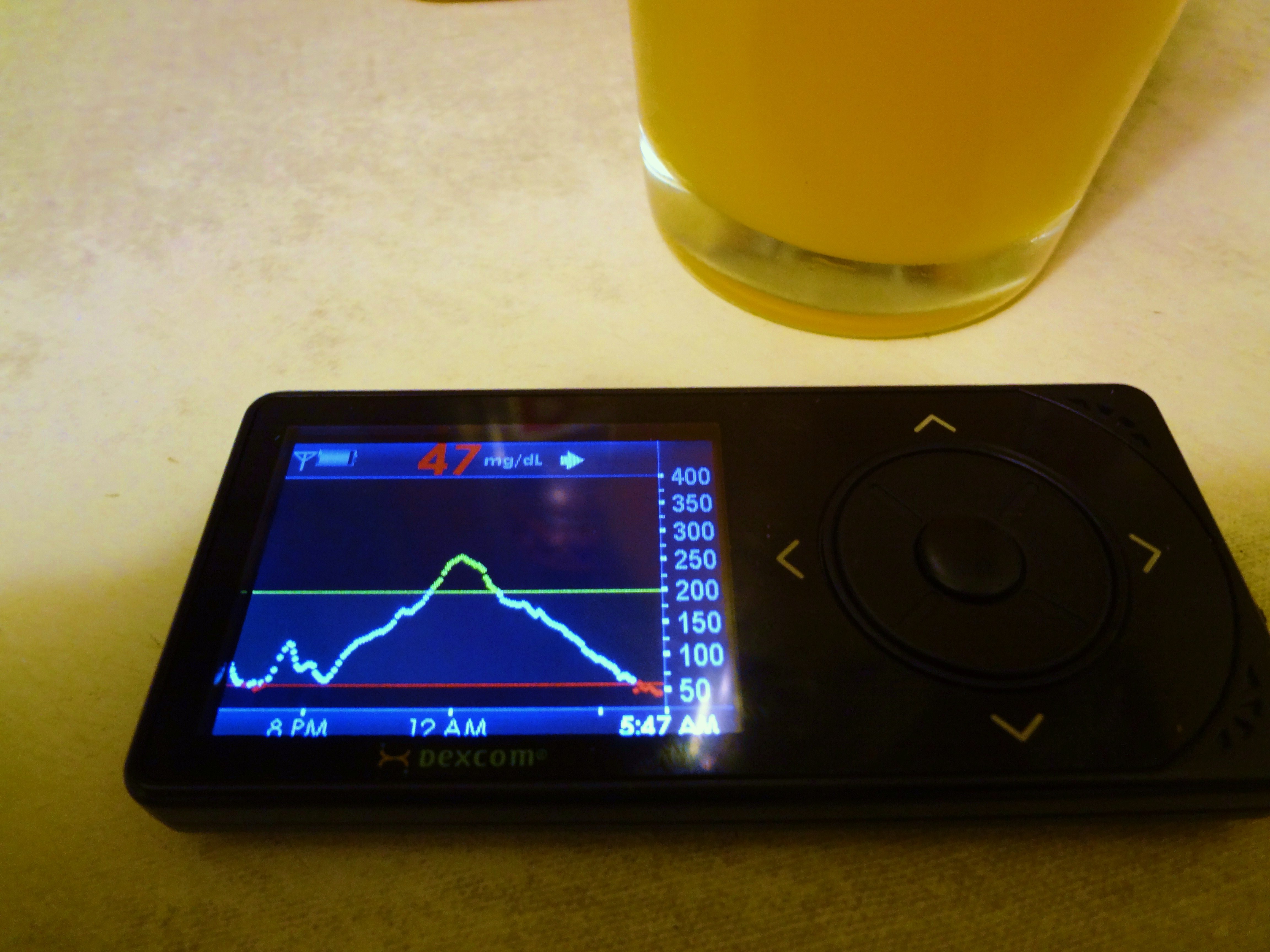
DSC00849

This is why changing infusion sites in the evening worries me a little.

I changed sites last night around 8:30… Great. I was primed and ready for the #DSMA Twitter chat. About halfway through the chat, The Great Spousal Unit brought me a small bowl of strawberry ice cream with fresh strawberries on top. There were more strawberries than ice cream, but when they’re fresh, I don’t mind at all. Now, where was I? Oh yes… the infusion site change.

So often after site changes, I’ll have a… What do you call it? A phenomenon? An anomaly? An unexplainable variance in The Force? It seems as though the site isn’t working at all for a while, which is why I got a high alarm around 11:30 while I was fast asleep. I’ve been through this kind of thing before, so I knew better than to do a correction bolus at that time. And my BG just kept on climbing, up into the neighborhood of 250 mg/dL at around midnight.

From that point on, however, I started dropping. Again, this is without a correction bolus. Certainly, the ice cream and strawberries had lost a lot of their oomph by then. But I just kept getting lower and lower until I was awakened by a low alarm at around 5:00 a.m. No big deal, because that’s when I get up for work (if I don’t go to the gym first). But I just don’t understand why, at least half the time I change sites, all of the insulin I’m pumping seems to be worthless until all of a sudden it’s not worthless anymore. And then it makes up for it with a vengeance over the next few hours. I’ve seen others write about this, so I know I’m not a weird statistic. But I don’t have a scientific explanation for it yet.

Just to be sure it was the new site and not the dessert that caused my glucose to skyrocket last night, I may have to try the ice cream and strawberries again this evening. You know, just to be sure.


Sometimes, I just hate getting blood drawn.

Excuse me while I vent a little…

I had to get blood drawn today for the clinical trial I’m participating in. Instead of going all the way down to Virginia to get it done, the team there sent me a lab slip so I could get the work done here. Fine so far, right?

So I go into the local corporate-owned lab processing place (are there any mom and pop lab processing places?) and gave them the lab slip that had been scanned and e-mailed to me. In the office there was me and three lab technicians. That’s where the trouble started.

“This says ‘Virginia’ on it… I don’t know if we can do that here”. Well, yes, you can. You’re a multi-state organization, which is why they chose you to do the work (I live in Maryland, for those who don’t know).

“This doesn’t have your name on it, just your initials… I don’t think we can do this without your name on it.” They’re trying to keep the study participant information as private as possible, I think, and I just let you look at my driver’s license, and by the way, the form says “patient’s initials” where my initials are.

“Okay, we just need your name, date of birth, your phone number, and your address.” Really? Do the words “Patient Privacy” mean anything to you? Actually, that’s only what I was thinking, it’s not what I said. I eventually gave it to them to keep the process-at-a-snail’s-pace moving.

What I said, eventually, was: “Look, I’m not going to come in here out of the blue with a forged lab slip because I like going around and getting poked in the arm all the time. No one would do that.”

Ten minutes later, the blood was drawn and I was on my way. After answering questions like “did we get your date of birth?” (Yes) and “This goes to Johns Hopkins, right?” (No, University of Virginia). Start to finish the process took about 50 minutes. And I was the only patient in the place.

I was a retail manager in a previous life, and I know this is a different setting, but let me put it this way: I never believed in the notion that “The customer is always right”. My feeling was, the customer should never be made to feel that it’s their fault if they’re wrong. If I hand you a piece of paper that doesn’t look like every other piece of paper you receive (even though it does have your company’s logo at the top), let’s work together so I can ease your fears and you can ease mine.

If we had worked together, the whole episode would have taken less time, and you and I probably would have had smiles on our faces at the end of the process. If you even care about that kind of thing. Which, maybe, you don’t.


Hard decisions.

You may have read in the last few months (because I’ve been kind of bragging about it) about a triathlon that’s on my schedule in just a couple of weeks. I’ve completed two triathlons before, both two years ago, and I’ve been excited about the idea to add another one to my list.

But it’s not going to happen. Over the weekend, I made a heartfelt decision to cancel my participation in the event this year.

Making this decision, and writing about it right now, is pretty emotional for me. I’m not a quitter. But I feel like a quitter, and thinking about it that way is particularly galling. I suppose I could just go out there, try my best, and somehow get myself through the event. But finishing like a weakling is not my style. And I think it would take everything I have to finish this time. If I could finish.

In reality, there are a number of reasons why I’m crossing this off my list. Only part of it is that I’m not in the kind of shape I would like to be in to swim, bike, and run over two hours. Part of why I’m not in the best of shape is because of how often I was sick over the first four months of the year. It was May before I could get on a steady schedule that would keep me getting stronger up to this point.

Being busier is a reason too, but not a good one. I’m still getting used to being busier than I have in both my work and personal lives in the last ten years. That’s a good thing for me. Being involved is good. But it also means that I have less time to hit the gym, or the road.

But ultimately, it comes down to the most important factor. When you’re involved in a relationship with someone, and you commit your lives to each other, you’re saying (among other things) that when you really need me, I’m going to be there for you. I got out and rode my bike for over an hour on Saturday morning, then came home to help The Great Spousal Unit clear away debris from two large tree limbs that had fallen in our yard. It smashed a lattice wall we had constructed some years ago, and took out a bench we had sitting there too. The cleanup required us to do about five hours of work in the hot sun before making a trip to the county dump to get rid of the lattice, the bench, and a couple of other things that needed to go.

If I had finished my ride and then run for about an hour, like I had planned, it would have meant that Maureen would have been left clearing away that debris all by herself. Because by the end of that ride and run, I would have been useless for the rest of the day. And the thing is, I’ve been doing that kind of thing to her a lot this Spring. Traveling to conferences and leaving her at home. Letting her do the yard work while I went to the gym. Granted, you’re going to do some of that when you’re busy, and when you’re training for an event that requires more than just a little stretch beforehand. But I knew that it was getting to be too much for her. I also heard her the hundred times when she suggested that I should call off the triathlon this year. Partly that was out of worry for my welfare, I think; and partly that was out of concern that she wasn’t getting enough help (let alone enough attention).

So while there are probably about a dozen reasons for me to call off this event, my spouse of almost twenty years is the one that tipped the scale. If I feel better in a couple of weeks (I gave blood again on Friday morning and Saturday’s work was especially tiring), I may make a last minute decision to participate. But right now, I’ve got to come to grips with being mad as hell at myself today, then get back to my reality tomorrow. Sometimes you do things you don’t want to because it’s right for someone important, and often that someone important isn’t even you.