Tag Archives: diabetes

End of the line. This time.

My clinical trial is over.

Last weekend I made the trip down to Charlottesville to wrap things up. The group of us that participated in the trial sat together in a focus group to talk about our experiences as we went about our daily lives during the length of the study.

Our group was diverse: Different ages, from different parts of the eastern half of the USA, different walks of life. I loved spending the 2 1/2 hours or so hanging out with them and listening to their stories. In other words, a typical D-meetup, if under different circumstances than usual.

One of the things that really struck me was the comments in the group about how we gathered the daily information we entered for each day in the trial. With a couple of exceptions, we all gathered our data the same way. I thought that was interesting in that none of us were told how to gather the data. But because we’re all people with diabetes, we all knew how to get the data the easiest way, and we just had different ways to record it.

We talked a lot about the performance of the web-based application we were using. I can’t really reveal any details about that until the study is published… sorry about that.

The end of the trial also means the end of my use of the Dexcom® G4 continuous glucose monitor. I never thought I would hear myself saying this, but I miss it already. I’m definitely feeling the withdrawal symptoms this week. When my current CGM’s warranty period is over, I’ll be looking at the Dexcom again.

In the end, while I realize that what we accomplished in the trial didn’t move the diabetes needle too far toward a cure, I do realize that it did make a difference. It was truly an honor to participate. I’m happy, especially at this point in my life, to participate in something that might help others like myself. I’m not overstating it when I say that’s a really great feeling. And by the way, I can definitely see myself participating in another clinical trial in the future.

You don’t have to always be involved in something that involves investigational drugs that may or may not be successful. Sometimes you’re testing new technology or therapy; or in my case, taking a website for a spin and seeing how it works for your diabetes self-management. The point is, the opportunity exists for you to help move the needle toward the positive side for everyone living with and affected by diabetes.

Interested in participating in a clinical trial of your own?

The USA’s National Institutes of Health has a complete list of clinical trials taking place all over the USA, and even some outside of my country. To find them, go to www.clinicaltrials.gov and enter “diabetes” into the search box. A recent search found 9,994 studies.

JDRF has a very helpful web page that lists multiple sources for registering and finding out about clinical trials. Just go to www.jdrf.org/research/clinical-trials/ to find out more.

To read more about the University of Virginia’s Center for Diabetes Technology, including staff bios and more on Artificial Pancreas technology, visit the center’s website at www.medicine.virginia.edu/research/institutes-and-programs/cdt/the-center-for-diabetes-technology-at-uva.html


Traces of Diabetes. What it means to me.

DSC00969

I guess all of us see something like this from time to time. Especially if you spend too much time looking down at the ground while you’re walking (subject for another post at another time). I saw this test strip as I was walking on the sidewalk in the neighborhood where I work.

Lots of people have talked about their experiences coming face-to-face with diabetes in the wild. Often it’s something innocuous like this; sometimes it’s a real life meeting with another PWD. Reactions seem to range from the funny to the poignant to the ironic. Let me tell you what it means to me when I see something like this.

Often, when I come across evidence that someone else with my condition is around, I’m almost… shocked. I go through about 98 percent of my life never coming into contact with anyone living with or affected by diabetes. Actually, I’m almost never coming into contact with anyone who wants to reveal those things. So I kind of forget that there are others out there. You would think that with all of the blogs, Twitter feeds, etc. I read, and my own participation in social media, it would be enough to help me remember that there are actual real people going through the same things that I do every day.

But still, when I saw that test strip, it was a big surprise. To me, it wasn’t something exciting as much as it was a slap in the face. Guess what? You’re not the only one, stupid. And no, you haven’t really connected with any PWDs in your part of the world yet.

I’ve tried, but all previous attempts just kind of fizzled. The reasons are many and varied, and in some cases, I’m the one to blame. I’d like to think that my biggest obstacle to connecting in real life with others like me is my schedule, which has been busier in the last two years than it was the previous ten. The truth is, it’s both an obstacle and an excuse. I don’t have a lot of extra time, but I have a little. Maybe that little extra time can be used for some grass roots effort somehow. I don’t know.

What I do know is that I’ve changed a lot in the past couple of years. If I want that change to be even more meaningful, I’m going to have to find a way to do something for others living with and affected by diabetes right here in my own community. I’ve just got to figure out how to make that happen.


#DSMA July Blog Carnival. Test strip accuracy.

Let’s get right to it… One of the most basic things about our diabetes, and July’s DSMA Blog Carnival topic:

Blood glucose. It’s front and center when it comes to diabetes. It is how we get diagnosed and it is what we are trying to manage. An important tool we use to manage our blood glucose is our meter and its strips. But what happens if our meters aren’t giving reliable information? Let’s explore that this month as we discuss a topic from the June 26th chat Fill in the Blank. Weigh in on the following statement:

Test strip accuracy is important to me because______.

The easy answer is: Because our lives depend on it.

The more difficult, but very necessary analysis of what test strip accuracy is even more important, but leads to the same answer.

Let’s face it: Most of us don’t think too much about test strip accuracy once we’ve bought our blood glucose meters. Some of us received our meters from a doctor. Some of us went out and purchased a meter based on quality, or how it looks, or whether it has a function that lights up your test strip so you can check your BG at night without turning on the light. But for most of us, once we have a meter, we don’t stop to think much about the accuracy of the strips that we insert 3 or 4, or 10 or 12 times per day.

But we’re learning that there are reasons to be concerned about the accuracy of our test strips. Even the USA’s Food and Drug Administration, the agency of the government that has to approve all medical devices before they can be marketed or sold here, acknowledged that some test strips are not as accurate today as they were when they were approved for use in the first place. Furthermore, they have no method of removing inaccurate test strips from the market once they’re found to be inaccurate.

How does this happen? That’s the subject for another blog post. Instead, let me ask: How does that make you feel?

Raise your hand if you can live with using test strips that may be off by 50 or 100 points at any given time, based on any number of factors. Raise your hand if you it’s okay with you that heat or cold tolerances, or age, or humidity can skew the numbers on your meter display by enough to cause you to bolus a unit or more different from what you really need. Raise your hand if you’re perfectly fine with the idea that the company that developed the technology for the strips you’re using doesn’t have a plan to test the continuing accuracy of those strips (**Note: Some manufacturers do conduct ongoing tests on strips… many do not, and are not required to do so).

Think about it… millions upon millions of us, living with diabetes. Testing our blood glucose many times per day. Making decisions about diet and exercise and bolus amounts based on the numbers showing on our meters. Why? Because we want to believe that if medical technology has been approved for our use, the accuracy of that technology is above reproach. Do you see now why test strip accuracy is so important? It’s the baseline for countless decisions we make every day.

So without question, test strip accuracy means the world to myself and my loved ones. We want to know that the number on our glucose monitors is correct. Because our lives depend on it.

This post is my July entry in the DSMA Blog Carnival. If you’d like to participate too, you can get all of the information at
http://diabetessocmed.com/2013/july-dsma-blog-carnival-3/


Happy #BlueFridays to you.

Happy Blue Friday!!!

DSC00947

Okay, I totally stole this idea from Alecia over at SurfaceFine, who posted a photo of her blue boots.

It’s Friday, and for me and for everyone living with diabetes, I’m wearing blue today. Back in 2010, Cherise Shockley of Diabetes Community Advocacy Foundation and DSMA Twitter Chat fame decided to ask everyone to wear blue on Friday to show support for people living with and affected by the big D. The idea caught on, and three years later, it’s still going strong. A giant blue wave, if you will. I was a little late to the party, but now I’m one of a zillion people out there sporting the blue and raising awareness. To find out more, click on the photo above to go to the Blue Fridays page at Diabetes Social Media Advocacy, or visit the Blue Fridays page on Facebook.

The Great Spousal Unit bought me these retro sneakers for Christmas last year. When she asked me what color I liked, you better believe I said blue right away.

Is it wrong to look at something in blue and wonder how you’d look wearing it on a Friday? I think not. #MakesSenseIfYouHaveDiabetes

Enjoy your weekend!


Reservoir Recall, and the FDA Gets Tough.

DSC00940

This is an FYI post, in case you haven’t heard about it yet. If you’re a Medtronic pumper, you will hear about it because Medtronic is sending a letter and FAQ sheet to all their pump users.

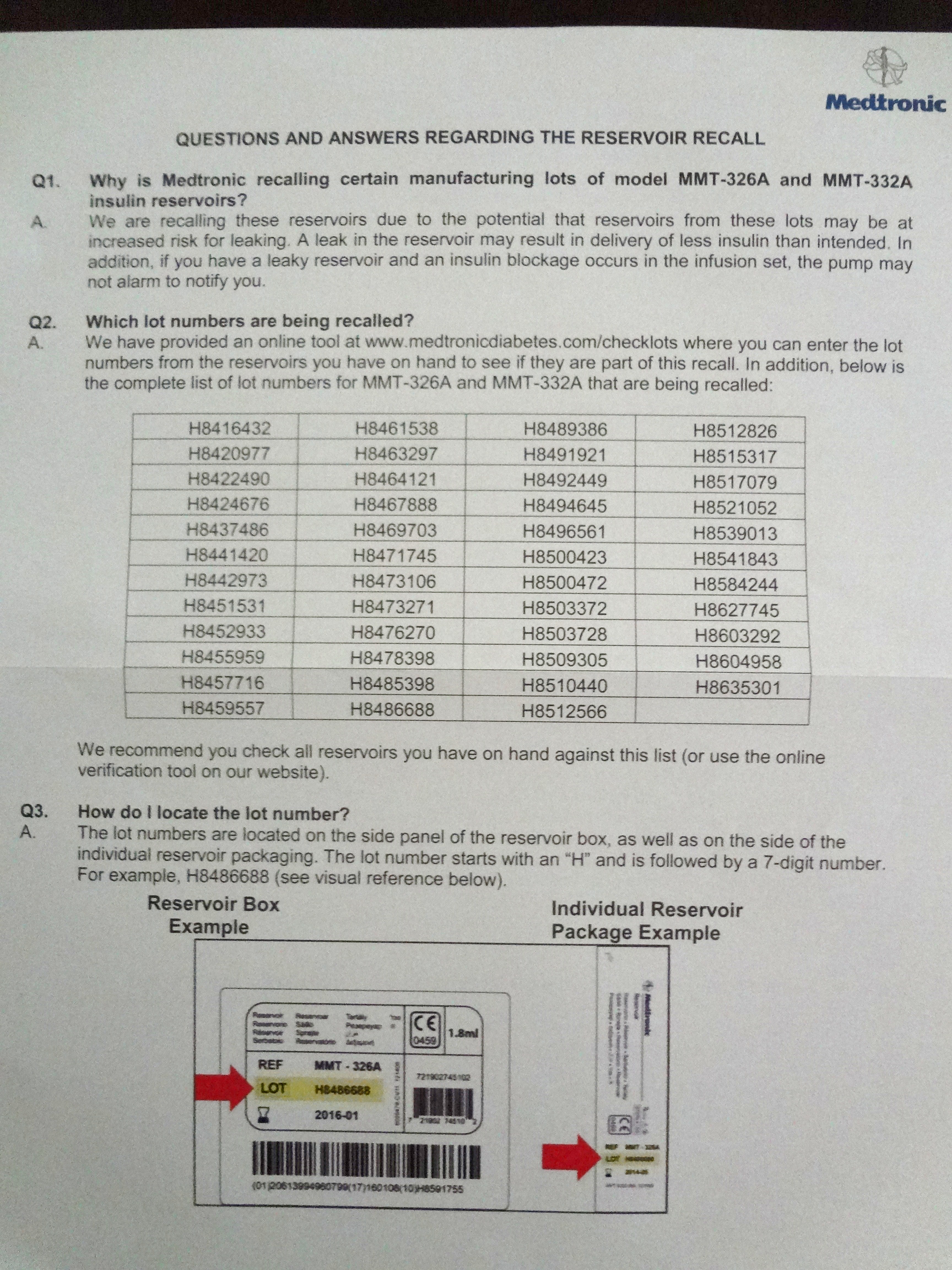
Medtronic Diabetes is voluntarily recalling specific lots of reservoirs for Paradigm insulin pumps. Apparently, the affected reservoirs are at increased risk for leaking. The photo above is part of the FAQ sheet I received that lists the lot numbers that are being recalled.

Now, I know it’s easy to bash a company for making something that is eventually found to be faulty. But I will also give you some facts, according to the recall notice sent to me:

– First of all, this is a voluntary recall. No one made Medtronic recall these reservoirs. I don’t know if there was any kind of communication between them and the FDA, for example, that led to the voluntary recall before a mandatory one. But still, a voluntary recall always happens faster than a mandatory one.

– Medtronic conducted an investigation of the cause of this issue, and found that the reservoirs in question were all manufactured on a specific manufacturing tool that developed “abnormal wear”. They have corrected the issue and put additional testing and inspection in place.

– Med-T has a number to call if you have the recalled reservoirs and need new ones right away: 1-866-450-0890. They will ship the new ones free of charge to you.

Medtronic acknowledges a few cases of diabetic ketoacidosis requiring hospitalization that may have been caused by the faulty reservoirs. I don’t want to belittle these cases, or the patients and their loved ones involved. I also think it would have been nice if I’d have received an e-mail, or a tweet from @MDT_Diabetes. Other than that, what I am saying is that if a product I’m using does need to be recalled, I want the recall to be done like this.
 
 
Also, the FDA has cracked down on companies selling products that claim to help mitigate, treat, or cure diabetes, but as we know, they don’t. This includes “natural” treatments that have undeclared ingredients; dietary supplements that claim to treat, cure, or prevent diabetes; homeopathic over-the-counter meds that claim to help with peripheral neuropathy; and prescription drugs sold by pharmacies without a prescription.

Take a look at these products, and where they’re from. It proves that there are scam artists just about anywhere you go. These products are being pulled from the market by the FDA:

– Diexi by Amrutam Life Care Pvt. Ltd., Surat India.

– Anastasia Diapedic Foot & Leg Treatment by Anastasia Marie Laboratories Inc., Oklahoma City, Okla.

– Exermet GM, Galvus, Nuzide, Triexer and unapproved versions of Januvia, all from
bestcheapmedsonline.com.

– Diaberex by Enhance Nutraceutical.

– Zostrix Diabetic Foot Pain Relief Cream, Zostrix Diabetic Joint & Arthritis Pain Relief Cream and Diabeti-Derm Antifungal Cream, all from Health Care Products, Hi-Tech Pharmacal Co., Amityville, N.Y.

– Sugar Balancer by Health King Enterprises & Balanceuticals Group Inc., Chicago.

– Insupro Forte by INS Bioscience Berhad, HLS International Sdn. Bhd., Easy Pha-max, Selangor Darul Ehsan, Malaysia.

– Diabetic Neuropathy Foot Cream, Diabetic Foot Cream, and Diabetic Hand & Body Cream by The Magni Group, doing business as MagniLife, McKinney, Texas.

– Eradicator by Naturecast Products, Coral Springs, Fla.

– Diabetes Daily Care by Nature’s Health Supply Inc., College Park, Md.

– Glucocil by Neuliven Health, San Diego,Calif.

– Neuragen PN and Neuragen Cream by Origin BioMed Inc., Halifax, Novia Scotia, Canada.

– Nepretin by Nutrient Synergy, Longmont, Colo.

– ProBeta by PharmaTerra Inc., Bellevue, Wash.

For more information, and to stay up-to-date or report on Diabetes drugs or devices, visit FDA MedWatch at www.fda.gov/Safety/MedWatch/default.htm
 
 
Happy Wednesday… Stay safe!