Tag Archives: diabetes

Tuesday is ADA’s Alert Day.

alert-day-2014-banner-728x90

Tuesday marks the American Diabetes Association’s 26th annual Alert Day.

It’s an effort to find as many people as possible who might be at risk for developing Type 2 diabetes. They do that with a simple risk test. Many of us know that 26 million Americans are living with diabetes of one type or another. But did you know there are 79 additional Americans who are at risk of developing diabetes? Alert Day is designed to help people identify if they are at risk, and then encourage them to make healthy choices to help them do what they can to be as healthy as possible.

Part of our job as advocates, I guess, is to help educate people about diabetes, and help them get help when they need it. So… if that’s the case, maybe we should encourage those we love who aren’t living with diabetes to take this test.

One of the best things about that is the fact that Boar’s Head Brand® (the deli products maker) will donate five dollars to the American Diabetes Association (up to $50,000) for every test taken.

The test is available in both English and Spanish. You can find it on the ADA’s website at diabetes.org/risktest, or on Facebook at facebook.com/AmericanDiabetesAssociation.

Knowledge is power. Share this with someone you love today.


Same routine, different location.

I toyed with the idea of headlining this post “Oops, I did it again”, but that just seems cliche now. And a little sad. And who could ever confuse me with Britney Spears? Okay, I’ll just stop now…

Saturday, I did it again: I donated blood.

According to the American Red Cross, “Diabetics who are well controlled on insulin or oral medications are eligible to donate”. When I learned this over a year ago, I was thrilled to know I could again participate in something I consider a civic duty.

This was the first time I had donated blood outside of my work environment, where they usually hold 2 or 3 blood drives every year. Instead, this time, I went to the local Red Cross office, which, thankfully for me, was only about a ten minute drive from home. I arrived early and was greeted by a friendly person who asked me to sign in, then chided me for looking at my donor card to double-check my blood type. “You should always know your blood type. It’s critical information in times of emergency”.

In my defense, I did know my blood type, but I wasn’t 100 percent sure of it until I looked again. For the record, I’m an O Positive. I think that’s kind of rare, because as soon as I’m eligible again, the Red Cross will start calling me, asking me to come back, the vampires. I joke all the time that the only two phone calls I ever get are from my wife and the Red Cross.

Only they don’t look like vampires down there. They’re just ordinary people going about their jobs, complaining about the bad children’s music blaring from the television in the waiting area, comparing nail polish, and talking about their husbands and wives. They make the whole process easy, comfortable, and as painless as possible.

It was about as nice an experience as you can have (sans the bad kiddie music) while having blood drained from your body. I generally don’t have any of the post-donation wooziness that some people experience after giving. But Saturday, I did have one or two moments where I needed to find a chair for a couple of minutes. Too much running around, I guess.

For the record, that makes four blood donations in a little over 13 months. It’s true… I have Type 1 diabetes and I can donate blood. And to quote Martha Stewart (which I thought I’d never do on this blog), that’s a very good thing.

Curious about whether you can donate blood yourself? If you’re in the USA, you can find all the info at redcrossblood.org, or send me an e-mail using the link in the upper-left corner of this page and I’ll tell you what I know.


A window of opportunity is closing.

I really didn’t expect to write about this again, but… This still needs to be talked about. And for various reasons, this may be my last chance to write about it before our window of opportunity closes.

The U.S. Food and Drug Administration is in the process of drafting guidance for manufacturers of blood glucose meters. The guidance will be for future production of both over-the-counter meters (the ones we, as individuals, use), and the ones used in a clinical, point-of-care (i.e., hospital) setting.

As of right now, the FDA has opened up these draft guidance documents for public comment.

In other words, they want our input, and they’re even welcoming it.

But they will only accept our input until April 7. So please… Right now… Do something for me:

Go now to this one page, follow the instructions, take two or three minutes, and add your voice to something that will be extremely meaningful to me for years to come.
 
 
As I publish this post, only 167 comments have been posted on the OTC guidance.

As I publish this post, only 101 comments have been posted on the point-of-care guidance.

Every man, woman, and child in America with an internet connection should be commenting on this guidance.
 
 
Are you living with diabetes? Is someone you care about living with diabetes? Do you work with someone living with diabetes? Do you drive on a roadway with someone living with diabetes? Do you interact ever with someone living with diabetes? Are you starting to understand why this is important and critical and time-sensitive?

Maybe you don’t care about making meters more accurate. Or maybe you do.

If you’re living with diabetes, improving meter accuracy is important to you, and you know it, and you can do something about it.

If someone you care about is living with diabetes (and someone you care about is), improving meter accuracy is important to you, and you know it, and you can do something about it.

If you aren’t affected by diabetes at all, improving meter accuracy is important to you, and you know it, and you can do something about it.

Do something about it.

Go now to this one page, follow the instructions, take two or three minutes, and add your voice to something that will be extremely meaningful to everyone for years to come.

Future lives hang in the balance of blood glucose meter accuracy, and you can help win the day.

Thanks again to Christel Marchand Aprigliano and Bennet Dunlap for opening my eyes on this issue and leading the charge up the Hill of Guidance.
 
 
I now return you to your regularly scheduled day.


Champion Athlete With Diabetes: Couch to 5K, 10K, Tri, and beyond.

Can you believe we’ve handed out nine medals to Champion Athletes With Diabetes?

Inspirational stories have come from everywhere. By telling them, I hope I’m letting you know that you are capable of achieving more than you ever imagined too. Today’s story is exactly that.

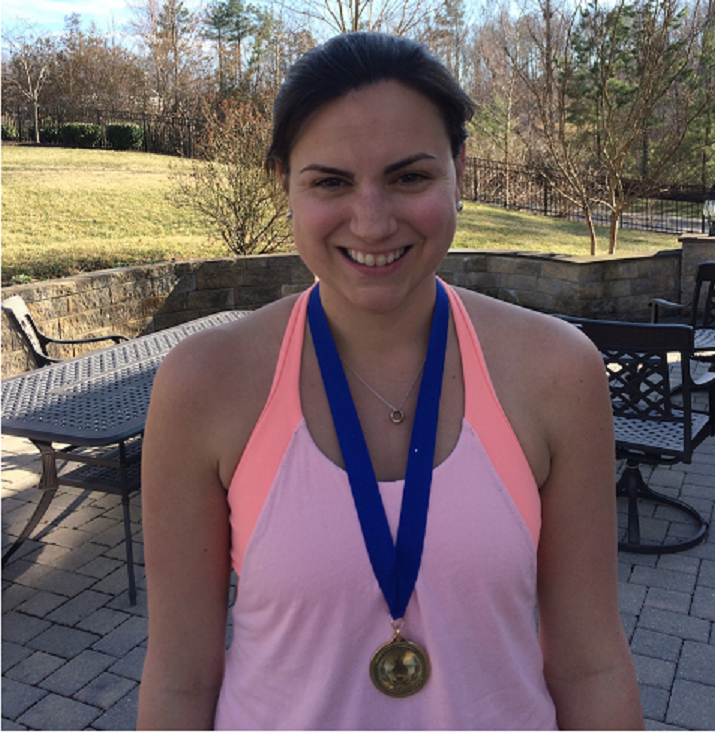
KelleyKentMedal

Kelley Kent lives in the Richmond area with her husband Chris. On her blog, Below-Seven, she describes herself as an accountant by day, blogger by night, an MBA soon to be CPA, and a Type 1 diabetic. For the record, she’s one heck of an athlete. I’ll let Kelley tell the story from here:
 
 
I got married in May 2011. By November 2012, I realized that I had gained thirty pounds and was my heaviest ever. It was a combo of enjoying the first year of marriage and also transitioning from an office job to a job where I work from home-the kitchen became way too close to where I was working! I decided that something needed to change and my sister, who is really into fitness (she’s done half marathons, Olympic triathlons, ragnar races, etc.), suggested I try a Couch to 5k program.

In November of 2012, I started the Couch to 5k program. I’ve always been pretty athletic (playing basketball, softball, flag football, etc. growing up) but I’ve never been in very great shape. The first day of the C25K was rough. I couldn’t even run for one minute! But that’s why the program works so well; it starts off slowly and you build up quickly but not too quickly. I remember texting my sister when I first started that I couldn’t imagine week five where I had to run for five full minutes!

By January (2013), I was running close to a 5k (30 minutes!) and feeling great about my progress. My sister was signing up for the Monument 10k, a race in Richmond in April, and suggested I sign up as well since I had been doing well with the C25k. My husband, who was also doing the C25k with me, and I decided to sign up for the 10k training group and registered for the race. I was scared at first because 6 miles seemed impossible! But April 13th rolled around and I did it! I ran the entire race.

I’m a person very motivated by goals. After the 10k, I didn’t have any races that I was signed up for so my running slacked a little. I was so happy with my new hobby that I didn’t want laziness to take over. So I decided to sign up for an 8k in June, then a 5k in July and then a triathlon in August. The triathlon came about randomly. My sister was competing in an Olympic triathlon in June and I went to cheer her on. I didn’t know much about triathlons at the time but it ended up being a lot of fun to watch. While I was spectating, I thought to myself, I can swim, I can bike, and I have just gotten the running under my belt, I bet I could do a triathlon too! After watching my sister’s race, I decided to sign up for a sprint triathlon. A triathlon is a completely different beast than just running a race. For a triathlon, you have to figure out what to do with your pump during the swim portion; you have to deal with three different activities that all affect your blood sugar different; you have to test your blood sugar during the transitions, causing your transition time to be higher than non-diabetics. I was able to figure out and overcome those obstacles and I had a lot of fun while doing it! I’m debating doing another one this year (maybe even an Olympic).

Feeling pretty confident after completing the triathlon, I decided to get a little crazier and I signed up for a half marathon in November. Then I went one step further and signed up for another half marathon in January. I started running in November 2012 and one year later, I completed a half marathon. It’s pretty remarkable what the human body and mind can accomplish. I NEVER thought I would run a half marathon in my life! Somehow I have transformed into thinking a 5k is a short run! I started running because I wanted to shed a few pounds and I lost about 25 pounds (close to my 30 pound gain!) In addition to the weight loss, running included an even better benefit, getting my A1C below seven, a goal I have been working towards for years! Running is now a part of my life and something I hope to do for the rest of my life.
 
 
I think the interesting thing about Kelley’s story is that here she was, living her life, diabetes in hand, and she just woke up one day and said “I want to do this”. And she made it happen.

Maybe you’re feeling like you’ll never be the kind of athlete that Kelley is. So what? I won’t either. What’s important is to get moving, and to persevere through whatever might try to stop you. Despite all the things that could have gone wrong, Kelley handled it all in a way that was surprising even to her. You know what? Even if surprising to you is walking around the block every day for a week, I’m know you’re capable of the same kind of determination.

That’s what makes these stories so inspirational, and so worthy of recognition by all of us. Not the actual accomplishments. It’s the strength that comes from knowing we turned fear and loathing into courage and fortitude. That’s where champions are made.

Are you achieving athletic goals while living with Type 1, Type 2, or another flavor of diabetes? Send me your story, and I’ll send you a medal just like Kelley’s. Click here to find out how to get yours.


Looks can be deceiving.

I had a wierd high and a strange low in the past four days. Neither fit the stereotypical low or high.
 
 
Thursday night at about 3:00 a.m., I found myself with a very dry throat and an overwhelming urge to use the bathroom. When I came back, I did a quick BG test to find a 53 mg/dL staring me in the face. Not a common occurrence.
 
 
Sunday, the tables were turned. I had completed a hard hour-plus workout at the gym. I spent extra time to recover and drink lots of water to rehydrate my muscles. Apparently, it wasn’t enough, because when I got back into my truck, a quick test revealed 260 mg/dL as the result. Probably too low of a temp basal during the workout, and I was still dehydrated.
 
 
Moral of the story: Things are not always what they may seem. And test, test, test.