Tag Archives: bg

I’m number 1! No, really… I was #1

In short, I was the first person at the check-in table for the 65-mile ride at the Tour de Talbot, which benefits both the Midshore Riverkeeper Conservancy and JDRF.

So they gave me number 1. And since I was wearing a yellow jersey (I always try to wear bright colors when I’m on the road), I became the subject of about 20 Tour de France-type jokes on the course:

“Number 1 and the yellow jersey? No pressure there!”

[While I’m being passed] “Yellow jersey, huh? And number 1 too? Where’s your team to defend you?”

Yeah, yeah, ha, ha, that was funny the first twenty times. Those kind of comments were understandable, but not fun. However, an interesting set of circumstances had me changing my mind.

At the first rest stop on my ride, I briefly saw John Anderson from Sanofi Team Type 1 (He’s actually part of Team Type 2). He lives in Annapolis, about an hour’s drive from the start. He did the 100 mile ride Saturday. While taking a photo of the volunteer table at the stop, I caught John as he was getting back on his bike.
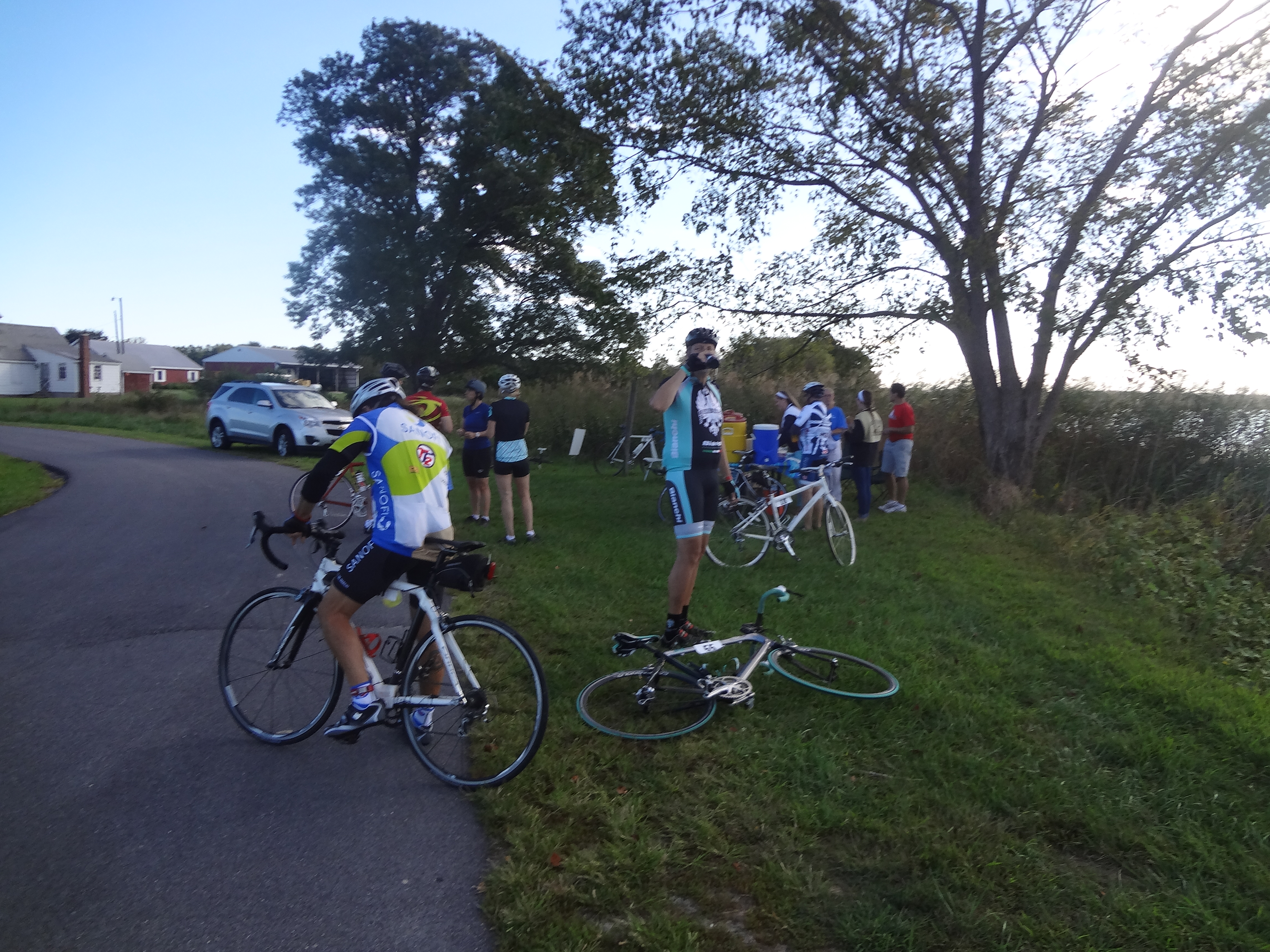
I didn’t want to bother him as he was getting ready to take off, so I just went about my business and didn’t think about it again. I figured that was the only time I would see him all day.

Then at the next rest stop, I had a quick break, ate a granola bar, and got ready to go again. But I realized that I hadn’t checked my BG yet, so I pulled my meter out of my bag to check. I did a quick turn to my right as I checked, and who was there? John Anderson.

“Yeah, gotta check those numbers. How ya doin’?”
“I’m a little lower than I’d like, but I just ate, so I think I’ll be okay.”

We had the normal D-conversation… “Are you on insulin, or pills?”. “Pump? What make?” (we’re both using the Medtronic Revel). “CGM?” (he’s a big proponent of using the CGM, I’m not… especially the Med-T). I asked if I could get a quick photo, since I didn’t get one earlier:

Then I thanked him, shook his hand, and went to put my meter away and get on the bike to finish the last third of the ride.

When I started off, I noticed someone else was getting started again to my right, and when I looked over, it was John. We rode together for about a mile, talking about exercise… I mentioned my blog… and he told me a story about being in a run in Baltimore a few years back. And because he’s usually at or near the front of the alphabet in these events, he received number 1 for the run. “It made me feel good; I thought it was kinda cool. Everybody notices you when you’re wearing number 1”.

That lifted my spirits for the rest of the ride.

So what was the ride like? Well, it was a measure of redemption after the 100 mile ride I was a part of in June. I got advice from other riders and from my doctors in the interim, and my nutrition and overall preparation was a lot better than it was for the last ride.

I did not finish number one on this ride, but that wasn’t the point. In fact, this was the most laid-back event I’ve been a part of in some time. There was no official start/finish line. There was someone who gave a brief announcement at the start, but that person didn’t even say “Okay, Go”, or blow a horn, or anything. He stopped talking, all of the riders looked at each other, and then we just started. When we all finished, we just stopped, next to where we parked our cars in the lot of the country club where the ride originated. That was it.

But it was a nice ride, through some beautiful country near Easton, Maryland. There was a cold front that came in a couple of hours before the ride started, and that resulted in some strong headwinds through most of the first 40 miles or so. After that, it was great. Temperature at the start: 60 degrees, with 10-20 mile per hour winds. At the end, it was around 70 and the wind had died down a lot. This time, especially at the end, I stopped trying so hard and started enjoying the ride and the view from the saddle.

Time to finish: About four hours, not counting the time at the two rest stops.
Blood Glucose at the start: 158 mg/dL
BG at 1st rest stop: 91 mg/dL
BG at 2nd rest stop: 81 mg/dL
BG at the finish: 66 mg/dL (treated with juice and another granola bar, then lunch)

And best of all: I felt great after! Priceless.


The Accu Chek Nano.

This isn’t quite a product review. The reason why is at the bottom of this post. But I wanted to touch on something I think about every time I change meters or almost anything else.

At my last visit with my endocrinologist, I mentioned that my meter is kind of old and asked if she could recommend a new one. Fortunately, my insurance doesn’t severely limit my choices meter-wise (or strip-wise, which is what they’re really doing). Well, it turned out she had an extra Accu-Chek Nano meter she could let me have, and I gladly accepted.

Obviously, accuracy is of utmost importance in any glucose meter. And the Nano is promoted as 23% more accurate. Actually, that’s not exactly what they’re saying. The meter isn’t supposed to be more accurate, the strips are. In fact, Roche (maker of the Nano) states that their SmartView test strips have been tested against a 23% tighter specification. That’s great, but I’m not sure how stringent the 23 percent lesser specification was. And in the long run, it doesn’t matter. As long as it’s consistently in the ballpark.

Here’s what I mean: my first reading of the Nano side-by-side with my old Contour meter was an exact match.

And then I proceeded to test side by side with the Contour over the course of about 3 1/2 weeks. While the readings were close most of the time, the photo above was the only match between the two. But how do I really know which one was more accurate? I kept the Contour for a lot longer than I should have because I was happy with its consistency. And that’s what I want from a new meter.

Honestly, three months after you start using a meter, you’re probably not thinking about accuracy anymore. At that point, what’s on the meter is just the new normal, whatever it says. Now, I know that we don’t want big inaccuracies in our meters. But as long as it’s consistently close to where my BG is at, that’s what matters for me.

I have to admit to really liking the back light feature on this meter. Makes it easy to read wherever you are. Also, I like that the reading stays on the screen for an extra second or so after I pull out the test strip. I can’t tell you how many times, out of habit, I’ve pulled a strip from a meter and proceeded to forget the reading almost immediately. And I’ve liked how small it is… fit in my pocket pretty easily.

That’s about as much as I have on the Accu-Check Nano right now. Unfortunately, even though it fit into my pocket easily, it also slipped out easily while on the train home about a week ago. Never even knew I lost it until the train pulled away at my stop. So I’ve gotta go back to the old standby while I troll Amazon and eBay for a deal on a new one.

Here’s hoping your new normal doesn’t involve getting two new meters in six weeks.


Public Diabetes.

I went to New York on Saturday to hang out with The Great Spousal Unit’s brother and his family. I’ve made no secret of that fact that up until about a year ago, I never took my meter out in public. In addition, I never really wanted to show my pump in public either. I always had it under a big shirt. And I was very careful to kind of turn away from everyone (even if it was friends or family) when I used the pump to bolus or adjust my basal.

It’s not that I really care about anyone seeing me. Anybody who has a problem with it can just shove it, you know? But I don’t want anyone to get sick once they see the sight of blood on my finger. And I’ve certainly noticed how freaked out people get sometimes when they see me using my pump, like I have some sort of really scary problem. Well, it is a scary problem. But that doesn’t make me scary, does it? Anyway, I don’t want anyone to be afraid of me. And I don’t want anyone to look at me with pity. Those kind of things make me feel bad… like it could be avoided if I just hide it away for a while. So until now, I’ve either left the meter at home, or left it on the bus. While I was away, or at least while I was in Manhattan, I was guessing about basals and boluses.

But I’ve been reading posts in the past year or so from many in the DOC who show that testing, set changes, pump adjustments in public are no big deal. It’s just part of what you do. Those posts were powerful, empowering examples for me. I started to realize that at some point, my health and my care had to become a priority. And damn the consequences. So this time, I put my meter in my pocket and used it all day.

I used it at lunch (142 mg/DL). And then about 45 minutes before I got on the bus to go home, I stopped in a small place to grab a sandwich and some iced tea. After walking around all day (that’s what you do in New York) in the 95 degree heat, I was feeling pretty crappy. I wasn’t moving well, and I was thirsty, my mouth was dry. I was certain I was still high. So much so, that I almost didn’t even check. But then I thought: no, I have to know… coming down from 150 requires a different strategy than coming down from 250 or more.

So I pulled out the meter, and right in front of about 35 people, I checked: 52 mg/DL

If I had just bolused based on a guess, how long before I would have gone hypo? What would that have looked like? How would I feel about myself the day after?

I’ll name it: I overcame fear Saturday. Ridiculous, stupid, ego-based fear. Stupid, dumb, vain things that I’ve been feeling and keeping deep inside for a long time. Saturday, it could have affected me in a very bad way.

Don’t be me. Make your health and your care the top priority. Today. Right now. And who knows? Maybe your initiative could serve as an example to someone who’s still hiding their diabetes from the rest of the world.


Random Glucose.

I finally got out my brand new Accu-Chek Nano this past weekend. I’ll talk more about it after I’ve used it a bit. And I’m sure that hundreds of others have already reviewed this product. Anyway, I wanted to try it side by side with my old reliable Contour meter for a few days, so that’s what I’m doing. Each test on a different finger, different hand. And guess what the first reading looked like:

Dinner went down really well after this.


Diabetes, Exercise, Nutrition, and Getting Older.

So now I’ve finished two events this year: a 100 mile bike ride in early June, and a recently completed 5k run. There are a few thoughts I’d like to get down while they’re fresh in my mind. Things that are different between this year and just a few years ago.

First, the good news. My diabetes has been managed fairly well this year. Notice I didn’t say that I managed my diabetes well. It’s really been a wonderful team effort. The Great Spousal Unit has been both supportive and insightful. Asking the right questions at the right time, and not letting me get away with those half-hearted “I’m okay” answers when I’m really not. A D conversation with her can be difficult, but I always feel better after.

If I can take any credit here, it’s for bringing my endocrinologist in on my training and efforts to continue competing. She’s the reason I was finally able to train and compete while wearing my pump. The results haven’t always been spectacular (see here), but it wasn’t the diabetes that caused my problems.

Second: I need to re-learn nutrition. I’m ashamed at the absolute lack of knowledge I have about nutrition at this point in my life. About what kind of foods will serve me well in training and competition. Granted, I could stand to lose a few pounds. But first, I have to get smart about what I’m putting into my body all the time. Not just on race day. I haven’t seen a dietician since I was diagnosed 21 years ago. That was in the days of diabetic food exchanges. It worked like this: Inject the same amount of insulin every day. Eat the same amount of protein, carbs, veg, dairy, and fat every day. Hope for the same BG result every day. Hey kids– my diet needs an upgrade. Version 2.0. ASAP.

Third: I’m getting older. And yes, it sucks. In just the last year I’ve had to come to grips with the fact that my body can’t recover as fast as it once did. Where I used to be able to work out day after day, now I need a day (or two) to recover after a hard workout. Now, I find myself asking: When will just finishing be enough? When do I cross over from being a competitor to being a participant? I want to be competitor. I need to be a competitor, for as long as possible.

Well, I don’t have all the answers yet. Who does? But I believe in the notion that the real honor is in trying. In the effort. Despite age. Despite diabetes. Champions are made not by overcoming every obstacle, but in recognizing that they’re there and trying anyway.