#FFLFC16: A Weekend Well Spent.

Over the weekend, I was able to attend another gathering where People With Diabetes were able to learn, share, and enjoy the company of one another.

From the team that brings you the Friends for Life conference in Orlando each July, the Falls Church, Virginia version was a welcome weekend spent with a different group than I’m used to hanging out with.

But that’s good, because I like families, I like kids, and I definitely like meeting new people. Over the course of two and a half days, I was also able to get back up to speed on the latest in Artificial Pancreas research from two groups, get firsthand accounts of the amazing development of the Nightscout system, and I was able to take in (and speak with attendees) about advocacy issues including Medicare CGM coverage, our relationship with FDA, #SuspendBidding, and more.

This event was pretty well attended, and the location couldn’t be better. From a purely personal perspective (and this has nothing to do with the content of the conference), the buffet meals were really good. Lots of options, including gluten free, and carb counts on everything.

The content of the sessions, as you might expect, varied depending on whether they were for adults, kids, or parents. The adult sessions included Dr. Korey Hood from Stanford covering diabetes burnout; a guide to applying the glycemic index to what you eat by Gary Scheiner; nearly a full day on diabetes advocacy from the super team of Christel Marchand Aprigliano and Bennet Dunlap; and finding support through social media with Kerri Sparling.

There was also an exhibit space that featured every U.S. pump maker except Medtronic, Roche (and their latest Accu-Chek meter—I’m interested), the Diabetes Patient Advocacy Coalition (with laptops people could use to e-mail their elected officials in Congress and the Senate!), and both the American Diabetes Association and JDRF.

A couple of tidbits from the weekend: we were told that this was the first Children With Diabetes conference that featured more adult attendees with diabetes than kids or families. And, it looks like Jeff Hitchcock and Laura Billetdeaux are looking at options to come back to the Capitol area for another conference very soon. Which I think would be fantastic. It was three years between events in the D.C. area, and that’s too long to wait.

The Great Spousal Unit likes to say that after a diabetes event, I come home more energized, and walking on air for a considerable time afterward. Since she made the trip with me this time, I think she now knows why. I hope she does. Because no matter how often I gather with people who walk the same path I do, it still means a great deal to me to be together with them in the same space.

Thanks to all of the staff and volunteers at Friends for Life Falls Church for being so welcoming, helpful, and informative. And in case you were wondering, I was not given anything to say that. It comes straight from the heart.

 

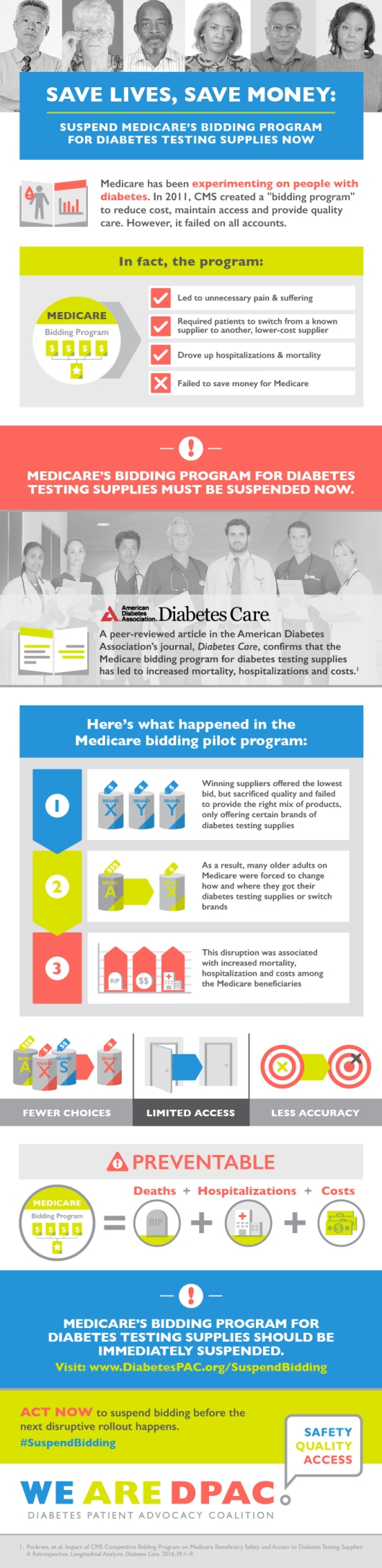
#SuspendBidding

I’m not going to sugar-coat this for you, even though this is a diabetes blog.

We’re at the point where this is untenable.

For the past five years, the Centers for Medicare and Medicaid Services (CMS) has been conducting a grand experiment, opening up competitive bidding on a wide range of necessities for People With Diabetes who have Medicare as their primary healthcare partner (hint: that’s 11 million U.S. citizens over the age of 65). They have been told as far back as three years ago by nurses, educators, and patients themselves that competitive bidding endangers the lives of senior citizens with diabetes, but they keep ignoring the warnings.

There’s a new publication in Diabetes Care, the peer-review journal of the American Diabetes Association, that shows that competitive bidding is an abject failure at all levels.

Wait… why is competitive bidding bad, you may ask? Isn’t it better if we get the best price for the products we need?

Let’s answer the second question first, and the first question second: It is imperative for seniors living with diabetes to pay the lowest price possible for the healthcare, devices, and drugs that will help them live the best they can through their golden years. To answer the first question, yes, competitive bidding is very bad, and there is proof it is bad, and that proof is being ignored by CMS, and that must stop.

Let me give you a simple example: I use a BG meter made by Ajax Corporation (not a real BG meter maker—remember, this is an example). It works pretty well, pretty accurate, and I’m nearly out of test strips for my existing meter. But now, Ajax lost out on the latest round of competitive bidding, and I now have to use a meter made by Acme Corporation. That means, as a senior on Medicare, I have to go get a prescription for the new meter, find the new meter and test strips, pay for them, and learn how to use the new meter. Immediately.

What do you think the chances are that 11 million people are going to be able to do that easily?

Let’s face it: they aren’t.

Which means some of them won’t, which means some of them won’t be checking their BGs, which means some of them will wind up in the hospital or a skilled nursing facility with hypoglycemia (low blood sugar) or hyperglycemia (high blood sugar), where a best-case scenario is a stay of days in the facility, costing Medicare thousands, maybe hundreds of thousands, more than the continued cost of strips for a meter the patient was comfortable with in the first place. All because of the competitive bidding process.

And that’s only one example. Pissed off yet?

Good. Here’s what you can do: Use the Easy button.
ActNow_Web_Btn_3.23-01
CLICK HERE NOW and go to the Diabetes Patient Advocacy Coalition to help add your voice to the growing #suspendbidding chorus demanding an end to competitive bidding until CMS is called to answer for this destructive practice before a congressional hearing.

I promise you, it will take less than1 minute for you to let your House representative and both your Senators know that the CMS competitive bidding process is dangerous and deadly.

CLICK HERE NOW. I will be Medicare eligible in 11 years. Let’s end this process before I’m eligible in 10.

If you have any questions, please let me know by using the E-mail Stephen link in the upper left corner of this page.

Living with diabetes or not, we… I… don’t want your help with this. I need it.

CLICK HERE NOW.
dpac_infographic_4-1
 

Diabetes By The Numbers: Daniele Hargenrader.

Daniele Hargenrader is one of the hardest working people I know of in the diabetes community. Both on a personal and a professional level.

She’s a nutritionist, a health coach, a certified professional trainer. She’s an international speaker, and an author too.

Today, Daniele talks about the things that motivated her to lose weight, get fit, and rock her diabetes. She talks about why nutrition is focus number 1. She talks about her book, Unleash Your Inner Diabetes Dominator: How to Use Your Powers of Choice, Self-Love, and Community to Completely Change Your Relationship With Diabetes for the Better. And she talks about her latest project.

Seriously, I don’t know how she does it all, but she does it well.
DBTN

Reference Material – Click below for more information on this topic

Daniele Hargenrader writes blog posts, hosts video chats, teaches online courses, and more through her website:
diabetesdominator.com

Daniele mentions using MyFitnessPal to log her food choices:
myfitnesspal.com

Want to pick up Daniele’s fantastic book? You can find it on Amazon right here:
Daniele’s Book– Unleash Your Inner Diabetes Dominator

(nearly) Wordless Wednesday: World Health Day/Diabetes.

Did you know that Thursday, April 7 is World Health Day? World Health Day is the one day each year where the World Health Organization encourages everyone to try to stem the tide on a worldwide health crisis. Guess where the World Health Day focus is this year?

That’s right… it’s diabetes.

Let’s face it: with the rise in the numbers of those diagnosed and the many who remain undiagnosed, making diabetes a focus just makes sense. And I’m completely supportive of the World Health Organization’s efforts to take this on this year. To find out more about WHO’s World Health Day efforts, including some infographics and posters, CLICK HERE.

And how about this? How about, on Thursday, April 7, we do the Blue Fridays thing a day early and wear blue to recognize and support those living with and affected by diabetes? I’m in if you are…
 
 
Recently, the folks at Amino, a relatively new company, asked me (and a couple of others) for some feedback on what living with diabetes is really like. They took our input, added some facts, and came up with a spiffy infographic of their own. Any of the blog names at the bottom look familiar?

From their website:
“Amino aims to connect everyone to the best health care possible. Powered by a comprehensive database that includes nearly every practicing doctor in America and experiences from more than 188 million patients, Amino’s service empowers people to make confident decisions about their health care, starting with the doctors they choose.”

Special thanks to Amino for reaching out. Full disclosure: I was not compensated in any way by Amino for providing my input or sharing it here.
Amino_WHD_diabetes
 

Old School vs. New School

Fact: I’m not a spring chicken anymore. I’ll be 54 in about two weeks. So you’d think I’d be someone who rejects everything new, clinging to my old habits and my old way of life (pun intended) as long as I possibly can.

If you think that, you’re wrong.

Okay, well, you’re not entirely wrong. I drive a thirteen year old truck (still in great shape), I cling to every last dollar like it’s my last dollar, and I’m not much of a Coldplay fan. But I recognize that Old School definitely loses out to New School when it comes to my diabetes.

Sure, I hung onto my previous insulin pump for nearly six years before getting a new one. But I did get a new one, and it seems to be working fine. I like the new color too (blue). And although I’ve been using the same meter for a few years now, in my opinion, it’s the best for me, so I’ll continue to use it as long as I can afford the strips. Which may not be very long. However, if something better for me comes along, I have no problem choosing that one and leaving my Accu-Chek Nano behind.

I’m always surprised when I come across people at a gathering where they are so excited for the future of technology, but almost in the next breath tell me that they can’t quite bring themselves to consider a new CGM, or a new meter, or even updated, free technology that’s available out there on the interwebz.

The truth is, innovation is only good if we actually put it to use. If we see something out there that might work for us, might help us manage our diabetes better, why not consider it? Where would I be if I hadn’t started on an insulin pump six years ago? Where would I be if I hadn’t learned more about counting carbs and sugar surfing?

The caveat to all this is, of course, that not everything new works for everyone living with diabetes. New things might mean more options; they don’t necessarily mean new requirements. But sometimes new is helpful. Researchers are finding new successes in typically Type 2 medications being used by Type 1s. They’re also finding success when they see some Type 2s start on insulin sooner.

Looking back, it seems like each decade brings different options for dealing with our diabetes. And that’s always good, even if I don’t always adopt every new option right away. Even though I’m a little Old school, I know that thinking New school and looking for the latest in technology and ideas will always benefit me and my diabetes.