Category Archives: Healthcare

PPACA Survives intact.

Healthcare advocates throughout my country were thrilled yesterday when the U.S. Supreme Court upheld the part of the Patient Protection and Affordable Care Act (“Obamacare”) that allowed for subsidies to help patients pay for healthcare insurance obtained through insurance exchanges nationwide.

Had the justices overturned that part of the legislation, something akin to chaos in the insurance marketplace could have ensued, owing to the fact that many who can barely afford coverage with the subsidy probably would have dropped their coverage and risked prosecution for not being covered at all. It might have meant that many who are relatively healthy but still couldn’t afford the coverage without a subsidy would drop their coverage, which would have put insurers in a tough spot, with too many chronic and acute issues to pay for, and not enough money coming in from healthy patients to make up the difference.

The vote of the nine-justice panel was 6 to 3. Chief Justice John Roberts wrote the majority opinion, once again surprising many who thought he was the perfect neo-conservative to lead the highest court in the land when President Bush appointed him to the post a decade ago. His remarks included this little nugget:

”Congress passed the Affordable Care Act to improve health insurance markets, not to destroy them.”
 
 
Imagine that… he goes against nearly every republican in America, using one of their biggest rallying cries to do it: Free Market Capitalism!

The dissenting opinion, given from the bench by Justice Antonin Scalia, smacked of sour grapes, though I guess every dissenting opinion does to some degree. At one point, he got laughter from the courtroom for saying “We really should start calling this law SCOTUS-care”. He also referred to the majority opinion as “interpretive jiggery-pokery”.

Well, I’m just a high school graduate, so I never learned from books that contained such eloquent terms as “jiggery-pokery”, but I really hope that Justice Scalia, or Justice Alito, or Justice Thomas, who also sided with the minority, never have to experience moments where they have to choose between paying for healthcare for themselves or a loved one, and paying the rent. Republican members of the U.S. Congress, for their part, are still vowing to repeal this important legislation. They’ve already tried repealing all or parts of it 67 times.

I will also point out that a day later, our fair republic still stands, and still stands for the right to healthcare for everyone.

If we’re not for that, what are we saying? Really… if you’re against my right to affordable healthcare, are you saying that, although my diagnosis of Type 1 Diabetes is not my fault, I don’t deserve to be able to afford to pay for care, drugs, and devices? Are you saying I should “work harder”, “get another job”, “do whatever it takes”, or adhere to some other catchphrase out of the conservative handbook?

Well, let me quote from another one of your favorite books, the holy bible.
Matthew, chapter 25, verses 44 through 46:

“Then they themselves also will answer, ‘Lord, when did we see You hungry, or thirsty, or a stranger, or naked, or sick, or in prison, and did not take care of You?’ “Then He will answer them, ‘Truly I say to you, to the extent that you did not do it to one of the least of these, you did not do it to Me.’
These will go away into eternal punishment, but the righteous into eternal life.”


Again, I am thrilled at the result of yesterday’s ruling. I do recognize that the law isn’t perfect, but had the challenge to the law been upheld, it would have been even less so.

Now, as I mentioned on Facebook yesterday, we can… continue to defend this law against all manner of attacks. Hopefully, yesterday’s decision makes defending it easier.

In other news: The Supreme Court just handed down another ruling, legalizing gay marriage nationwide. It’s been a busy week, Justices. Take the rest of the summer off.
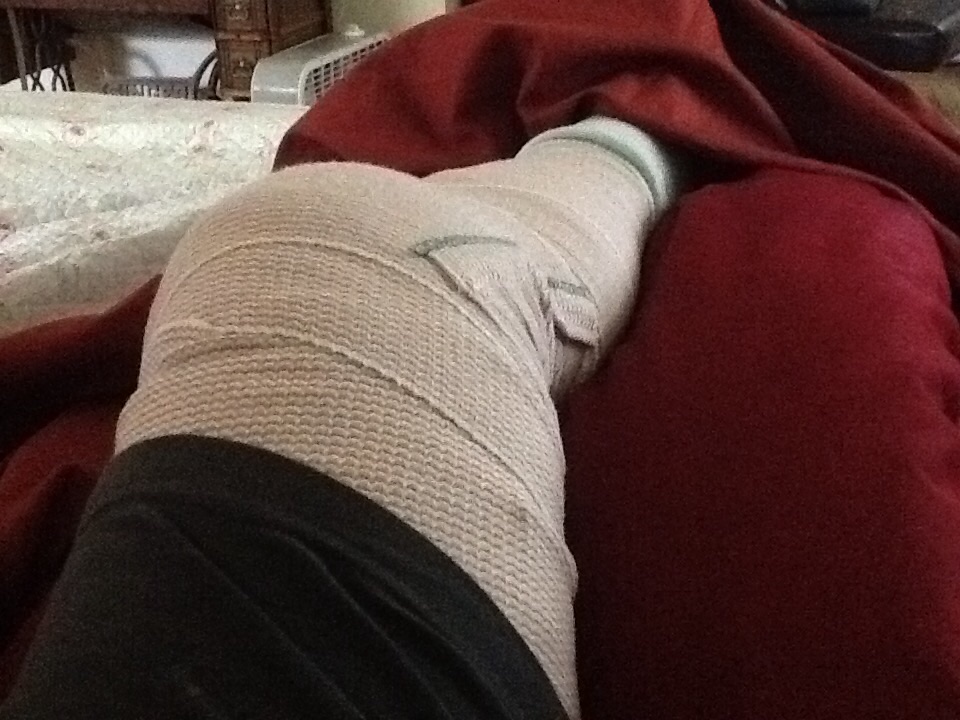


Post-op.

My arthroscopic knee surgery is complete. I’ve got a few more days of slowly getting used to using it again, and another couple of months of geting it stronger and back to normal.
image

I have to admit to having had a little fear over being put under for the operation. It had been nearly 50 years since the last time I was under general anesthesia (1966– I was four years old– can you believe it?). But it was relatively simple. One minute I was awake, and the next I woke up in recovery. And fortunately, no nausea like a few people had warned me about.

The thing I was most proud of was the fact that I fought for, and won, the right to keep my insulin pump on through everything. In coordination with my endocrinologist, we agreed to do a fifteen percent reduction in my basal rate after midnight. The surgery took place around 9:30 a.m.

I got my endocrinologist to write an okay for me to keep everything running during surgery, and she also included all my basal settings, insulin-to-carb ratio and correction factor numbers, and sent it to the orthopedist. In addition, I gave the staff detailed instructions I wrote up (photos included) on suspending and restarting my pump, and disconnecting my pump, should that have been necessary. They probably thought I was nuts, but better to leave nothing to chance while you’re unconscious.

I should also mention that I spent some time cleaning up my pump the night before, since I knew I was going into a sterile environment. That wasn’t a requirement, but I thought it would be a respectful thing to do.

We did glucose checks before and after (the procedure was only half an hour start to finish). I was 181 mg/dL pre-op, even though I had been fasting since about 10:30 the night before (hello, nerves). I was 151 mg/dL post-op.

I was told I had a significant tear of my interior meniscus, and that got fixed. The doctor also told me I had some arthritis in my knee, and he cleaned that out. I don’t know much about arthritis, so I don’t know if that makes sense.

At any rate, like I said, I’ve got to work on getting steady on my feet enough to get back to work on Monday. After that, I need to get everything stronger little by little, every day. In a couple of months, I hope to get back to riding my bike and swimming some (as a workout, as opposed to just soaking).

Now that it’s over, I’m eager to get this chapter behind me as soon as possible, and get back to feeling good, and being as healthy as possible.

A lot of zeros.

Like many, I’ve seen and heard the recent NPR story:
Why is insulin so expensive in the U.S.?

The story is based on research from Dr. Jeremy Greene from The Johns Hopkins University in Baltimore (still trying to get an interview), where he is a professor of medicine and history of medicine. He did some research on the history and cost of insulin, and published his findings in The New England Journal of Medicine.

The truth is, we all know insulin is very expensive here. And we all have our own opinions on why we think insulin is expensive here (where are the generics?). After reading a few of these stories this week (because diabetes stories with an impact aren’t reported for months, then the same story is reported by everyone in a few days), and then reading comments below each piece, I started to become overwhelmed.

Partly, it was because of the numerous “facts” presented by commenters; and partly, it was because of the fact that I felt the really difficult questions haven’t been asked or answered on this yet. Regardless, I started to feel information overload coming on.

For me, when that happens, I usually try to pull back and simplify the subject at hand. I may not solve the problem this way, but it gives me a good starting point. So that’s what I did. I did some initial research into market share for the three big companies selling insulin in the States. I also researched how much insulin costs me, about how much I use on a monthly and yearly basis, and then I extrapolated that (which is fancy talk for multiplied) by the number of people taking insulin in the USA. I wanted to be conservative in my calculations.

This is not scientific… this is just designed to take a typical Type 1 customer (me), and consider the cost of the life-giving medication that I need every day. How much are me and my D-peeps, and our insurance providers, shelling out for insulin?

According to Dr. Greene’s research paper, there are currently 6,000,000 patients taking insulin in the United States.

I looked at the cost of insulin from my prescription provider for Lantus, Apidra, Novolog, Levemir, and Humalog. According to my prescription plan, the cost of a 100 unit insulin vial (my cost plus my employer’s cost) breaks down as follows:

Lantus (made by Sanofi-Aventis): $250.01
Apidra (also made by Sanofi): $204.56
Novolog (made by Novo Nordisk): $204.65
Levemir (also made by Novo): $250.01
Humalog (made by Eli Lilly & Co.): $204.01

Humalog is not my insulin of choice, but it’s the cheapest in the list, so let’s go with that as a benchmark. In fact, let’s just round that number down to $200.00 to make the math easier. And to make it even easier, let’s say that I use one 100 unit vial of insulin every month. At that rate:

$200.00 per month X 12 months per year = $2,400.00

Now, let’s go a bit further (but not too much), and multiply again:

$2,400 per year X 6,000,000 insulin users in the USA = $14,400,000,000

That’s a lot of zeros, people. And this is just the United States we’re talking about. In fact, research from 2013 suggested a worldwide insulin market of $21 billion dollars in that year alone. And we know that there aren’t any fewer people living with diabetes in this country, or around the world today.

But still, let’s take that conservative $14.4 billion number and break it down by market share across these three companies. Again, there is no way this is science, but it should give us some sort of ballpark estimate of the amount of gross revenue that Sanofi, Lilly, and Novo are generating. The only data I could find on market share goes back to 2011, and is contained HERE. Since that is all I have, that is what I’m going with. Again, I’m just ballparking here. I’m not trying to arrive at the actual-to-the-dollar accounting involved, because how could I? Here we go:

In 2011, Sanofi-Aventis had a 37% value share of the market. Of our $14.4 billion, that would be:
$5,328,000,000

In 2011, Novo Nordisk also had a 37% value share of the market. Of our $14.4 billion, that would be:
$5,328,000,000

In 2011, Eli Lilly had a 26% value share of the market. Of our $14.4 billion, that would be:
$3,744,000,000

Let’s be honest here, and recognize it takes lots of research and development, plus a lot of clinical trial testing, plus building out production of the drug, providing documentation to patients and doctors, and a lot of other things to bring a new insulin to market. What would that cost, exactly? A billion dollars? Two billion? If it cost three billion dollars for Lilly to bring Humalog, my lowest costing insulin to market, they almost certainly would have made a profit on their investment in one year alone. In this country alone.

You know, we still haven’t solved the “Why are there no generic insulins?” question. But really… why would there be? If you’re a director of one of these drug makers, or a shareholder, and you, or someone you love, doesn’t live with diabetes; or you can afford insulin regardless of the cost; why would you not want to fight tooth and nail to keep low cost alternatives out of the hands of patients?

This is where I like to remind people that making a profit is good… until it starts to affect someone’s well-being in a negative way. Then this practice must be stopped. Just like patients should trump proprietary, patients should also trump profit. Believe me… there is still plenty of money to be made.

Guess what? It costs a lot of money to buy insulin to stay alive too. I think… I hope… we can find a—dare I say it—Happy Medium here. I’ll be okay with drug companies making money on insulin, if they’ll be okay with me affording said insulin so I can stay alive. For a long time to come.


How are you feeling?

So… How are you feeling?

Hopefully, you haven’t had to go through the awful cold bug that’s been going around the USA. I got to experience that around Christmas and New Year’s. Lots of gunk in my chest, off and on nausea, and it took a little over two weeks to feel right again.

Now that I’m on the mend, I’m back to getting active. Mostly, that means time on my spin bike upstairs. I’ve been trying to get into better shape by simply electing to do more than I was doing the previous three months or so, and be more consistent about it. No big predictions about what I’ll look like in six months, no lofty goals about competing in the Iron Man triathlon in Hawaii (although, in reality, I’ve never dreamed that high).
Workout Room with Large Mirrors
Right now, it’s all about doing what I can do to feel better. Looking better will hopefully come later. Oh, there are athletic events on my radar… there always are. But at this point, I just want to be able to string together a few months of regular workouts without getting sick or having something else happen that will give me an easy excuse to give up.

My record-setting days are probably behind me now. Heck, even my personal record-setting days are probably behind me now. But I’m not dead yet. Far from it. Now I’m concentrating on feeling good, being healthier, and when I do participate in an athletic event, having fun. There ain’t nothing wrong with that. Especially if I’m able to make more efficient use of the insulin that squeezes from the pump attached to my waist each day.

Meanwhile, I’m making extra-sure that I cough into my elbow, dress in layers this time of year, and use plenty of hand sanitizer (but not before I perform a BG check).

What about you? How are you feeling? Have any personal goals this year, athletic or otherwise? Let’s talk.


It’s all intertwined.

I’ve been feeling a little off the past few days. Physically off. It’s not an “I feel like crap” feeling. More like, “I’m definitely not one hundred percent”.

But when I get this way, I can’t help but think about the autoimmune origins of my Type 1 diabetes. Having an autoimmune disease makes you more susceptible to other ailments.

I had a tooth problem a couple of weeks ago. There was an infection, and I needed to take an antibiotic prior to getting a root canal last week. And now that the infection is at bay, and I don’t have the root of the tooth left (which means I shouldn’t experience any more pain there), I feel kinda lousy this week.

Which makes me ask certain questions:

Since I already live with Type 1 diabetes, is my immune system compromised to the degree that I’m more likely to experience these kinds of issues back to back?

Do I have to worry that each time I take an antibiotic I’ll be less likely to be helped by it? Will that be compromised by my faulty immune system?

Will all of this get worse as I get older?

If that’s true, how do I mitigate the effects of, well, getting older?

It’s that last question that really gets me going. I don’t like being sick… I’m not a good patient (except for the diabetes, and it’s taken me nearly 24 years to get there). If I’m going to feel better in the future, I’ll need to become more knowledgeable about everything having to do with my health.

For now, my diabetes numbers are looking pretty good through all of this. I have to do what I need to do to feel better, and then learn more about my diabetes, my overall health, and how they go together. We never stop learning. I hope.