Category Archives: Events

UnConference Scholarships: This is your last chance to apply.

Here’s your final reminder: Applications for scholarship opportunities to attend the Diabetes UnConference can be submitted through today.
 
 
Christel Marchand Aprigliano of ThePerfectD dreamed up this conference where diabetes peers of all types, from all over, will get together and actually set the agenda in the first hour of the conference. Actual adults living with diabetes will be asking and answering questions all throughout the weekend. There will be tons of information gathering, support, and encouragement from Friday, March 13 through Sunday, March 15 of next year. I don’t know if anything like this has been done before, and I’m pretty excited about it.
 
 
The best part is, you (yes, you) have an opportunity to get a scholarship that will pay for your travel and accommodations at the Flamingo Las Vegas, and pay for your registration to the conference too. There are scholarships for Type 1, Type 2, a Medicare recipient, and room scholarships that will pay for your hotel only. The application process is simple, quick, and easy. Have you been wanting to attend a diabetes event but haven’t had the space in your budget to fit it in? Here’s your chance… but only if you get your application in today. Click on this link and get started:
http://diabetesunconference.com/scholarships-for-the-diabetes-unconference-2015/
 
 
Scholarships were made available through sponsors of the event and The Diabetes Collective, Inc., a Florida not-for-profit corporation. I have no affiliation with the sponsors or The Diabetes Collective, Inc., and I am not being compensated in any way for talking about this here. I just want you to be able to be there next March!
 
 
If you’d really like to attend a diabetes conference by People With Diabetes, for People With Diabetes, this just might be for you. Find out more about the Diabetes UnConference and register by going to:
diabetesunconference.com



#MasterLab: Advocacy and Movement.

MasterLab

I was fortunate enough to attend the Diabetes Advocates MasterLab in Orlando last week. I was there thanks to a scholarship provided by Diabetes Hands Foundation. My thanks to everyone who made this event possible, and made it possible for me to attend.
 
 
This MasterLab thing… it was great, it really fired me up to do more with my advocacy, and it even boosted my morale.

Now what? And by extension, you may be thinking, “What do you want me to do?”.

For me, advocacy is a very personal thing. I think it should be for you too.

My only advice: Don’t let the word handcuff you.

I try to think of advocacy with a little a, rather than a big A. I don’t give the word too much influence over me. Earlier in my life, I was intimidated by the word. That intimidation caused me to do nothing at all, which doesn’t help anyone.

But not any longer. Not because I suddenly got braver. No… now I try to concentrate on the things I’m capable of focusing on. If my efforts need to start small, then grow later, okay. I simply try to do what I can, when the need arises. If that eventually turns into full-fledged Advocacy with a capital A, then great. If not, I’ll find something else to get involved in. Not everything is a roaring success.

But… some things are. I not only want to be a part of those successes. I want to help make them happen sooner.

Here’s how you can take a tangible step toward joining a movement, all from the comfort of your own electronic device:

Go to the Diabetes Action Hub now. Take the Diabetes Advocacy Survey (you’ll complete it in less than 5 minutes). Add your information to the database. Help build a strong group of supporters that will be part of a movement, allowing us all to help make our cause bigger and stronger. Then check out the rest of the Diabetes Action Hub to find out how you can help right now. And don’t forget to visit often for updates and calls to action on issues that mean the most to us.

Do you know what has happened to me over the past two and a half years? I’ve gotten involved from time to time in efforts designed to help people. I haven’t always had the time to throw myself fully into whatever need arose, but often I was able to do at least something. What that means is that unlike two and a half years ago, I am actually doing something.

There is a difference between advocacy and a movement. Advocacy is being in someone’s corner… I’ve got your back. I’ll stand up for you, whether or not you can stand up for yourself.

A movement is when many people take tangible steps that have a positive impact for others. Those tangible steps are often small steps. But in big enough numbers, they can move mountains. One big effort by one person is significant. Many small efforts toward the same goal create a movement that no one can ignore.

We need more advocates. No question about it. We need more agitators and litigators and innovators. If that’s you, please step forward. I’ll stand with you and support you.

But I think what we’re missing is a movement. A movement that comes from an army of people that numbers in the hundreds of millions worldwide, who are living with and affected by diabetes. An army of people who are willing to say “I can’t do everything, but I can do something, just let me know”. An army of people who are just trying to do what they can, when the need arises. Because life, and the quality of life, hangs in the balance.

Things have improved tremendously for People With Diabetes in the past few decades. But we’re still an underfunded, misunderstood, red-headed stepchild of a condition. Whether you think five people calling your congressperson is a movement, or whether you think 500,000 people marching on the capitol is the correct definition of a movement, the fact is we need both you and me to be able to reach those numbers. We need you and we need me and we need your family and we need the people at your local coffee house and we need the Congress and the Senate and the President of the United States and if need be, the Supreme Court to get on the steamroller that’s just starting up right now. I look forward to the day when we’re no longer talking about starting a movement, but rather talking about the movement we started.

Are you with me? Take the Diabetes Advocacy Survey now.


#MasterLab: What I learned, and what I experienced. (part 2)

MasterLab

I was fortunate enough to attend the Diabetes Advocates MasterLab in Orlando last week. I was there thanks to a scholarship provided by Diabetes Hands Foundation. My thanks to everyone who made this event possible, and made it possible for me to attend.
 
 
Wow, there was a lot in yesterday’s post. And that only covered half the day! Today, I’ll cover the afternoon presentations at MasterLab.

A lot of what I got out of the afternoon talks is how great we do when we all work together on something important. And how much we miss out when we don’t. I also picked up a lot of important information. Let’s begin:
 
 
The afternoon started with Kelly Close and Adam Brown from DiaTribe, the PWDs source for detailed information on a variety of topics that touch our lives. Kelly and Adam gave us a lot of that detailed information, including why it’s so important to not only have a good A1c, but why it’s important that your good A1c includes a lot of time spent with your BGs in a good range. Did you know that an A1c under 7 percent sometimes means that the patient could have wildly different BG numbers over the time span that that A1c covers? Just look at these examples:

A1cSlide

Obviously, we don’t want to have a BG trend that goes up and down a lot. So when people get excited about advocating for better devices, drugs, and therapies, we need to keep in mind the importance of making sure those devices, drugs, and therapies help keep us in range for longer, safer periods of time than they do today.

They also shared this with us… check it out (you may have to zoom the picture to see everything):
Common

Yes, Type 1s and Type 2s have a lot in common. Including the fact that Type 1s can benefit from typically Type 2 medications like Metformin. And Type 2s can benefit from typically Type 1 medications like insulin. That’s not just opinion anymore. That’s a fact. When I saw that part of the presentation, it caused me to really think hard about my long-held feelings of never wanting to consider Metformin or Victoza. Time for a new point of view, Stephen.

Kelly and Adam shared a wealth of information in a short amount of time. Again, I encourage you to check out the presentation slides and the videos (once they’re posted at diabetesadvocates.org/masterlab) to get a look at their talk. I promise you it will be well worth your time.
 
 
I met Manny Hernandez earlier in the day, and when I did, he mentioned that he thought I would get a lot out of the talk by Rebecca Wilkes Killion, patient representative and voting member with the U.S. Food and Drug Administration’s Endocrinologic and Metabolic Drugs Advisory Committee.

He was right.

Rebecca, a Type 1 herself, has been sitting on panels that review new and existing drugs since 1999. She lends the very important patient voice to what is being discussed. Knowing that not all of us live close to Washington, D.C., she offered five pointers on making an impact and getting the attention of decision makers wherever we are:

1. Membership has its privileges– We didn’t ask for a diabetes diagnosis. Don’t be afraid to share your story, be vocal when the moment calls for it, and hold people accountable for their actions or inactions when it comes to your diabetes.

2. Stand in your own truth– Be authentic. She mentioned interacting with the media: If your story is real and authentic, they’ll pick up on that. I think of this as using the term “staying within yourself”. Don’t try to be who you’re not. Your story is compelling just as it is. Just tell it honestly.

3. Cut to the chase– We often think of this as developing an “elevator speech”. If you were on an elevator with someone for less than thirty seconds, how would you tell your story before you reached your destination? Brevity works.

4. Visual aids– Data, photos, anything that would help people grasp your message right away can be extremely important in making sure that your input is considered in the decision-making process.

5. Own your space– “As a diabetes advocate, you have a position that is hard fought”. You know who you are, and what you live with every day. Don’t let someone back you off your spot. No one knows more about your diabetes than you do.
 
 
After that, the fabulous Kerri Sparling talked about mobilizing the Diabetes Community. As an example, she shared with us the amazing success of the Spare A Rose, Save A Child campaign. How’s this for a visual aid?

SARinfographic

Over 1,000 tweets? $27,000-plus raised? Children’s lives were saved. How big is that? Whether you know it or not, if you tweeted, blogged, donated, or made cookies to help get donations, you are a diabetes advocate. Kerri’s plea, and mine too: Keep being a diabetes advocate.

Finally, we were joined by David Lee Strasberg, son of the great Lee Strasberg, and creative director and CEO of The Lee Strasberg Theatre and Film Institute. Another Person With Diabetes. David talked to us about how to get that big grant, how to raise money for your walk team, or how to get your congressman to sign on to an important piece of legislation. When we need something, how do we go about getting it? David says there are four keys to the perfect ask:

1. Relationship: It begins with acknowledgement of the other person and the issue at hand, and includes sharing a story that helps connect you with the person you’re asking.

2. A vision: Simple enough, right? Be sure to state your vision clearly. Not in a “mission statement” kind of way. More like, “I want people with diabetes to have access to keep their CGMs when they turn 65” kind of vision. Make it clear what you intend to do with what you get from the person you’re asking.

3. Opportunity: Look for the right opportunity to ask and be ready to seize it when it appears.

4. Make a clear ask: Don’t be vague about what you want. Be sure that the person you’re asking knows without a doubt what you need them to do.

After David’s talk, we broke off into small groups and practiced The Art of the Ask. I gave my pitch, and you know what I got wrong? That last one. I thought I had it all down, and it turned out that when I was finished, people liked my idea but weren’t clear about what I really wanted them to do. Oh well… Now I know what I have to work on.

All of this that I’ve described, plus what I described yesterday, really only scratches the surface of an extraordinary day spent learning all parts of the diabetes advocacy landscape. I don’t know if this experience will make me a better advocate. But I know I’m a smarter advocate. And I know I’m going to try hard to be a better advocate in the future.

Tomorrow, a little more about the experience and some of the people I met at MasterLab.


#MasterLab: What I learned, and what I experienced.

MasterLab

I was fortunate enough to attend the Diabetes Advocates MasterLab in Orlando last week. I was there thanks to a scholarship provided by Diabetes Hands Foundation. My thanks to everyone who made this event possible, and made it possible for me to attend.

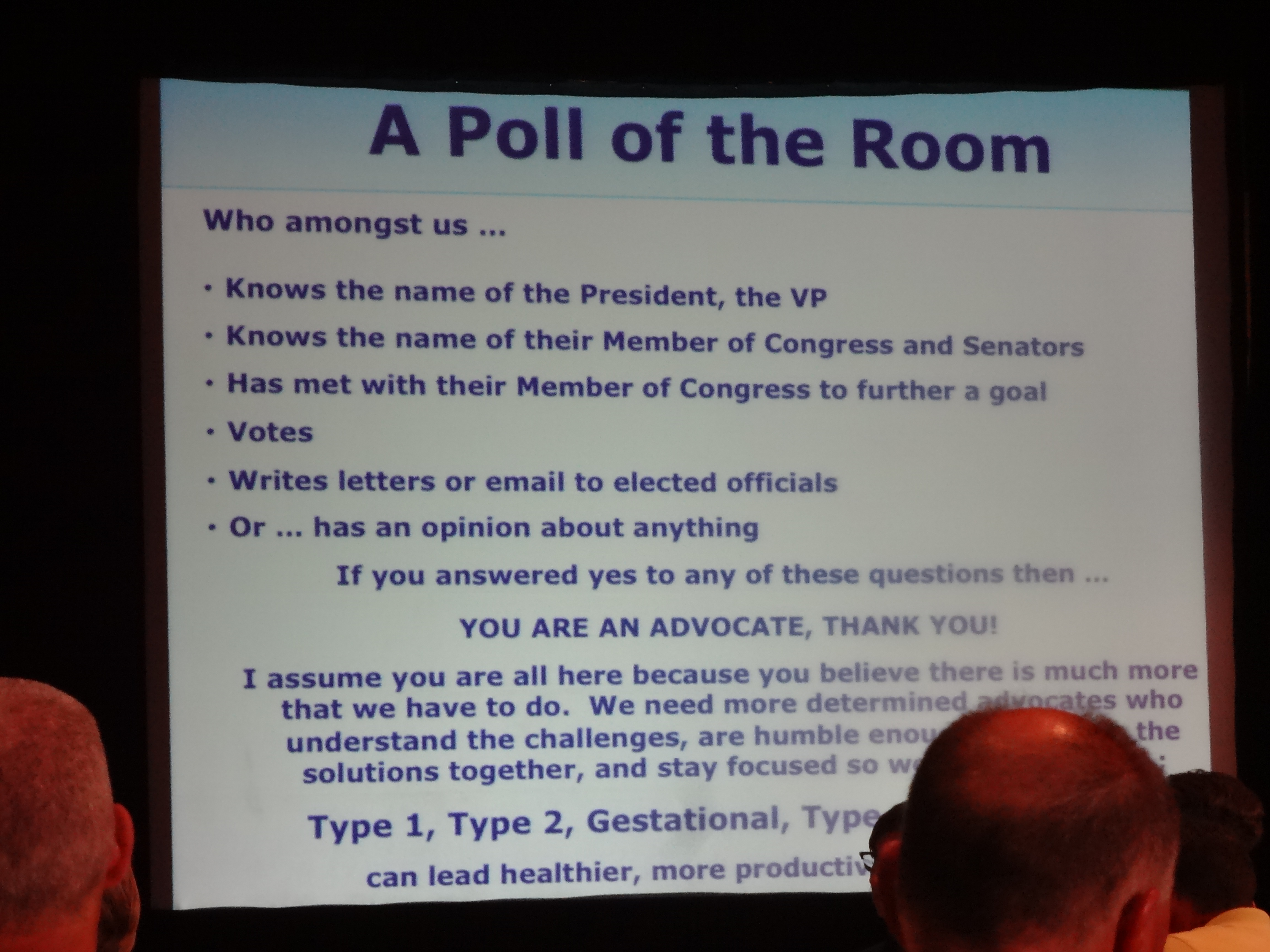
MasterLab– A one-day diabetes advocacy workshop– contained a full day’s worth of information, education, encouragement, and real world examples of how advocacy has been successful in both the diabetes world and in other areas.

The major takeaways for me on this day: Our advocacy needs to be bigger. In other words, more people need to be involved. And… I really believe this… All of us… This generation… can have a major impact on making lives better for people living with and affected by diabetes.

There was a lot to take in. Partly because of the content of the workshop, and partly because of the people I encountered during my 42 hours or so in Orlando. If you don’t mind, I’d like to break all this down into a week’s worth of blog posts. Okay?

Okay. The day began, as you might expect, with some opening remarks from Manny Hernandez, President of Diabetes Hands Foundation. Among the first things he shared with us was his dream. Stop me if you’ve heard this, but he shared his dream of thousands upon thousands, type 1s and type 2s, LADAs and others, young and old, parents and siblings, friends and spouses and partners, marching on Washington, advocating for the things that all of us living with diabetes need and deserve as human beings who just happen to have defective pancreases. If you’ve never met Manny, or heard him speak, I’ll just tell you this… he’s a dynamic, charismatic leader. When he speaks, you can feel the passion of his convictions. I’m glad he’s in our corner.

DSC01622

Then it was on to our keynote address, given by Paul Madden, a Senior Director at Project Hope. He helped set the tone for the rest of the day. I wish you could have heard him. Here’s a guy who’s been living with diabetes for forty years, and he’s still a D-advocate of the highest order. A couple of things that resonated with me:

“Everyone here is making a conscious decision to change the landscape of diabetes advocacy”

“We are a quiet, sleeping giant in advocacy”

“If you don’t stretch your limits, you set your limits”

And something I’ve been saying for a while now:
“When I’m healthy, I’m productive, I pay taxes, government doesn’t have to support me with tax revenues”

That last quote: Makes so much sense, doesn’t it? Keeping us healthy, as opposed to just keeping us paying customers, saves the government money.

Then we heard from Stacye Beck, Branch Chief for the Diagnostic Devices branch of the U.S. Food & Drug Administration. She spoke about the role of the FDA in regulating diabetes devices, and in advancing safe innovation in diabetes management. What that statement doesn’t say is that this is a person who actually writes some of the guidance that comes down from the federal agency responsible for assuring the accuracy and safety of our diabetes devices.

So what can she tell us about advocacy? She told us about the six hundred comments that were submitted in response to the open dockets on glucose meter and test strip accuracy. Remember Strip Safely? That.

She told us that those six hundred comments were about six or seven times the number of comments they usually receive on open dockets. Remember what I said earlier about more people needing to be involved? That’s what I mean. Sometimes advocacy doesn’t require getting out and raising a lot of money or doing something loudly public. Sometimes, we just need to see an opportunity and take advantage of the opportunity, right from the comfort of our own laptop or tablet. Simple as that. I learned a lot from this presentation.

Stacye also reminded us that there are three things that we can continue to do for people living with diabetes. You don’t even have to leave home to participate in this kind of advocacy:

– Report adverse events to the manufacturer and the FDA

– Comment on dockets for draft guidances (Strip Safely isn’t our one and only chance to make a positive impact)

– Become informed on the facts (from all perspectives)

After that, there was an interesting panel discussion on the topic “What I Wish Patient Advocacy Looked Like”. I loved this panel, because for the first time since I’ve been attending events like this, I saw a true variety of individuals weighing in on this topic.

From left:  Moderator Mike Swearingen, Stayce Beck (FDA), Christel Aprigliano, Andy Balo (Dexcom), John Agos (Sanofi), Melissa Schooley (Medtronic), Bruce Taylor (Roche)

From left: Moderator Mike Swearingen, Stayce Beck (FDA), Christel Aprigliano, Andy Balo (Dexcom), John Agos (Sanofi), Melissa Schooley (Medtronic), Bruce Taylor (Roche)

As you might expect, each panelist had their own opinion about what works and what doesn’t as far as advocacy is concerned. Each panelist seemed to have their own opinion of what constituted a “movement” in terms of D-advocacy. But all seemed to be saying the same thing: We do not yet have enough people involved in advocacy. I invite you to check out the videos that were recorded for each session once they’re posted. You’ll see what I mean. And you’ll see that people from all sides of diabetes are involved in what happens to us. Why shouldn’t you be involved too? You’re not any less important than they are.

The morning also included an inspiring talk from Michael Manganiello, a founding partner at HCM Strategists, a public policy and advocacy firm headquartered in Washington, D.C. Michael is an HIV survivor, which is inspiring in and of itself. He also was at the forefront of the advocacy movement for AIDS patients in the 80s and 90s. Listening to him speak for five minutes would be awesome. We got to hear him speak for about 25, and it was pure gold.

Michael was direct, to the point. He told us things that reassured us, and challenged us too:

“I feel like today, we’ve been talking too much about the status quo”

“If patients are not part of the solution, there is no solution”

“Leadership is built and grown and nurtured and taught”

Speaking about our relationship with lawmakers and federal policy makers:
“You don’t have a movement. They’re just checking your box”

Ouch. I’m embarrassed to admit that he’s right.

We rounded out the first half of the day with Manny and Bennet Dunlap telling us about how we can do it too. How can we, as patients living with diabetes, and friends, family members, spouses of patients living with diabetes ramp up our advocacy efforts?

One way to do it, right now, is to click right here:
http://diabetesadvocates.org/masterlab/

The Diabetes Action Hub has simple, easy instructions on what you can do right now to be a bigger diabetes advocate than you ever thought possible. You’ll learn about the National Diabetes Clinical Care Commission Act (House Resolution 1074 or the Senate bill 539). Both bills call for a commission of health professionals, agencies, and patients to coordinate disparate federal actions to help people living with diabetes.

I know I often refer to advocating for things like this by saying how important they are. Do you know why? Because they are important. They are all important. Is everything okay in your diabetes world? If not, they are all important.

This seems like a good place to stop for now. More to come on the rest of MasterLab throughout the week.


The Glu Real-World Research App is a finalist today.

Got anything on your plate today, say at 1:00 EDT in the USA? Are you a MyGlu member? If so, you might already know about this. If not, you probably want to log in and check this out.

I got a chance to chat by phone with Christine from T1D Exchange this week, and she filled me in on the details of a live streaming presentation being made today for (official title) Sanofi’s Partners in Patient Health and North America Research & Development Hub Innovation Challenge: Collaborate Innovate. T1D Exchange is a finalist for the $100,000 prize!

So… many of you are familiar with the T1D Exchange, an online database effort headquartered in Boston that gathers oodles of data from people with Type 1 diabetes. T1D Exchange also works with 73 clinics in the USA, covering 27,000 patients. In addition, part of T1D Exchange’s efforts is MyGlu, which is an “online community designed to accelerate research and amplify the collective voice of those living with T1D.” MyGlu has something approaching 10,000 members now, who share information and participate in data gathering in a huge way. To that end, they’ve been wanting to create an app (called the Glu Real-World Research App) that would make it easier for patients to participate in studies. Their presentation will be centered around that. In their own words:

”Our hope is to expand our already successful model to help mitigate the issues in R&D and accelerate progress for those living with T1D and, in the future, other disease groups.”

I was interested in the challenge, and what T1D Exchange and MyGlu hope to accomplish through all of this. So I asked some questions. Questions like:

How many competitors are you going up against on Friday?
There are four finalists that were selected from a large number of presentations. Since the finalists were announced, they’ve all been working with mentors assigned to help the teams develop their pitch in a clear, concise fashion designed to wow the judges. All of the teams will present via live streaming beginning Friday at 1:00 eastern time. The T1D Exchange presentation will be second. After that, from about 2:30 to 3:30, the judges will deliberate, and at 3:30 the winner will be announced.

Note: You can view the live streaming presentations at 1:00 today by going to www.collaborateinnovate.com. You can also follow @CollaboratePIPH on Twitter for updates throughout the course of the challenge.

What is the app about? What will it do?
The app will further T1D Exchange and MyGlu’s mission, connecting and supporting patients, and helping researchers and patients share information in a very easy way. Say, for instance, a researcher is doing a study that requires real-world responses from T1D patients that meet a certain criteria: pump users, CGM users, MDI patients, etc. Researchers would find those people from among those who’ve downloaded the Glu Real-World Research App and completed their profiles. This way, study organizers could more easily find study subjects, and potential study subjects could find researchers seeking the data these patients are uniquely qualified to deliver.

This is also a collaborative effort with others?
They’re partnering with MIT’s (Massachusetts Institute of Technology’s) H@acking Medicine in the design of this app, and they’re partnering with Joslin Diabetes Center in Boston. MIT obviously brings technical expertise to the table in areas such as rapid product design, lean start-up methodology, workflow re-engineering, novel data collection, big data analysis, and information publishing. And Joslin brings unparalleled knowledge and passion for researching diabetes and treating patients with diabetes.

You seem to have a pretty good idea of what you want. Let’s say you win. What happens next?
Should they win, they would immediately start sitting down with various stakeholders and subject matter experts to determine timelines and establish priorities. Then they’ll assign people to various aspects of the project, and keep track of specific milestones to make sure everything is going according to plan and budget.

Anything else you wish to tell us?
They’ve been wanting to develop an app like this for a long time. They’re thrilled to be a finalist for this award. They’re hoping everyone will watch!

Once again… You can watch the live streaming event at 1:00 EDT (US) today by going to www.collaborateinnovate.com, and you can follow the challenge via Twitter by following @CollaboratePIPH.

This is a wonderful opportunity to see what forward-thinkers in the diabetes world are working on. I hope you can make it! Don’t forget to share this with others.