Category Archives: Advocacy

Congress, we need your RSVP. Today.

Hello again… it’s me, your friendly neighborhood internet town crier here to let you know that we need your help, by performing your own bit of (less than) 2 minute advocacy.

We (and by we, I mean the ENTIRE Diabetes Community) need your help, right now, this instant.

Over 285 members of the Congressional Diabetes Caucus and the Congressional Black Caucus have been invited to an important briefing on the impact that CMS competitive bidding has been having on senior citizens in my country.

Officially, these influential members of congress have been invited to “The Diabetes Access to Care Coalition for a briefing on ‘Impact of CMS Competitive Bidding Program on Diabetes Beneficiary Safety and Access to Diabetes Testing Supplies Analysis’“. I’ve written about the dangers of CMS competitive bidding, and I want all of my federal lawmakers to know what I know: that CMS competitive bidding costs money, and costs lives. It’s unsustainable.

Better yet, Christel Marchand Aprigliano is presenting to this esteemed group. That’s right… a patient, someone with skin in the game, as the politicians say, is going to spell it out for them. There is no one I would like to see there more.

Where do you come in? Listen… we need as many members of congress and their staff to be there in the room to hear the presentation! That’s where you come in.

Click here to invite your Congressional Representative to this gathering

It’s so easy to do this, and it does so much good. This is your chance to connect directly with your elected representative in Congress. Make sure they hear your voice, then hear Christel’s voice.

We need everyone in the room. But they must RSVP by June 10. Please help them get there by sending them a friendly message.

The whole exercise will take less than 2 minutes. Help save money for the federal government, and save a few lives in the process. CLICK HERE to perform your own Diabetes Advocacy right now… when we need you most.
 

Your Story Is Important. And it’s critical right now.

As you know from the UHC/Medtronic uproar last week (CLICK HERE to read my take), diabetes advocacy has taken on a renewed sense of purpose.

But when I mention diabetes advocacy, the two biggest reactions I hear from people are: I don’t have the time; and I don’t have the platform.

What if I told you that you do have a platform? And what if I told you that taking advantage of that platform could save time over, I don’t know, writing a letter and sending it in the mail. Or creating a website and posting to it. Or going onto Facebook and shouting to all of your friends and family, most of whom agree with you anyway?
Print
Enter the Diabetes Patient Advocacy Coalition. Just as they have done for the CGM Medicare and #SuspendBidding issues for seniors in the USA, DPAC has created a page (your platform) where you can tell your story about navigating the not-so-enchanted forest of healthcare. Whether it’s the latest debate about exclusive agreements with device makers, or unexplained formulary changes that force you to switch from the insulin that works best for you, you now have a place to voice your frustration and share your specific details.

CLICK HERE to access your very own platform for change.

Diabetes Patient Advocacy Coalition will be compiling the stories submitted and sharing them with the Diabetes Community, the healthcare universe, and our elected officials. So tell your story… no one else knows it as well as you. Speak from the heart. Use this opportunity to provide your own brand of diabetes advocacy, and help others who are undoubtedly going through the same things.
DPAC-Tweet-In
One additional item I’d like to share with you too: There will be a DPAC Tweet-In on Thursday night in the USA beginning at 8:00 ET. It will be an hour where we’ll get together and send advocacy tweets on the #SuspendBidding and #DiabetesAccessMatters issues, and much more. There’s a web page that gives you the entire step-by-step process so you don’t have to ask “where do I start?”. You’ll find that page HERE.

All are welcome, and in fact encouraged, to submit their story. More than that, all are needed to enact real change for our community. The best part is, Diabetes Patient Advocacy Coalition allows you to perform that advocacy on a real level in a very easy way.

Diabetes advocacy should not be the domain of a few. Take just a couple of minutes today… a couple of minutes Thursday night. I promise you that your voice will be heard. You will make a difference. And you will feel good about it. We have the numbers. Now let’s work on putting our numbers to use not only for ourselves, but for the betterment of everyone living with a chronic condition.

Thank you for your advocacy.

#SuspendBidding

I’m not going to sugar-coat this for you, even though this is a diabetes blog.

We’re at the point where this is untenable.

For the past five years, the Centers for Medicare and Medicaid Services (CMS) has been conducting a grand experiment, opening up competitive bidding on a wide range of necessities for People With Diabetes who have Medicare as their primary healthcare partner (hint: that’s 11 million U.S. citizens over the age of 65). They have been told as far back as three years ago by nurses, educators, and patients themselves that competitive bidding endangers the lives of senior citizens with diabetes, but they keep ignoring the warnings.

There’s a new publication in Diabetes Care, the peer-review journal of the American Diabetes Association, that shows that competitive bidding is an abject failure at all levels.

Wait… why is competitive bidding bad, you may ask? Isn’t it better if we get the best price for the products we need?

Let’s answer the second question first, and the first question second: It is imperative for seniors living with diabetes to pay the lowest price possible for the healthcare, devices, and drugs that will help them live the best they can through their golden years. To answer the first question, yes, competitive bidding is very bad, and there is proof it is bad, and that proof is being ignored by CMS, and that must stop.

Let me give you a simple example: I use a BG meter made by Ajax Corporation (not a real BG meter maker—remember, this is an example). It works pretty well, pretty accurate, and I’m nearly out of test strips for my existing meter. But now, Ajax lost out on the latest round of competitive bidding, and I now have to use a meter made by Acme Corporation. That means, as a senior on Medicare, I have to go get a prescription for the new meter, find the new meter and test strips, pay for them, and learn how to use the new meter. Immediately.

What do you think the chances are that 11 million people are going to be able to do that easily?

Let’s face it: they aren’t.

Which means some of them won’t, which means some of them won’t be checking their BGs, which means some of them will wind up in the hospital or a skilled nursing facility with hypoglycemia (low blood sugar) or hyperglycemia (high blood sugar), where a best-case scenario is a stay of days in the facility, costing Medicare thousands, maybe hundreds of thousands, more than the continued cost of strips for a meter the patient was comfortable with in the first place. All because of the competitive bidding process.

And that’s only one example. Pissed off yet?

Good. Here’s what you can do: Use the Easy button.
ActNow_Web_Btn_3.23-01
CLICK HERE NOW and go to the Diabetes Patient Advocacy Coalition to help add your voice to the growing #suspendbidding chorus demanding an end to competitive bidding until CMS is called to answer for this destructive practice before a congressional hearing.

I promise you, it will take less than1 minute for you to let your House representative and both your Senators know that the CMS competitive bidding process is dangerous and deadly.

CLICK HERE NOW. I will be Medicare eligible in 11 years. Let’s end this process before I’m eligible in 10.

If you have any questions, please let me know by using the E-mail Stephen link in the upper left corner of this page.

Living with diabetes or not, we… I… don’t want your help with this. I need it.

CLICK HERE NOW.
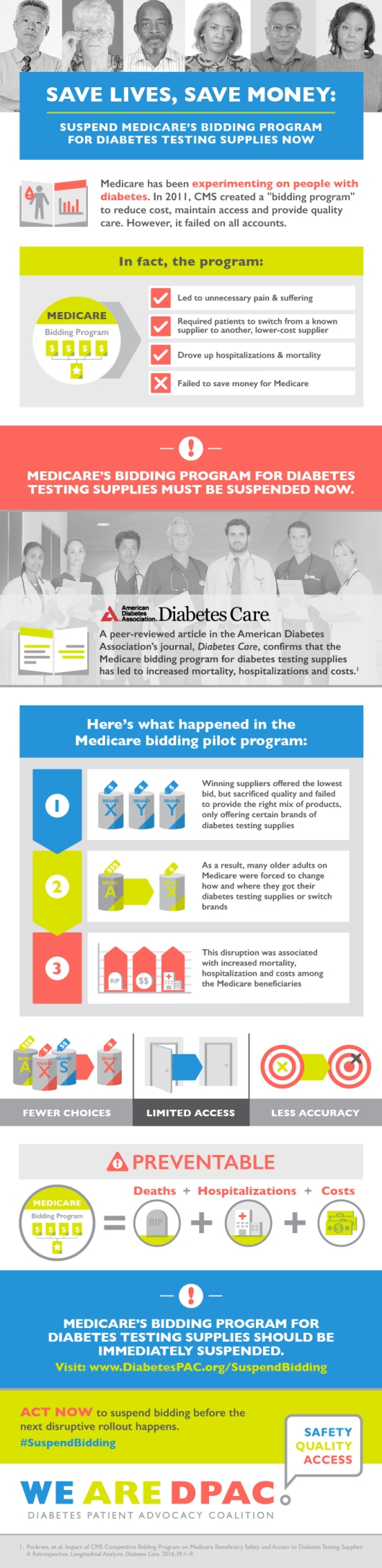
dpac_infographic_4-1
 

Not a schmuck.

SpareARoseBanner

Today, I finally got around to making my donation to this year’s Spare a Rose, Save a Child campaign.

I consider myself very fortunate, because sometimes I have a few dollars to spare to donate to worthy diabetes-related causes. More importantly, even if it were a real stretch, I would still want to find a way to give to Spare A Rose.

That’s not because it’s visible right now, it’s not because it’s the flavor of the month, it’s not because people I know and like are involved.

It’s because Spare a Rose, Save a Child saves lives.

The bad news: Children diagnosed with or living with diabetes in a developing country can die without access to the insulin, meters, test strips and more that are part of my simple, everyday management of this chronic illness. Why should those kids be left out? Why should they be denied the very things that will keep them alive?

The good news: I can do something about it. I can’t get CGM approval for Medicare patients approved all by myself. I can’t keep companies from marketing cinnamon/okra/yogurt treatments or “diabetic socks” all by myself. I can’t cure this stupid condition all by myself. But I can, all by myself, make a contribution that will make a measurable difference in the life of a child who could die without my intervention.

That’s pretty powerful stuff.

It’s a simple idea. The cost of one rose on Valentine’s Day? That’s about the cost of one month’s worth of life-giving insulin for a child living in a developing country. The International Diabetes Federation’s Life for a Child Programme has boots on the ground in those countries, saving lives where they otherwise would be lost. Partnering for Diabetes Change helps gather donations through the Spare a Rose, Save a Child campaign and get them to the IDF.

Look at the next child you see. Imagine that child not having access to the insulin they need to life the life they deserve. Then imagine what you can do about it. I’ll bet you can come up with something.

Giving to Spare a Rose, Save a Child means I’m more than just a schmuck with a blog. It means I’m a schmuck with a blog who’s a life saver too. Not the butterscotch kind, though those are pretty good. Think of yourself as the kind of person who saves lives. Then go do it. Give, so children can live.

CLICK HERE or on the banner above to donate to Spare a Rose, Save a Child.
 

I need to write a letter.

A little noise came about earlier in the week when people noticed that the stock price of Eli Lilly & Company, a large producer of insulin, had slipped six percent in a single day due to concerns that complaints of price gouging could ultimately hurt their bottom line. According to the Nasdaq report, the price of Humalog increased 10% just in the past quarter alone.

A lot of people focused on a quote from Lilly’s CEO, John Lechleiter, who, in the company’s quarterly conference call, when asked about the big increase in the price of Humalog, said that while the treatment is costly, the disease itself is a “lot more expensive.” Well, thanks a lot for that. Part of why it is expensive is because of Humalog. I think that’s what he was saying there, right? The disease itself is a “lot more expensive”, so the price of Humalog shouldn’t be a concern then, m’kay?

But it was a similar comment on the call from Jan Lundberg, Ph.D., Executive Vice President of Science and Technology, and President of Lilly Research Laboratories, that made me cringe the most. He was asked by an analyst about the “drug pricing debate”, the upcoming elections in the USA this November, how he had mentioned earlier that the industry was beginning to defend itself regarding pricing, and how he sees it all playing out over the next few years. Here is part of his response:
 
 
“In terms of what we can expect after the election, anybody that thinks they can predict the nominations, much less the election right now, I would love to talk to them. But I think this is going to continue to be an issue, or it’s going to continue to be on the radar screen because of demographics. And to some extent, as people get older, they are going to be more and more reliant on our medicines. I think we’ve got to continue to demonstrate that there’s value in the medicines we bring. Yes, they can be expensive, but disease is a lot more expensive. And emphasize the fact that low-cost generics, which account for over four out of five prescriptions today, represent ultimately the legacy of these investment efforts on our part, and provide the American consumer with tremendous value. So I think you can assume the industry is going to continue to maintain an active dialogue with each of the candidates, and to work across party lines to make sure that the views that ultimately translate into policy — and that’s what we’ve really got to be focused on — remain balanced and factual over time.”
 
 
Last time I checked, there were still no generic insulins available on the market, nearly 100 years after the discovery and implementation of insulin as a means to keep People With Diabetes alive.

Just trying to remain balanced and factual here, folks.

So, that really bothers me… the clearly false dialogue that it’s okay to overcharge patients for drugs they cannot do without, because there will eventually be generics available, which there won’t. Ever, without a fundamental change in policy at the governmental level. For heaven’s sake, Humalog was approved for use in the USA nearly 20 years ago.

That’s the frustration. What can I do about it?

I don’t know if there’s much I can do about it at all. But I know what will make me feel better. I need to write a letter.

I say a letter because on the Eli Lilly website, there is not one single e-mail address available. But they did publish the address of the home office in Indianapolis.

Do you want to write a letter too? Does this comment bother you enough to voice your concern?

Address it to:
Jan Lundberg
Lilly Corporate Center
Indianapolis, Indiana 46285 USA

Use your words. Tell your story. Be fair. Be kind. Above all, speak from the heart.

I will be putting together my own message, which I’ll share once it’s sent. I don’t know if it will do any good, but I know it will make me feel better. And it can’t hurt.

It should be noted that Eli Lilly & Company provides a lot of insulin to the IDF’s Life for a Child Programme, which also is helped through donations to Spare a Rose, Save a Child. So we’re on the same team there. Lilly helps provide assistance for people having trouble meeting the cost of their medicines. All initiatives that deserve praise.

They also have an executive who made a disingenuous comment on their most recent quarterly conference call, and that should be noted as well.