Author Archives: StephenS

Hello… I’m Stephen. I live in Baltimore, Maryland, USA with The Great Spousal Unit, Maureen. I’ve been living with Type 1 Diabetes since January 1991. I’ve been a pump user since April 2010, and I’m currently wearing the Animas Vibe pump. Also wearing the Dexcom G5 continuous glucose monitor.

I found the Diabetes Online Community in the summer/fall of 2011, and that discovery has changed my life. I started this blog in April 2012, and since then, my diabetes advocacy has continued to grow. Among other achievements, I’ve attended and spoken up at FDA workshops and participated in clinical trials.

I’ve been thrilled to serve as a facilitator for the Diabetes UnConference. And I’ve been honored to volunteer for Diabetes Patient Advocacy Coalition. You should Google both of those.

I’m currently serving as a member of the State of Maryland’s Advisory Council on Health and Wellness, where I am co-chair of the Diabetes committee. In addition, I’m part of the 2018 Reader Panel at Diabetes Forecast magazine.

I’m always searching for the perfect balance between the highs and lows of my blood glucose level and my life… always searching for the Happy Medium.

Anything you’d like to share? Please let me know… I’d love to hear from you.

The 10 most interesting diabetes people of 2015.

Since we’re nearing the end of the year, and with a nod to Barbara Walters’ list of the ten Most Interesting People of 2015, I thought it might be nice to narrow it down a bit and give you a list of the ten most interesting diabetes people of 2015.

Ha! You thought I was going to give you a list of names, right? I just can’t do that. Even if I tried, I know I would leave someone deserving out of the post. So I’m not going to go there.

Instead, I’d like to list ten people who really made a difference this year, but by category rather than by name. If you still think I left someone out, leave a comment and maybe I’ll have to do a part 2.

Anyway, in no particular order, here’s the list:

1. Clinical Trial Participants
You’ve heard me say it a thousand times. We don’t get the new technology, or the new drug, or the new anything without clinical trials. People who sign up to be a part of clinical trials are brave, at times patient, and absolutely necessary. If you meet someone who’s been part of a clinical trial, ask them about it. I know you’ll find it to be fascinating conversation, and you’ll appreciate them even more.

2. Social Media users
Because it’s become such a part of our lives now, it’s easy to forget the impact that social media has made with regard to diabetes and people living with diabetes. But make no mistake: there may be more voices, there may be more avenues for expression, but the results are the same. People feel less alone. People are welcomed. People are not judged (we hope). Social media has its drawbacks, but it continues to bring more people toward diabetes enlightenment every day. Doesn’t that make them healthier too?

3. Researchers
How about those researchers anyway? It takes an awful lot of dedication to conceive an idea and try to see it through the process of ups and downs, starts and stops that come with bringing any new idea to the forefront. From new insulins to water soluble glucagon to new treatments for retinopathy, researchers continue to bring their A game every day.

4. Technology Developers
Nightscout. Artificial pancreas. CGMs that won’t need finger sticks for calibration. Whether it’s something just rolled out or something we’ve been waiting for for a long time, diabetes technology is still, in many ways, the undiscovered country. Creating new devices, mapping algorithms and figuring out how to keep it all working safely and securely is hard work. And to me, it’s wicked cool too.

5. Diabetes Advocates
There are people… dedicated people, all over the world who are speaking on our behalf in front of governments. Lobbying for research dollars. Dispelling diabetes myths in the checkout line. For everything that they do, and you do, big and small, you have earned my gratitude and admiration. Forever.

6. Long-Timers
Thirty years. Forty years. Fifty years and more. There are more of us living longer and longer with diabetes, and that is encouraging beyond belief. From someone who is nearing 25 years with Type 1, to all of you living longer than that after diagnosis: Thanks for showing me how it’s done.

7. Diabetes Writers
Telling a story is still so important when it comes to empowering that “Me too!” feeling we’re all so fond of. Hey diabetes writers: I still love reading your blogs, your books, and your Facebook posts. Keep it going for the next person who is looking for a connection.

8. Diabetes Podcasters
How about all of those new diabetes podcasts? How about all of those old diabetes podcasts? Whether you’re an adventure sports enthusiast, a parent of a Child With Diabetes, or someone looking for information from the Centers for Disease Control or the American Diabetes Association, you now have more podcast options than ever to choose from. A recent iTunes search on “diabetes” yielded around 80 podcasts that partly feature or totally feature diabetes. More information, and more ways to get that information, is always good.

9. Our Healthcare Team
We all know about situations where a doctor’s behavior or actions did not work with what a patient needs. But when the doctor(or nurse, or physician’s assistant, or CDE)-patient relationship does work, it yields tremendous results for both the treated and the treatee. So, those of us with terrific doctors: let’s thank them for being an integral part of helping us manage our lives with diabetes.

10. YOU!
Let’s recognize that it’s been a long year. However we’ve lived it, we’ve survived. And the best part is, we’ll have a whole new story to tell next year. Because things don’t always stay the same. That’s true if we’ve had a super year or a terrible year. Our future stories remain unwritten. I’m kind of excited about that. How about you?
 
 
That’s my list… Who were the most influential and interesting diabetes people of your life this year?
 

All about podcasts (not mine).

As the headline implies, this post is about podcasts, but not my own. I was actually thrilled and honored to be part of two of them. And the other one hasn’t happened yet, but I am very excited about the idea. Here goes:

Have you heard of the Everybody Talks podcast? From TuDiabetes, the podcast delves into many of the facets of life with diabetes, with really interesting people. I was so happy to join Corinna Cornejo to introduce and recap Emily Coles’ conversation with diabetes nurse, CDE, advocate, and researcher Jane K. Dickinson. Jane has been researching the many words that affect people living with diabetes, and their effects on our psyche and the management of our diabetes. It’s a fascinating discussion, and I encourage you to take some time to listen to it. If you’re a healthcare professional of any kind, you will find this talk a treasure trove of useful information that will help you communicate with diabetes patients better than ever before.
CLICK HERE to listen.
 
 
I really feel like I hit the big time this week, when I was interviewed by Christopher Snider for his Just Talking podcast. The first half of that conversation might be a little difficult to listen to… as the interview went on, my BGs were going lower and lower until I finally had to take a break and treat a 59. I can hear myself really straining for every word there for a bit.

Anyway, it was a terrific hour spent with someone I admire and respect a great deal. We talked about this blog, how I found the Diabetes Online Community, how the idea to give away medals to athletes with diabetes came about, and also my podcast, Diabetes By The Numbers. It’s available right now via iTunes, Stitcher Radio, and at justtalkingpodcast.com.
Or CLICK HERE to listen to the full interview.
 
 
Finally, a quick note about a great idea. This is my way of trying to help spread the word about Diabetes Podcast Week, which is coming up in February! Stacey Simms of the Diabetes Connections podcast came up with the idea, and we’ll all be producing podcasts to air during the week of February 1. Even better, each podcaster will be leading the charge in encouraging everyone to join the Partnership for Diabetes Change in supporting the annual Spare A Rose, Save A Child campaign.

I am very much looking forward to participating with the rest of my fellow diabetes podcasters (am I really allowed to say that after 9 episodes?) on this worthy endeavor. Mark your calendars for February 1!
 
 
While I’m at it, let me just throw out a reminder that if you have something diabetes-related you’d like to talk about; or, if you know of a good diabetes story that should be told, send me an e-mail by clicking on the E-mail Stephen link in the upper left corner of this page. Talk to you soon!
 

Will my pump get hacked? Maybe not. But my phone? Maybe.

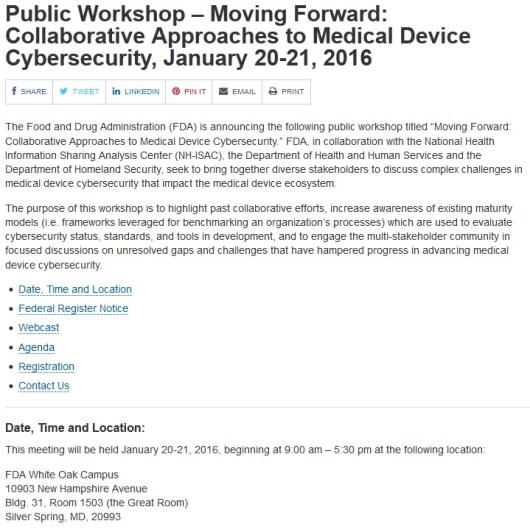
Once again, the U.S. Food and Drug Administration is inviting us to a public workshop… this time, in January, to talk about cybersecurity and our diabetes devices.

What? Who would want to hack my insulin pump?
2016Workshop
The truth is, probably no one. But as we know all too well, the world is more complicated than that. Especially lately.

Are you using a CGM? Is it the new Dexcom G5? Is it something else that is using a wireless signal to send data to an insulin pump, a watch, or a smart phone? Ever want to use something like that?

What about uploads? Do you upload data to DiaSend or some other website? Does your provider? Do they download from one of those sites?

Guess what? All of that can be hacked.

That’s what I’m worried about. Now that we have Bluetooth-enabled devices, and we’re able to start to see personal medical information on our phones, how do we protect ourselves? How do we engage both device makers and FDA to better protect us in the event something is compromised?

Let’s face it: maybe the question isn’t “can it be hacked?”; maybe the question should really be “what do we do if my device gets hacked?”.

I’m not in favor of backing up the trolley on innovative ways to view and use our data. But I think it’s smart and altogether appropriate that FDA is bringing people together to talk about it. I don’t want to not have the latest and greatest technology available to help me live a better, healthier life. But I think it makes sense to define protocols for how to react when/if someone gets access to something they’re not supposed to have access to. How do we protect ourselves? It’s a classic “fail to plan, plan to fail” scenario.

Just off the top of my head, I have questions about whether makers will be properly educating users about risks of a data breach, and how safe or vulnerable their device is to attack (while at the same time not scaring the bejeezus out of patients—it’s a fine line). Also, if my phone is hacked, what’s the protocol for how to react? What are the steps we should take in the event of someone hacking our phone and stealing our personal health information?

I know what some of you might be saying: it’s up to the phone maker to deal with that situation. True, in part. But what if a hacker is using the Bluetooth signal coming from my CGM to hack into my phone? If that happens, what is the manufacturer’s plan to address this and limit interruptions or theft of information?

I’m not really worried about someone hacking my diabetes devices. I am really worried about someone hacking my health information, either through an upload site, a smart phone, or by some other means. And really, I’m worried about whether anyone, anywhere, has any plan to deal with that if it happens.
 
 
If you want to know more about this two day public workshop, or register to attend, just click on the image above.
 

Diabetes By The Numbers: Mary Beth Withers Wyss.

Mary Beth Withers Wyss has been living with Diabetic Macular Edema for some time. She went through a two year clinical trial of an experimental drug designed to treat DME. She talks about her experience, about why clinical trials are perfect for a patient like her, and even why she is still a Cleveland Browns fan (to put the timeline into perspective, this was recorded before the Cincinnati Bengals had lost a game this season, and now they have lost two).

Mary Beth frankly talks about the difficulties of living with DME, and living with the fact that the best treatment available to her involves injections directly into her eyes.

Want to know about Diabetic Macular Edema from someone who’s been there? Want to know about clinical trials designed to find a viable treatment for DME? Then you’ll want to listen to this podcast.
DBTN
 
Reference Material – Click below for more information on this topic

Learn more about diabetic macular edema (and other diabetes-related eye diseases), and find out more about the center where Mary Beth was treated during her clinical trial:

National Eye Institute – Facts About Diabetic Eye Disease

Ohio State University department of Ophthalmology and Visual Science
 
 
©Stephen Shaul

Thanksgiving 8 (plus one)

Another Thanksgiving is upon us here in the USA, and it’s natural to sit down and consider what we should be thankful for. Especially if we write a blog. It’s been a crazy, busy, up and down kind of year, but when it comes right down to it, I still have much to be thankful for.  In no particular order, here are Eight (plus one) reasons I’m thankful this year.
8
– First and foremost, I’m thankful to family that puts up with me as I am, and continues to support me in ways big and small. I’m grateful to my wife, a person who drives downtown late on a Friday night to pick me up instead of waiting at home for me to return on the subway. That’s just one of the many things she does for me, all the time.

– As usual, I’m thankful for insurance that allows me to pay for test strips, infusion sets, insulin, and doctor visits. Even if though I’m still paying too much.

– I’m thankful for this space to share my thoughts and what I’ve learned and experienced while living with diabetes. And I’m incredibly grateful to anyone who still comes here to read it. You know who you are.

– I’m incredibly thankful to organizations like Diabetes Hands Foundation, Diabetes Community Advocacy Foundation, Diabetes Patient Advocacy Coalition, JDRF, and the American Diabetes Association for persuasively advocating more, and in bigger numbers, than I could ever muster on my own.

– I’m thankful to all you crazy bike riders who cover as much as 100 miles in a single day, while raising millions of dollars for research toward a cure. You know who you are.

– I’m thankful for gatherings that allow me to meet new friends and extend existing friendships due to nothing more and nothing less than having a permanently vacationing pancreas. Diabetes UnConference, I love you.

– I’m thankful for People With Diabetes, famous and not-so-famous, who inspire me and have shown me that there is life, wonderful life, after diagnosis.

– I’m also thankful that I got to spend a few days in Brussels at the end of a business trip in February, experiencing all of the grand architecture, good food, and lovely people of a city that now has a very different look to the rest of the world. Trust me, what you’re seeing on the news is not the Brussels I discovered.

– Finally… though it sounds redundant, I’m thankful that there’s an actual Thanksgiving in the USA. If there wasn’t, there would probably be years when I would completely forget to stop and enjoy and actually, you know, be thankful for the many, many great things in my life.

Whatever your life looks like right now, I hope that this Thanksgiving brings you health, hope, and happiness. And I hope that next Thanksgiving is the first Thanksgiving without diabetes. Hey, I can dream, can’t I?

What are you thankful for this year?