Author Archives: StephenS

Hello… I’m Stephen. I live in Baltimore, Maryland, USA with The Great Spousal Unit, Maureen. I’ve been living with Type 1 Diabetes since January 1991. I’ve been a pump user since April 2010, and I’m currently wearing the Animas Vibe pump. Also wearing the Dexcom G5 continuous glucose monitor.

I found the Diabetes Online Community in the summer/fall of 2011, and that discovery has changed my life. I started this blog in April 2012, and since then, my diabetes advocacy has continued to grow. Among other achievements, I’ve attended and spoken up at FDA workshops and participated in clinical trials.

I’ve been thrilled to serve as a facilitator for the Diabetes UnConference. And I’ve been honored to volunteer for Diabetes Patient Advocacy Coalition. You should Google both of those.

I’m currently serving as a member of the State of Maryland’s Advisory Council on Health and Wellness, where I am co-chair of the Diabetes committee. In addition, I’m part of the 2018 Reader Panel at Diabetes Forecast magazine.

I’m always searching for the perfect balance between the highs and lows of my blood glucose level and my life… always searching for the Happy Medium.

Anything you’d like to share? Please let me know… I’d love to hear from you.

What good is new technology if you can’t pay for it?

My great nephew celebrated his second birthday this past weekend. I celebrated another day on the blood sugar roller coaster.

It was a busy day. Maureen’s sister and two of her children had been visiting for a few days, and they left Saturday morning for the trip back to Ohio. So we were up at 6:00 a.m. to see them off. Maureen also had to pack and leave for a few days taking care of some pets in another part of town. Add in another event on the other side of town prior to the birthday party.

I don’t know if it was the choreography of putting the day together, or my eat-whatever-you-can-whenever-you-can-eat-it dietary selections, but I was sitting over 200 mg/dL for hours. The correction doses of insulin I had been giving myself were finally paying off around 4:30 in the afternoon as I headed off to the birthday party.

My glucose level was coming down, though not fast enough to cause alarm. I was at 109 mg/dL when I arrived. I added a pre-bolus for dinner, and thought I was set.

But as luck would have it, I didn’t time dinner perfectly. It was a little later than I thought it would be, and as we finally sat down to eat, my eyes glazed over and I got that “Stop Talking and Eat!” look from Maureen.

Everything righted itself eventually, but I’ve had a couple of days like that back-to-back now. It shows me that I’m good with my diabetes management, but I’m not perfect. That’s usually a good time to remember that there are tools and technological advancements on the way that promise to help reduce the burden of days like this. In the case of artificial pancreas research, Someday is a lot closer than ever before.

Then, almost in an instant, the next thought popped into my head: But… what good is a great new device if you can’t pay for it?

The U.S. House of Representatives passed their version of “repeal and replace” health care legislation on Thursday. What was already expensive could get prohibitively expensive should the Senate follow suit. We know there are already people using Facebook groups to try and get the insulin they need. Test strips are $1.00 or more per strip, which adds up fast. The retail cost of a new insulin pump is thousands of dollars.

For people who desperately need insurance to help defray some of these costs, purchasing insurance through a high risk pool that costs more (someone my age living with diabetes might have to pay $20,000 or more per year) creates an impossible dilemma.

There are 14 doctors and nurses serving right now in the House, and 3 doctors serving in the Senate. In the House vote, 10 of 14 voted for this legislation. Do No Harm, my ass.
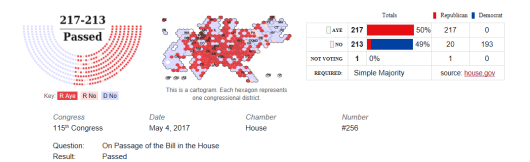
From govtrack.us


Managing diabetes was already expensive before Obamacare. It was still expensive under Obamacare. It will be prohibitively expensive under this new legislation. The House of Representatives, at least, are exacting an impossible price on Americans simply because they hate the previous president.

But I’m not giving up without a fight. And I will remember at the ballot box. I’m going to call and send e-mails consistently, even after this fight is over. If I’m going to have to manage my diabetes every day while protections for myself and my loved ones are being taken away, only because they’re expensive, I’m not going to let them rest. I will make their victory a difficult one. I will make their victory unworth the price they have to pay to get it. What about you?

Let Congress know that you’re not going down without a fight. And if they try again, you’ll fight again.

CLICK HERE to download the DPAC app. With the DPAC app, you can get timely alerts, contact elected officials without going to a website, and insert your own diabetes voice into the conversation faster and easier than ever before.

THIS PAGE has every member of the House of Representatives listed, links to their websites, and most importantly, their phone numbers.

THIS PAGE lists contact information for every member of the U.S. Senate.

Please call!

“I’d rather be right than…”

There are countless quotes out there of famous people using the phrase, “I’d rather be right than…”. I thought a lot about those this week as I’ve watched Congress consider healthcare legislation again.

”I’d rather be right than be president”—U.S. Representative Henry Clay, 1838

Only there isn’t anything right about it.

The latest twist in the tale involves the MacArthur amendment, written by Republican House Representative Tom MacArthur of New Jersey, which relieves states from complying with protections for anyone living with a pre-existing condition. Oh, and those essential benefits that all insurers must provide through the Affordable Care Act? Under the amendment, states will get to decide what those essential benefits are. If there will be any at all.

Then there are the protections that state that everyone in the Obamacare exchanges must be charged the same for insurance, whether they’re male or female, living with a pre-existing condition or not. The MacArthur amendment provides an avenue for states to request a limited waiver in these cases, which would allow them to charge less for people not living with a pre-existing condition.

That means people who do live with pre-existing conditions could and would get cordoned off into high-risk pools that provide less coverage, but charge more for premiums. If this passes, someone my age, living with diabetes, could be looking at spending something north of $20,000 per year for health insurance.

But that’s okay, Republicans say, because they’re throwing an extra $8 billion into a fund to help those with pre-existing conditions. By my math, that’s a little more than $47.00 for everyone living with a pre-existing condition. Using our $20,000 per year premium, that’s less than 3 percent of one month’s payment.

“When history looks back, I’d rather be judged as solving problems and being correct, rather than being popular”—President George W. Bush, 2006

Once again, we are literally fighting for our very lives.

Perform a Google search for politics and morality, and you’ll get a lengthy list of online articles telling you that either morals do or don’t belong in politics. Regardless of how you feel about morals and politics, in this instance, morality is sitting firmly on the sidelines. It’s not getting invited to this dance. Don’t forget, Congress tried to exempt themselves and their staff from this legislation.

”I’d rather be right than consistent”—Winston Churchill, 1956

Actually, I think this situation is a little backward. The truth is, Congress would rather kill Obamacare than be right. They would rather let Americans die than be right.

There’s very little time. The House expects to vote on all this today. As of this writing, just 22 or 23 more No votes were needed to kill this cruel legislation.
THIS PAGE has every representative listed, links to their websites, and most importantly, their phone numbers.

Want to make it easier than that?
CLICK HERE to download the DPAC app. I’ve mentioned before how Diabetes Patient Advocacy Coalition makes it so easy to contact elected officials. Now, with the DPAC app, you can get timely alerts, take action without going to a website, and insert your own diabetes voice into the conversation faster and easier than ever before.

Let Congress know that you’re not going down without a fight. And if they try again, you’ll fight again. Our right to equitable, accessible, affordable care hangs in the balance. American lives are at stake.

Like these links.

It’s been quite a long time since I’ve done one of these posts. The truth is, I don’t get to read diabetes blogs nearly as much as I used to. I miss that. I miss it a whole helluva lot.

Here are some things I have discovered that I think you might find interesting. Happy reading!
 
 
It’s May, and May means another edition of Diabetes Blog Week! Karen Graffeo, writer at Bittersweet Diabetes, will be kicking off the 8th year of her wildly popular series on May 15th. Here’s how it works: People who blog about diabetes get a subject to write about each day for five days in a row. There are usually a couple of wild card topics thrown in there in case a particular day’s topic doesn’t appeal to you.

There will be a place for you to link to each day’s post that you write. This makes Diabetes Blog Week fun and a place for you to find new blogs to read.

Sign-up for Diabetes Blog Week starts on May 9th. For more information,
CLICK HERE.

————————————————————————————————————

I linked to this in a Facebook post, but I think it deserves mention again. Sanofi, makers of Lantus and Apidra, has received FDA approval of their My Dose Coach app, which is designed to help people who deliver insulin via multiple daily injections (MDI) adjust their basal rates. Let’s face it… there are still millions out there who aren’t pumping due to budget, access, or by choice, and a number of apps have been developed that can help patients figure out how to dose, and keep track of their dosing.

I wrote about this in very limited detail a while back. But I think that, of any outlet reporting on this, maybe diaTribe is doing the most thorough job of describing what these are and how they work. There are millions on MDI, and I’m a little surprised that these apps don’t get more press. To find out about this one,
CLICK HERE.

Bonus Link: diaTribe’s Adam Brown has written a book! Find out about it here.

————————————————————————————————————

Finally… who doesn’t love a good puppy story? Reva over at Type ONEderful wrote a lovely post about how her dog Levi helped her handle a high blood sugar, just by doing what a dog does. Check it out HERE.
 
 
That’s all for now… I hope your week is off to a great start!

Sharing Diabetes in our Everyday Life

So… now that we’ve talked about sharing your diabetes (or not sharing your diabetes) with the people you work with, let’s talk about interacting with others. Non-work others, including people in the diabetes community itself.

Thinking about writing something on this subject was really interesting. So many things we encounter while interacting with others can be charged with emotion. There are some potential land mines here, so let’s tread lightly.

It seems to me that a good place to start on this subject is right where we started on my previous post. You have to decide whether sharing your diabetes, and your diabetes details, and giving up any medical data privacy protections you might enjoy, are worth it. To you.

That said, should you decide to share, there are plusses and minuses you will undoubtedly experience.

Everyone has encountered the “you mean it won’t go away If you eat yogurt?” person. Also, the person who wants to shoo you away from anything that has sugar in it. These situations are relatively easy to deal with, simply by knowing what you’ll take and what you won’t take from someone.

That can change from situation to situation, but can also change based on how we’re feeling that day. It feels really great to set the record straight and debunk myths. But if you feel like you just don’t have enough energy to school another person today? That’s fine too. Their ignorance isn’t your fault.

Most of the time, I do my best to set the record straight when someone spouts off incorrect diabetes information. But there are nuances too. Sometimes, we give what we think is a super explanation of why we need to do a glucose check even though we’re wearing an insulin pump or a CGM (“wait… you’re not cured?”), and the person receiving the information cannot grasp it anyway. Again, not my problem. I tried.

But what I can do in those situations is be grateful they listened at all. I can be patient. I’m not responsible for someone’s ignorance, but they’re not responsible for my diabetes either.

In some situations, maybe all I really can accomplish is to plant a seed in their mind to remember me whenever diabetes crosses their lives again. And that has come in handy, when someone they know has faced a new diagnosis, or a family member wanted to know more about introducing insulin to their Type 2 management. So not everything that seems like a failure really is.

Diabetes or not… kindness, being a good listener, asking respectful questions, and a smile still go a long way with people.

When I worked as a retail manager, I would often hear the phrase “the customer is always right”. I would tell the people working for me that the customer wasn’t always right, but they should never be made to feel as if it’s their fault they’re wrong. That’s sort of what I’m talking about here. Make sense?

We’re so hard wired sometimes to perfectly explain what we know to be the diabetes truths. We have to be, in order to dispel misinformation and advocate for those who cannot advocate for themselves. The more we can do that with a smile, a joke, or a kind word, the happier both I and my family and friends will be.

After all, as much as it’s about being right, it’s also about building relationships, friends, and allies. No matter what, whether you share a lot or a little, remember:
I support you… no conditions.

“I don’t know what I would have done without you guys”

I agreed to do something on Saturday. I set off at around 9:00 a.m. and slogged my way across town in the cold mist, which later turned into a cold April rain. I went to help a friend clear the basement in her parent’s home.

This is not what I wanted to be doing Saturday. It was not where I wanted to be.

For decades, my friend’s parents have spent part of their year in Baltimore, and part of their year in Cairo. Her father’s Egyptian, her mother American. A little over a month ago, after a long illness, her father passed away in his home city. Her mother is still there, tying up loose ends until she is able to return to the States.

My friend has two sisters, but they don’t live here anymore, and that left my friend as the one left to try and make sense of decades of paper, old electronics, window shades, and other nic-nacs on shelves. And shelves. There was a lot of stuff in that basement. A lot to deal with.

There was a 30 foot long dumpster in the driveway, and in a little over 2 1/2 hours, we filled it. But it wasn’t easy. There was a lot of stuff do deal with. A lot of decisions had to be made.

The easy part was deciding what to throw out. But… it was decided that some of what we found should be donated. Some of the items we found actually had some value, and were kept. There were things that needed to be decided on by her mother later. They would stay in the basement.

I had my own issues during all this. In addition to helping with a difficult task, I had to take care of my own diabetes, making sure to fuel up at times to avoid being useless due to a low blood glucose level.

As we worked through the mass of material before us, from time to time, I could see that the process of it all was affecting my friend in a profound way. It wasn’t just stuff to her… it was decades of memories. Occasionally, she would retreat and her boyfriend needed to take over the duties of deciding what stayed and what went.

This process frustrated some of her friends who were there to help. They had trouble understanding why it took so much time to decide on a strategy, on what to do with something they found. Why couldn’t we just clear the basement? Why weren’t we doing this faster?

But it needed to happen this way. If it didn’t, we risked frustrating my friend, causing her to pull back entirely, sending us away and forcing us to try on another day. This was not what she wanted to be doing Saturday either. It was not where she wanted to be.

So carefully, deliberately, we started to chip away at the pile of things before us. Children’s toys. Scrap books. Old televisions. Boxes and boxes of books. A lifetime of memories. There’s no guide book or training manual on how to deal with this.

When it was over, my friend and her boyfriend were extremely grateful. I heard things like “I owe you big time”, and “You guys are rock stars”. Those sentiments were as sincere as any I have experienced.

Sifting through decades of memories, finding what you can work with and what you can’t, and emerging on the other side of it all with a feeling that you’re making real progress, is a lot more complex than just throwing a bunch of shit in a dumpster.

In the end, I know I was where I needed to be on Saturday. The real breakthrough was not in how I helped, but in what I learned.

As I stood on the edge of a nearly overflowing dumpster, I tried to encourage my friend, telling her that this was a sign of real progress. She said, “Have you looked in the garage yet?”.

There’s likely another Saturday there in my future. Progress has been made, and much more needs to be accomplished. But my friend understood that your friends mean so much more when they’re there for you to help with the difficult tasks. As her friend, it’s so worth it to hear “I don’t know what I would have done without you guys”.