Author Archives: StephenS

Hello… I’m Stephen. I live in Baltimore, Maryland, USA with The Great Spousal Unit, Maureen. I’ve been living with Type 1 Diabetes since January 1991. I’ve been a pump user since April 2010, and I’m currently wearing the Animas Vibe pump. Also wearing the Dexcom G5 continuous glucose monitor.

I found the Diabetes Online Community in the summer/fall of 2011, and that discovery has changed my life. I started this blog in April 2012, and since then, my diabetes advocacy has continued to grow. Among other achievements, I’ve attended and spoken up at FDA workshops and participated in clinical trials.

I’ve been thrilled to serve as a facilitator for the Diabetes UnConference. And I’ve been honored to volunteer for Diabetes Patient Advocacy Coalition. You should Google both of those.

I’m currently serving as a member of the State of Maryland’s Advisory Council on Health and Wellness, where I am co-chair of the Diabetes committee. In addition, I’m part of the 2018 Reader Panel at Diabetes Forecast magazine.

I’m always searching for the perfect balance between the highs and lows of my blood glucose level and my life… always searching for the Happy Medium.

Anything you’d like to share? Please let me know… I’d love to hear from you.

Endo recap.

Can’t believe that I’ve let almost two whole weeks go by without mentioning something about this. Too busy with other things, I suppose.

Here are some random moments from the appointment with my fabulous endocrinologist a couple of weeks ago:

– Hemoglobin A1c was pretty good. I’m again in the range where she’s worried that I’m encountering too many lows. It still feels weird after so many years of “Your numbers need to come down” to hear “This is a little lower number than I would like to see”.

– After reading about my adventurous week in January, she asked if I’m still eating gluten free. Umm, no… I’m not. But I do dig the pizza that I made, and the bread, and I felt pretty good that week, so if I can afford it, I’ll probably be doing at least some gluten free meal making in the future. Also, I’m eating a lot of salads right now, and I’ve been looking for gluten free salad dressings (Wish Bone makes some good ones).

– We talked about infusion sites. I had a stubborn high BG episode a few days prior to the visit, and we talked about whether it might have been site-related. I’m convinced that it was insulin that went bad after five days hanging on my hip. But I finally remembered to ask her opinion about whether sticking to the FDA-mandated 3 day limit to infusion sets would cause me to have too much scar tissue over time, as opposed to what I do now: keep the thing in until the insulin is gone (usually 4-6 days). Her opinion? If I’m careful about rotating my sites, I shouldn’t have to worry too much about changing out every three days. And there’s no evidence that keeping a set in longer is doing me any good anyway. I may have to rethink my position on this one.

So in conclusion: I have to tweak my basals ever so slightly, and stop aggressively blousing at every opportunity. I like eating gluten free, but haven’t moved all the way there yet. And I should consider going back to site changes every three days. Oh, and my other lab work came out okay too. No liver, cholesterol, or thyroid issues. I’m good for another three months!

Of course, I still have plenty to work on in the meantime.


A rare non-D post. With pictures!

Today, no talk about diabetes, really. Just some photos. The one at the end is for all of the DOC cupcake freaks out there.

We went to a play on Sunday afternoon. But first, we stopped off at the Howard Peters Rawlings Conservatory in Baltimore.

If you live in the USA, chances are that you live somewhere near a facility like this. A lot has been written about diabetes and depression, about winter and depression, about seasonal affective disorder (it’s actually a thing). I’m not going to say that a trip to your closest conservatory will cure these problems for you. But I can tell you that if you make a trip like this, even for a short time, you will definitely feel better. For me, it’s the perfect cure for Cabin Fever.

So without further ado, please enjoy these images from the Rawlings Conservatory.

This slideshow requires JavaScript.

And one final photo… we stopped to have a little nosh at a local place after the play, and we indulged in this lovely treat (I ate about a third of it):
DSC00669

I hope this brightens up your Tuesday. Or Wednesday. The trip to the conservatory certainly brightened up my day. Which is a good thing, ’cause we woke up to about four inches of snow on Monday morning. Come on Spring!


C’mon, CVS!

From the wonderful relationship that exists between employers and employees in the United States these days comes this little nugget. Go ahead, read it. I’ll wait.

http://www.cnbc.com/id/100573805

Does this bother you a bit? It bothers me a lot.

I’m not bothered by the fact that an employer wants to try to help their workforce get healthier. My employer does many of the same things that CVS is talking about here. In fact, I’ve written about it. Done correctly, these initiatives are a win-win: employees get help identifying and taking action against illnesses they might not have known about before screening. And employers, helping employees get healthier, mitigate some of their risk against future insurance claims. This is especially true if, like a lot of large employers, they are self-insured: meaning, they pay their own claims, but pay the insurance companies to leverage networks of doctors and handle claims processing and other administrative functions.

But that’s about the extent of the good stuff in what CVS is doing here.

If I were to ask questions of the CVS/Caremark CEO, and their benefits manager, the first question I would ask is: Why do you want to penalize employees for non-compliance with a policy, when you could be incentivizing employees to get healthy?

How much that might cost would be in the details of how and what kind of incentives you would deliver, but let’s be honest. The cost would be miniscule. How do I know this? Oh, why don’t you ask the thousands of employers who have been delivering incentives to employees for completing smoking cessation classes, weight loss programs, and medical/bio screenings for decades here in the USA?

Second, I would simply ask if they understood that by forcing their employees to comply (and they are forcing them—when you earn the kind of money the people at the retail store level are earning, you’re forcing them to comply), they are destroying their workforce?

Knowing what we know now about this issue, even if you’re 100 percent healthy… let’s see a show of hands: Who wants to go to work for CVS right now? Anyone? Bueller? That’s what I thought.

Certainly, if you’re a person with good skills and an ability to land a job elsewhere, CVS/Caremark is immediately going to the bottom of your list of prospects. Which means that the new employees they will be landing in the future will be bottom of the barrel talent who can’t get a job anywhere else. And existing employees who might have other choices (like maybe Walgreens or Rite-Aid or, oh… anyone else) are going to bolt the first chance they get too, even if it’s for no increase in pay. Which means the employees that remain after a couple of years under this program are again, bottom of the barrel talent. So, CVS/Caremark: What do you hope to gain here? And have you considered how much it will really cost you? Because it will cost you. You will not save money with this plan.

And you, dear reader, may ask, after 500 words or so, “Hey Stephen… what’s this got to do with Diabetes?”.

I don’t know. I guess I’m saying that I don’t trust a company that will force you to do these things. Because if they’ll do this, what’s next? Will they start denying coverage to people who are diagnosed with diabetes? Thankfully, under the Affordable Care Act, they won’t be able to. But will they try to cut back on what they cover? That, I think, is a very real possibility.

Their new policy says: “Going forward, you’ll be expected not just to know your numbers – but to manage them”. By who’s measure? Will they pay less in claims if a PWDs Hemoglobin A1c isn’t within range (and we all know how difficult that can be)? Will they (for example) try to push someone with diabetes, in their 50s, like me, toward the exit so they can avoid paying what they think will be larger and larger claims until the person is eligible for Medicare? And in doing so, try to justify their decision by pointing at this policy?

Maybe that seems far-fetched. But is it? I mean, they’re already willing to coerce their employees into complying with their demands or risk giving some of their pay back to their employer. Does this sound Anti-American to you? It does to me.

That’s the crux of the thing right there. CVS is portraying this as a wellness initiative, designed to keep employees as healthy as possible. I’m viewing this as being too heavy handed. Mostly, I see what they’re trying to accomplish, at least from their public statements, as possible– if they would just put a different spin on it and act like they actually cared about whether their employees are healthy. And happy. And if they did it without docking employees’ pay or using the information to penalize employees that they are trying to keep healthy in the first place.

By the way, I have a choice of major drugstore chains in my area. And guess what? CVS is not my retailer of choice anymore. They just don’t get it. And geez, these people are running a multi-billion dollar company.

Do you feel the same? Different? Feel free to let me know how you’re thinking.


Book Review.

I guess there really is a first time for everything, so here it is… my first book review. This book has already been written about in multiple places. Here is my take.

DSC00629

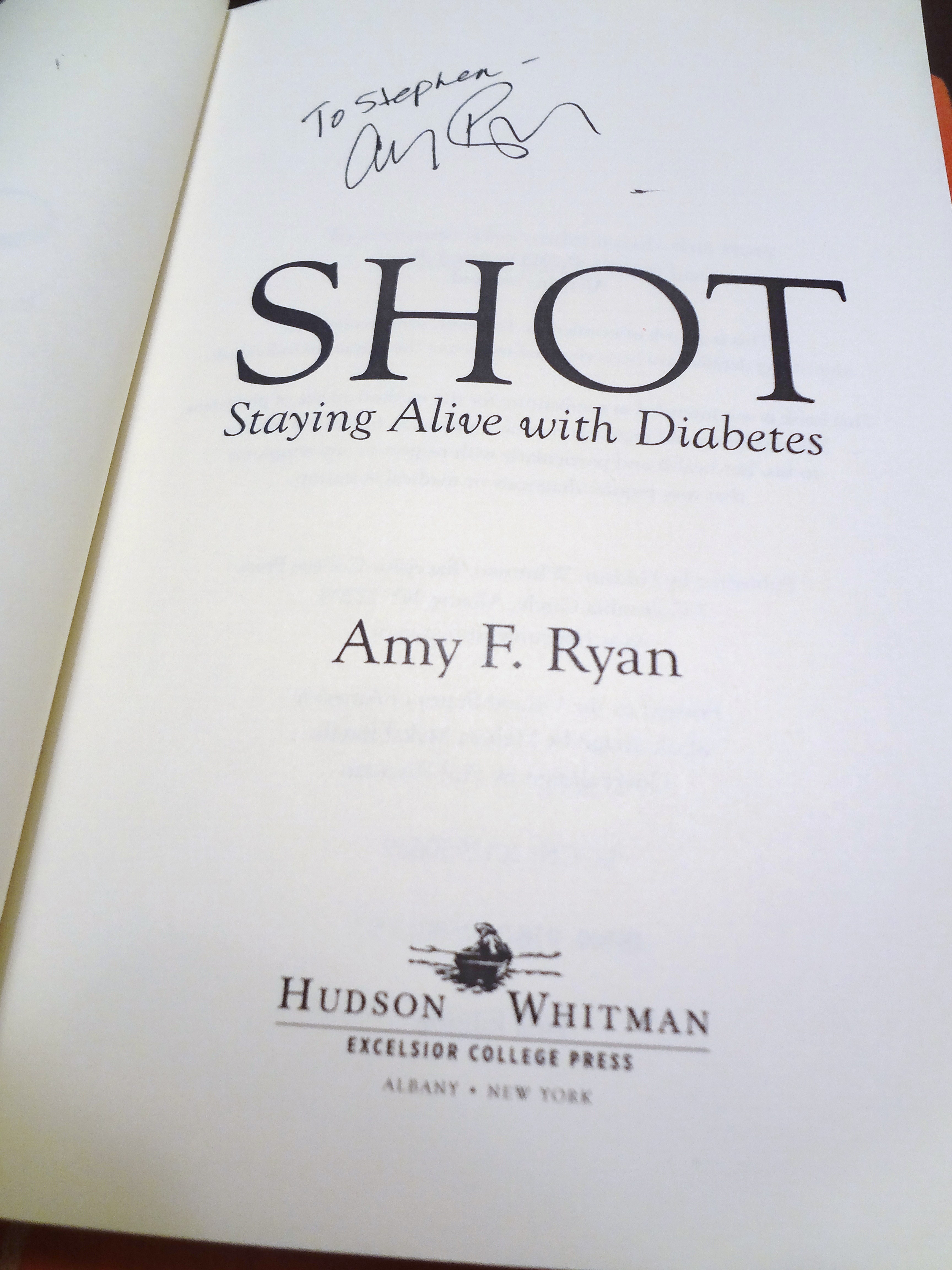
When I attended the JDRF summit in Bethesda, Maryland a couple weeks back, I picked up Amy Ryan’s book Shot: Staying Alive with Diabetes.

Amy is a lawyer by trade, practicing in Washington, D.C. (why do they say practicing? Seems to me she’s working), specializing in the commercialization of new medical technologies. She was diagnosed with Type 1 Diabetes at age 29.

The book details her diagnosis, getting through law school, carrying her daughter through to full term delivery, surviving a pretty serious infection, and everything in between.

A lot of Type 1s will identify right away with Amy’s descriptions of high and low BGs, MDI versus pump decisions, and the general idea of living a meaningful life with diabetes. Especially if you’re a woman living with Type 1. That’s not a knock; it’s the truth. Amy is a woman, and she brings a perspective to the story that the fellas can’t.

But I think the most value in this book is in Amy’s clear descriptions of things like hypoglycemia, diabetes burnout, how an insulin pump works, and more. For this reason, I think it’s a terrific book for a parent, a spouse, or a co-worker of a Person With Diabetes. She explains things in terms that someone not living with diabetes can understand.

So while I can endorse the book for PWDs, I can most definitely endorse the book for any non-PWD who wants to understand us better. I’m making The Great Spousal Unit and The Live-In Niece read this book. Then I think we’ll talk about it a bit. Maybe have a question and answer session.

More information on Shot: Staying Alive with Diabetes, including an excerpt from the book and information on where to purchase, is available at http://www.amyryanshot.com/.

Disclosure: I bought the book, I read it, and now I’m writing about it. Nothing deeper than that.


March DSMA Blog Carnival: My Superhero

I’m very flattered to have been asked to be a monthly contributor for the Blog Carnival over at Diabetes Social Media Advocacy. Beginning today, you’ll start to see me over there too.

Now on to this month’s question. It comes from a DSMA Twitter Chat not too long ago:

Disney just gave you funding to create a character with diabetes. What type of character would you create? What would you want your character’s message to be for adults and children living with diabetes?

When I looked at this topic, I realized that I needed some kind of special assistance to complete my project. I’ve never been good at creating things like this. So I went to the ultimate source of knowledge in the world… the internet. I mean, hey, if it’s on the internet, it must be true, right (he said, tongue in cheek)?

I typed “How to create a superhero” into my search engine and found multiple sites that list complete how-to guides on how to create a superhero. Some even provide software to let you piece together how your superhero will look.

Most of the sites I checked covered the same ground in their online tutorials. So let’s take these tasks one at a time and apply them to our super Diahero.
 
• Origins: Where does your superhero hail from? What about this makes him or her unique?
My superhero is born from a single healthy beta cell, originating in the obscure Islet of Langerhans, home of other beta cells in our pancreases. Being able to escape from this land of origin prior to the destruction of all of his fellow beta cells, he’s able to uniquely empathize with similar individuals who have suffered the same fate.
 
• Special Powers: This is delicious. What kind of superpowers does your superhero have?
My super Diahero has an amazing mind that can deduce insulin on board, current blood glucose, and the amount of carbohydrates on your plate. Then, factoring in insulin to carb ratios, exercise, and future basal rates too, he provides the precise measurement of insulin for any scenario.

Also, my hero has a great ability to educate and slay those troublesome diabetes myths. Don’t even try to mislead, or misrepresent facts: “You can’t eat that”, “You brought this on yourself”, and “You can’t have children” are all eradicated with split-second, persuasive action. Complete enlightenment is our hero’s hallmark.
 
• Weaknesses: What is our hero’s kryptonite?
Alas, our super Diahero is susceptible to the evil twin demons known as hyperglycemia and hypoglycemia. The hyperglycemia that makes him sluggish and irritable, thirsting for water but searching for the demon’s lair so BGs can be brought to mind at a healthy level. And the hypoglycemia that tries to turn his brain to mush, dulling his Special Powers until he is able to find the right combination of fast-acting carbohydrates (occasionally administered by his trusty sidekick, who sometimes takes the form of a Parent or Spouse, or another member of the League of Super Diaheros. Hey, it’s my superhero… I can create whatever I want, right?).
 
• Mission: Of course, our superhero needs a mission.
My superhero travels the world searching for other healthy beta cells in an effort to prevent those of his kind from being destroyed. And where they have been destroyed, his hope is that one day, a new, healthy Islet of Langerhans can be reborn in a Perfect Pancreas World that can live within all of us.
 
• Finally, our superhero needs a name. What’s your name?
No, really… what’s your name? Because if you’re living with diabetes, you know that living a meaningful life requires superhuman effort. You also know that it’s possible. And I hope you know that you can do it. To all my fellow People With Diabetes: You are my carb-counting, insulin-adjusting, educating, myth-busting, hypo- and hyperglycemia surviving, AWESOME Super Diaheros.
 
 
Mission accomplished.
 
 
This post is my March entry in the DSMA Blog Carnival. If you’d like to participate too, you can get all of the information at http://diabetessocmed.com/2013/march-dsma-blog-carnival-3/