Monthly Archives: May 2014

#DBlogWeek Day 2: A poem.

DBlogWeek

For the 5th year in a row, diabetes writers from all over the world will be participating in a solid week’s worth of informative, educational, and inspirational blog posts. To find out everything you need to know about Diabetes Blog Week, click on the banner above. A big Thank You to Karen Graffeo for making this happen every year!

Today’s topic:

This year, Diabetes Blog Week and TuDiabetes are teaming up to bring out the poet in you! Write a poem, rhyme, ballad, haiku, or any other form of poetry about diabetes. After you’ve posted it on your blog, share it on the No Sugar Added® Poetry page on TuDiabetes, and read what others have shared there as well!

—————————————————————————-

Testing, treating, waiting

My life is a series of tasks
One after another

Reservoir fillup, set change
Sensor change, calibration

Testing, then math
Testing, then math, then bolus

Bolus, then eating, then waiting
Then waiting, then hoping

Insert life here
Life goes on, while I’m hoping

Hoping my blood sugar won’t skyrocket
Hoping my blood sugar won’t plummet

When it does, I test, then correct, then wait

So many tasks
So much extra

Testing, treating, waiting
All so I can survive– until the next time

Testing, treating, waiting

All in the name of survival.

—————————————————————————-

Don’t miss day three of #DBlogWeek coming up tomorrow!


#DBlogWeek is back! What fires you up?

DBlogWeek

Yay! Diabetes Blog Week is back!

For the 5th year in a row, diabetes writers from all over the world will be participating in a solid week’s worth of informative, educational, and inspirational blog posts. To find out everything you need to know about Diabetes Blog Week, click on the banner above. A big Thank You to Karen Graffeo for making this happen every year!

Today’s topic:

Let’s kick off Diabetes Blog Week by talking about the diabetes causes and issues that really get us fired up. Are you passionate about 504 plans and school safety? Do diabetes misconceptions irk you? Do you fight for CGM coverage for Medicare patients, SDP funding, or test strip accuracy? Do you work hard at creating diabetes connections and bringing support? Whether or not you “formally” advocate for any cause, share the issues that are important to you. (Thanks go out to Kim of Texting my Pancreas for inspiring this topic.)

Changing the world, eh? No pressure there.

I don’t know if what I’m passionate about right now is changing the world. But I do know of two things that I hope will be of use to others in the future.

You can find out the first by clicking on the button with the medals in the upper right portion of this page. Since November, we’ve sent out 11 medals to Athletes With Diabetes who do their best to fight through the scary things that come with taking along your diabetes to gym classes, bike rides, or half marathons. Our eleven winners (that’s right… we’re up to 11!) have all set an example of courage and determination that others will always look up to. So I didn’t really do much there except shine a light on something great that was already happening.

But I get such a huge kick out of shining that light, and introducing everyone to amazing people that maybe they haven’t met before. And a few that they probably have. In any case, it’s exciting to give someone a medal like that. I remember finishing my first triathlon three years ago, and the feeling I got when I crossed the finish line and received my medal. I wanted brave D-Athletes to feel the same thing.

The second thing I’m really fired up about right now is happening… right now.

Last week, I started participation in another clinical trial. This will make three in the past year, and it’s something I take very seriously. This study will be my first artificial pancreas trial. I’ll talk about it more as the study progresses. But I want to help you understand why participating in clinical trials is so very important.

All of us want to see new ideas tried out. New therapies, new drugs, new understandings of how our bodies-with-failed-pancreases work. Often, the only way we’re going to get those ideas tried out is during clinical trials. And clinical trials need volunteers. So here I am.

Participating in a clinical trial isn’t necessarily easy. The ones I’ve taken part in aren’t hard, either. What they do require is a lot of attention to detail. If you’re supposed to do something at a certain time in a certain way during the trial, you have to do that. Otherwise, you risk not meeting the parameters of what is being studied. Researchers might not get the proper data they need to move forward with their idea.

But trust me: The feeling of participating in a clinical trial is awesome. To know I’ve helped move the needle, even a little bit, for people living with diabetes is something that will stay with me forever. I’ll bet you’d feel the same way.

To look for clinical trials involving diabetes, you can always go to clinicaltrials.gov and put Diabetes in the search box. If you’re in the UK, go to the UKCTG—the UK Clinical Trials Gateway. Also, JDRF sponsors its Clinical Trial Connection, that helps connect potential participants with diabetes clinical trials.

And don’t miss day two of #DBlogWeek coming up tomorrow!


The Glu Real-World Research App is a finalist today.

Got anything on your plate today, say at 1:00 EDT in the USA? Are you a MyGlu member? If so, you might already know about this. If not, you probably want to log in and check this out.

I got a chance to chat by phone with Christine from T1D Exchange this week, and she filled me in on the details of a live streaming presentation being made today for (official title) Sanofi’s Partners in Patient Health and North America Research & Development Hub Innovation Challenge: Collaborate Innovate. T1D Exchange is a finalist for the $100,000 prize!

So… many of you are familiar with the T1D Exchange, an online database effort headquartered in Boston that gathers oodles of data from people with Type 1 diabetes. T1D Exchange also works with 73 clinics in the USA, covering 27,000 patients. In addition, part of T1D Exchange’s efforts is MyGlu, which is an “online community designed to accelerate research and amplify the collective voice of those living with T1D.” MyGlu has something approaching 10,000 members now, who share information and participate in data gathering in a huge way. To that end, they’ve been wanting to create an app (called the Glu Real-World Research App) that would make it easier for patients to participate in studies. Their presentation will be centered around that. In their own words:

”Our hope is to expand our already successful model to help mitigate the issues in R&D and accelerate progress for those living with T1D and, in the future, other disease groups.”

I was interested in the challenge, and what T1D Exchange and MyGlu hope to accomplish through all of this. So I asked some questions. Questions like:

How many competitors are you going up against on Friday?
There are four finalists that were selected from a large number of presentations. Since the finalists were announced, they’ve all been working with mentors assigned to help the teams develop their pitch in a clear, concise fashion designed to wow the judges. All of the teams will present via live streaming beginning Friday at 1:00 eastern time. The T1D Exchange presentation will be second. After that, from about 2:30 to 3:30, the judges will deliberate, and at 3:30 the winner will be announced.

Note: You can view the live streaming presentations at 1:00 today by going to www.collaborateinnovate.com. You can also follow @CollaboratePIPH on Twitter for updates throughout the course of the challenge.

What is the app about? What will it do?
The app will further T1D Exchange and MyGlu’s mission, connecting and supporting patients, and helping researchers and patients share information in a very easy way. Say, for instance, a researcher is doing a study that requires real-world responses from T1D patients that meet a certain criteria: pump users, CGM users, MDI patients, etc. Researchers would find those people from among those who’ve downloaded the Glu Real-World Research App and completed their profiles. This way, study organizers could more easily find study subjects, and potential study subjects could find researchers seeking the data these patients are uniquely qualified to deliver.

This is also a collaborative effort with others?
They’re partnering with MIT’s (Massachusetts Institute of Technology’s) H@acking Medicine in the design of this app, and they’re partnering with Joslin Diabetes Center in Boston. MIT obviously brings technical expertise to the table in areas such as rapid product design, lean start-up methodology, workflow re-engineering, novel data collection, big data analysis, and information publishing. And Joslin brings unparalleled knowledge and passion for researching diabetes and treating patients with diabetes.

You seem to have a pretty good idea of what you want. Let’s say you win. What happens next?
Should they win, they would immediately start sitting down with various stakeholders and subject matter experts to determine timelines and establish priorities. Then they’ll assign people to various aspects of the project, and keep track of specific milestones to make sure everything is going according to plan and budget.

Anything else you wish to tell us?
They’ve been wanting to develop an app like this for a long time. They’re thrilled to be a finalist for this award. They’re hoping everyone will watch!

Once again… You can watch the live streaming event at 1:00 EDT (US) today by going to www.collaborateinnovate.com, and you can follow the challenge via Twitter by following @CollaboratePIPH.

This is a wonderful opportunity to see what forward-thinkers in the diabetes world are working on. I hope you can make it! Don’t forget to share this with others.


With a little help from our friends.

DSC00819

How did I get into this? Why did I get into this?

Because I’m a sucker for a good idea and D-Athletes, and I want to support my friends.

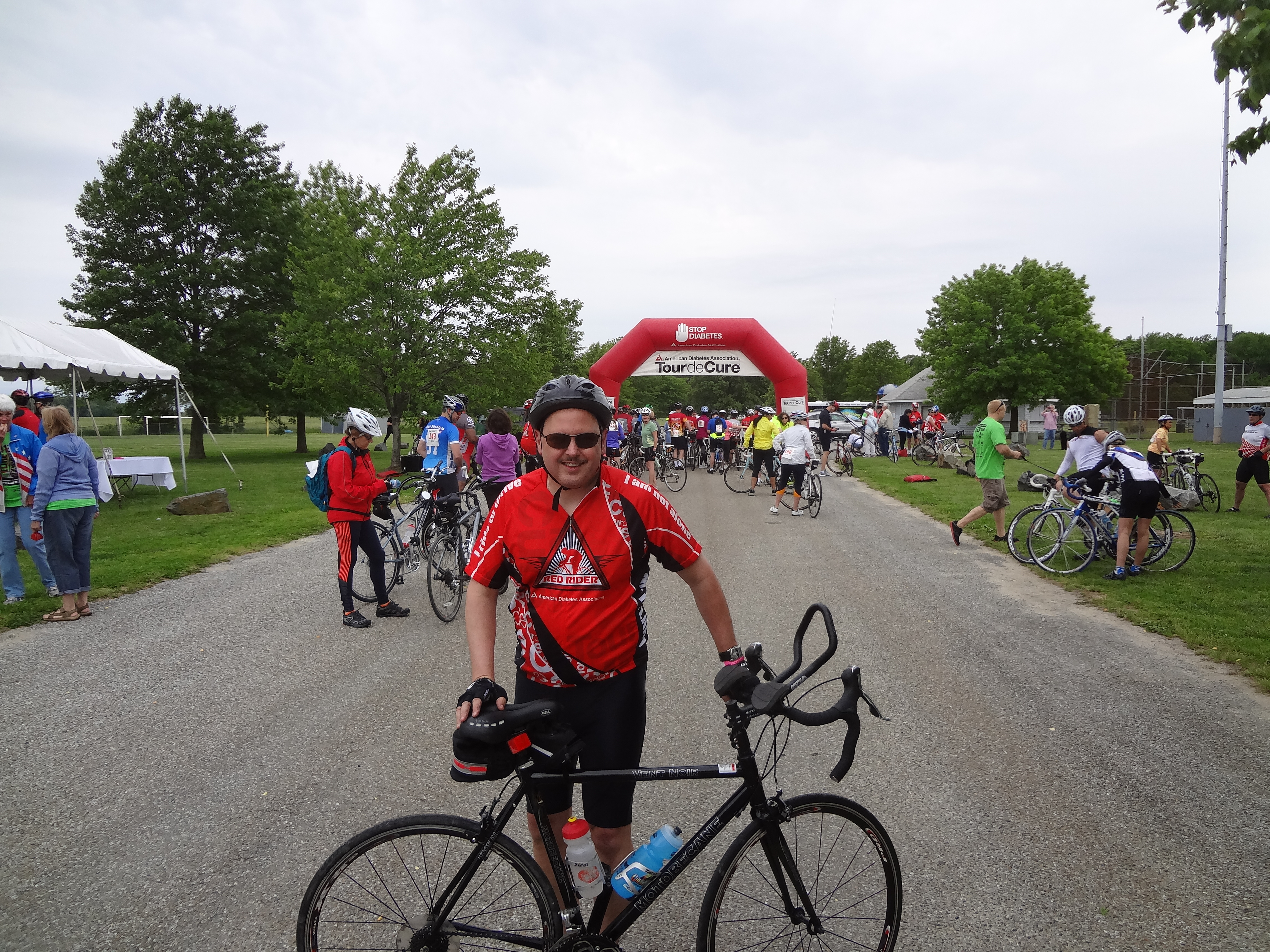
Many of you know Victoria Cumbow, who, among other things, is a passionate diabetes blogger and a dedicated bike rider. She’s participated in two JDRF rides in the past two years (hope I got that right), including one in Death Valley. And this year, she’s participating in two more: the Lake Tahoe ride, and her hometown ride in Nashville.

May is National Bike Month, and Nashville has jumped on the bandwagon to designate this Nashville Bike Month too. To kick start both her fitness goals and her fundraising efforts, Victoria has decided to complete a challenge of biking all 31 days in May.

She’s taking photos of her rides this month, and using the hashtag #inthesaddle to share her experiences. She also asked a very pointed question: Who’s with me?

I don’t think there’s any freakin’ way I can bike all 31 days this month. In fact, I know I can’t, partly because of restrictions and admission days for my clinical trial. Also because I missed biking on day 1. If you miss the month-long challenge on day 1, you can’t really make it up.

But I did decide to go halfsies: To support Victoria, I’ll be biking at least 16 days in May. So far, I’ve been #inthesaddle four out of eight days this month. Some days will be on my bike, some days will be on one of the spin bikes at the gym. And one day will be at the Chesapeake Bay Tour de Cure, which is less than ten days away. Shameless plug: You can still support my ride by clicking on the donate button to the left. Thank you.

So far, the challenge has been good for me, helping me to focus on what’s really important (people), how much I like riding a bicycle after all these years, and helping me get into better shape for my big ride a week from Saturday.

Look for the #inthesaddle hashtag. And if you’re on your bike during this month, maybe you can take a photo and post it too. If you want to support Victoria’s JDRF rides this year (she’s raising $6,000 for research toward a cure!), click here to support the Tahoe ride, and click here to support the Nashville ride.

And pray that my legs hold out for 12 more days #inthesaddle this month.


An update.

A quick update on my story from Friday, when I lamented those “Cash for Diabetic Test Strips” signs showing up in low income parts of Baltimore:

One of the local news outlets (ABC2) has a relatively new in-depth news show called In Focus, which tries to do more of a deep dive into local stories of interest. Well… last night they did a story on these signs, and interviewed a couple of people, one of which is executive director of the Maryland chapter of the American Diabetes Association, and one who is living with Type 2 and really has something to say on this subject.

They didn’t do as in-depth a story as I would have liked, but it’s very nice to see that someone else is talking about this issue in my town. Here’s the link to the story:
http://www.abc2news.com/news/region/baltimore-city/cash-for-test-strips-diabetics-putting-their-health-at-risk

—————————————————————

On a related note, Manny Hernandez and I were interviewed by the same organization (separately) for an online story about diabetes. Manny’s part is at the beginning, and it’s very good.

Unfortunately, the reporter did not get the facts right in my case (near the end). I am not participating in an Artificial Pancreas trial in Virginia—yet. That may change in the near future, but when I spoke to the reporter, I didn’t say I was participating in an AP trial. To be honest, I’m kind of embarrassed about it. If I get turned down for the trial (which is possible—I’ve been turned down for two others), I’ll feel like I’m misleading anyone who might read it. So keep that in mind if you decide to read this:
http://www.abc2news.com/news/health/advances-in-diabetes-testing-technology-improves-patient-care

—————————————————————

I did find out a little more about the “Cash for Diabetic Test Strips” issue, and I’m working on a still more. Hopefully, I’ll have something meaningful to talk about when it’s all over. Happy Wednesday!

1:10 p.m.– An update to the update: I received a phone call a little over an hour ago to let me know that I met the criteria for a clinical trial that indeed does have an artificial pancreas component. Phew! At least I don’t feel as bad as I did yesterday about it. I’ll tell you more about it next week.