Monthly Archives: October 2012

Creatures of Habit.

When I meet other dog owners, and we talk about our dogs, we always seem to share stories about something funny, or strange, or baffling that our dogs are up to. Whether we come up with a reason for these or not, I’m always fond of saying that dogs are creatures of habit. So if there’s something they like, even if it’s weird, they’ll keep doing it unless we give them something else to do.

You know what? People are creatures of habit too. And PWDs are sometimes the most habitual of the lot. I mean, we’re already addicted to insulin, right? No choice there. But sometimes we just get used to things that either make sense, or feel good to us.

I will disclaimer this list with the statement that I go out of my way to avoid superstition. I’ve been known to change my routines over and over again because I don’t like to do things the same way all the time. So here are a few of my D preferences, if you will:

– I like to get everything else out of the way in the morning before I test my BG. That means feed the dog, feed the cat, start the coffee, make my lunch for the day, get my breakfast together. Sometimes all of this can take half an hour or more. I don’t know why I do things in this order. It’s just the way my routine goes, and I haven’t changed it in a while. Look at that… blew my disclaimer right out of the water in the first bullet point.

– When I change my infusion set, I take everything out of the package (reservoir, set, IV prep) before I get started. Or actually, that is the start. I wait until the reservoir is filled before I remove the old set.

– If I do all of that just before a meal, I make sure to bolus from the old set before I insert the new one. But this just makes sense. Don’t want to waste good insulin remaining in the old reservoir, and the set near the end of its use is usually still more reliable than a new set that’s just getting started.

– Here’s a weird one: when I insert the cannula, I do a long five count before removing the needle (One… Two… Three… etc). I haven’t read anything anywhere that suggests you should do this. But I’ve generally had good luck with the set working properly early on in its use since I’ve been doing it. That kind of logic has got to be bogus, and I know it. But I still do it every time.

– I almost always tend to over-count the carb content in a meal when eating out. Partly, that’s because restaurants tend to guess low on carb counts, in my opinion. But I also think it’s because I feel a little guilty getting a sandwich and fries, or a crab cake and baked potato. And I don’t want a high glucose level to make me feel guilty all over again a few hours later.

– I don’t know how long it takes me to shower in the morning. But I always bolus 0.4 units of insulin before I jump in. Works like a charm too. So if you asked me how long it takes me to shower, I would say 0.4 units. Only I know what that really means.

What are your diabetes habits? Do you have any D habits? Maybe there’s something you’re doing that actually makes sense. Weird or not, feel free to share it here.


October DSMA Blog Carnival. What can diabetes educators/HCP learn from the DOC?

This month’s DSMA Blog Carnival topic asks the question:

What can diabetes educators/HCP learn from the DOC?

To begin with, they could learn that our lives are more than “How are your sugars today?” and “Have you been exercising?” and “Have you been doing okay with your diet?”. We lead real lives just like everyone else, and the DOC is a prime example of a group of people telling their real-life stories, with diabetes along for the ride.

Reading those stories can give healthcare professionals a reminder of what it’s like to live with a chronic illness every minute of every day. Let’s face it: diabetes educators, endocrinologists, nurses, phlebotomists, and office staff see so many people throughout each day and each career that it becomes easy to tune out everything that isn’t an A1c, or blood pressure, eye/foot exam, or any other clinical element. Getting a look at someone’s life via a blog or podcast can help them reintroduce the human element into their patient’s numbers.

Also, from this patient’s experience, I know that healthcare professionals can find out about the latest medical gadgetry from PWDs online. About six months ago, I asked my endo about a couple of new things that had recently hit the market. She hadn’t heard of them yet (this is totally understandable—she has many patients, not all of whom have diabetes), so I explained to her what I had read via a couple of DOC sites. A week later, she sent me an e-mail telling me she had read up on what I’d asked about and spoken with a couple of the local sales reps about the products. She also wanted to share my blog with other patients and with another HCP she works with. This wouldn’t have happened without the information being out there, and without my endo and I engaging in both online and offline dialogue.

The DOC isn’t there to get me prescriptions the doctor won’t prescribe, or to turn me on to voodoo cures (air quotes optional). But I do count on the DOC for:

Validation. I will always remember the first time I read about another PWD’s hypo experience, and the feeling I got when I realized I’m not alone on this D planet. Changed my life.

Empowerment. Stories from people just like us helps us decide that yes… we can take on that nasty low and come back strong from it. Yes… we can figure out that meal bolus, factoring in insulin on board + BG + carb count + exercise. Yes… we can have a job, a family, a life. Yes… we can do this.

Support. Just the glasses story from this past July is all I need to mention here. If you haven’t looked at this, click and find out. Enough said.

Guidance. We all have those moments when we’re not sure about the next step. Getting real-time feedback via Twitter, Instagram, Facebook, etc. from those in the know (#makessenseifyouhavediabetes) is incredibly valuable, especially during non-office hours.

Most of all, I want my healthcare professionals to know (read: understand) that the DOC is part of my overall care team. The Diabetes Online Community is not a replacement for my healthcare professionals. But the DOC is just as important.

This post is my October entry in the DSMA Blog Carnival. If you’d like to participate too, you can get all of the information at http://diabetessocmed.com/2012/october-dsma-blog-carnival-2/


Airport Security.

I was thinking yesterday about all of the travel stuff from last week. The good news is that I didn’t have a single issue going through airport security. I rarely do.

But my observations of the security process, for myself and others, revealed that there are some things that I think could be better through the entire process. So taking the “It Takes a Village” viewpoint, here are a few suggestions for everyone:

For TSA Screeners: Can we get a little consistency here? I always point out that I’m wearing an insulin pump as I start the process. Yet sometimes, I get walked through the metal detector and waved on, just like any other passenger. Other times, I get directed to the full body scanner (which I decline based on guidelines provided by my pump maker—more on that in a minute), then to the full pat-down. Then finally, always finally, they do the “touch your pump with both hands” routine where I touch the pump, and my pump and hands get swabbed with something that looks like it came from the inside of a diaper, and the diaper-like product gets run through the machine to check for explosive residue. But TSA: If I had explosive residue on either, wouldn’t you want to know that first? Oh well… it always goes okay, and I don’t have the kind of modesty that bothers me to go through that process. Or maybe I realize that for most screeners, it’s more uncomfortable for them to do the pat-down than it is for me to get it. Although it kind of bothers whoever I’m traveling with. They get through security in seconds; I get through security in minutes (sometimes, many minutes).

Let me say also that I realize I’m in the minority here, and I completely sympathize with anyone who has an issue with this process… there must be a better, smarter, higher-tech way to do this. Full body pat-downs of kids or anyone else just because they’re wearing a medical device is ridiculous. I won’t waste time today going into the myriad of reasons why.

For medical device makers: Why can’t your devices go through full body scanners? Is it because you’ve never tested them? Is it because you’re not sure, and you’re just hedging? Is it because you truly believe that the scanner could foul up the software?

Whatever the reason, my suggestion is this: Fix it. Make your device good enough to go through the scanner. Or if you think it might be good enough, run it through a scanner a few thousand times to test and make sure. If you’re unwilling to do either of those, please communicate with TSA personnel to let them know, so we won’t routinely get directed to the full body scanner just because we’re wearing your device. My guess is your device will handle the scanner just fine. But I won’t know until I know I can go through the scanner for myself, without fear of invalidating my warranty. Wouldn’t you like to be able to say to kids, “You can go through security just like anyone else”? Again, it takes a village, okay?

And that brings me to:

Travelers: Actually, I don’t have any advice for you. Except to 1) Do your homework; 2) Get there early; 3) Be calm; and 4) Be nice to TSA staff. People have bad days, or their bosses are giving them a hard time about being extra diligent with the screening that day, or something else. The more we can take a deep breath and go with the flow, the easier things will probably be.

That does not mean that we should take any crap from TSA staff. When people are wrong about proper procedures, you are absolutely right to set them straight. When people are rude or unprofessional, you are absolutely right to point it out. TSA has a job to do at airport security. That job does not involve making us feel like we’re criminals if we didn’t get everything perfect before we hit their checkpoint today.

Okay, enough ranting. My point is, we all have a part to play. If we do our best, or at least try to do our best, we’ve done our part. Now let’s see if we can get the other players in this game to do theirs.

By the way, here’s the Transportation Security Administration (TSA) website’s latest update, and a few links to pages that have travel information for various manufacturers:

TSA

Medtronic

Animas

OmniPod


Take The Big Blue Test!

Ohmygosh! I completely lost track of time and missed the beginning of The Big Blue Test.

Once again, the Diabetes Hands Foundation, with a little help from Roche Diabetes Care, is sponsoring this effort to get more than 20,000 people to test their blood glucose, get active for 14 to 20 minutes, and then test again. What’s that again?

1. Check your BG

2. Get active for 14 to 20 minutes

3. Check your BG again

4. Log onto http://www.bigbluetest.org and answer five easy questions to log your test

Want to know more? Click here for a great FAQ page with all of the answers. Hint: You don’t even have to have diabetes to take part!

If the goal of 20,000 is met by November 14 (World Diabetes Day), the program sponsor will donate $100,000 to organizations that provide life-saving supplies and services to people with diabetes in need.

So join together with your friends and family and take part between now and November 14. You can test more than once… so test early, and often. On Twitter, look for the hashtag #bigbluetest.

Now, excuse me while I map out the next month’s exercise routine.


Hiatus complete.

I’m back after a week in the warmth of Sanibel, Florida.

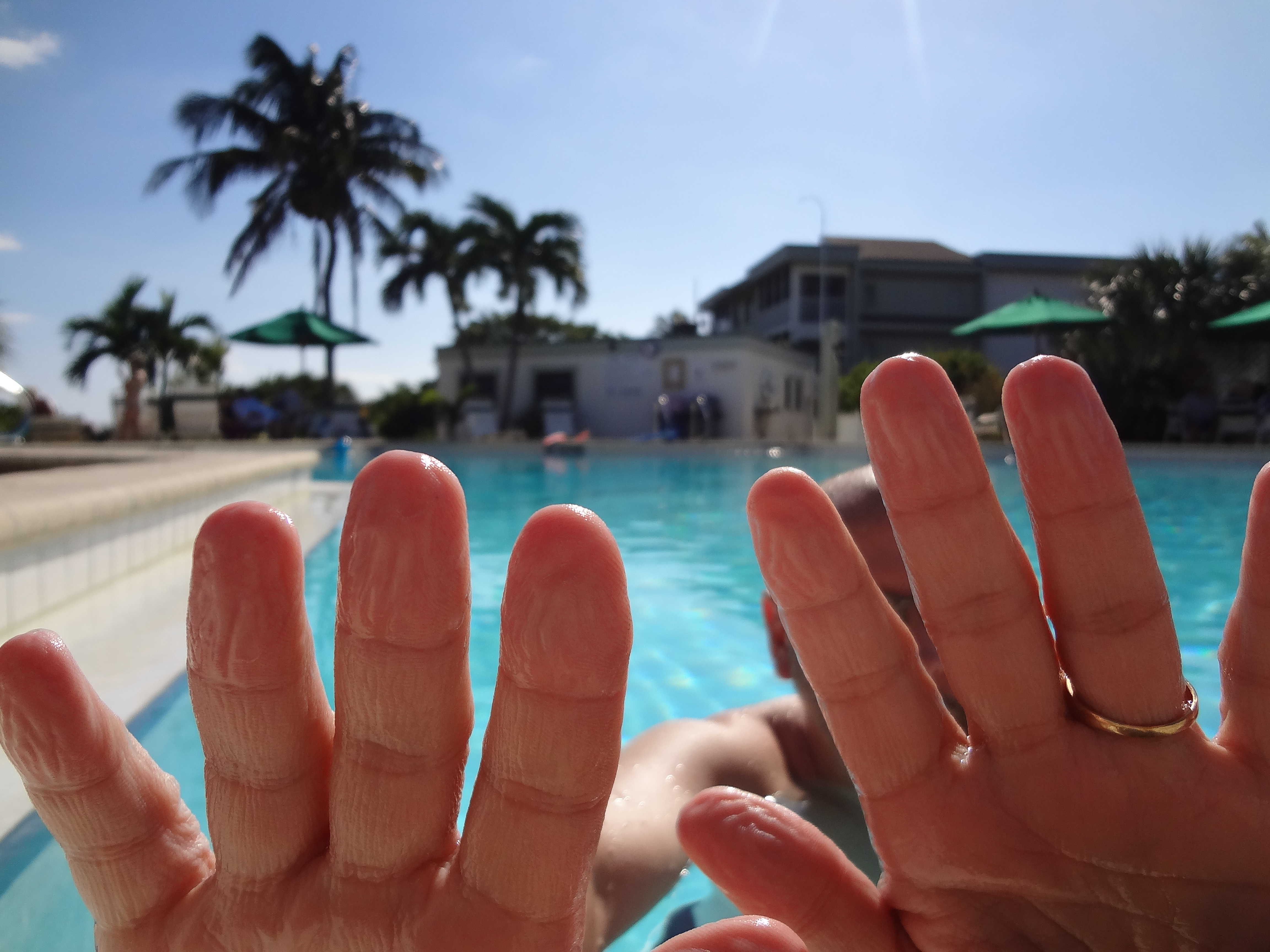
It was a peaceful, relaxing week. As evidenced by the photo above, I spent a lot of time in the pool. I only had one South of the Border incident, and I had half a day after a site change where I was maddeningly North of the Border. But overall, the week was just what I needed: a chance to relax and disconnect from work.

But I did take some time to read what many of you were writing last week. Here’s a sample, in random order:

From Kim at Texting My Pancreas

From Brian at Buzz, Buzz, Not my Cell

From Kate at Sweet Success

From Wil at Diabetes Uncensored

From Kelly at Diabetesaliciousness

Hope this is the beginning of a great week for you!