Tag Archives: Medtronic

Medtronic Acquires Diabeter: Hopefully, the beginning of something great.

A couple of weeks ago, Medtronic, the maker of the insulin pump I’m wearing, made a few waves with its acquisition of the Diabeter clinic in the Netherlands. Diatribe has some of the details, and they were able to speak with Medtronic Diabetes President Hooman Hakami. To read the full story, CLICK HERE.

Diabeter has clinics in four different locations in the Netherlands, specifically designed to help children manage their diabetes. They do a lot to work on a continual basis with patients, employing technology where possible to help patients make updates and manage their care in between visits to the clinic. And they’re pretty successful too: Eighty-five percent of their Type 1 patients who wear insulin pumps carry an A1c under 7.5, and half of their patients on MDI (multiple daily injections) do the same. Notable is how involved they are in their patient’s care. In short, they and their patients are sharing data, and making updates to therapy where necessary, a lot more often than the every 90 days model that most of us here in the States work with.

What does this deal do for Medtronic? I think it probably means a lot of things, not all of them bad.

First, they’ll be able to get real up-to-date information on patients, allowing them to see where they, as a company, might be able to step in and make a positive impact. If one particular product or plan works better than another for a patient, they’ll be able to see that and then bring their vast resources to bear on helping bring that to a wider group of patients. Likewise, Diabeter should be able to continue helping patients without worrying about who is going to pay the rent every month.

Let’s make no mistake though. Medtronic would not have made this investment without wanting to profit from it. Initially, we know they would like to expand the Diabeter model to others in the Netherlands and throughout Europe. What would that look like? Do patients get charged every time data is shared back and forth with a healthcare professional? If patients are considering an insulin pump or CGM for the first time, will they be able to choose between a Medtronic pump/CGM and other offerings on the market in Europe? We don’t know how it’s going to work… it’s still too early. But I don’t think it would thrill Med-T if most of the patients at Diabeter clinics were wearing an Animas Vibe system.

And finally… since it’s so successful, could the Diabeter model work here in the USA? I certainly think it could. But I don’t think it would have a chance here. That’s because of restrictions that insurance companies would make on constant feedback to and input from your doctor. There’s a reason why we go to the endocrinologist only every 90 days, and it’s not just about A1c. I also think it would tax endos and CDEs, especially, to be that involved in a patient’s care. There aren’t enough of them to go around as it is.

I don’t know. Maybe I’m too pessimistic about all of that. I know this sort of system would work for People With Diabetes here. The real issues around making it happen would be resources and payment.

I must admit that I find this acquisition by Metronic interesting. I’m going to want to see how this works for everyone involved: Medtronic, Diabeter, healthcare professionals, and most of all, patients. Over the next few years, I’m hoping we see the expansion of proven techniques that help PWDs be as successful managing their diabetes as possible, with the least amount of work involved to get there. And I don’t care where the great ideas come from, as long as they keep coming.


Because… Progress.

January is practically over, and you know what? It’s been a pretty good start to 2015.

Tandem has announced approval of their larger-capacity insulin pump.
The t:flex pump may not raise a lot of eyebrows, but it does provide something no pump has provided before: The ability to pack 480 units of insulin in the reservoir. I can’t name anyone off the top of my head who needs this right now, but I have been in support group discussions where People With Diabetes felt they couldn’t use an insulin pump because their daily insulin needs are higher, and they would have to change a set out too often, and it just wasn’t worth it to them to go through that. For many, this will solve that problem.

Not to be outdone, Medtronic obtained approval (outside of the USA) for their new 640g system.

This is the first system available to the public that will both suspend insulin delivery when a patient reaches a low point on their CGM, and resume insulin delivery when a patient’s CGM reading recovers. It also comes with additional hardware that looks to me like a PDM, and a seriously-needed upgrade to the CareLink software that, in images on Med-T’s website, look an awful lot like what you see with Dexcom’s downloads.

Speaking of Dexcom… The FDA announced approval of the Dexcom app software that allows CGM users to share their data with others in real time.

For people with hypo unawareness, sharing CGM readings with people close to you is life-changing, and potentially live-saving. Dexcom’s system will employ a new Dexcom Share receiver (the previous version was the Dexcom Cradle), and existing users will be able to upgrade at little or no cost. Of course, you and anyone you connect with (via the Dexcom Follow app) will have to have an iPhone or an iPad device to make this happen. But yay for the FDA allowing Dexcom to go through the de novo classification process, a regulatory pathway for low to moderate risk medical devices that are novel and not substantially equivalent to any legally marketed device, rather than making them go through the gauntlet of the full medical-device approval pathway.

I know, I know… all of these devices may have issues and fall short of what we are looking for from innovations in the diabetes device space. But who was talking about real-time CGM monitoring a year ago? Who was talking about pumps that suspended, then resumed insulin delivery based on CGM readings? Who was discussing larger pump capacities? Okay, well, people were talking about those things a year ago, but at least some of us didn’t expect any of these innovations to be rolled out to actual customers within a year’s time.

In the end, we can’t complain entirely that we don’t get everything we want right now, because… Progress. Things are moving forward, and I’m hoping that we’ll eventually reach a tipping point where the urge to both innovate and get those innovations to patients as soon as possible will cause device and drug makers to move at a pace that matches the rest of the world’s technological advancements.

Because… Necessary.


Decision 2014: Pump update.

So… A quick update on my pump search. As I mentioned back in May, the warranty has expired on my Minimed Revel pump. I still have a fair amount of supplies on hand, so I’m taking a little while to learn more about other pumps out there on the market. You never know… I might re-up with Medtronic. But I don’t want to do so until I’ve had a chance to see what else is out there.
 
 
I may or may not have mentioned this, but I did get the chance to check out the Animas One Touch® Ping® during my last clinical trial. It seemed to work pretty well. I like that it’s waterproof. I also like that insulin bolus delivery is exceptionally fast compared to Medtronic. To be honest, that’s not a deal breaker or a deal maker for me, but it’s something I noticed. Another thing I noticed was how much there is on all of the menus on this pump. Just to prime and begin insulin delivery using this pump requires a lot of button pushing. Again, not a deal breaker, but if all things were equal, that’s something that could sway me toward a different pump. Overall: Good experience.
 
 
That brings me to Tandem®’s t:slim®. I met last week with one of the local reps for this product. Like the other pumps I’ve inquired about, Tandem is not going to let me do a test drive on their model. But I feel like I got the next best thing when meeting with this rep. We spent over an hour talking about everything t:slim. This was pretty unscripted, though I suppose a couple of his answers were because they had to be. The best part was, I was able to handle the pump (which I had not been able to do up to that point).

I practiced filling the cartridge, priming, setting basal rates, programming a bolus. Our conversation was all over the place, which in this case, was good for me. He showed me how specific things worked, and if I had a question out of left field, I was able to ask it and get it answered before we resumed what we were originally doing. It wasn’t a power point presentation; it was two people talking about an insulin pump.

The other thing I liked about this rep was that he didn’t shy away from the difficult issues. Let’s face it: There isn’t a pump on the market that doesn’t have something less than wow about it. But when we talked about those things, I got honest answers. Which is both refreshing, and the decent thing to do.

I liked a couple of additional things related to this pump. I like the bolus reminder. Set your bolus reminder and it will alarm you if you forget. I also like the temperature gauge that can tell you whether you might be in danger of skunking your insulin due to extreme cold or heat. Again, not deal breakers or deal makers, but nice features nonetheless.

I also like that the battery charges like a phone or tablet, rather than requiring the replacement of a AAA battery every month, which I’m doing now. You might not think that’s a huge deal, but it’s at least a minor deal to me. Changing a battery every month isn’t that difficult. But in the time I’ve had my current pump, I’ve gone through 50 or 51 of them. Multiply that by who-knows-how-many insulin pumpers out there, and you get an idea of how much we’re filling our landfills with dead batteries that we don’t need to use anymore.

Bottom line: I like the t:slim, for the obvious sexy reasons. I’m not in love with the cartridge fill, so I’d have to convince myself it’s not a big deal. And Maureen thinks that sliding the cartridge into place in the way the pump works would drive me crazy. She cites my issues with the battery and SIM card on my cell phone as an example. Any honest answers from current t:slim users would be helpful and very much appreciated.
 
 
Next up: I’m looking into the Asante Snap. According to their website, I might actually get to try one out! More to come as I continue to explore the world of insulin pumps.


Minimed® 530G with Enlite®. Five questions.

So the Medtronic 530G and Enlite sensor are here, featuring a new pump and a new CGM (continuous glucose monitor) that talk to each other, with a never-before-available-to-the-public Low Glucose Suspend (LGS) feature. Essentially, when your CGM hits a pre-determined threshold, the new Med-T pump will suspend itself for two hours (or less, if you’ve recovered from a hypo event before the two hours are up).

This is a super development. It’s great that advances in glucose monitoring and insulin delivery and interaction between the two are making their way to the market.

Being the inquisitive sort, after I got excited about the news, I started asking myself questions. Five came to mind in about ten minutes. I don’t have answers to these questions. Maybe no one does. But since it’s my blog, I thought I would ask them here.

A couple of my questions came after reading a fine piece on the 530G at Diabetes Mine. They interviewed company officials and provided some information that I’ll be referencing here. If you’d like, feel free to read their story, then come back here.
http://www.diabetesmine.com/2013/09/new-medtronic-device-gets-fdas-nod-but-dont-call-it-the-veo.html
 
 
Now, the questions:

1. Who gets priority when the orders start coming in?
Will it be new Medtronic customers? Replacements? Upgrades? Influence-peddlers (bloggers, diabetes organization muckety-mucks, etc.)? In all honesty, this is kind of a non-starter for me, because a)There’s really no way for me to find out, and b)The supply will probably outstrip the demand for the product within the first year anyway. By then, we’ll forget how bad some folks wanted it right now back in October 2013.

2. In replacement/upgrade scenarios, what happens to used pumps?
I could (and should) have asked this long ago, but what happens to the old pumps? If the 530G is the greatest system out there, I certainly would like to upgrade. But if someone can’t do that, either because of cost or other factors, I would feel great knowing my Revel™ pump is still going strong, working its magic for another patient. Is that even possible? If not, will the pump’s material be recycled somehow? How does this work today?

3. New users of the 530G will work with a trainer, like they do when starting on other Minimed pumps. What kind of education will 530G users get?
I ask this question because while I was trained, I was not educated about insulin pumps and pump therapy in general before starting on my pump. I was good at getting my A1c down, but there was still a lot I didn’t know. Thanks to my fantastic endocrinologist, I was able to get up to speed pretty quickly. Still, I did not know what insulin on board meant until I read about it online. So theoretically, I could have had the 530G, stacked my boluses up to the ceiling one evening, had the threshold suspend feature kick in on my pump, and still had plenty more insulin acting in my system for a while. Without knowing what was happening to me or why.

I don’t want a new user of the 530G to find out about IOB the hard way like I did.

4. The Diabetes Mine piece mentions that the 530G will not communicate with Medtronic’s MySentry remote monitoring system because the FDA didn’t clear it to communicate wirelessly. Isn’t the CGM communicating wirelessly already? And why do they need FDA approval for something like that?
I remember being at the JDRF Research Summit in Bethesda, Maryland back in March. People working on artificial pancreas technology at the University of Virginia’s Center for Diabetes Technology presented, and among the things they revealed was a remote monitoring feature. Parents in attendance were super-interested in this, and they asked the presenters about whether something like that might be available soon. I remember the UVA presenters said that they didn’t anticipate rolling out the remote monitoring ahead of any device they might be working on. But they also said that they didn’t believe something like that needed FDA approval, because it wasn’t doing anything medical. It was just reflecting what was already going on with the AP system, and the remote monitoring itself wasn’t being used to make any medical decisions for patients.

And like I said above, the Enlite CGM will be communicating wirelessly with the pump already. Shouldn’t be too hard to get it to talk to the MySentry too.

5. Finally: What’s all this artificial pancreas posturing about?
You knew I would ask this, right? This is a little touchy for me. Rhonda at FifteenWaitFifteen wrote about being uncomfortable about this too. Medtronic, and by extension now, many in the media, are using the term “Artificial Pancreas” when referring to this system. The LGS feature in this system is very AP-like. But after seeing numerous talks about artificial pancreas technology, from more than one source in the past year and a half, I can tell you that the 530G is not an artificial pancreas device in the way I think of one.

Last time I checked, no one copyrighted the term “artificial pancreas”, so Med-T is within their rights to tout it as an AP device if they want to. But I worry about two things: First, will using the term with this device, which doesn’t have all of the features of artificial pancreas technology, cause non-D friends, family, and co-workers to think this is the holy grail, and now we shouldn’t have any trouble with our diabetes from here on out? Second, will using the term “artificial pancreas” like this eventually dilute the term for all of us, to the point where just a CGM that talks to a pump will be considered an AP device? We’re just now making big strides in technology that will benefit many with diabetes. When an outfit uses the term “artificial pancreas”, I don’t want it to be less than I’ve been led to believe it will be. Just my two cents. Feel free to disagree.

Full disclosure: Okay, half disclosure. I have a particular interest in this topic, especially right now, and I recognize that this may skew my viewpoint. More about that next week.
 
 
So those are my five (plus) questions on the Minimed 530G with Enlite. As with almost everything, time will probably provide the answers. Do you have any questions of your own? Have any answers for mine?


Reservoir Recall, and the FDA Gets Tough.

DSC00940

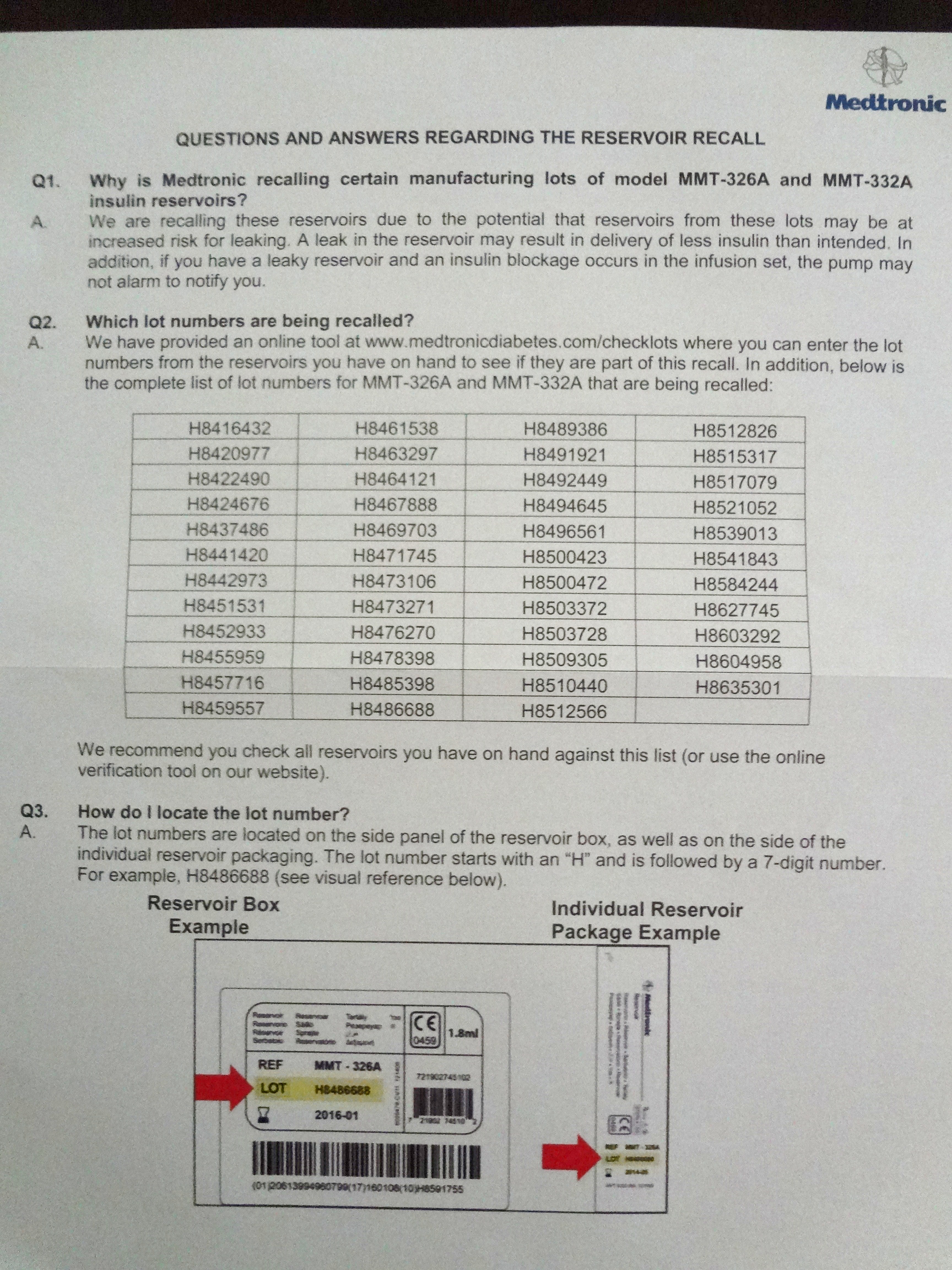
This is an FYI post, in case you haven’t heard about it yet. If you’re a Medtronic pumper, you will hear about it because Medtronic is sending a letter and FAQ sheet to all their pump users.

Medtronic Diabetes is voluntarily recalling specific lots of reservoirs for Paradigm insulin pumps. Apparently, the affected reservoirs are at increased risk for leaking. The photo above is part of the FAQ sheet I received that lists the lot numbers that are being recalled.

Now, I know it’s easy to bash a company for making something that is eventually found to be faulty. But I will also give you some facts, according to the recall notice sent to me:

– First of all, this is a voluntary recall. No one made Medtronic recall these reservoirs. I don’t know if there was any kind of communication between them and the FDA, for example, that led to the voluntary recall before a mandatory one. But still, a voluntary recall always happens faster than a mandatory one.

– Medtronic conducted an investigation of the cause of this issue, and found that the reservoirs in question were all manufactured on a specific manufacturing tool that developed “abnormal wear”. They have corrected the issue and put additional testing and inspection in place.

– Med-T has a number to call if you have the recalled reservoirs and need new ones right away: 1-866-450-0890. They will ship the new ones free of charge to you.

Medtronic acknowledges a few cases of diabetic ketoacidosis requiring hospitalization that may have been caused by the faulty reservoirs. I don’t want to belittle these cases, or the patients and their loved ones involved. I also think it would have been nice if I’d have received an e-mail, or a tweet from @MDT_Diabetes. Other than that, what I am saying is that if a product I’m using does need to be recalled, I want the recall to be done like this.
 
 
Also, the FDA has cracked down on companies selling products that claim to help mitigate, treat, or cure diabetes, but as we know, they don’t. This includes “natural” treatments that have undeclared ingredients; dietary supplements that claim to treat, cure, or prevent diabetes; homeopathic over-the-counter meds that claim to help with peripheral neuropathy; and prescription drugs sold by pharmacies without a prescription.

Take a look at these products, and where they’re from. It proves that there are scam artists just about anywhere you go. These products are being pulled from the market by the FDA:

– Diexi by Amrutam Life Care Pvt. Ltd., Surat India.

– Anastasia Diapedic Foot & Leg Treatment by Anastasia Marie Laboratories Inc., Oklahoma City, Okla.

– Exermet GM, Galvus, Nuzide, Triexer and unapproved versions of Januvia, all from
bestcheapmedsonline.com.

– Diaberex by Enhance Nutraceutical.

– Zostrix Diabetic Foot Pain Relief Cream, Zostrix Diabetic Joint & Arthritis Pain Relief Cream and Diabeti-Derm Antifungal Cream, all from Health Care Products, Hi-Tech Pharmacal Co., Amityville, N.Y.

– Sugar Balancer by Health King Enterprises & Balanceuticals Group Inc., Chicago.

– Insupro Forte by INS Bioscience Berhad, HLS International Sdn. Bhd., Easy Pha-max, Selangor Darul Ehsan, Malaysia.

– Diabetic Neuropathy Foot Cream, Diabetic Foot Cream, and Diabetic Hand & Body Cream by The Magni Group, doing business as MagniLife, McKinney, Texas.

– Eradicator by Naturecast Products, Coral Springs, Fla.

– Diabetes Daily Care by Nature’s Health Supply Inc., College Park, Md.

– Glucocil by Neuliven Health, San Diego,Calif.

– Neuragen PN and Neuragen Cream by Origin BioMed Inc., Halifax, Novia Scotia, Canada.

– Nepretin by Nutrient Synergy, Longmont, Colo.

– ProBeta by PharmaTerra Inc., Bellevue, Wash.

For more information, and to stay up-to-date or report on Diabetes drugs or devices, visit FDA MedWatch at www.fda.gov/Safety/MedWatch/default.htm
 
 
Happy Wednesday… Stay safe!