Somehow, I was down in the 30s this morning at 3:00. The remedy: two juice boxes, some peanut butter, and three hours of sleep. This is the result:
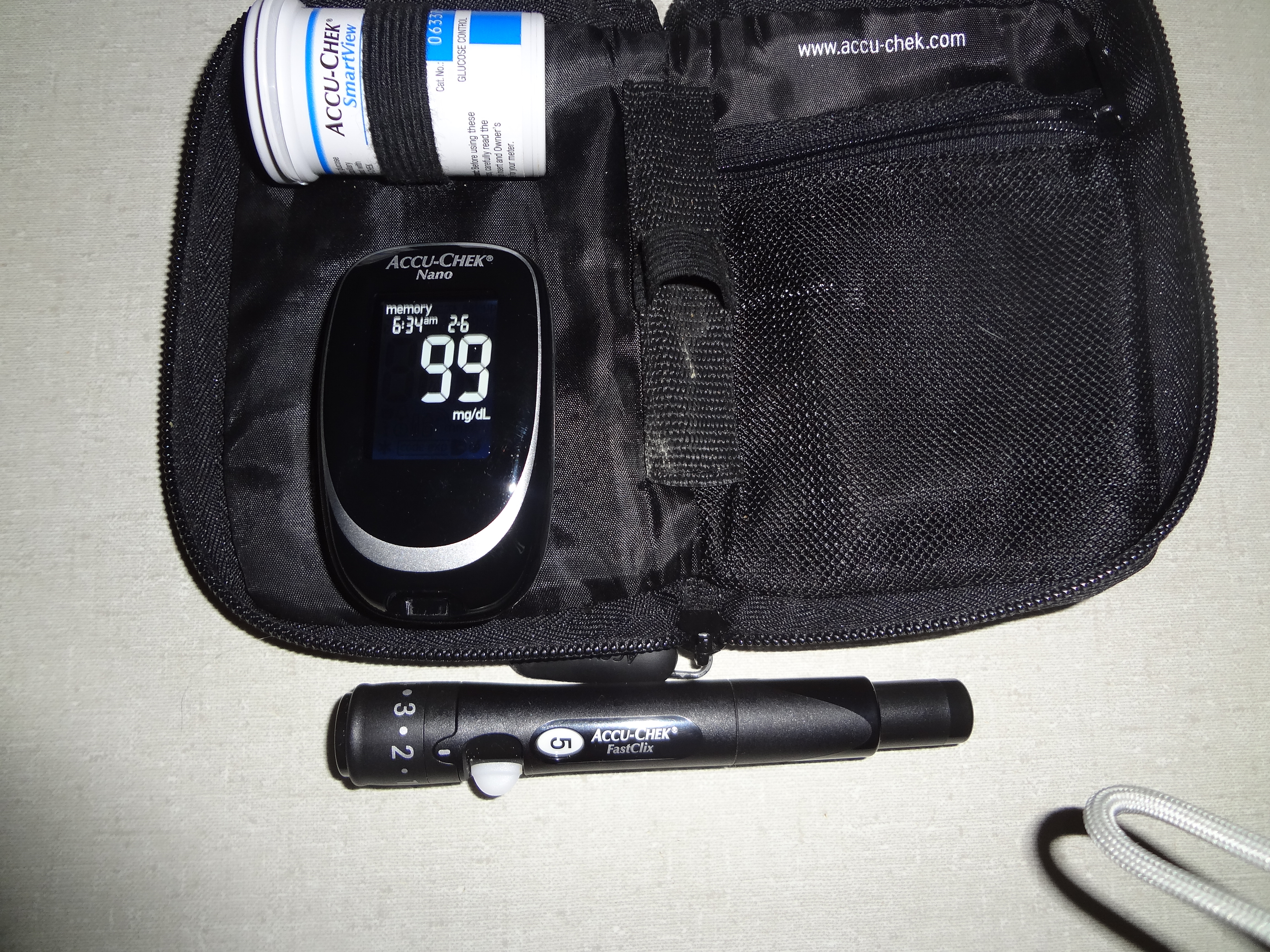
Have a great Wednesday!
 Diabetes Blog – Happy-Medium.net
Somehow, I was down in the 30s this morning at 3:00. The remedy: two juice boxes, some peanut butter, and three hours of sleep. This is the result:
Have a great Wednesday!
This Sucks! Sucks!
As if it happened because I wrote about my Saturday night low, I was low twice Wednesday. This does not happen often.
Once at work, about 4:00 in the afternoon. Typical symptoms… shaky, sweaty (always appealing in an office setting), trouble focusing. No one noticed. That’s okay.
Then again, about 2 hours later, after walking to the train (it’s about 1/2 mile from my office). By the time I get there, I’m sweating again and very, very tired. I shut my pump off and reached for the candy in my pocket. Just then, my nephew walks up. He works nearby and rides the train too.
We rode together to my stop. I couldn’t put two intelligent words together for about half the ride, but by the time I got to my stop, I was fine. Of course, on the way home from there (it’s only a mile), I get a phone call from The Great Spousal Unit.
“How are you feeling?”
“You’re kind of late, and I was getting worried about you.”
“Yes, Brian called and told me you were low.”
How nice is it that I have great, caring family around me?
There is that.
I’m not sure there’s a moral to this story. There doesn’t have to be one anyway.
I really don’t want to write about this, and as you can probably tell, I’m having trouble getting started. But if I’m going to tell my story, well… this is one of the chapters.
I’m a typical blogger in that I love to talk about myself. I also like to paint a nice picture of myself whenever possible. I don’t really want to mention anything that doesn’t make me look good. But that’s what this post is about.
Long story short: On Saturday, I over-bolused for dinner and whatever I snacked on later (I don’t even remember what it was). Later, about 1:45 in the morning, The Great Spousal Unit woke me up and said “You should go test your blood sugar”. It took me what seemed like a long time to actually get up. I was awake for sure, but… non-responsive would be the best way to describe it.
So Maureen did what she normally does in these situations.
Step 1: Try to shove juice, honey, peanut putter in my mouth.
She tried to shove some things in my mouth, but I was still feeling very full from whatever I had consumed earlier. By this point I knew I was low, but I wanted to take it slow. Bad Strategy. And, of course, I was tired and I really wanted to sleep. It was getting harder and harder to motivate me. We made it downstairs to the kitchen, but still, I was having trouble coping. Enter Step 2.
Step 2: If step 1 doesn’t work, call 911.
Maureen later admitted that she probably jumped the gun on this one a bit. But I reminded her that it’s not her job to know exactly how I am at any given moment, and if she’s at all unsure, make the call. It took a long, long time for me to come to this way of thinking. I never want an EMT to come and help me when they might be needed for something more important. But for Maureen, at that moment, nothing was more important. They were coming to help her as much as to help me.
I checked my BG once we got to the kitchen: 43. About 5 minutes later, the call went in to 911. About 5 minutes after that, the EMTs came through the front door (the local fire house is about a mile away). By this time, I’m groggy but able to make conversation, able to drink some juice and eat a little. The EMTs were great. They knew what was going on, and they were content to just wait it out with me.
So we waited. Those 15 minutes we were all standing in the kitchen seemed like forever. Then I checked again: 89.
Back to some semblance of normal. The EMTs left, and TGSU and I sat in front of the TV for a while longer to make sure my glucose was going in the right direction. Kelly at Diabetesaliciousness talked about waiting out a high Monday night, and being really tired, wanting just to sleep, and having to wait. And how that’s one of the things that sucks about diabetes. I agree.
Well, that’s what it was like for me, except from a low. I was super, super tired. And cold, very cold. Lows always do that to me. And I had to wait so I could check my glucose again. 20 minutes later: 131.
Not much more to it than that. Everything turned out okay in the end. I could have done without the drama though.
A week ago Tuesday was the annual meeting of the Maryland JDRF. I was happy to get out to an actual JDRF event for the first time in a long time. It was a fun event and I got to meet some very nice people.
In addition to the normal business that gets done at the annual meeting (election of board members, officers, etc.), they handed out awards to many who did a fantastic job of organizing teams, raising money, and volunteering for the JDRF walk in Baltimore held back in April. The amazing amount of greatness that results from these grassroots efforts are immeasurable. I’m adding this to my calendar for next year everyone… count me in.
The final part of the evening was well worth waiting for. A member of the staff at the Center for Diabetes Technology at the University of Virginia School of Medicine talked about the Artificial Pancreas Project. I had heard the term Artificial Pancreas, and I had read an occasional post or two about it, and I knew that the FDA had approved the AP for outpatient clinical trials, but it wasn’t until this talk (and after catching up by phone with the speaker early this week) that I realized there is still much for me to learn about this fascinating technology.
Now, before you say it, I will: This is not a cure. I get that. And trust me… I want a cure as much as you do. I also have to admit to some skepticism when it comes to wealthy companies that spend a lot of money developing gadgets that can help to keep our conditions chronic, rather than searching for a way to make our conditions history.
That said, there’s no denying the fact that the Artificial Pancreas, or something like it, is something that could have a significant, life-altering (life-affirming?) impact on millions of us living with diabetes. Let me tell you why. I’m not blessed with total recall, but I’ll try to give you what I can from this interesting presentation.
First, a brief description: the Artificial Pancreas is a device that works with your insulin pump and continuous glucose monitor (CGM) to make adjustments in the delivery of insulin throughout the day, based on multiple factors, including: your glucose level and how it’s trending; what you just ate and how you bloused for it; whether you’re heading out to exercise, and more. The primary function is to keep your BGs in a safe range. And more importantly, to keep you out of the danger zones, both high and low.
It’s all done on a mobile device. That’s right… all the technology is loaded onto an Android phone. The device has had the software cleaned, then loaded with the AP platform. Software is loaded to the phone as Android apps.
It’s 3G, WiFi, and Bluetooth capable. Per FDA guidelines, it’s outbound only, so you won’t get any text messages or voicemail. Also, no phone or browser, and no third party apps… so you won’t be playing Words with Friends on the runway with this sucker.
Why the WiFi if there’s no browser? That’s where the remote monitoring comes in. It’s a way for a parent, or your endocrinologist, or your spouse to monitor your condition without having to make a million calls (are you listening honey?).
The algorithms developed (and still being worked on) are to account for unique things like exercise and pre-bolus and post-bolus conditions. Other algorithms are still being worked on to cover additional factors, like child versus adult or male versus female physiology. Hey, Your Diabetes May Vary, right?
The folks at UVA have also developed a watch-like device that can be used to monitor the AP device. Think about being on a road trip, and you’re unable to take the effort to check out your AP while driving (whether that would even be legal is yet to be determined). So you look at your wrist, and you can see how you’re doing. It means that potentially, if you’re the parent of a CWD who is out on the soccer field, your son or daughter could have the watch on while you monitor the AP from the sideline. Sweet.
That’s just some of what we learned during this fabulous talk.
So, what about the testing? The folks at UVA are conducting both inpatient and outpatient clinical trials on the Artificial Pancreas. The University of Virginia-developed AP was the first to get FDA approval to conduct outpatient clinical trials. And get this: In the entire testing of the UVA-developed Artificial Pancreas, in testing both in Europe and in the USA, patients have encountered zero nighttime lows. Let me say that again: Zero overnight hypoglycemic events.
And what is JDRF’s role in all of this? Most of you probably know already that JDRF has played an integral role in funding research for the Artificial Pancreas. In addition, JDRF has used its influence as an advocate for type 1s to inform lawmakers and urge them to continue funding research; to pester the FDA to accelerate testing on this game-changing technology; and even help with gathering volunteers for clinical trials on this and other exciting advancements in care and technology.
When someone raises another five dollars in a JDRF walk in Wichita, or participates in the Ride to Cure Diabetes in Death Valley, or includes JDRF in their will in upstate New York, they are helping to make this kind of effort possible. When I was diagnosed back in 1991, I was told how lucky I was that I didn’t develop diabetes a generation earlier. That drugs, technology, and overall care had improved so much. Now, 21 years later, we are on the cusp of another leap forward. JDRF is a huge part of that change in the landscape. Guess what, PWDs? The best is yet to come.
Let me finish by leaving you with a few links:
First, information about the Artificial Pancreas at the Center for Diabetes Technology at the University of Virginia School of Medicine. Check out the staff bios and you’ll be impressed at the creativity and knowledge of everyone working on this project:
http://www.medicine.virginia.edu/research/institutes-and-programs/cdt/artifical-pancreas-technology
Interested in becoming part of clinical trials for the Artificial Pancreas at UVA? Send an e-mail here:
artificialpancreas@virginia.edu
JDRF’s official website devoted to the Artificial Pancreas Project:
http://www.artificialpancreasproject.com/
You can also sign up via JDRF to participate in active diabetes clinical trials in the USA:
https://trials.jdrf.org/
Disclosure: Actually, there is no disclosure. Neither the Center for Diabetes Technology at the University of Virginia School of Medicine, nor JDRF influenced me in any way in writing this post. I’m a blogger, not a journalist. But I try to get the facts as accurate as possible. If I missed something somewhere, please let me know.
I’m so happy… I finally got to get out on the bike Saturday and put in something near 30 miles. I only have five more weeks until I have to go 150 miles over two days. 100 miles on Saturday, 50 miles on Sunday. But getting in almost 30 miles, over very hilly terrain, was good. Only I wound up chasing lows the rest of the day.
I’ve been a pumper for two years now (Medtronic), and up until now, in events like runs and triathlons, and in workouts, I’ve always disconnected the pump. All of these events have taken less than two hours to complete, and I’m able to handle that without getting excessively high glucose levels. Usually up near 300, but for me, not a deal breaker. But this event won’t allow that kind of flexibility. The pump has to stay on for the entire event. So now in workouts, I’m getting used to leaving the pump on, using temp basals to adjust for the workout.
That’s what I did Saturday. Set the temp basal for 2 hours, 0.75 units per hour.
When I finally got home, my BG was a respectable 71. Not bad since I hadn’t had breakfast yet. That was about 9:45. So I ate breakfast, and helped The Great Spousal Unit with some work in the garden. We broke for lunch around 12:15. That was a little more than two hours since my last meal. What was my BG? 64. Okay, I’m still hanging in there. I just won’t bolus since I had a lot of exercise this morning. I should be fine now, right? Not exactly.
We went to the local big-box home store to pick up a few items for the garden we were working in. We came back, I unloaded everything, and guess what? I needed to go in and get some juice! I could feel myself get all jelly-legged, and I knew I needed to act. So now, I should be okay for sure, right? Not exactly.
It only took about 45 minutes for us to finish up in the yard, and we went in to get a shower. Maureen was taking me to one of the local bar & grills for dinner before the Kentucky Derby (did I mention that I’m a huge horse racing fan?). Maureen went up to get in the shower, and I stayed downstairs to watch the end of the Capitals victory over the Rangers.
I go upstairs to get my shower, and Maureen says, “Hon, are you okay? You’re sweating a lot”. More juice. About 3 1/2 hours after I ate lunch with no bolus. So I have more juice, and some crackers, and get a shower. Before we go to dinner, I check, of course. What’s the BG? 59!
So you can guess what most of our conversation was about over dinner… how am I going to manage the glucose over a day when I expect to be riding around 8 hours?
This is a big part of life with diabetes. Finding the best way to handle a day, an event, anything, and planning as far ahead as possible. And the planning is completely separate and apart from anything that a non-PWD has to contend with in this event. For now, the plan is to ratchet down the basal rate to something like 0.400 for the 8 hours I’ll be riding. Maybe less. And finding a way to get more carbs in my system during the event. I’m also going to start searching for some additional guidance from experts who deal with this kind of thing a lot (Team Type 1?).
And I am so glad that I have a champion there for me while I’m riding. I love that TGSU is there at all of the events. But I’m equally grateful that she is there to help me, and also challenge me when I need it. I never asked her to do this. Never expected her to. But I can’t tell you how great it is to know that someone has my back.
Five(!) weeks to go. Despite the lows Saturday, I’m feeling like I’m getting closer to being ready. This will happen. I can do anything with diabetes that I could without. Like so many others have said, not trying is not an option.
A Disclaimer
I have no medical training. If you consider anything written here as medical, legal, financial, or any other kind of advice, you’re out of your mind. Please speak to a learned professional before making any changes that might affect your health. Any of the original content found on this site is my property and should not be reproduced, copied, or otherwise used without the author’s expressed written consent.

Athletes With Diabetes: Want a medal like this? Click to find out how to get yours!

 | Bebygirl on My week with Celiac… Day… |
 | Patricia Harper on Review: The Accu-Chek Gui… |
 | Gráinne on The Long Goodbye |
 | kelly2k on The Long Goodbye |
 | Karen on The Long Goodbye |
 Diabetes Blog - Happy-Medium.net