Tag Archives: healthcare

#IGNITEInterop – Let’s all communicate (Part 2).

DSC01377
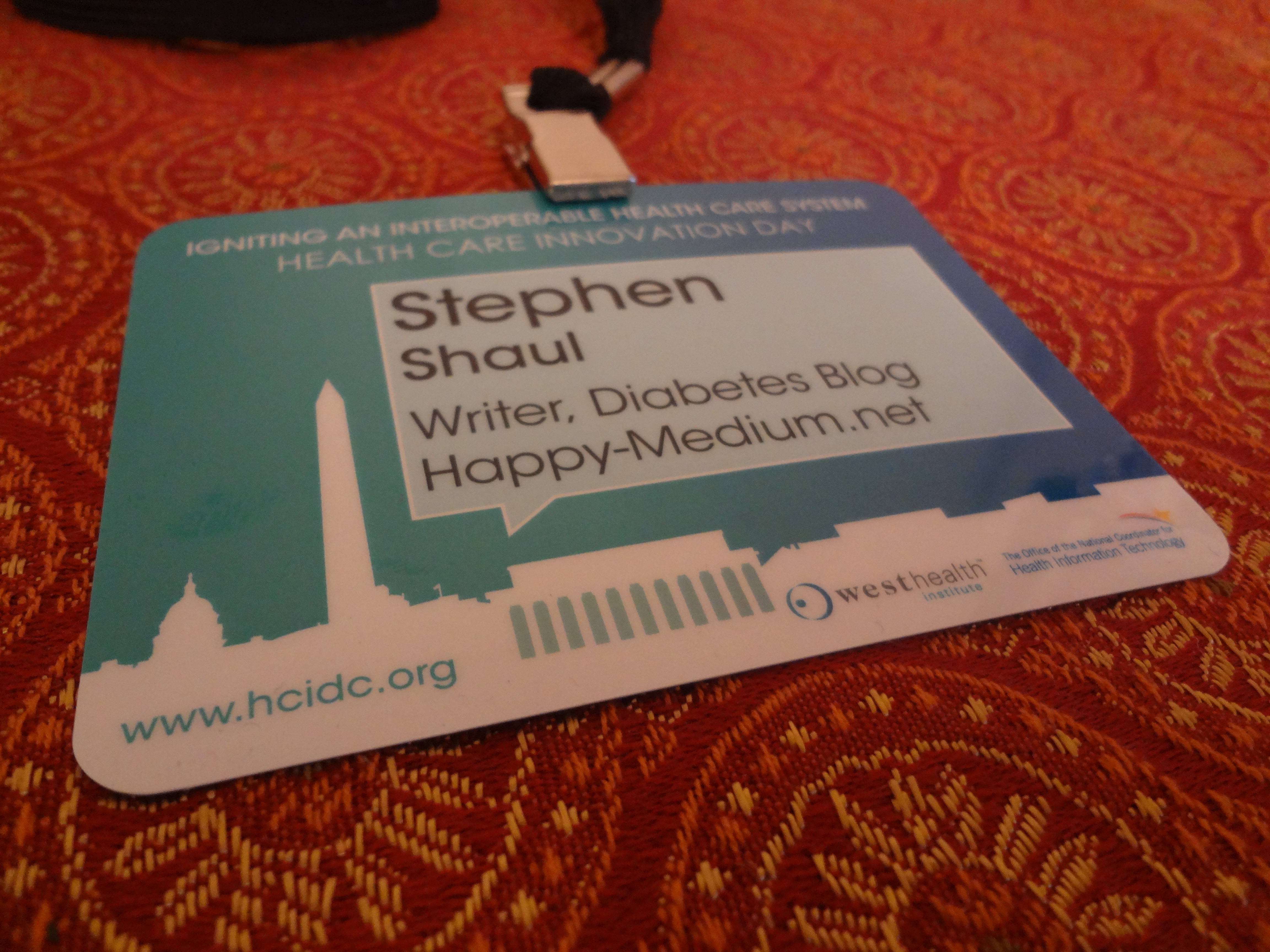
Since it’s only 40-some miles away (though a two hour commute) from home, and I got enough advance notice, I headed to Washington, D.C. last Thursday for HCI-DC 2014: Igniting an Interoperable Health Care System.

The event was co-hosted by two different groups: The Gary and Mary West Health Institute, which, according to its website, “is an independent, non-profit 501(c)(3) medical research organization whose mission is to lower health care costs by developing innovative patient-centered solutions that deliver the right care at the right place at the right time.” And the Office of the National Coordinator for Health Information Technology (trust me, it’s an actual government office).

The idea of the day was to get as many people in the room as possible to talk interoperability in health care. Not just, “Can I get my CGM to talk to my pump”, although there was some of that. But there was also a lot of talk about how to push for standards in medical record-keeping, and making them accessible to health care professionals, in the same format, worldwide. Imagine this: I have an accident in another city, I get rushed to the ER, and a doctor could pull up all of my medications and doses, and my pump settings, etc. Today, all of that might be on paper somewhere, and depending on the timing, a doctor may or may not be able to get access to it right away. You get the picture.

There were things I liked about this conference, and things I didn’t like. I hope I can explain a bit here. Yesterday, I talked about the things I liked. Today, things I didn’t like.
 
 
What I didn’t like:

Unless they were hiding under a chair or something, there were no manufacturers present at this gathering. I don’t know if they weren’t asked to attend, or if it was too long a trip from California or Europe or wherever they are, or if they just didn’t want to talk about interoperability at all.

If it’s that last thing: Let me just share something I mentioned in a conversation with someone over lunch that day.

I’m sure that the cost of the CareLink software is baked into the overall cost of my Medtronic insulin pump. But if Medtronic, for example, decided to make their code available to all, or if they agreed to adhere to a standard software protocol with future products, I would still want an insulin pump. And you know what? If they did get on board with interoperability, I might actually want to buy their pump even more. Insulin pumps and CGMs won’t go away once their data is “democratized”, to borrow a phrase I heard that day. Each patient will buy what’s best for them at the right time, but they will still want pumps and CGMs. And if manufacturers finally move toward a standard for device interoperability, they would finally be free to spend less time worrying about how to make their software proprietary, and spend more time worrying about how to make a better product (disclosure: I’m perfectly happy with my insulin pump right now, even if I see it as less than perfect).

There was something else that touched me that day. I want to move delicately around this subject. But… here’s the thing: There were a few female presenters (like, three). All the rest were male. Nearly everyone in a panel discussion or presenting was white.

Now, I realize that even if there was a concerted effort to bring more diversity to the stage for HCIDC 2014, there probably still would have been an overabundance of white people facing the audience. That’s just the way it is. But the fact is, the audience was pretty diverse in itself. Enough so that there were a couple of tweets from others who noted the steady stream of people walking onto the stage wearing a dark jacket, white shirt, and a tie.

Washington is a very diverse city. America is an amazingly diverse country. For next year’s event I kind of hope the presenters, or the members of panel discussions, will reflect that diversity just a little more.
 
 
So, now my overall take on this event:

I liked it. I really liked what I heard from everyone, onstage and off. I’m encouraged by where the discussion about interoperability is headed in the future. The will to make this happen, or at least get down the road a little farther, is really starting to crystallize.

But without manufacturers becoming part of the discussion, we’re not going to get very far. As Malcolm Gladwell alluded to in his keynote address, “No one will work toward interoperability in health care unless it is framed as urgent, imperative, life or death”.

Well, guess what? It is. Interoperability isn’t everything. But it is a game changer, because it would 1) Free up already overworked people from writing and entering so much data that can’t be shared anywhere else but at the point of care; 2) Lower costs for manufacturers, because once a standard is in place that everyone can follow, work on proprietary software will be minimal; and 3) Help improve patient outcomes, due to devices working together to ensure safety and optimal results for the patient, rather than being in their own silos just so they can generate more imagined revenue for the maker.

I agree… the time is now. We have the means and the determination to make interoperability in healthcare a reality. I hope this event comes back next year, and I’m looking forward to what kind of changes will happen between now and then.


#IGNITEInterop – Let’s all communicate.

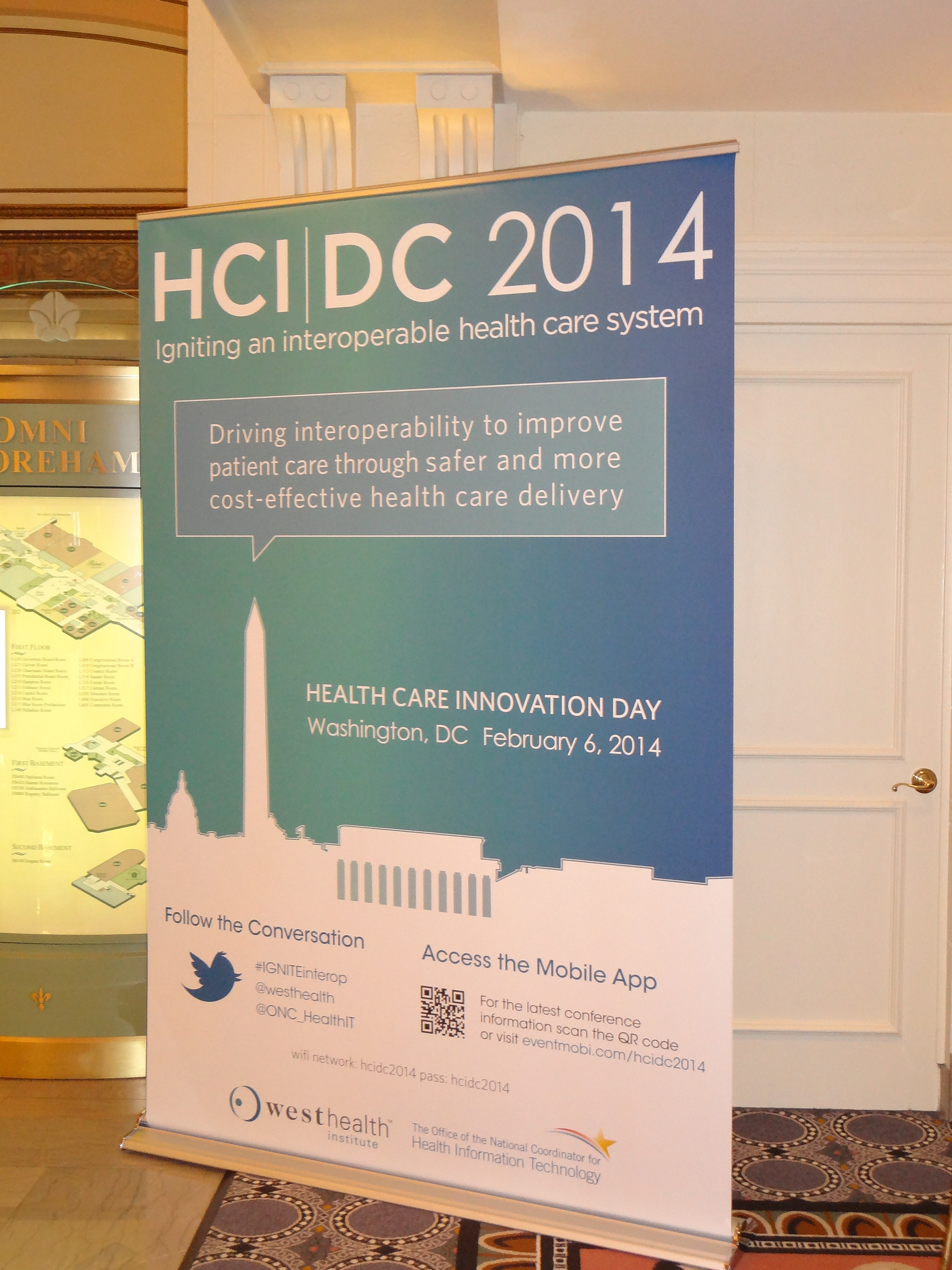
Since it’s only 40-some miles away (though a two hour commute) from home, and I got enough advance notice, I headed to Washington, D.C. last Thursday for HCI-DC 2014: Igniting an Interoperable Health Care System.

DSC01339The event was co-hosted by two different groups: The Gary and Mary West Health Institute, which, according to its website, “is an independent, non-profit 501(c)(3) medical research organization whose mission is to lower health care costs by developing innovative patient-centered solutions that deliver the right care at the right place at the right time.” And the Office of the National Coordinator for Health Information Technology (trust me, it’s an actual government office). The idea of the day was to get as many people in the room as possible to talk interoperability in health care. Not just, “Can I get my CGM to talk to my pump”, although there was some of that. But there was also a lot of talk about how to push for standards in medical record-keeping, and making them accessible to health care professionals, in the same format, worldwide. Imagine this: I have an accident in another city, I get rushed to the ER, and a doctor could pull up all of my medications and doses, and my pump settings, etc. Today, all of that might be on paper somewhere, and depending on the timing, a doctor may or may not be able to get access to it right away. You get the picture.

There were things I liked about this conference, and things I didn’t like. I hope I can explain a bit here. Today, I’ll give you the things I liked. Tomorrow, things I didn’t like.
 
 
Things I liked:

The first panel discussion covered Perspectives from the Point of Care. It was an interesting discussion moderated by the Chief Medical Officer of the ONC (Office of National Coordinator for Health Information Technology). The panel included some great voices from a healthcare provider point of view, and from the patient point of view, including Anna McCollister-Slipp, Co-Founder of Galileo Analytics and a fellow Type 1. A large part of the discussion centered around Anna’s Type 1 diabetes, the devices she uses, and these two facts: 1) None of her devices talk to each other, and 2) Her healthcare providers cannot, due to rules coming down from the healthcare system they’re working in, download any information from her pump or CGM. From first-hand knowledge of the conversation, I can say that everything Anna said, and everything she advocated for, was right and correct and she was a super advocate for PWDs everywhere. I wish you could have been there to hear it.

Pretty much every discussion during the day was like the one above. There was a real feeling that the time is right to move toward interoperability in health care. One of the photos that really brought the point home was when we were shown someone in an ICU room, with about ten different machines at work helping to keep the patient alive. And none of them talked to each other, or shared their data with any system in the hospital. So doctors or nurses needed to view what was happening with each machine, then write the data down in a chart or a folder, then enter some of that data into the hospital’s system. How much time does that take? How much care is not being given to the patient while a doctor or nurse is compiling data like a drone?

I liked the following statements that were made (please understand that most of these are paraphrased):

Anna McCollister-Slipp: “An A1c is helpful, but kind of like using The Farmer’s Almanac to plan your afternoon. My endo needs to be able to see my CGM data”.

Stephen Jones, President and CEO, Robert Wood Johnson University Hospital and Medical Center: “If health care systems develop uniform standards, we can then use our buying power to drive interoperability, and force the issue with manufacturers and vendors”.

Dr. Michael Johns, Chairman of the Center for Medical Interoperability: “We need to move now, or we’re letting down the next generation”.

There were many comments like this throughout the day.

Also, I very much liked the keynote speech from Malcolm Gladwell, best-selling author of The Tipping Point and other books, and a former writer on the medical beat for the Washington Post. Which, he reminded us, meant that if he were still at that job, he’d be covering the event this day for the paper.

He used three examples of how interoperability in other arenas allowed for increased outcomes for consumers and businesses, not less. How the interoperability wasn’t always made possible by the people who designed the parts that inspired the interoperability. And how the time is now… the moment is right for pushing this cause forward. He mentioned how there are three roadblocks to interoperability: Culture, meaning how things are done today and how people expect them to be going forward; How to frame the message, because sometimes it’s more than shouting, but rather getting people to understand when, and why they have reached a critical moment that requires change; and the concern over Consequences to change. Maybe one part of a business does suffer, but another part of the same business grows as a result of the implementation of interoperability. There was a good recap of the speech written at Healthcare IT News by Diana Manos, and I will refer you there for more:
http://www.healthcareitnews.com/news/gladwell-interoperability-war

A couple of the things he said that resonated with me:

“The time for deep thinking about interoperability is over. We already know it’s important. The resources are there. Now we need to act.”

“No one will work toward interoperability in health care unless it’s framed as urgent, imperative, life or death.”

Tomorrow, more on this event, especially what I didn’t like, and my take on a few things.


Better, not best.

For many people, living with diabetes means also living with depression and other mental health issues. That’s why this story in the New York Times this weekend caught my eye. It doesn’t have to do with diabetes and depression, but rather with what mental health care looks like today and what it will look like later in the year. Or next year. Or maybe later. What I read in the story is a prime example of one of my biggest frustrations with medical care of any kind. The two hallmarks of managed care in America: Confusion and Delay.

The story describes improvements (hopefully) in access to care for addiction and mental health for patients. Under the Patient Protection and Affordable Care Act, mental health care must be included in all insurance plans. No more leaving it out. And under recent updates to a separate law, the Mental Health Parity and Addiction Equity Act of 2008, plans are not allowed to charge more for co-pays or deductibles for mental health coverage than they charge for physical care. In addition, insurance plans will be required to show consistency when determining whether coverage for physical or mental care is medically necessary. They won’t be allowed to make getting prior approval for in-patient mental health treatment more difficult than the approval needed for admission to an acute care hospital. I like the idea of consistency in the law, and the recognition that care for mental hygiene should be considered on an equal footing with physical care.

What I don’t like is this: According to the NY Times story,

“The new parity rules apply to most health plans and are effective beginning July 1, although many plans will not have to comply until January of next year.”

The rules apply to most plans? What plans? Why not all plans? The piece mentions that some insurers have implemented the equity requirements into their plans already. For those who haven’t, why wait until July 1? What’s the deal with exempting some plans from compliance with the law until next year?

I’ve seen now several provisions of the PPACA and other laws over the last few years get delayed. It seems like it’s almost a given that the most contentious parts of these legislative efforts will always be delayed for one reason or another. Some of the reasoning for those decisions have to do with timing, and how fast insurers can react to change. I get that. But if we’re going to concede that point, we must also recognize that part of the reason for staggering compliance with the equity rules goes back to those ideas of Confusion and Delay. The more confusing insurers make things, and the more they delay, in their thinking, the more money they’ll save. Even when it’s been proven that early access to care of any kind almost always results in better outcomes, helps avoid complications in many cases, and often results in cost savings too.

So, I would ask of insurers: What are you afraid of? If someone needs coverage so they can see their psychiatrist or therapist, or to check into a treatment center for depression today, they need that coverage. Today. At some point, you will be covering that in tune with how you cover a broken arm anyway. Do you want to take a chance that someone could be irreperably harmed by denial of coverage, or by the constraints of cost? Are you okay with, can you visualize, someone being lost just so you can keep your plan the way it is for another six or eleven months? I can’t. I couldn’t live with myself knowing that.

So, insurer, if you can somehow turn off that fear, whatever it is, residing in your backbone somewhere, or if you can ignore it, you can begin the process of going from a bottleneck to being a conduit leading to positive outcomes, for people who are unquestionably worth it.

Stepping off of my soapbox now… How do you feel about this?


#DBlogWeek – Day One. To share or not to share?

diabetes-blog-week

Yay!!! Diabetes Blog Week has officially begun. Myself and many others will be posting for the next 7 (seven!) days. Haven’t heard of Diabetes Blog Week? Get the lowdown by clicking on the banner above. Now, on to the first day’s subject:

Often our health care team only sees us for about 15 minutes several times a year, and they might not have a sense of what our lives are really like. Today, let’s pretend our medical team is reading our blogs. What do you wish they could see about your and/or your loved one’s daily life with diabetes? On the other hand, what do you hope they don’t see?

Well, um… my endocrinologist already reads my blog. Not every day, but enough that if I post something about a terrible low, for instance, I’ll probably get an e-mail within the next week or so.

What do I wish she, and my primary doctor could see about my daily life with diabetes? Probably that my life isn’t perfect, but I’m living. And I’m living a pretty good life. Sure, there are tough days, but I keep on going. It’s not the tough days that define me. It’s getting back up after I’ve been knocked down by this disease that means everything. And if I’m having a hard time getting my BG up into the hundreds or down into the hundreds, it doesn’t always mean I’m screwing up. Sometimes it means I’d be even worse off if I wasn’t trying so hard.

But honestly, when it comes to me and my endo, there’s not much I don’t share. What? What’s that? You’re honest and open with your endo? In what world does this happen?

It happens in a world where your doctor speaks your language. Where your doctor wants to hear what’s going on with you… so if updates are needed in your care, you can discuss them. It happens in an atmosphere where the object of an appointment is both to measure how you’re doing and to discuss what to do in the future to make you better. Such a universe does exist, and I encourage you to find it if you haven’t already.

Now, what do I hope my medical team doesn’t see? I hope my doctors don’t see how concerned I am about my weight. I’m doing what I can to keep from gaining, but my metabolism just isn’t helping me these days. Still, I’m doing what I can. But I could use the help of a dietician. I’m still eating a lot of junk. Anyway, that’s probably the top of the list.

Other than that, my medical team pretty much knows everything. And that’s good. My doctors can help the most when they know the most. It goes without saying (but I’ll say it anyway), two-way discussion without making a patient feel guilty is worth its weight in gold. Hope your medical team is 14 karat spectacular!


Can we make it about care again?

I thought about writing about the Diabetes Research Institute’s recent BioHub announcement, but there are already several excellent posts written on the subject. Instead, I’m going to put this piece up for you to consider. Sorry if it seems like I ramble a bit here… this is a multi-faceted subject, and it’s hard to concentrate on one part of it while ignoring everything else. At any rate, I hope this gives you something to think about, and I hope it gives you a little bit of a break from all of the DRI posts this week.

Over the weekend, I heard a rebroadcast of an interesting topic on Diane Rehm’s excellent radio show. It was about healthcare in the USA since the Affordable Care Act has been passed, what we can expect once a large slice of the law takes effect in 2014, and how the law itself doesn’t address the high cost of healthcare in my country, and why. Her guest was Steven Brill, who wrote a cover story for Time magazine on the subject. It’s a really good show and a great story, if you want to check it out:

Show: http://thedianerehmshow.org/shows/2013-03-03/us-health-care-costs-rebroadcast

Story: http://healthland.time.com/2013/02/20/bitter-pill-why-medical-bills-are-killing-us/

One of the points made by Mr. Brill on the show is that he believes that Medicare works pretty good for seniors (compared to the plans most of the rest of us deal with anyway), and most of all, it holds down costs. As a result, he thinks we might be better off if we just allowed everyone the opportunity to enroll in Medicare. I don’t know if this is a great idea or not, but it got me thinking.

Why do I care about this? To begin with, Medicare is where I’m headed in another 15 or 20 years. Also, it’s where you’re headed in the future, if you’re not there already.

So I thought I would look into it. I can’t say much with regard to whether Medicare’s costs are low or astronomical, but there is evidence that the rate of increase in costs for Medicare is nothing compared to the 97 percent increase in insurance premiums Americans have seen since 2002.

When it comes to what Medicare covers, and what it doesn’t cover, there’s a little more documentation. But surprisingly (my skepticism of government-run programs is legendary), there’s a fair amount in there for Seniors With Diabetes (SWD).

For instance… when you’re newly diagnosed, Medicare approves 10 hours of Diabetes self-management training in the first 12 months. Also, you get this training if you’ve already been diagnosed, but you’re going from oral medication to insulin therapy for the first time. I got about an hour’s worth of training back in 1991. What’s covered in the training? The basics about managing your BGs, your diet, and exercise. Also, these interesting bullet points: How to adjust emotionally to having diabetes, and the use of the healthcare system and community resources. By the time I’m eligible for Medicare, I hope this includes finding online support. In addition to the initial training, Medicare recipients are eligible to receive 2 hours of training per year after the initial training. Not sure what’s covered in that.

Now, let’s talk durable medical. On the one hand, Medicare will cover an insulin pump for you and cover 80 percent of the cost if your doctor prescribes it. On the other hand, if you’re on insulin therapy, Medicare will pay for up to 300 test strips every three months. That only allows you to test about 3 times per day. It’s even worse with non-insulin taking SWDs. If you’re like a lot of Type 2s and not on insulin, Medicare will approve up to only 100 test strips every three months. But there is this little caveat, from the online guide Medicare’s Coverage of Diabetes Supplies and Services:

“If your doctor says it’s medically necessary, Medicare will allow you to get additional test strips and lancets. “Medically necessary” means that services or supplies are needed for the diagnosis or treatment of your medical condition and meet accepted standards of medical practice. You may need to keep a record that shows how often you’re actually testing yourself.” So there is that.

On the bright side, your insulin is covered under Medicare part D if you’re on MDI (multiple daily injections). Part D is the prescription drug part of Medicare. If you’re using an insulin pump: Your insulin is still covered, but under the durable medical portion of Medicare part B. In case you’re wondering, they’ve gotten Medicare down to 4 parts:

Part A – Hospital coverage
Part B – Medical coverage, including durable medical supplies
Part D – Prescription drug coverage

Part C – Also known as Medicare Advantage. Offered by Medicare-approved private insurance companies, Medicare Advantage Plans are a way to get the benefits and services covered under Part A and Part B. Most Medicare Advantage Plans cover Medicare prescription drug coverage too. So if you have Part C coverage, you won’t need Part A or B, and you might not need Part D either. Confused yet?

And this is where I have to jump off of the information train for now. The more I read about Medicare, the more I worry about senior citizens in this country (including my parents). Keeping costs down is great, getting coverage for everyone at a time in their lives when they may be the most vulnerable is great, but confusing them with a lot of rules and websites and documents and other things is most definitely not great. Can we make it about caring for our seniors again?

I’m going to be a senior citizen in a couple of decades. I hope by then, coverage will be more universal (there… I said it). I hope we’ll have better access to care and drugs and therapies that will help us live great lives into our golden years. And I hope care for everyone, senior or not, will be determined by need and not by politics or the size of your estate.
 
 
Here are some great resources I found on Medicare and Diabetes…

From Diabetes Monitor:
http://www.diabetesmonitor.com/medicare

From the Centers for Medicare and Medicaid Services, Medicare’s Coverage of Diabetes Supplies and Services:
http://www.medicare.gov/Pubs/pdf/11022.pdf