Tag Archives: FDA

Reservoir Recall, and the FDA Gets Tough.

DSC00940

This is an FYI post, in case you haven’t heard about it yet. If you’re a Medtronic pumper, you will hear about it because Medtronic is sending a letter and FAQ sheet to all their pump users.

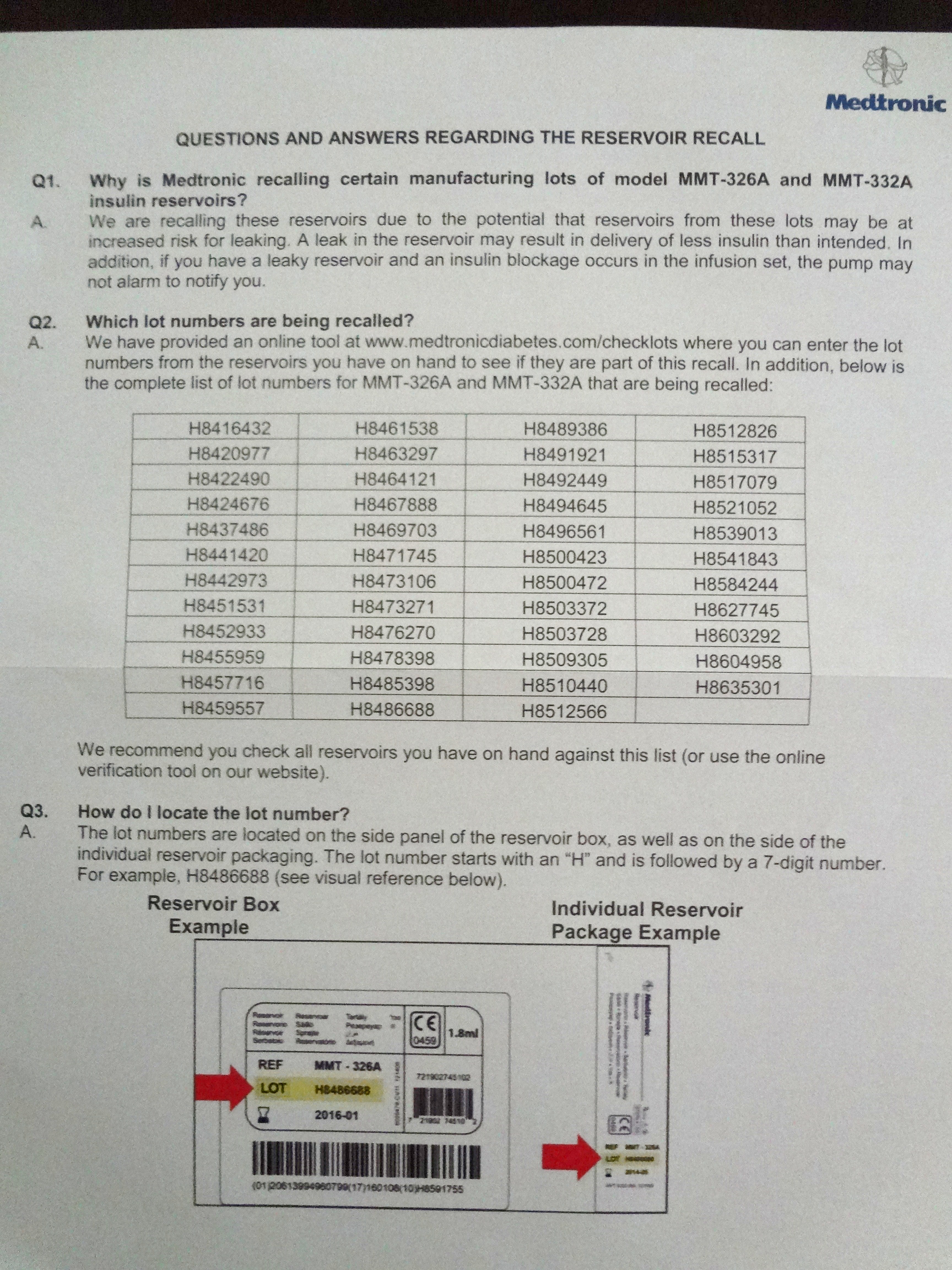
Medtronic Diabetes is voluntarily recalling specific lots of reservoirs for Paradigm insulin pumps. Apparently, the affected reservoirs are at increased risk for leaking. The photo above is part of the FAQ sheet I received that lists the lot numbers that are being recalled.

Now, I know it’s easy to bash a company for making something that is eventually found to be faulty. But I will also give you some facts, according to the recall notice sent to me:

– First of all, this is a voluntary recall. No one made Medtronic recall these reservoirs. I don’t know if there was any kind of communication between them and the FDA, for example, that led to the voluntary recall before a mandatory one. But still, a voluntary recall always happens faster than a mandatory one.

– Medtronic conducted an investigation of the cause of this issue, and found that the reservoirs in question were all manufactured on a specific manufacturing tool that developed “abnormal wear”. They have corrected the issue and put additional testing and inspection in place.

– Med-T has a number to call if you have the recalled reservoirs and need new ones right away: 1-866-450-0890. They will ship the new ones free of charge to you.

Medtronic acknowledges a few cases of diabetic ketoacidosis requiring hospitalization that may have been caused by the faulty reservoirs. I don’t want to belittle these cases, or the patients and their loved ones involved. I also think it would have been nice if I’d have received an e-mail, or a tweet from @MDT_Diabetes. Other than that, what I am saying is that if a product I’m using does need to be recalled, I want the recall to be done like this.
 
 
Also, the FDA has cracked down on companies selling products that claim to help mitigate, treat, or cure diabetes, but as we know, they don’t. This includes “natural” treatments that have undeclared ingredients; dietary supplements that claim to treat, cure, or prevent diabetes; homeopathic over-the-counter meds that claim to help with peripheral neuropathy; and prescription drugs sold by pharmacies without a prescription.

Take a look at these products, and where they’re from. It proves that there are scam artists just about anywhere you go. These products are being pulled from the market by the FDA:

– Diexi by Amrutam Life Care Pvt. Ltd., Surat India.

– Anastasia Diapedic Foot & Leg Treatment by Anastasia Marie Laboratories Inc., Oklahoma City, Okla.

– Exermet GM, Galvus, Nuzide, Triexer and unapproved versions of Januvia, all from
bestcheapmedsonline.com.

– Diaberex by Enhance Nutraceutical.

– Zostrix Diabetic Foot Pain Relief Cream, Zostrix Diabetic Joint & Arthritis Pain Relief Cream and Diabeti-Derm Antifungal Cream, all from Health Care Products, Hi-Tech Pharmacal Co., Amityville, N.Y.

– Sugar Balancer by Health King Enterprises & Balanceuticals Group Inc., Chicago.

– Insupro Forte by INS Bioscience Berhad, HLS International Sdn. Bhd., Easy Pha-max, Selangor Darul Ehsan, Malaysia.

– Diabetic Neuropathy Foot Cream, Diabetic Foot Cream, and Diabetic Hand & Body Cream by The Magni Group, doing business as MagniLife, McKinney, Texas.

– Eradicator by Naturecast Products, Coral Springs, Fla.

– Diabetes Daily Care by Nature’s Health Supply Inc., College Park, Md.

– Glucocil by Neuliven Health, San Diego,Calif.

– Neuragen PN and Neuragen Cream by Origin BioMed Inc., Halifax, Novia Scotia, Canada.

– Nepretin by Nutrient Synergy, Longmont, Colo.

– ProBeta by PharmaTerra Inc., Bellevue, Wash.

For more information, and to stay up-to-date or report on Diabetes drugs or devices, visit FDA MedWatch at www.fda.gov/Safety/MedWatch/default.htm
 
 
Happy Wednesday… Stay safe!


More on #StripSafely.

StripSafely

No doubt you’ve already heard of the Strip Safely campaign. But maybe you’re still asking, “Stephen, what’s it all about? What can I do about it?”. Here’s the lowdown:

At a public meeting back in May, the U.S. Food and Drug Administration (the FDA) acknowledged that there are glucose meters and test strips out there that are no longer as accurate as they were when they were approved by the FDA in the first place. That’s a big deal, no?

What if I also told you that even though the FDA acknowledges this issue, they have no program to perform post-market testing or remove inaccurate test strips from the market? Bigger deal, yes?

Our very lives depend on the accuracy of the numbers that appear on our meter’s display. If we see too low a number… we dose too little insulin and wind up with high glucose, high A1c results, and higher risks for complications later. If we see too high a number… we could dose too much insulin and wind up with severe hypoglycemia, or even death. No pressure, FDA.

So Bennett Dunlap and a few others started the Strip Safely initiative, to shine a light on this issue and encourage everyone affected by it to agitate. Call or write your congressional representatives, senators, and even the FDA. Voice your concern. Help lead the charge for better outcomes through more accurate test strips.

Want to do your part? I thought you would. Visit the Strip Safely site at www.stripsafely.com. There you’ll find a number of great templates you can use to send your own letter or e-mail. There are also links to help you find your elected officials in Washington. You can stay up to date on this issue with the latest updates, and even take the Strip Safely quiz to test your knowledge of test strip accuracy. Or take the quiz and then read about what’s happening… your choice.

For the record, here is a sample of the letters I sent by e-mail to U.S. Representative Dutch Ruppersberger, and U.S. Senators Barbara Mikulski and Ben Cardin of Maryland:

Dear _______,

I’m a constituent who has been living with Type 1 Diabetes for the past 22 years. Because my pancreas doesn’t produce insulin on its own, I receive insulin through my insulin pump 24 hours per day.

How much insulin is administered is based on a number of factors. Most notably, my blood glucose. As you may know, people with diabetes check their glucose levels several times per day as a baseline for determining how much insulin to administer as a result of diet, exercise, stress, and a number of other factors.

I’ve recently learned that the Food and Drug Administration, at a public meeting, acknowledged that some glucose meters and test strips are not as accurate today as they were when they were approved for use in the first place. Furthermore, they have no method to deal with removal or review of potentially inaccurate products from the marketplace once they’re found to be inaccurate.

The issue is simple: If the readings on our meters are inaccurately low, we might wind up not taking enough insulin, which could result in dangerously high blood sugars. If our readings are inaccurately high, we might take too much insulin, which could result in hypoglycemia, insulin shock, and even death.

So we know that not all meters meet the +/- 20% standard set by the FDA in real world conditions. Some manufacturers are now delivering products into the market that put us at increased risk. The lack of an ongoing periodic post market audit of real world strip performance helps these manufacturers risk lives.

What I’m asking you and your fellow representatives/senators to do is to look into implementing a post market program of ongoing random sampling of glucose meters and test strips to insure that all brands consistently deliver the accuracy in the real world that they were approved to do.

Without question, meter and test strip accuracy means the world to myself and my loved ones. We want to know that the number on our glucose monitors is correct.
Because our lives depend on it. Won’t you help? Thanks so much for your consideration of this very important topic.


This is important. I’m going to say it again: Lives are at stake. I encourage you to get involved and help to save lives today.


Things to consider this weekend.

Just finished up a great visit with my endocrinologist this morning. More about that next week. In the meantime, in case you didn’t hear about these, here are a few things for you to mull over this weekend:

I’m headed to Bethesda, Maryland (okay, North Bethesda, Maryland) on Saturday for the 2013 JDRF Type 1 Diabetes Summit. Lots of Artificial Pancreas and Islet Cell talk, and a chance to commune with other Type 1ers. I’ll try to write about what I find out next week. If you see me there, I hope you’ll stop me and say hello. It would be my pleasure to meet you. More information about the summit is available at http://www.jdrfsummit.org.
 
 
The Medicine X Conference is scheduled to take place on the campus of Stanford University September 27, 28, and 29. Courtesy of Christopher Snider, notice that MedX is taking submissions for ePatient scholarships to attend the conference. Find out about it at http://medicinex.stanford.edu/medicine-x-alliance-health-epatient-scholarship-program-2013/.

Man, that’s a long web address.
 
 
Finally, I found this little tidbit in my inbox from the U.S. Food and Drug Administration:

FDA wants you to be a part of a new working group “that is geographically diverse and consists of experts and interested persons from all stakeholders in the HIT (Health Information Technology) community to help develop the required strategy and recommendations.”

If you would like to nominate someone or even yourself to serve on this new working group, please visit http://onc-faca.altaruminstitute.net/apply and complete the application by March 8th, 2013.

That’s today, folks. Hurry. And enjoy your weekend!


Like these links– #NEDAwareness and more.

Let’s get right to it…

I can’t confess to having a serious eating disorder, but I know that I have way too much of an affection for salty carbs. Potato chips, pretzels, popcorn… you get the idea. Sometimes I get mad at myself for it. Other times, I redouble my efforts and try to remember that moderation is always best.

This is National Eating Disorders Awareness Week, and it goes by the theme “Everybody Knows Somebody”. Ain’t that the truth. Everybody knows somebody who could use a word of encouragement, support, cheering to let them know that they are not alone. And guess what? Having Type 1 diabetes (like I do) can double your chances of developing an eating disorder, according to a recent report. So spread the word. Lend a hand. Send a message of support. Blog about it. To find out more about NEDAwareness, and what you can do, go to:
http://nedaw.myneda.org/about
 
 
I don’t have any kids, but I still check in to see what some of those great D-Moms and D-Dads are up to from time to time. Diabetes Dad Tom Karlya has a series of great posts this week. They go all the way back to Sunday and Monday, with Tom’s call to action to do what we can to speak for those who cannot speak for themselves. But all of this week’s posts are great, so go and check them out:
http://diabetesdad.org/
 
 
I don’t know how to explain this, but I wanted to mention it so you could attend, if you’re near the D.C. area; and so you could comment, which you may very well want to do regardless of where you are. The FDA is holding a meeting of its Device Good Manufacturing Practice Advisory Committee on April 11, 2013 in Gaithersburg, Maryland. The meeting is about Extreme Weather Effects on Medical Device Safety and Quality. I’m thinking you might have a suggestion or two. To find out about the meeting, and to make a comment, start here:
http://www.regulations.gov/?source=govdelivery#!documentDetail;D=FDA-2013-N-0118-0001
 
 
And just one more mention of the JDRF Type 1 Diabetes Research Summit taking place in Bethesda, Maryland on Saturday, March 9. It’s an all day affair that promises great educational opportunities and chances to network with other like-minded souls. It’s free to attend. Wanna go? Go here first:
http://www.jdrfsummit.org/
 
 
That’s it for now. Have a great Wednesday!


FDA Guidance on the Artificial Pancreas.

The latest FDA guidance is out on the Artificial Pancreas, and I’ve been taking a look to get a better idea of what it’s going to take to bring something like this to the market here in the USA.

I haven’t had a look at previous statements from the Food and Drug Administration on this issue, but after looking at the 63 page document recently released, I can tell you that it’s going to take a lot.

There are a number of reasons for that assessment, so let me see if I can break it down for you a bit. This isn’t a complete, detailed look, and I’m still seeking some other input on what some of the finer points really mean. For now, I’ll just try to give you some of the highlights.

When I think Artificial Pancreas, I think (like many others do) that we just need a device that will use data from our CGM to tell our insulin pumps what to do to help manage our glucose. Simple, right? Now, let’s think of everything having anything to do with that.

From the FDA’s point of view, that means anything and everything to do with your BG meter, your CGM, your insulin pump, and then your Artificial Pancreas device, which would probably be a modified phone of some sort.

If your meter, CGM, and pump have all been tested and approved before, great. Just provide all of the documentation that supports that, including the models, the way they each interact with each other, their adaptability to heat, cold, being dropped on the floor, your line getting kinked, getting wet, and on and on, ad infinitum.

Ready to move on to the AP itself? Okay, let’s talk about that. You’ll still need to detail how each piece of your AP system is going to work in a real-world setting. Detail how your device will interact with the CGM and pump, including how you plan to calibrate the CGM with each change, and how you plan to communicate that to the AP itself. Detail your algorithms, who they’re designed for.

Will the device be unidirectional (information moving in one direction only)? Or multi-directional (information moving between each piece of the system)?

A big question: How will the device combat hypoglycemia and hyperglycemia? And in that vein, will the device help in the proper delivery of just insulin? Or possibly insulin and glucagon? Or, as written here before, the delivery of insulin and amylin?

What about security? How can you ensure that the device won’t be hacked in some way? How can you be sure that the radio frequencies being used for the system won’t impede other systems? And while you’re at it, please detail how your system won’t be impeded by other systems like magnetic resonance imaging (MRIs), or even cell phones, computers, iPads, etc.

Once you’ve documented all of that, you can get down to the business of detailing the human factor. How will humans interact with your system? Will someone be allowed to override parts of your system? What about incorrect entry of key elements? What happens when someone leaves their CGM in “beyond the sensor wear period, when CGM results may be compromised” (actual language in the document)?

Now let’s talk about Clinical Study progression… including Early Stage testing, which includes proof-of-concept testing and studies regarding the effects of modifications to algorithms. Then later-stage feasibility studies, including some basic outpatient testing. After that, there’s “Studies to Demonstrate Performance of Risk Mitigation Strategies” (I think we all know what that means).

Finally, the Pivotal Clinical Study, designed to “gather data to support the safety and effectiveness of the device”. Real-world testing including individuals that the device is intended for. The patient population information detailed in the guidance on page 31, 32, and 33 is very important and worth the read.

Also worth the read are the very detailed Study Endpoints noted from page 33 through 35 that should include “objective characteristics or variables that reflect how a patient feels, functions, or survives. Surrogate endpoints should predict meaningful clinical outcomes and be based on valid scientific evidence”. This includes information on the use of CGM data, how the device handles hypoglycemia and hyperglycemia, how the device helps A1c results, how much the device helps the patient keep BG within range and what that range is, and how much time is spent within the range. Add in detail about safety mechanisms like low-glucose suspend and how high glucose and elevated ketones are dealt with. A final statistical analysis is expected.

But wait… you’re not finished yet. You have to include all of the documentation you intend to give the end user in:
– A User manual, written at an 8th grade level
– Training materials
– Professional documentation for prescribing physicians
– Package inserts for the AP device and any components that are packaged separately from the device itself
– Box and container labels for the AP device and any components that are packaged separately from the device itself

Don’t forget to describe how your device will be manufactured, including anything having to do with sterile parts of your system, if applicable.

And finally, you’ll want to include detail of the protocol of any Post-Approval studies you’ll want to conduct, assuming you’ll get approval in the first place.

That’s the very basic, 50,000-foot level view of what needs to be included in anyone’s application for an Investigational Device Exemption (IDE) or premarket approval (PMA) for their artificial pancreas device. That’s a lot, isn’t it? And to tell you the truth, I can’t find a whole lot in there that isn’t useful in defining how something will work, how it will be studied, and how it will keep us safe. But despite everything that’s necessary to bring this closer to the everyday patient, I’m still looking to the future with a hopeful eye. I’ll let you know if I find out more.