Tag Archives: diabetes

Please let me know if Mr. Glassman would be available for an interview.

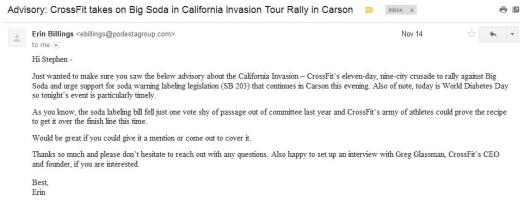
I received an e-mail last week from a PR firm that is handling an account for CrossFit. You know, CrossFit, the company with the CEO that doesn’t seem to really know what causes diabetes. Guess what? No one does, even though it seems that CrossFit’s CEO, Mark Glassman thinks he does.

Anyway, the e-mail was in reference to a California ballot initiative that CrossFit is in favor of. Here’s the text of the e-mail:
CFEmail
It’s not that I don’t care about this ballot issue, because I do sort of, but that’s not what I’d really like to talk about if I were to interview Mr. Glassman. Would I really want to interview Mr. Glassman? The truth is, yes, I’d like to at least have a conversation with him. I’d like to have an honest discussion about the fitness, and diet, and how those things, or lack of those things, from a scientific perspective, do not necessarily cause or reverse diabetes.

So in reply, I sent this e-mail to the PR rep:
 
 
Erin, thank you so much for reaching out regarding this story. You may or may not be aware of this, but Mr. Glassman, CrossFit’s CEO, was especially critical of People With Diabetes in an incident earlier this year. People like me. I don’t think my blog or podcast would be a good place to discuss the ballot initiative mentioned in your e-mail, though I wish you well with it. But I would like to invite Mr. Glassman to my podcast, Diabetes By The Numbers, to talk about CrossFit and diabetes.

My goal is not to ambush Mr. Glassman, but rather have a brief (30 minutes or less) conversation about how a diabetes diagnosis cannot be traced scientifically back to diet or lack of exercise, and how a diabetes diagnosis often makes one an even tougher athlete than they were prior to diagnosis. In addition, I’d like to find some common ground where we can create a dialogue, through which CrossFit and People With Diabetes may connect and be partners for positive change, celebrating what we can do together, rather than just shouting at each other.

If you can’t arrange this, I understand. But considering the fact that I live with diabetes year round, the fact that I write a blog about diabetes, and host a podcast related to diabetes, I think you can understand why I would rather talk on this subject. Please let me know if Mr. Glassman would be available for an interview.

All the best
Stephen Shaul


There are a few reasons why I responded this way. First, we often talk about seizing the opportunity to educate those who may not understand diabetes. If I’m going to be true to that, I’m going to at least ask for the interview.

Second, maybe, not likely but maybe, we can come to some sort of understanding, some sort of mutual respect or even a path by which we can both celebrate athletes who achieve their athletic goals despite diabetes.

Third, I admit… I like the challenge of an interview like this. I’m obviously not a professional, but I like to get out of my comfort zone once in a while with an interview subject. I know something like this wouldn’t be easy, and maybe it would be a disaster. But I’d like to try anyway.

If this ever amounts to anything, I’ll let you know. My guess is it won’t. But that’s not all bad either. Sometimes you just need to ask anyway.
 

Diabetes By The Numbers: Dr. Vivian Pao (Part 2)

Some people only get to spend about 40 minutes each year with their endo… I got to spend close to an hour with her last week. The conversation was so good that I’ve broken it up into three parts.

In this episode, we talked about how an endocrinologist considers outside factors, including depression, in treating a Person With Diabetes. Also, she talks about how she stays up on the latest and greatest in her profession, including a reference to Dr. Oz and some “raspberry, ketone thingamajiggy”.

This is part two of our conversation. We get into a lot more in part three. I hope you’ll join us for that. In the meantime, here’s Part 2.
DBTN
 
Reference Material – Click below for more information on this topic
Learn more about endocrinologists, read research and updates, and even search for an endocrinologist by clicking on one of the links below:

American Association of Clinical Endocrinologists

Endocrine Society

Pediatric Endocrine Society

Like these Diabetes Awareness Month links.

It’s Diabetes Awareness Month! Saturday marks another World Diabetes Day.

Guess what? There are still very easy ways to advocate and show your solidarity with your friends who are also living with or affected by this disease. Here are just a few:

Big Blue Test: In case you didn’t know, Big Blue Test is the yearly effort from Diabetes Hands Foundation that encourages us to check our BGs, get up and get moving, then check again and log the results at BigBlueTest.org. Don’t have diabetes? No problem! Just leave out the BG test results. Or, if you really want to, go ahead and prick your finger before and after your exercise anyway. Whatever makes you happy.

The best part is that each test logged helps to raise much needed cash for worthy diabetes organizations like SucreBlue and CarbDM. They’re about 6500 tests short of their goal of 110,000 entries by Saturday night. So do not forget to log those Big Blue Tests, either at the website or via the handy-dandy app.
 
 
CGM coverage for Medicare patients: If you live in the USA, Diabetes Patient Advocacy Coalition makes it super easy to e-mail your congressperson and senators. In fact, I’ll bet you can do it in under one minute. Start the clock! CLICK HERE and get the necessary text, including references to the existing bills before the House and Senate. Enter your information, click submit, and your piece of advocacy is on its way. Really, it doesn’t get any easier than that.
 
 
World Diabetes Day Twitter Chat! Diabetes Community Advocacy Foundation is once again sponsoring hour upon hour of Twitter chats on World Diabetes Day, hosted each hour by a different person, all designed to raise awareness, support one another, and have a few laughs. Check in throughout the day and meet new people from around the world, engage in the conversation, and tell us how your day is going.

This year we’re doing 14 hours of continuous Twitter chat using the hashtag #WDDChat15. Each hour will have a different theme. I’ll be leading off beginning at 7:00 a.m. Eastern time here in the USA, followed at 8:00 by Kelly Kunik. Remember… follow the #WDDChat15 hashtag to join the conversation.
 
 
However your week shapes up, I hope it’s filled with raising awareness and celebrating our fellow friends living with and affected by diabetes. So get going, write those letters, and I’ll talk to you on Saturday morning!
 

Diabetes By The Numbers: Dr. Vivian Pao (part 1)

“Who is this Dr. Vivian Pao anyway?”, you might ask.

She’s my endocrinologist.

Some people only get to spend about 40 minutes each year with their endo… I got to spend close to an hour with her this week.

Together, we talked about what exactly an endocrinologist specializes in (in addition to diabetes). We also covered what she’s looking for from a diabetes patient at the quarterly appointment (and more importantly, why); and why she made me wait before allowing me to begin on my insulin pump. Hopefully, you’ll begin to understand why I believe in her the way I do. She is a huge, important part of my diabetes care team, and I value her input very much.

The best part is, this is just the first part of our conversation. We get into a lot more later on. But you’ll have to wait for that. Sorry. Our talk was just too good to cut out questions for the sake of brevity.

Part 2 is coming in the next installment. In the meantime, I hope you enjoy this view from both sides of the desk.
DBTN
 
Reference Material – Click below for more information on this topic
Learn more about endocrinologists, read research and updates, and even search for an endocrinologist by clicking on one of the links below:

American Association of Clinical Endocrinologists

Endocrine Society

Pediatric Endocrine Society

It’s a gravatar. Not an insult.

In the end, I decided to publish this post. You have every right to complain about it to me, but please leave my friends alone.

So, it’s been an exciting first week of Diabetes Awareness Month. I’m noticing, and I suspect you’re noticing too, that a lot of people in our online community are either burned out on advocacy, feeling insignificant, or getting digitally slapped around by the passion of someone’s feelings on things as innocuous as a gravatar. Yep I’m going there just this once.

I’ve been watching posts this week, mostly on Facebook, and for me (you must make the decision on what’s right for you), I think it might help to put some things in perspective. Here are a few things I’ve found out about diabetes advocacy, the Diabetes Online Community, and how we treat each other:

First: there are not nearly enough of us.
For all of the wonderful things that have been accomplished in terms of awareness and education about life with diabetes, the fact is that there are a lot of things left undone. Like anything else, there is more than one reason for that. But I think one of the things that gets overlooked is the fact that we cannot do everything by ourselves, and the number of people practicing diabetes advocacy on a regular basis is extremely small. So why would you want to criticize those people for not doing enough, or for being at the forefront of a movement, or for just showing up on Twitter and on podcasts more often than someone else? If those people advocating all the time stopped advocating all the time, who would take their place? Anyone want to step forward? Full Time? Every Day? We should thank our lucky stars that we have someone, anyone advocating for us anytime. Can we thank someone for their advocacy today?

Diabetes Awareness Month is during November. Diabetes, and diabetes advocacy, is year round.
This is what I try to remember when I think about Diabetes Awareness Month and how much I haven’t done so far this November. I know I will try to advocate as best I can, but I try to do that anyway. And if I have a super idea that pops into my head on December 18, am I supposed to sit on it for eleven months so I can reveal it during Diabetes Awareness Month? I don’t think so. I started podcasting in August… I didn’t wait until November just so I could tie a blue circle around the idea.

When I think about diabetes advocacy burnout this time of year, I often wonder if it comes as a result of people doing their best all year and once November rolls around, there’s not much left to give. If that’s the case, I think it’s all right to say “Sorry… all of my great ideas are gone for the year. I’ll get back to you when I come up with something else”. That means less emphasis on November, but let’s face it… we’re not getting a lot of notice this time of year anyway. Other than December and October (for obvious reasons), I don’t know if I could have picked a worse month for Diabetes Awareness Month than November.

Advocacy comes in many shapes and forms. And we forget that.
We do… we forget what we ourselves do that is absolutely diabetes advocacy in action. I’m going to list a few things I’ve done in the last two years that, in my mind, qualify as diabetes advocacy. I’m including the last two years because this year has been pretty sparse, unfortunately. Here’s the list:

– Rode in ADA’s Chesapeake Bay Tour de Cure, raising money for a worthwhile organization
– Promoted various advocacy initiatives started by others, like BigBlueTest and Spare A Rose/Save a Child
– Attended the first Diabetes Advocates MasterLab in Florida a year ago (thanks Diabetes Hands Foundation, who paid my travel and hotel)
Gave away medals to People With Diabetes who achieve their athletic goals
Donated blood three times (in the USA, you can live with diabetes and donate)
Attended an FDA public workshop and spoke during public comments portion
Participated in a clinical trial
– Told my story here, on other web sites, and in interviews
– Started podcasting, interviewing diabetes newsmakers
– Participated in the weekly DSMA Twitter Chat (and moderated a few times too)
– Lived my life with diabetes to the best of my ability for two years

I’m going to guess that your list of advocacy is similar, if not better. Now, that’s not a huge list, and it’s not major in terms of diabetes advocacy. But it’s not nothing either. Like my diabetes, I’m doing the best I can with the time I have and the resources I have. If I need to remind myself of these things, I will because it’s proof that my presence means something. I hope I don’t forget that. More importantly, I hope you don’t forget that either.

If you let it, conflict will take the place of advocacy. And sometimes, people are just too damned sensitive.
Don’t get me wrong: If I’ve done something you’re not happy with, and you want to say something about it, then okay. News flash: Sometimes I’m wrong! It happens. I’ve been lucky in that when it happened, I had people show their displeasure with me in a way that is respectful and caring. It’s still uncomfortable to hear you’re not perfect, but if I want to expect people to be respectful, I must be respectful too.

However… when you focus your energy on one little thing, and you want to translate your feelings over that one thing toward me as a person and decide I suck because of a fucking gravatar… I’m not sure I have any words for that. Except fucking gravatar. Here’s what I mean:

When we take on someone for something they’ve done, or not done, said or not said, posted or not posted, real or imagined– that act, that emotion, is taking the place (and time and resources) of actual advocacy. Time that could be spent contacting our elected officials on important issues, telling our story so others will better know and understand our disease, or helping someone come to grips with their new diagnosis gets cast aside in favor of Being Right. The truth is, Being Right is completely subjective in many cases. And often, there is more than one definition of Being Right. Regardless… individually, we are almost always not the Official Arbiter of Being Right. It would be kind of cool if I was though. Still… in this case, it’s a gravatar, not an insult.

In addition, when you’re engaging in conflict, you’re running the risk of making people feel like they should just walk away from advocacy altogether. In my mind, having one less diabetes advocate is not fair compensation for Being Right. I don’t know about you, but I need every advocate I can get.

This month, I’m not engaging in the T1D Looks Like Me campaign. But I support people who do. I’m not using the #TypeNone hashtag either. But I think it’s a fabulous idea. I live with Type 1 diabetes, and I have many friends who live with other types that are fantastic advocates. I want to continue working to understand them and support them as best I can, while also helping and supporting my T1D friends. I do not run an exclusive club. I don’t believe my Type 1 friends do either.

This November, I’m going to keep on with my life, engage in my own form of advocacy, while supporting as many causes and people as I can along the way. For me, it’s a heck of a lot easier than worrying about Being Right all the time.