Tag Archives: diabetes

A Champion Athlete from Trinidad.

Today, I’m thrilled to bring you our latest Champion Athlete With Diabetes, and the first guest post here at Happy-Medium.net!

Corey Melke is a U.S. expat living with her husband in Trinidad. She’s been living with Type 1 diabetes for about a year and a half, and she writes about her life (with some fantastic recipes too) at her blog, Learning Patience.

Corey’s story is the perfect example of perseverance in the face of adversity. She never let her setbacks define her… In fact, she seems to have used them as touchstones for even greater accomplishments. Don’t ever tell Corey she can’t do it– She’ll prove you wrong! Take it away Corey…

IMG_2226

Ever since I was little, i played sports. Softball, basketball, swim team, track…i tried it all. I loved the thrill of competition and it helped me stay in shape. But when college was over and work started, working out kinda fell off my daily to-do list. My vegetarian diet helped keep my weight in a decent spot, but I was not strong or frankly, all that healthy. It wasn’t until I met my husband that I decided to make a lifestyle change and get healthy. That meant more sleep, less drinking, working out at the gym and starting to run. At first, I couldn’t even make it a block without stopping. Running did not come easy to me, it was a real challenge and it had been way too long since I felt that thrill of working hard to achieve a non- work related goal. We ran 5k’s together, mud runs and a 10k right before we moved to Trinidad. In one year, I had gone from couch potato to runner girl!

run blog 2

Moving to Trinidad, 3 years ago, meant a world of new experiences and lifestyle changes and not working. Not working meant being able to workout whenever I wanted, but it also meant I would need to be more focused than ever, because it’s just as easy to be lazy or snack whenever you want. One day, a blog friend convinced me to train for my first half marathon, something I never thought I would do. I agreed, but with loads of hesitation and fear of failure. It was then that I signed up to the Daily Mile, a website where you can friend other runners, track your workouts and get support and advice from others. It has been a critical part of my success. As the race date got closer, my friend got injured and I was devastated. I felt like I could never do it without her, but the next morning I ran 13.1 miles. I did it under 2 hours too, definitely one of my proudest adult moments. There was no crowd cheering me on and no shiny medal handed out at the finish line, it was just me and my determination to succeed.

431314_10150655279567708_516307707_9169843_1398760251_n

After that, I was hooked. I wanted to run faster, participate in a “real” race and i wanted a medal. I was lucky enough to be selected as an Ambassador for the Women’s Half Marathon series and planned to run in September in Nashville. Training was going great until one Sunday afternoon when a simple photo op at the pool, changed my life forever.

jump

The picture is fantastic, eh?! When I landed in the water my right toe touched my right heel and I sat on my foot underwater. I basically crushed my foot. When I surfaced, i was crying without even knowing what had happened. Getting injured underwater is very weird. There really isn’t time to feel pain because you are focused on trying to hold your breath. I saw a specialist the next day and was told I had a fracture, I needed a aircast for 6 weeks and all would be OK. If you have ever been injured when you are in the best shape of your life, you know its dreadful.

552526_10151074807027708_757545382_n

I followed the Drs. orders and was soon pool running and my life was almost back to normal. While on a vacation in the US, I was told I could finally take the aircast off and even go for a run. I cannot explain how amazing those 3 miles felt. But while running, I had noticed that my eyes were really dry. I mean like my eyelids were sticking to my eyes, dry. Weird. Later that day, I felt sick, my mouth was dry, my appetite gone and I had no desire to drink wine at all. You can laugh at the wine comment but it just might have helped saved my life. By the time my husband arrived a couple days later, I knew something was wrong. I felt worse, much worse and I went to the ER. At first, I was told I had jet-lag and to go home, but I pressed for more tests. Then, the the lady who said I was “fine”, told me that I had diabetes. The nurse told me that I was a Type 2 diabetic, which didn’t make sense to me – I was healthy, in shape and had been a vegetarian since 6th grade. At that point, I was in a state of shock. The nurse showed me how to test my blood sugar and gave me Metformin. At that point my blood sugar was 835. I was released, I took 1 pill and we went home to figure it all out. I sat my husband down and told him and we all just kinda sat there. The next morning, I hoped a run would help clear my head, but as I started on down the driveway, I couldn’t breathe. I fell to the ground, gasping for breath and then somehow managed to crawl back into the house for help. I felt like I was dying, I couldn’t get a full breath in and it was terrifying. After a quick call to the pharmacy, my dad just looked at me and said “You have to go to the ER, now”!

August 10, 2012

Turns out, I was not a Type 2 diabetic, I was a Type 1. I was in DKA, just minutes from passing into a coma and that pill was making things much worse. DKA occurs when the body cannot use glucose as fuel because there is no insulin in the body. So, the body burns fat instead which produces keytones. A urine test showed my keytone level was over 90. That week I lost almost 10 pounds. I found out that I never should have been released from the hospital the day before, in fact, I was so sick, I had to spend an entire week there. Going for that run saved my life, it helped my body process the Metformin faster, which took my breath away, which then alerted me to go to he hospital. Our original plan was to get on the boat and spend all day on the lake. If I wouldn’t have gone for a run, the Dr. told me that sometime that day, I mostly likely would have lapsed into a coma and could have died. My endocrinologist say its hard to determine how long I had T1D, I had probably been controlling my own BS with running. Then, when I was side-lined with the aircast, my BS just kept creeping higher and higher and higher.

set backs (1)

Figuring out my new life of insulin shots, counting carbs and all that other fun stuff that goes with having this horrible disease was hard, but realizing I was only 4 weeks from my BIG Nashville race and I wasn’t going to be able to run in it, was even harder. I was banned from running for another 2 weeks. All of my organs were shutting down and I had lost almost 60% of my vision, a result of having a high blood sugar for so long. My body was broken, my cells needed more time to repair themselves and eventually my sight would return. After two long weeks of resting, I was finally able to start running again. Running with diabetes was much more difficult than originally expected. Keeping a steady blood sugar while burning 800-1000 calories and running in almost 100 degree temperatures is a huge challenge.

393642_10151159452662708_1784022632_n

603354_10151158061677708_792233349_n

I went to Nashville anyways and competed in the 5k. Although it stung not to be running the half, I’m glad I went and did my best, I even placed 2nd in my age group! The amazing folks at the WHM series offered me a re-do in St. Petersburg, FL in November, 2 months later. I was thrilled and started training again. Once my training runs got over the 8 miles mark, I soon realized how training with T1D would be MUCH HARDER than originally thought. I had to learn how to fuel properly before, during and after my runs. No more not eating post workout, I experienced a couple extreme BS drops and was soon reading all I could about athletes with T1D. The more I learned, the more I felt overwhelmed. My endocrinologist told me I needed to slow down. She had never seen a new T1 who had gone from a 11% A1C and almost dying to a 6.2% A1C in three months and running 15 miles a a week. It was then that I got my first Dexcom, we call him Dex in my family.

No more sore fingers from testing 10-13 times a day and no more scary nights wondering if I would wake up all sweaty with a low. Dex saved my life and continues to help me be as healthy and as safe as I can be every, single day. Sure, he can be annoying at times and sometimes he’s off a little bit every now and then, but I simply could not imagine my life without him. So, with Dex, my training improved and I was more confident on my runs. But just as things seemed like they were getting better, on my last long run before my big race, I felt more than the usual pain in my right foot.

It was then that my Dr. told me that his original thought, that I might have a LisFranc injurya very complicated injury that 50% of people need surgery to repair, was right. He told me to pull out of the race and head to the US. Against my Dr. orders and against my husband & parents wishes, I went to Florida and i ran that race anyways. I don’t suggest running injured but after all I had been thru earlier that year, I wasn’t going to be stopped.


30986_10151243940522708_538825862_n
The next day, I headed to Houston where I was told that I needed surgery ASAP. The middle joints of my foot were separated more than 5 times the normal amount. He was shocked I was even able to walk on it, let alone run a half marathon. 3 days later I had surgery. The surgery took over 3.5 hours and required 11 pieces of titanium to fuse 4 bones together.

281695_10151289705432708_84289025_n

Foot Hardware 3

The next 7 days were complete hell and that was with pain meds every 3 hours! I don’t think I have ever gone thru something so incredibly painful in my life, EVER. Growing bones isn’t as easy as one might think. I had to get off the pain meds ASAP because they were throwing off Dex & I couldn’t handle that.

I would be in a non-weight baring cast from Dec 22 until April 1.

150048_10151357589962708_1103327242_n
When the cast came off, I couldn’t wait for rehab.
I had no idea how difficult the process of just learning how to walk again would be…

b3
I had rehab 3-4 times a week, every week till June. On June 20, my birthday, I ran 4 miles.
#feltliketen

Then, I found a half marathon in October in Houston and signed up…my BIG comeback run! I was going to show diabetes and my stupid LisFranc injury who was boss. Don’t tell me I cant run again!

8

On October 27, in the pouring rain and cold, I finished in 2:02. I did it and crossed that finish line with a smile on my face and tears in my eyes. The next day I visited my foot surgeon with my much deserved medal around my neck. He was beyond thrilled. He told me that the chance of me running again was slim, he just didn’t want to tell me that from the beginning.

1623653_10152164901452708_1169121123_n

I’m currently training for 4 races in the Spring and I’m running faster than ever before. My last A1C was 6.1% and I currently am using the latest and greatest Dexcom, which I wear on the back of my upper arm, and I am on injections, Levimir (2X day) and Apidra My diabetes will be always be a daily challenge and a pain in my ass the rest of my life but it will never stop me from achieving my goals and living life to the full! You can follow my island life, training, travels and recipes over on my blog, Learning Patience. Last November, I even traveled to Africa and saw a cheetah kill, it was pretty amazing!

P1120417

Life tried knocking me down not once, but twice and I still got back up. Without sounding too cheesy, LIFE IS A GIFT, don’t waste it. Break a sweat each day, eat healthy and colorfully, drink loads of water and laugh as much as possible!

xoxo from Trinidad

P1120111

Thanks Corey! You are an inspiration, and very worthy of the designation Champion Athlete With Diabetes!

So maybe you’re thinking: “Hey, I’ve been working hard… where’s my medal?”. To find out how to get yours, click here.


No CGMs on Medicare? What????

On the heels of the Spare A Rose, Save a Child campaign, I’d like to ask for your help on another very important issue.

sue-b_head-square
Sue Berger, also known as Sue from Pennsylvania over at Test Guess and Go, is on a quest. And her quest is one that speaks to me, because in a little over 13 years, I’ll be right where her husband is. I’ll be 65 in 2027, and that means I’ll be getting pushed off to the Medicare system here in the USA.


Why is that a concern? Well, among other things, being on Medicare means you can’t have a CGM anymore. Oh, if you have deep pockets, you can buy one outright. But Medicare will not pay for a CGM. Doesn’t matter if you have one prior to age 65. Doesn’t matter if you need a CGM due to hypoglycemic unawareness, or just because it might help you actually stay healthier. It won’t be approved by Medicare.

Sue is working hard to change that. Up to now, she’s carried on a nearly single-handed campaign to get Congress involved. And guess what? Congress is now involved! Representative Carol Shea-Porter (D-NH) has introduced H.R. 3710: Medicare CGM Coverage Act. The resolution (H.R. stands for House Resolution) allows for coverage of continuous glucose monitoring systems if recommended by a doctor. In case your civics classes were decades ago like mine, the Act would have to pass the House, then get a majority vote in the Senate, without any changes to the Act. If the Senate approves changes to the Act, then it goes back to the House for another vote on the amended bill. If both houses of Congress finally agree on the final language, the Act goes to the President for his signature. So it might take a while, which is why your help is needed now to help get the ball rolling. Now.

As Sue mentioned in her post on this issue, a lot of the Diabetes Online Community has asked how they can help with her crusade. Well… here’s your chance. According to Sue, there are three things you can do to help get this wrong righted:

– The most effective step you can take is to ask your own Representative to cosponsor the bill. Good news! There is one co-sponsor so far, Representative Matthew Cartwright (D-PA). But we need many more!

– Call your Congressperson’s DC office and ask for the email address of your Congressperson’s Legislative Assistant for health issues.

– Email the Legislative Assistant the text of Shea-Porter’s Dear Colleague letter (available on Sue’s post), along with a personal note. That way they will understand why the issue is important to you, the constituent, and they will also have the Dear Colleague to show their boss so that he/she will know how to sign on.

As sue says, “The only way to fight Medicare’s denial of the CGM is to get the guideline changed. The best thing that we can do now is to let our voices be heard and join with Congresswoman Shea-Porter and her new cosponsor, Congressman Matthew Cartwright [D-PA17] in asking Congress to pass H.R. 3710, the Medicare CGM Coverage Act of 2014.”

This is a very important issue for me, because I’ll be in the Medicare system toward the end of the next decade. And if you live in the USA, you’ll be in the Medicare system at some point too.

At the beginning of this month, the DOC did a lot to help kids in developing countries get the insulin they need to survive. Let’s spend at least part of the second half of February fighting for those older Americans who, through no fault of their own, cannot get coverage for a CGM just because of their age.

To view Sue’s post at Test, Guess, and Go, click here.
The post also includes a sample letter you can send to your congressperson, and the Dear Colleague letter from Rep. Shea-Porter. She also has a kind of resource guide for bloggers to help with getting the word out.


February DSMA Blog Carnival. What is an advocate?

The February DSMA Blog Carnival picks up on the advocacy theme that’s been prevalent in our community in the first two months of 2014. The question is:

What is your definition of an advocate?

Officially, dictionaries define an advocate as a person who speaks or writes in support or defense of a person, cause, etc. But an advocate is so much more than that.

To begin with, an advocate is someone who identifies with a need, an issue. They can see a problem, and they realize how this problem affects people. At this point, the need of others becomes their cause too.

An advocate wants to be part of the conversation surrounding their cause. They expect to be part of the solution. They protect those who are affected by the negative impacts of the issues they’re facing. They bring a voice to the voiceless, a spotlight to shine on their cause and the people affected by it.

Advocates marshal resources and raise money and set up tables and hand out information and give talks, so people not affected by an issue have an opportunity to become part of their team, the team fighting for improvement and empowerment for all who are part of our diabetes community.

What is an advocate not? An advocate is not someone who is afraid of the word “advocacy”. Admit it… that word makes you cringe a little, doesn’t it? Let’s get rid of the stigma of this word, and the feeling it gives us when we read it or speak it. Advocacy, advocacy, advocacy. Get comfortable with it. Advocacy, big or small, is good, and it should make us feel good when we define it through our actions.

In addition, advocates are not people who worry that they’re not good enough, or influential enough, or important enough to do anything meaningful. Here’s a news flash: You Are. They’re not concerned that whatever they’re doing isn’t big enough or special enough to be helpful. Fact: If you’re doing something to further the cause, no matter how small your effort is, you are a champion and worthy of the definition “advocate”.

Advocates are those who possess the empathy to identify with a need, and the resilience to do what they can to eliminate the need. They further the issue they’re fighting for, and they support and empower others who are doing the same. They are not afraid to do something that will help, no matter how small or big.

Advocacy comes in all forms. Bravery does too. If you speak honestly, with a focus on making things better for people living with and affected by diabetes, you are an advocate. And I thank you for what you’re doing for me.

This post is my February entry in the DSMA Blog Carnival. If you’d like to participate too, you can get all of the information at http://diabetescaf.org/2014/02/february-dsma-blog-carnival-3/


Recipe! Cured fish with tequila.

Lots of pictures in this post today… I’ll try to do this recipe justice.

Living where I live today is different from anywhere else I’ve lived. I grew up catholic, way back in the old days when I used to go to mass all the time. However, the neighborhood I live in now has a high concentration of Jewish Americans, as well as Russian Jews and Polish, African, and, you get the idea. Over time, I’ve been lucky enough to make lots of friends in this part of the world, which means I’ve been invited to breakfasts, lunches, dinners, and everything in between by people who are as friendly as can be. Often, there’s some kind of cured or smoked fish on the menu. Not a big deal, right? Unless you’re used to eating beef and pork all the time. There’s a huge difference between a meat-and-potatoes Midwestern diet like I grew up with, and a Mediterranean-influenced Kosher diet.

But I’ve gotta admit… some of the food I’ve been exposed to has been awesome. Like the gravlax that I put together the other day. This isn’t a Kosher-exclusive dish, to be sure, but had I not been exposed to the influences I’ve been exposed to here, I probably never would have tried this. And I love it!

You’re going to find this is a very easy recipe, and one you can vary according to what’s on hand in your pantry and what you really like. If you close it up tightly after it’s cured, you can probably keep it in the fridge for four or five days.

DSC01346

I started with a ¾ pound filet. What you see was labeled as steelhead trout, but you might also see it as freshwater salmon in places. You’ll also need a deep dish, and a brick or something weighty to place on top of the fish while it cures. For my recipe, I included:

½ cup of kosher salt

1 tablespoon celery salt

1 tablespoon brown sugar

1 tablespoon dill (fresh is best, but I used dried because that’s what I had)

1 tablespoon McCormick’s® Grill Mates® mesquite seasoning

1 tablespoon extra virgin olive oil

Tequila

Basically, you mix all of the dry ingredients, then add the olive oil and tequila until you have what seems like a dry paste. If you think your mixture is too wet, just add some more dry ingredients.

DSC01347

Now it’s time to get your hands dirty. Put your fish in your deep dish… this is where it will sit for a couple of days. Take your mixture and rub it over your fish. Make sure the mixture covers every single inch of the surface of the fish. If you don’t have enough to cover the fish, make more.

DSC01350

Once the fish is covered in your seasonings, wrap everything up. First in plastic, then in foil. Again, make sure the entire surface of the fish is covered. Place the fish in your refrigerator, and then place your “something weighty” on top. We used a brick from our landscaping outside, and wrapped it in foil. This helps your spices to really get into your fish, and it helps with the curing process too.

DSC01355

Then the hard part starts. Because you have to wait 48 hours to unwrap everything and dig in. Don’t be surprised if some of the liquid drains from the fish during this time. That’s normal, and it’s why you have it in a deep dish.

Once your 48 hours are up, get the dish out of the refrigerator and uncover everything. If you have to, use a paper towel to remove any leftover moisture.

DSC01385

I love bagels, but I don’t love what they do to my BGs, so I mostly avoid them. Instead, I opt for small crackers for my lox. I thinly slice the fish, then put it on the cracker with a little cheese (provolone in this case, because… that’s what I had), and maybe some tomato. If I can make some sort of swanky mustard sauce for it, I might do that too, but that’s a matter of personal taste. Anyway, the recipe turned out great, and I’m looking forward to enjoying this for the next few days, and sharing it too.

DSC01389

So there you have it. Good for breakfast, lunch and dinner. Sorry I don’t have a carb count; any carbs come primarily from the tablespoon of brown sugar in the spice mix, so it can’t be too much.

I hope you get a chance to make this recipe too. It’s a great example of something that’s easy, but tasty. Enjoy!


#IGNITEInterop – Let’s all communicate (Part 2).

DSC01377
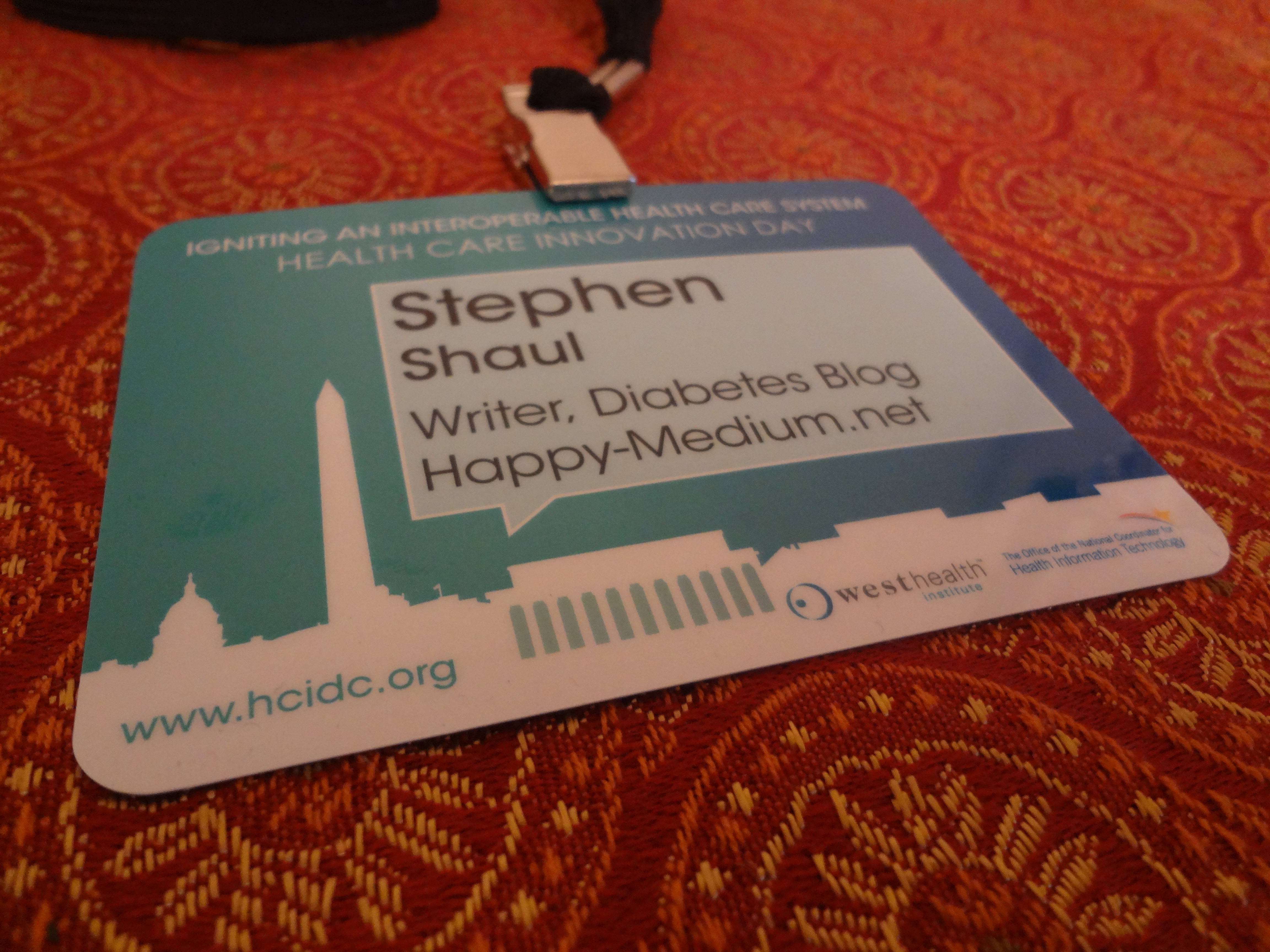
Since it’s only 40-some miles away (though a two hour commute) from home, and I got enough advance notice, I headed to Washington, D.C. last Thursday for HCI-DC 2014: Igniting an Interoperable Health Care System.

The event was co-hosted by two different groups: The Gary and Mary West Health Institute, which, according to its website, “is an independent, non-profit 501(c)(3) medical research organization whose mission is to lower health care costs by developing innovative patient-centered solutions that deliver the right care at the right place at the right time.” And the Office of the National Coordinator for Health Information Technology (trust me, it’s an actual government office).

The idea of the day was to get as many people in the room as possible to talk interoperability in health care. Not just, “Can I get my CGM to talk to my pump”, although there was some of that. But there was also a lot of talk about how to push for standards in medical record-keeping, and making them accessible to health care professionals, in the same format, worldwide. Imagine this: I have an accident in another city, I get rushed to the ER, and a doctor could pull up all of my medications and doses, and my pump settings, etc. Today, all of that might be on paper somewhere, and depending on the timing, a doctor may or may not be able to get access to it right away. You get the picture.

There were things I liked about this conference, and things I didn’t like. I hope I can explain a bit here. Yesterday, I talked about the things I liked. Today, things I didn’t like.
 
 
What I didn’t like:

Unless they were hiding under a chair or something, there were no manufacturers present at this gathering. I don’t know if they weren’t asked to attend, or if it was too long a trip from California or Europe or wherever they are, or if they just didn’t want to talk about interoperability at all.

If it’s that last thing: Let me just share something I mentioned in a conversation with someone over lunch that day.

I’m sure that the cost of the CareLink software is baked into the overall cost of my Medtronic insulin pump. But if Medtronic, for example, decided to make their code available to all, or if they agreed to adhere to a standard software protocol with future products, I would still want an insulin pump. And you know what? If they did get on board with interoperability, I might actually want to buy their pump even more. Insulin pumps and CGMs won’t go away once their data is “democratized”, to borrow a phrase I heard that day. Each patient will buy what’s best for them at the right time, but they will still want pumps and CGMs. And if manufacturers finally move toward a standard for device interoperability, they would finally be free to spend less time worrying about how to make their software proprietary, and spend more time worrying about how to make a better product (disclosure: I’m perfectly happy with my insulin pump right now, even if I see it as less than perfect).

There was something else that touched me that day. I want to move delicately around this subject. But… here’s the thing: There were a few female presenters (like, three). All the rest were male. Nearly everyone in a panel discussion or presenting was white.

Now, I realize that even if there was a concerted effort to bring more diversity to the stage for HCIDC 2014, there probably still would have been an overabundance of white people facing the audience. That’s just the way it is. But the fact is, the audience was pretty diverse in itself. Enough so that there were a couple of tweets from others who noted the steady stream of people walking onto the stage wearing a dark jacket, white shirt, and a tie.

Washington is a very diverse city. America is an amazingly diverse country. For next year’s event I kind of hope the presenters, or the members of panel discussions, will reflect that diversity just a little more.
 
 
So, now my overall take on this event:

I liked it. I really liked what I heard from everyone, onstage and off. I’m encouraged by where the discussion about interoperability is headed in the future. The will to make this happen, or at least get down the road a little farther, is really starting to crystallize.

But without manufacturers becoming part of the discussion, we’re not going to get very far. As Malcolm Gladwell alluded to in his keynote address, “No one will work toward interoperability in health care unless it is framed as urgent, imperative, life or death”.

Well, guess what? It is. Interoperability isn’t everything. But it is a game changer, because it would 1) Free up already overworked people from writing and entering so much data that can’t be shared anywhere else but at the point of care; 2) Lower costs for manufacturers, because once a standard is in place that everyone can follow, work on proprietary software will be minimal; and 3) Help improve patient outcomes, due to devices working together to ensure safety and optimal results for the patient, rather than being in their own silos just so they can generate more imagined revenue for the maker.

I agree… the time is now. We have the means and the determination to make interoperability in healthcare a reality. I hope this event comes back next year, and I’m looking forward to what kind of changes will happen between now and then.