Category Archives: Social Media

Diabetes Social Media Burnout?

Welcome to Tuesday. September 1st. Oh, and it’s my brother’s birthday. Happy Birthday Chuck!

Thanks to the people at Diabetes Daily, today is also Diabetes Social Media Burnout Blog Day. According to Diabetes Daily:

“… let’s talk about ways in which we can address and take care of our burnout! Let’s talk about ways in which we can step back for a bit and re-fuel or ways in which we can handle the situations where we feel like we’re being attacked or even where we might find ourselves attacking others for differences in opinion.”
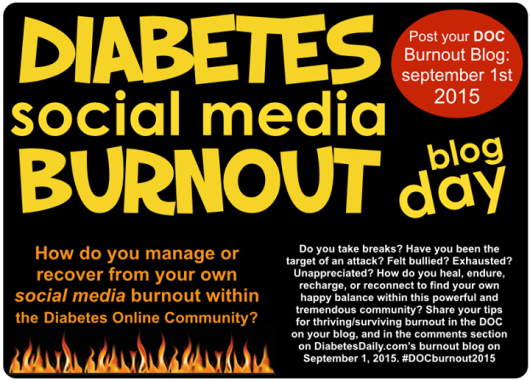
DSMBD
Okay… there are a few things I should get straight with you right from the outset:

First, maybe I’m late to the party, or maybe I just like this all too much, but I haven’t really felt social media burnout to the extent suggested by this topic. I’ve been connected to the internet since the early 1990s, but never in a big way until I found the Diabetes Online Community (the DOC) four years ago. Also, I never owned a mobile phone until about four years ago, and I’ve only owned a smart phone for the past few months. So that probably has a lot to do with it.

Second, and I hope I’m not jinxing myself, but I haven’t ever really been attacked on the internet. I’ve encountered a few uncomfortable situations here and there, discussions where someone felt a certain way on a subject, and were ready to go toe to toe with me if I disagreed with them. But those moments were few, and by and large, unless that person was advocating for something dangerous or unquestionably wrong, I just let them vent. Didn’t cost me a thing to do so.

Third, my influence on the internet, and within the diabetes community, isn’t that big to begin with. If someone wants to attack me, they’ll have to hit a pretty small target. I’m a fierce target… but when it comes right down to it, nobody is going to feel a lot of pride trying to knock down someone like me. I’m not a big enough fish for most trolls.
 
—————————————————————————————————
 
That’s not to say I haven’t ever experienced social media burnout. Usually, it’s around the time when I am busier than usual already. What I try to do is think of my social media interactions as fun. If it’s not fun, if it seems like too much of a chore, then I back off a bit.

Also, when I get a vacation (which is rare these days, but still), I usually disconnect totally from social media for the week or so I’m away. Once I do that, I’m really ready to engage with others again. Also, it seems like something big always happens during those rare times when I’m not as active on social media. More impetus to jump back into the conversation.
 
—————————————————————————————————
 
As for being attacked? It’s only happened twice that I know of, but I’ve experienced situations where someone accused me of somehow being a shill for a large company, or being part of a select group of bloggers within the DOC that always gets to go to big events while others stay home. Here’s how I deal with something like that:

Look… I know who I am, and what I stand for. I’m not afraid to change my stance on something if I feel that my stance needs to be changed. When someone has something critical to say, I try to listen first and consider whether there is merit to what someone is unhappy about. I allow for the possibility that I may be wrong. That’s a difficult thing to do, and I do it. And sometimes, I’ve changed my point of view. Also, it should be noted, I’ve paid my own way to nearly everything I’ve attended.

I also know the difference between disappointment and bitterness.

I didn’t get to go to MasterLab this year, or Friends for Life (never been to Friends for Life, actually). I am really bummed about that; I’m incredibly disappointed that I didn’t get to make it this year, and it still affects me when I think about it.

Now, if I were to take to the internet and complain about the people who were there, accusing them of being part of an exclusive clique of bloggers who always get to go to big diabetes events and hang out with each other all the time, blah, blah, blah (we’ve heard this before, right?)… well, that’s just bitterness. Bitterness comes from someplace different from disappointment. Those people who went to MasterLab this year? It’s not their fault I didn’t get to go. I get a lot more emotional mileage from being happy that they are there, as opposed to criticizing them for my not being there.

Bitterness can come from disappointment. But disappointment is never an excuse for bitterness. When the only argument you have is to say, in effect, “I’m better than you because look how bad you are”, that’s bitterness. I’m not going to give you my time. You have to own your bitterness all by yourself.

Also, I will add this: When you attack people in the diabetes community, you are attacking my friends. People who have laughed with me, who have befriended me, people who have commiserated with me through my failures, and celebrated with me through my successes. You don’t mess with my friends.

If it weren’t for this community, I wouldn’t be where I am today, physically, emotionally, or just about any other way you can think of.
 
—————————————————————————————————
 
Finally, and I hope this doesn’t sound overly simplistic, but I try to think of the information superhighway just the way I think of an actual superhighway. Along the road, there are places to eat, places to lay your head at night, places to gather socially with one another, places to share experiences, places to ask questions and seek advice.

Along the superhighway, there are good, helpful, strong individuals who live in communities that protect one another and support and encourage one another. And there are terrible, awful people, who thrive on the misery of others, and try to pump up their own sense of self-worth at the expense of someone else. Unfortunately, there is nothing to bar the access of those people from the information superhighway. The best we can do is protect ourselves, and each other.

Well, those are a lot of words, and maybe not a lot of advice. But if I were giving advice on dealing with social media burnout? I’d say: Participate as long as it’s fun and/or meaningful to you. Encourage and support others. Learn the difference between disappointment and bitterness. And…

Do not let a bitter person steal your voice.

 

How to react? How not to react?

For the benefit of anyone reading this months down the road:

CrossFit, the fitness company, posted a tweet that was particularly offensive to People With Diabetes. It was wrong, both in its tone and its wording, and because its statement had absolutely nothing to do with actual, you know, facts.

After this tweet went out, members of the diabetes community did their best to show their outrage at such a gutless attempt to guilt people into working out using their program, and shame People With Diabetes. Which brought out more ridiculous responses from the CrossFit CEO. Stupid is as stupid does, I guess.

The biggest diabetes organizations in this country got involved too, posting their own social media messages in response. For the most part, I was happy to see this. It’s good to know that when someone tries to hurt you via social media, JDRF, ADA, and others have your back.

But… and you knew there would be a but… some of the reactions were less than stellar from an inclusiveness point of view.

Is that too vague? I’m not sure I know how to put it into words. I think what I’m saying is, when I see a popular singing star, who lives with diabetes, tweet “Know the difference between types of diabetes”, I wonder what in the hell the different types of diabetes have to do with this issue in the first place. I’ve gotta admit… when I saw that one, I cringed a little bit. Why?

Because when we point out that my type of diabetes isn’t to blame for [fill in the blank], or we say this type of diabetes isn’t caused by [fill in the blank], we’re also implying that some other type of diabetes is to blame, or some other type of diabetes is caused by something that our type isn’t. Don’t believe me? Ask a Type 2 how they felt about some of the most vocal responses to the CrossFit issue.

And if you say, “Hey, well, that’s not what I meant”, I will tell you that it is not what you say, but rather how what you say is perceived that is important. Just ask my wife. And, Type 1s, when we make Type 2s feel this way, we are alienating 25 million People With Diabetes just in this country. 25 Million potential allies in the fight for better care, better access to medication, better acceptance by society. And, Type 2s, if you ever alienate Type 1s, you are alienating one of the most resourceful and vocal groups of diabetes advocates on the planet.

To varying degrees, we are all getting screwed in the media. To varying degrees, we are all getting more attention in the media. I don’t have the exact textbook way to respond to situations like these.

I just know that, like I’ve said before, it’s not always important to get there first with the most anger. It is extremely important that we respond to shaming and stigma-inducing ridiculousness by starting with what is in our heart… considering everyone affected by (and potentially viewing) the initial issue, and potential responses… and holding up a light to our shared humanity, and giving a voice to that shared humanity, in a way that protects us all, lifts our common cause to the highest plain, and encourages thoughtful discussion and meaningful change for the better.

I think that’s the longest sentence I’ve ever written.

There will be more discussion on this topic, coming on the next episode of Diabetes By The Numbers, here in a few days. As always, your opinion matters here too.


The DOC as an information source.

It’s easy for me to think of the Diabetes Online Community as this lovely group of people who advocate, support one another, and help others live better lives with diabetes.

What I sometimes forget, but can never underestimate, is the power of the DOC to inform and educate. Let me give you an example:

After working for my company for 15 or 16 years, I still hadn’t met one other person there living with diabetes. Now, after almost 17 and a half years, I know four.

One of those people contacted me last week to ask about the Animas Vibe system, the pump integrated with the Dexcom G4 continuous glucose monitor. They asked me if I had tried it, and if so, what I thought of the product.

I said that I had not, but had used an Animas Ping pump during a couple of clinical trials at the University of Virginia. This person was really looking to get first-hand knowledge of how the Vibe works and whether it was worth the hype. I then digressed into how awful it is that no insulin pump maker will let patients trial pumps anymore (lamenting the demise of the Snap), and how this would all be easier if we could just decide for ourselves, instead of deciding based on what a company rep or a doctor tells us. Digression is my strong suit.

But you know what? I knew that many people have used the Vibe system, and they’ve written about it, and it wouldn’t take too long at all to find a thorough piece on the subject.

In no time, I found this insightful review of the Animas Vibe by Melissa Lee at A Sweet Life. Sure, I knew that Melissa is knowledgeable and trustworthy, but even if I didn’t know that, her review was a very good one, and I think it’s just what this person needed.

I don’t know if this will help my friend decide on whether the Vibe is the right choice for them. What I do know is that I am often guilty of thinking about how I connect to the DOC, rather than how the DOC connects with me.

This is a good reminder of the vast treasure trove of information that we are all contributing to our community. People don’t have to always go blindly about the healthcare universe, not knowing about a product they and their insurance provider are purchasing until after they purchase it. Just knowing this information is out there already helps people make informed choices, rather than guesses.

Your story, your experiences matter. Sharing the stories of others and their experiences matter just as much. That’s been true since the earliest civilizations graced our planet so many years ago.

So today, let’s remember the power of the Diabetes Online Community as an information source. And let’s keep adding to the wealth of knowledge.


#DBlogCheck: Building Community.

It’s another D-Blog Check-In Day (for my previous thoughts on #DBlogCheck, see here and here).

Christopher Snider, who writes at A Consequence of Hypoglycemia, started this idea a while back. Basically, it’s a day where we’re less of a lurker and more of an active online participant in the Diabetes Online Community, by leaving a comment on every post we read on diabetes blogs, Tumblr, Instagram, and so on that we see.

If you read something today, leave a comment. Even if it’s just to say “check” or “I’m here”. Be sure to share and encourage others to do the same on Twitter and elsewhere by using the hashtag #dblogcheck.

It’s a way for us to support those bravely sharing their stories, a way to build community, and more than that, it’s a way to continue the dialogue among the vast hordes living with diabetes and helping those living with diabetes. That’s what I’d like to talk about today.

Writing this blog for nearly three years means that I’m not exactly a rookie anymore, but I’m not quite a seasoned veteran either. Even so, in the limited time I’ve been doing this, I’ve seen how the diabetes community has evolved. It’s true that the DOC is no longer a nascent community of random people shouting into the ether. Instead, it’s a vast interconnected network of people who know each other personally, know each other online only, or don’t know each other at all, but are nevertheless hanging on every word that is written.

Can you imagine what it must have been like in those early days? Writing out thoughts and posting them without knowing who was out there to see them? But someone did. And those initial readers responded. They connected, the same way you and I are connecting today. You know what? That kind of writing and that kind of response is still the basis of what grows the DOC, reaching more people, changing more lives.

Meanwhile, the community of it all has really grown in the last few years. Off the top of my head, I could probably list a dozen or more diabetes initiatives and organizations that have taken flight, including my own (notice the photo of the medals in the upper left corner of this page), through the sheer nature of someone raising their hand and saying I’m here, and someone else responding. How does that happen?

Through participation.

Through your participation.

Through your positive response.

It has all happened through your commitment to community.

As you comment today, think about what it means when you say “Yeah, me too”, and “Yeah, I think that’s a great idea”, and “Hey, what if you tried this”. Because while it still takes a great idea to start something, it also takes a great response to make a community successful.

So think about what your involvement means to this ever-growing community. What it means to someone who is finding their voice. What it means to someone advocating on your behalf before government officials. What it means to those raising money for an important diabetes cause. What it means to someone thinking about getting people together to encourage and support one another.

You, dear reader, are just as important as anyone else in our diabetes community. Let me take this moment to thank you for the insightful, inspirational, and encouraging comments you’ve left here so far. Let me also encourage you to continue to stay engaged with this wonderful community. You’ve made it the safe, empowering, and uplifting place it was long before I showed up. And you’ll make it the bigger, even better place it can be long after I’m gone.

Unless, of course, they find a cure first. Then you’ll have something even bigger to be proud of.


Happy Thanksgiving 2013.

TY

It’s a tradition in our family that every year at this time (the Thanksgiving holiday here in the States), we pause and mention something meaningful in our lives that we are thankful for. We go around the table, and everyone, young or old, optimistic or pessimistic, offers a Thank You for something significant.

Today I offer a giant Thank You to the Diabetes Online Community.

If you knew me, really knew me, you’d know I’m a very jaded individual. I never expect things to be as good as advertised, because they never are. My experience tells me that.

I know the DOC is growing larger by the day, and that’s good. The more voices we can add to the discussion about living with this chronic condition, the better. I do not expect those voices to always sound the same, or be focused on the same thing. I realize that even in the pursuit of positive things we can all agree on, sometimes personalities will clash and feelings will get hurt. Since the community is growing larger, it seems more likely that we’ll encounter an opposite viewpoint from time to time, or even an outright troll now and then. After all, one percent of 100 is 1. One percent of 10,000 is 100.

But I also know what my life was like before I discovered this thing, whatever it is. I know how I felt. I know how alone I felt. Like the saying goes, loneliness is everything it’s cracked up to be. What’s weird from my viewpoint is: I’m usually okay with doing things on my own; but doing them with understanding and support and encouragement from others in the same boat? It’s a lot easier, and it’s worth more to me than I’m capable of describing right now.

I could list hundreds of individuals and organizations that have made such a difference for me over the last two plus years. I would, if I had another couple of weeks to list them all. The list is that long. On the other hand, I think I could list maybe… maybe… two who I am less than enthusiastic about. But even those two are important to me, because in the end, they want what I want too. And in nearly every critical comment, I see at least one small thing I need to examine with a fresh eye, consider with a different viewpoint.

So on this Thanksgiving 2013, to the Diabetes Online Community, let me say:

Thank You—Gracias—Merci—Arigato—Danke—Toda—Mahalo


The world, in fact, is big enough for all of us. Thank you, DOC, for making it big enough for me.