Category Archives: Random Glucose

Living with a chronic condition is like : Laundry.

With a rare extra day off and nothing on my schedule, in between watching hockey and football on New Year’s Day, I worked to catch up on laundry.

And there, somewhere in between the Sabres and Rangers, and LSU – Notre Dame, it hit me: doing laundry is a lot like living with diabetes.

It’s not enough to just throw everything into the washer. You have to add soap, and fabric softener. Maybe bleach. Do you have soap, fabric softener? What about bleach? It’s not likely you have an abundance of all three of those in your laundry room at the same time. You might even have to pretreat an item or two before you get started. Every load is different. You can’t count on anything.

You’ll have to eventually shift each load from the washer to the dryer, or possibly hang up the more delicate fabrics. Do you use fabric softener sheets? Do you have fabric softener sheets? Do you need to make a trip to the grocery store?

Now you’re probably thinking you’re through with your laundry. Not likely. Because you’re going to have to fold or hang all of those clean clothes. All of them. The truth is, this is the part I hate the most. It never feels like I’m going to get to the end of what’s in the dryer.

And still, you’re not finished yet. You have to put it all away… unless you just want to select what you’re going to wear from your laundry basket. Personally, I wouldn’t think less of you if you did.

Just like the laundry, living with a chronic condition like diabetes means that I have to keep track of medications and supplies, at least one of which seems to need to be refilled every couple of weeks. I have to treat each circumstance differently. Whether it’s exercise, diet, stress, or something else, no two days are the same.

And here’s where living with a chronic condition is different from laundry, or anything else:

You’re never finished.

If my dirty laundry piles up and I just don’t have the time or the desire to get started on it, if I want, I can try to get away with wearing the same shirt or the same pair of pants twice. But even though I have days where I’d like to just kick back and ignore my diabetes, that’s just not possible.

Every situation, every piece of food I put in my mouth, every workout, every single day brings another factor I have to deal with. I can send my clothes out to the dry cleaner if I want, but I can’t pass off my diabetes to anyone else.

If you want to get a taste of what it’s like to live with a chronic condition, grab your dirty laundry and get going. If you really want to know what it’s like to live with a chronic condition, imagine doing laundry all day, every day, for the rest of your life.

Forty (or more) Winks.

I’ve been feeling tired lately. Like really, really tired.

That’s not uncommon among people living with diabetes… if you consider all the time diabetes tasks require of us, it’s a wonder we get any sleep at all. Add in getting up to use the facilities thanks to a nighttime high, or getting up to ingest carbs thanks to a nighttime low, and you’re talking about even less shuteye.

Is my age a factor? Is it causing me to get less sleep, or not process the sleep I get as well as when I was younger? I suspect one or both of these might be factors.

Real people sick is a thing too. Managing a cold or the flu while already managing an existing chronic condition will wear out anyone.

And let’s not forget other outside influences: the political climate, an economy that we hope will be good but we’ve seen crash before, and work-related stress all play their part too.

In my case, I guess I would have to add in advocacy, and a renewed effort to connect to friends and family more. These are good things, but I can’t sleep when I’m at meetings or other gatherings. What I mean is, when we’re involved in more and more activities, we have less time to just sit, relax, and let our brains and bodies recharge.

For additional context, I’ll refer you to this post at Diabetes Forecast. I especially like the quote “Your brain is a glucose guzzler”.

So what’s a fella to do?

Some of these are no-brainer ideas. Some are just things that work for me. All of them, if implemented properly, should help me get the most out of my downtime:

1. Go to bed! When you’re “on stage”, as the Disney Parks management puts it, all day, it’s hard to come home and suddenly shut your brain off so you can sleep. But I’m also guilty of staying up late, really late, on those rare days when I don’t have something scheduled the next day. I usually get up around the same time every morning, so that means I’m not even getting the most sleep I can get when I can get it. That has to stop. Everything in moderation.

2. Get into better shape. I’ve always been active, but less so in the past couple of years as I’ve gotten busier. Not only do I miss working out more, I need it so I can be stronger on those days when I really need it. It seems counterintuitive to try to add more into my schedule, but in this case, I think there will be a significant return on the investment of my time in being stronger.

3. Find the hidden wastes in my daily routine. Like Frank Bunker Gilbreth Sr. and his wife Lillian, I want to find the “one best way” to go through my days, so I can cut down on the time needed to finish items on my to-do list. I probably won’t find too much wasted motion, but if I look, I’ll likely find something. Even if I don’t find a lot of leeway, when your life is full of schedules to keep, every minute of leeway you gain is significant.

4. Stop complaining about it! Look, this is what I signed up for… this is what I wanted. I want to remain as healthy as possible, but maybe an attitude change could stop me from griping about how I feel every time I wake up in the morning.
 
 
There is probably more I can consider. But I think I’ll start with those four and see where it leads. It’s not about turning myself into a robot who only thinks of sleep, work, and wake. It’s about carving time out of my day to have the freedom to relax, or to have fun, or just to think.

We’re not meant to be robots. We’re meant to be living, breathing, flexible, adaptable human beings. But this human being needs to get more sleep.

Questions… and gratitude.

So many questions racing through my head today…

At the end of last week, I received the EOB (Explanation of Benefits) from my medical plan for my appendectomy hospital stay in September. Immediately, my eyes moved to the overall cost of my stay in the hospital, the surgery, the intensive care, the drugs.

Total cost: $25,191.74

This included various details, all laid out in my form, including $880 per day for five days’ stay in the hospital, $2,681 to cover services in the intensive care unit my first night, $7,437 in operating room expenses, $2,278 in pharmacy costs, plus nearly $9,000 in various other costs.

As I said at the beginning, there are many questions racing through my mind. I can’t stop thinking about this. How do they come up with specific pricing? Why break out the costs into so many different categories? As always, why are the pharmacy costs nearly ten percent of the bill?

Fortunately for me, I’m enrolled in a fairly generous medical benefit plan through my employer. This plan means that my cost for this stay will be something just short of about ten percent of that bill. Still very high, especially for someone who already spends a few thousand out of pocket for drugs, supplies, and doctor visits throughout the year.

Which brings me to these very important questions: What does someone do if they are not in an employment position as advantageous as mine? In other words, what does someone do without coverage, or without adequate coverage? If it’s early in the year and you’re under a high deductible plan, and you get a big fat statement like this one, how do you pay for it?

Don’t forget, acute appendicitis isn’t something that anyone plans for. Neither is diabetes. Simply reviewing my situation, it’s easy to see why families declare bankruptcy every day due to medical expenses beyond their control.

And now, the U.S. Congress wants to allow states, through the Affordable Care Act, to sell skimpy policies to so-called healthy people. For a moment, let’s put aside the fact that this would mean huge increases in rates for the insurance options available for People With Diabetes.

Instead, since this is a diabetes blog, let’s look at it from the standpoint of initial diagnosis. Let’s say it’s early in the year, maybe February, and someone covered under one of these skimpy plans is diagnosed with Type 1 diabetes, requiring insulin every day, plus the durable medical supplies, test strips, insulin needles or pump paraphernalia, that go with it.

The good news is that the plans being talked about for this kind of individual cover a lot of the cost of “catastrophic” care. The bad news is, the insurance company decides the meaning of the word “catastrophic”.

Even if they cover the cost of a short hospital stay due to DKA or something else just as serious, they’re not going to cover any of the continuing costs of regular daily diabetes maintenance. And, as we all know, daily diabetes maintenance is anything but regular.

So, our previously healthy person is now stuck with what could be overwhelming costs, and over ten months left on a medical plan that won’t pay for hardly any of it.

That’s just a diabetes diagnosis. What about something like a stage 4 cancer diagnosis, a heart bypass, or another condition? What does coverage (or non-coverage) for those look like?

Oh, I have many questions racing through my head today. And an incredible feeling of gratitude that I am one of the lucky few who can afford what just happened to me.

I already have to live with diabetes all day, every day. Why do I have to attach another thing to my body to remind me of that?

So, my new continuous glucose monitor had been sitting in the box it was shipped in since around Thanksgiving.
dexcomgraph
Beginning to wear it now is not a New Year’s Resolution, or an effort to game my diabetes data gathering to avoid the high carb temptation that bombards us during the holiday season. No, it’s not that simple. I’m not going gently into that CGM-inspired good night.

Nor do I have a simple answer for why I’ve waited so long to use a CGM, and why I’ve waited so long to start to wear it since it arrived. In this case, the answers aren’t simple. They’re also not pretty.

I can give you reasons why I’ve resisted so long. Worries about having to carry the receiver in my already overloaded pockets (no, I don’t have an iPhone, and until an iPhone carries a price less than a few hundred dollars more than a comparable phone, I’ll stick with my Android platform– which means I have to carry the receiver too). Concerns about using up already valuable real estate by having both an insulin pump and a CGM inserted into my body at the same time.

Any concerns I might have had about appearances, I lost long ago. When it comes to looks, I care a lot more about my clothes than about my devices. So how it looks doesn’t affect me.

Wearing an insulin pump was an easy process for me. No problems getting started or staying with it, and nearly seven years later, I’m a proud insulin pump user. What’s the issue anyway?

I don’t know, but it’s troubling. I know that something is definitely bothering me about this. I can tell by the way I delayed getting started, until the reasons for my delay were outweighed by the embarrassment that I have access to a device that many crave and cannot get their hands on. I must go forward.

Yet, when I did my first insertion, I was using language that would make a sailor blush. I got even more surly as that first insertion didn’t work, because my brand new transmitter was crap from the start. Now I’ve used two transmitters and two (actually three, after working with technical support to get everything right) sensors with nothing to show for them. Finally, on the fourth try, I got it to start up and calibrate properly. But my issues, I fear, go deeper than a sensor insertion.

I think my problem may be the notion, the confirmation, that a CGM gives you data 24 hours a day, seven days a week. In other words, it’s a constant reminder that I live with diabetes, a fact I try to forget every day.

Yet, there’s no question. I must begin my CGM journey. As The Great Spousal Unit shared, and she was right: sometimes, I don’t want to believe what my numbers are without a glucose check. If I’m going to be such a slave to data (and you have to be one if you live with diabetes), sometimes I need data I can access even quicker than a BG check.

But it’s not easy, and I’m not entirely sure why. The trick right now, I think, is to make the physical effort to get started, and then over time, work on what my brain and my heart are trying to tell me.

I recently read a statistic sharing that adults living with diabetes are at least three times more likely to develop depression than other adults living in America. Depression isn’t exactly what I’m feeling. Still, I already know I have diabetes all day, every day… why do I have to wear something additional so I can be reminded of that? All day, every day?

Ultimately, I need to remember that this is a device that could save my life. And over time, I may actually get used to wearing it. I’ll know I’ve turned the corner when my desire to get the data overwhelms the desire to rip it off of my body for good.

Until then, the emotional price of data gathering seems awfully high.

A dog’s life.

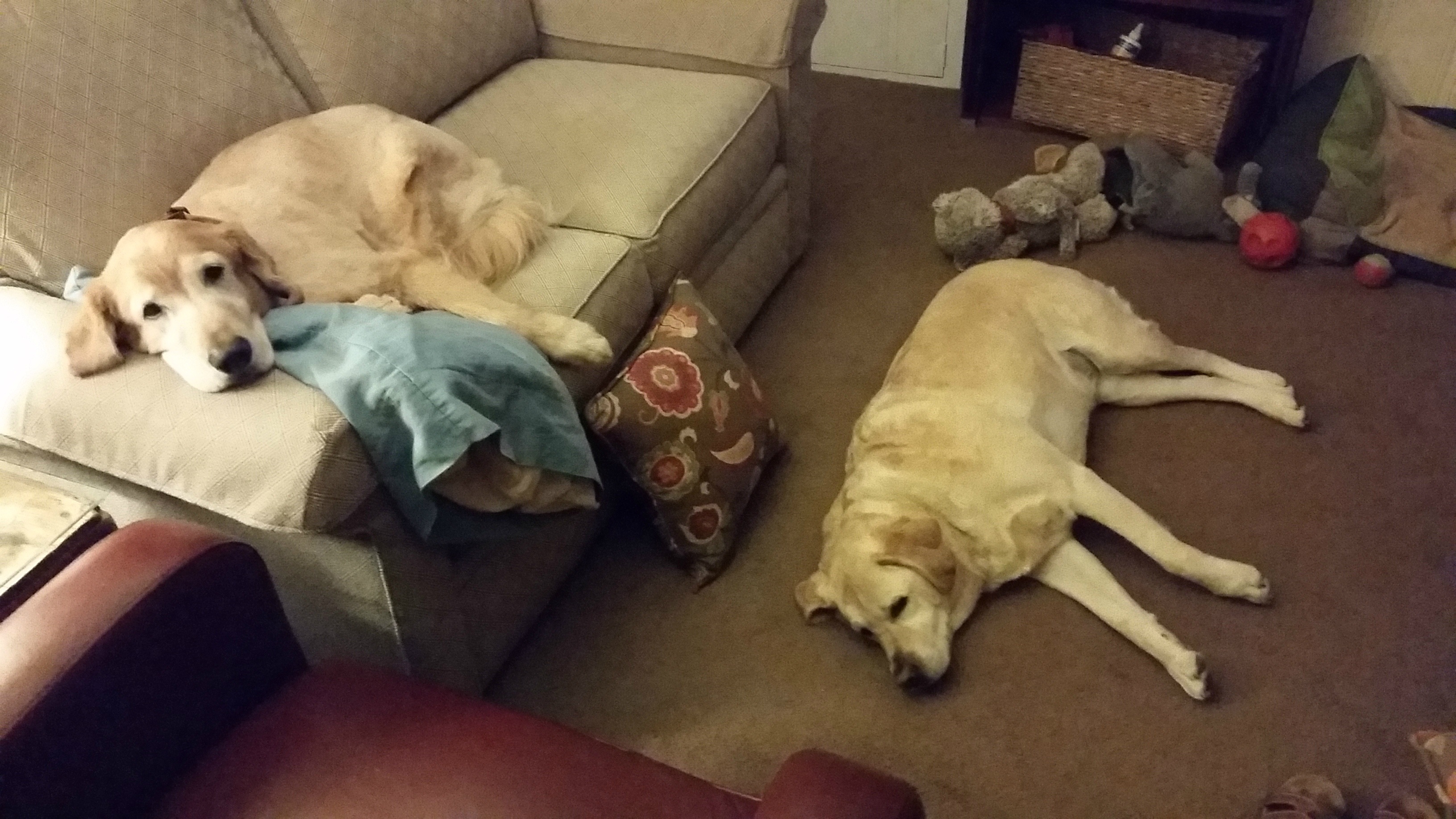
I’ve spent a lot of time at home this week, hanging out with the dog and the cat, and another dog that has been here for an extended sleepover. The dogs, especially, seem to have a certain calmness about them (most of the time, anyway). They don’t seem to be burdened by many of the things I am concerned with.
dogslife
Dogs don’t seem to worry about too much. They sleep when they sleep, they eat when they eat. They’re happy if you’re watching CNBC, or Drunk History, or the ballgame on TV. Their pursuits include fully stretching out on the floor, chasing after balls in the yard, and playing tug of war over a toy. If you’ve had a difficult day, they seem to empathize, but they’re also happy waiting nearby in case you need them.

The dogs that have been my companions this week don’t live with diabetes and all of the crap I live with as a Person With Diabetes. They don’t have to check their blood sugar 7 or 8 or 10 or 12 times every day. They don’t have to guess how many grams of carbohydrates are hiding in my noonday meal, or how many units (or partial units) of insulin are required to counteract the carbs entering my system, and they don’t have to remember to bolus before they eat those carbs.

These dogs get excited about dinner, and walks in the park, and the occasional mailman or jogger that goes by. But the rest of the time, they’re good just hanging out. They don’t have to live with the frustration of high glucose readings and doing the detective work to find out why the readings are high.

They drink water when they’re thirsty. They’re not forced to drink water to help get their blood sugar to come down. They’re not into why my insulin is so freaking expensive. They don’t have to fight with insurance companies to get them to cover devices like continuous glucose monitors and insulin pumps and enough test strips to be able to live the best life I can while standing in for my own pancreas.

Dogs are okay being lifesavers alerting us to highs or lows. Dogs are okay with just being part of the pack, and enjoying the occasional bacon flavored treat. Life isn’t much more complicated than that, because it doesn’t have to be more complicated than that.

I want that. I want a dog’s life.