Category Archives: Random Glucose

Apparitions and Optimism.

You know, if I were to describe a condition that’s as emotionally charged as it is physically challenging, I don’t know if I could describe one that fits the bill more than diabetes.

Our blood sugar can go from to perfectly annoying to perfectly comfortable to perfectly fearful in the span of a single day. We can do nothing we’re told to do to take care of ourselves and wind up with zero complications. We can do everything we’re told to do to take care of ourselves and wind up with multiple complications. Yes, we think about these things almost daily.

So we hope.

We dream of the day when we won’t have to worry about our poorly or totally non-functioning beta cells. Parents of kids living with diabetes dream of the day when they won’t have to check to see if their child is still alive in the middle of the night.

We’ve seen a number of promising products talked about on websites, in podcasts, and over various forms of social media. But most of those products never make it in front of patients.

Many don’t make it simply because they’re bad ideas. Others don’t make it because they’re not any better than the products they’re aiming to replace. Still others fail because the laws of science just won’t allow for the inventor’s dream to become a reality.

Some of the drugs and devices we get excited about do make it to market. But then they fail anyway. Again, because they’re a bad product, they’re not much of an improvement over existing options, or the company that produces the product just can’t make enough money from it.

When I think about all of the drugs and devices that don’t make it, inside and outside of diabetes, I often wonder why anyone even keeps trying with this stuff. Why do you try to develop a new insulin if it’s not going to be anything more than another insulin? Why try to come up with a new way to measure glucose in the body when only a few ways have ever proven to be successful so far?

The diabetes landscape, and the health care landscape in general, is a continuing exercise in finding apparitions on the desert horizon and waiting to see if they turn out to be a mirage. Yet, the overwhelming majority of us continue to hope as well. Our optimism may take a hit now and then, but it still remains as part of the health care landscape.

Why is that?

Well, to begin with… in many ways, optimism is all we have. It’s okay to despair now and then, but all you’re left with at the end of despair is more despair. When you have optimism, even if your optimism takes a hit today, tomorrow you still have optimism to go on.

That’s why I think people still go out and raise money for JDRF even though more people live with Type 1 diabetes today than ever before. It’s why brave people at the U.S. Food and Drug Administration worked to make the pathway to approval for new drugs and devices better and more transparent. I even think there may be people at companies working on products because they truly care about making life better, not to mention longer, for all of us living with diabetes.

I’ll be honest… my optimism has waned a great deal in the past two years. But I’m encouraged by the fact that people around me aren’t giving up. And if they won’t stop grasping for something better, I won’t either.

Here’s hoping that today’s apparition becomes tomorrow’s validation of optimism for everyone living with diabetes.

8 Things: Wordplay.


I’m a fan of words. Their spellings, their meanings. Learning to live with diabetes is like learning an entirely new language.

Here’s what I mean by that, using 8 examples:
 
 
1. Diabetus
I always hated when people said “diabetus” instead of “diabetes”. It’s the last two syllables… “beat us”. I don’t like the idea of living with a chronic condition that has that kind of language in its very name.

2. Medical Devices
There are more medical devices helping us to succeed with diabetes than ever before. Some people name their Dexcom Dex, or their pump some other name. If you’re someone using an Omnipod, do you call yourself a Podder? Are you Podding? I can tell you that I am definitely not Vibeing…

3. Co-morbidities
I don’t know about you, but I don’t even want one morbidity, let alone two or more. I might settle for 1/2 a morbidity, but that’s all. No more. I can only accept so much. I wonder if this is that bargaining part of bargaining, denial anger, depression, and acceptance we hear about?

4. Target range
To be honest, it would be a lot easier to hit the target if the target didn’t move constantly throughout the day. That’s the way it is with diabetes, every day. This is a term I’d love to find a replacement for.

5. Basal
When I wanted to begin on an insulin pump, I must admit that I didn’t even know what a basal or a bolus was. No endocrinologist I ever saw up to that point described dosing insulin in this way. Once my current endo educated me, I had trouble for a week or two remembering which was the basal and which was the bolus. So I tried to think of basal as the herb… you know, basil. I imagined an herb leaf every time I logged in what my basal rate was for the day. Don’t knock it… it worked.

6. Bolus
I don’t really have much to say about bolusing, except that I get ticked off every time autocorrect changes it to “blousing”.

7. Advocacy
Like many people, I used to think that advocacy was too big and too difficult for someone like me. The truth is that advocacy is easier than you think, it can take place in many forms, and it usually has a positive effect on both the subject and the practitioner of said advocacy. So let your advocacy loose… you’ve got a lot to give.

8. Lancet
Another word I don’t like. Probably because it has elements of onomatopoeia to it. In other words, the word itself sounds too much like what it does, which is lance the skin to get blood for a glucose test. I wouldn’t mind the onomatopoeiac nature of it so much if it were something a little nicer.
 
 
And there you have it… eight diabetes words, and eight ways of looking at them. I hope your weekend is fabulous. Talk to you next week!

You do You.

Some years ago, I was taught that everyone’s diabetes is different. On top of that, what works for your diabetes may not work for me, and vice versa.

That’s a great concept… but what does it really mean?

Well, they’re separate sentences, so let’s treat them separately, shall we?

Everyone’s diabetes is different.
Of course everyone’s diabetes is different! We come in all types. Non-insulin producing, insulin resistant, honeymooning, gestationally-high-BGing, and so on and so on. Diabetes comes in many flavors, all extra sweet (I couldn’t resist).

We also look at our diabetes differently. We refer to ourselves as a diabetic, or a person with diabetes. We see our diagnosis as a curse, or as a challenge, or as the greatest blessing we’ve ever received. Not sure I understand that last one, but if people are going to have to live with this the rest of their lives, they should be free to feel how they want about it.

What works for your diabetes may not work for me, and vice versa.
There are now officially more ways than ever to treat and live with this disease. If you’re living with type 2 diabetes, you may be taking something like Metformin or Victoza. Or you might be taking insulin, or some combination of all three.

If you’re living with type 1 diabetes, you’re definitely on an insulin regimen. But maybe you’re getting say, 70 units per day via a syringe or an insulin pump. Someone else living with type 1 might only be injecting 35 units per day. And the reasons for the differences aren’t always as clear as you might think.

We might also be taking additional medications or even hormones to help us manage our condition. Some people who have gastric emptying issues may be taking Amylin, which helps with that sort of thing. Or you may be like me and be taking a high blood pressure medication. Nothing to do with diabetes, except for the fact that when you have a compromised immune system, other health issues pop up from time to time too.

In addition to all that, there are many other additional tools that people use to help them find their best diabetes selves. Some rely on a continuous glucose monitor to help keep track of blood sugar trends, or even to help inform insulin dosing through a closed loop system. Many rely on platforms like mySugr or Tidepool to help them track everything in one place.

And if you’re reading this right now, you’re engaging in self care by participating in the Diabetes Online Community. You can check Facebook groups or Twitter chats almost daily to see how others are doing, and find out if there’s something you can learn about your own diabetes by reading about someone else’s experience.

All of this is why, whenever someone asks me ”What should I do?”, I first ask them about themselves and their experiences. Then, I might provide a couple of resources they could use to learn more. And then I tell them the most important thing:

You do You.

I’m not saying you’re on your own… I’m saying that your individual approach is the one that will be best able to handle the unique form of diabetes that inhabits your endocrine system. Nobody should have to figure out how to do this alone. But once we get ideas and guidance from those we trust, we should be free to personalize our own diabetes priorities.

The proof of success is in the many people living better and longer lives with diabetes, even though they’re each living them in a different way.

You do you. I’ve got your back.

Finally… Spring.

I’ve waited a long time to write that headline.

Winter lasted an exceptionally long time here on the east coast of the United States, and at times (March and April), it seemed like it would never end. And as it happens every three months or so, I’ve begun to take another look at my diabetes and make a few subtle changes.

To begin with, I started to clean up and rearrange all of my diabetes supplies. Winters are really hard for me. Most years, I just try to get through the winter without attending to anything other than the things that absolutely need to be done. I realize that winter officially ended nearly two months ago… but this weekend, I cleaned up my supply cabinets.

When the weather finally breaks, I take on other tasks related to my diabetes too. Yes, I changed my lancet. 🙂
I also looked at my CGM graphs over the past weeks, and then checked my basal rates to see if they needed to be adjusted in any way. My guess is that I’m fine for now, but I’ll be sure to discuss it with my endocrinologist when I see her in a couple of weeks.
 
 
Spring and summer are also the seasons of fresh produce, and there’s no question I eat better from May through September than I do from October through April. Especially when the fresh produce comes from my own garden.

I actually made a salad with some of that red leaf lettuce this past weekend. And it was delicious.

Do you ever feel like the coming of warm weather and additional sunshine gives you extra energy that you didn’t have a month earlier? That’s exactly how I’m feeling today. Here’s hoping your Spring, or, depending where you live, your Autumn, brings a renewed energy and the motivation to continue to live the happiest life you’ve ever known.

Prickless.

No, this is not a story about removing the president of the United States from office.

Instead, this is about something I did recently.

I went a full day without doing any fingersticks. Twice.

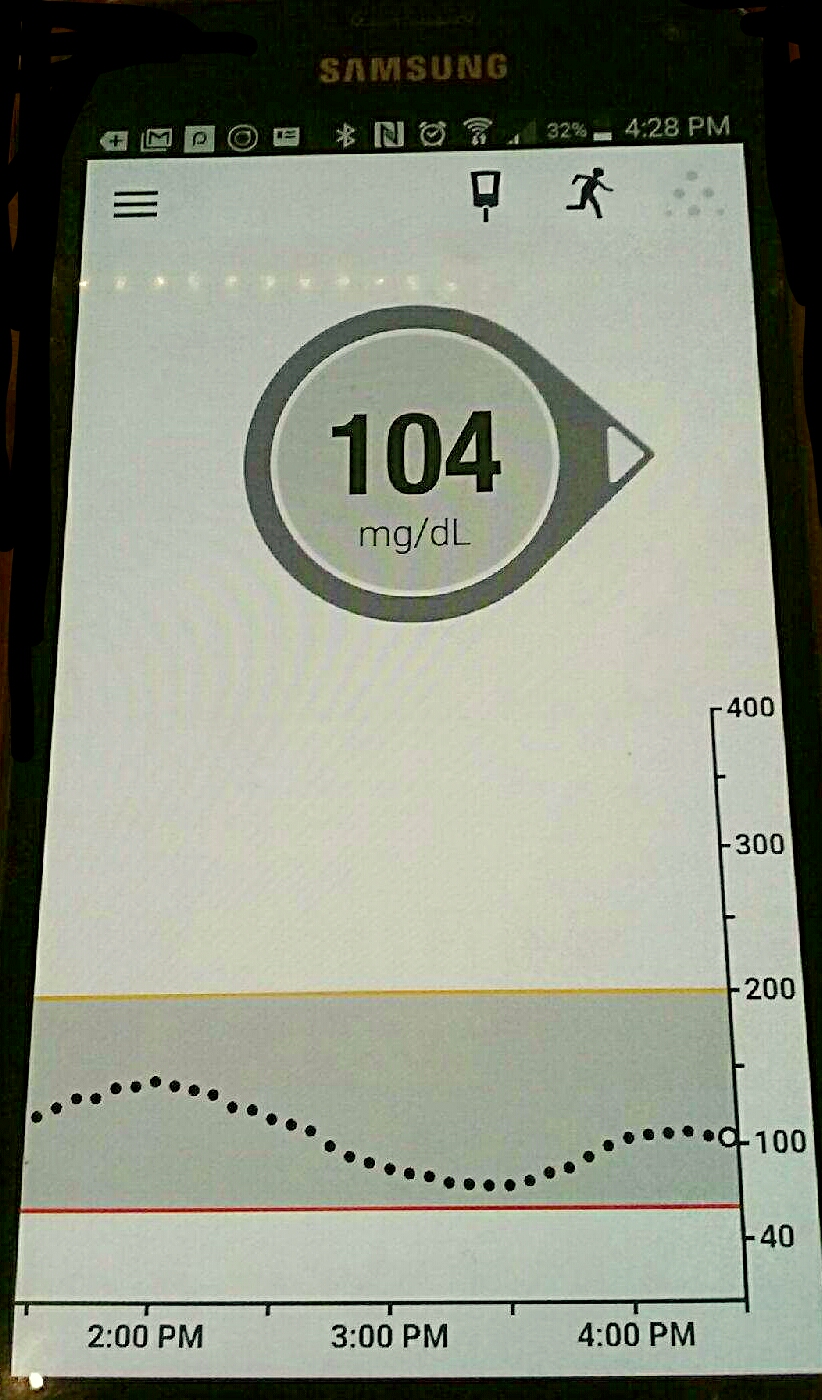
I got the idea when a Dexcom sensor ended, and I still had about four days left in my trial of the Freestyle Libre (Disclosure: Abbott paid for the reader and two sensors. Opinions are my own).

At first, I wasn’t sure about only wearing a CGM that I didn’t have a lot of experience with. But during the trial, it had been pretty reliable. Then I thought, “the Libre doesn’t require fingersticks, even for calibration… what if someone didn’t want to do one?”. So I spent an entire day, a Sunday, not using my meter even once.

Then, once I got through a day using only the Libre, I knew I had to do the same thing with my Dexcom G5. The Dexcom only requires fingersticks for calibration, so in theory at least, after calibration, I could go quite a long time managing my diabetes with only the Dex. Dexcom’s turn came earlier this week.

I don’t know a single person using either of these systems who ever actually does this. I’m sure there are, but I haven’t seen anything about it anywhere. How was my experience?

In a word, I was terrified. When you rely on pricking your finger with a sharp (okay, blunt) object multiple times per day for years on end, drawing blood and using that blood to give you a handle on your diabetes, you get used to it enough to rely on it first. For me, my meter is my truth teller.

Occasionally, my CGM will give me a weird reading I just can’t believe. When it does, it’s important, even comforting, to know that I can grab my meter and trust what it tells me. But the thing is… more often than ever before, even in these moments, the meter and the CGM are very close.

I didn’t have any notable moments during the two days. No big highs, no major lows. I just lived my life, checking my BGs only via my CGM display. Managing insulin dosing and carb intake accordingly. Out of sheer instinct, I took out the meter a couple of times each day, nearly checked, but then put it back in the drawer with a laugh.

Since things worked so well over these two days, you may be wondering if I might want to ditch the meter entirely. The answer is No. As I said, when it comes to blood sugar, I’ve come to rely on my meter as the one bastion of truth above all others.

But… I could see backing off on glucose checks in my future. Maybe I won’t check seven to ten times each day. Maybe four or five, or even three or four might do the job. Maybe it’s time to think of my CGM as more than just an emergency alert system.

What this experience has done is give me the feeling that I can step back and reassess whether I need to give my continuous glucose monitor more of a place at my diabetes table. I would have never guessed that I might do that. I’ll still keep my meter handy. But going forward, I’ll be just as likely to rely on my CGM.