Category Archives: Pumps

Pump Exploration, Part 1.

I’ve been interested in writing about my pump and its many features for some time. But to be honest, I haven’t been able to find the time lately, since my real job and worries about Hurricane Sandy have been taking up most of it.

I tried going through the pump manual/owner’s guide for a few days in my off hours to get some ideas, but that eventually made me sleepy. Sorry Medtronic… it’s not you, it’s me.

So since I wanted to write something, but I don’t have a lot of time to go in depth yet, instead of breaking down some unique feature of my Minimed Paradigm® Revel™ insulin pump, I’m going to invoke the Same Time, Next Year rule.

This rule is named after The Great Spousal Unit’s favorite movie: Same Time, Next Year starring the great Ellen Burstyn and Alan Alda. In the movie (and the earlier play of the same name), there’s a scene where the characters decide that they’ll each tell one good story and one bad story about their spouses, thereby insuring that they don’t look either too good or too bad to the other. So that’s what I’m going to do here. It’s my blog, I make up the rules.

The good story: Gotta admit, I like the freedom. I held off on pump therapy for a long time because I didn’t want to be tethered to a device for the rest of my life. But as time has gone on (2½ years), I’ve figured out that I can do pretty much anything (except swim) with my pump.

I also like the freedom that comes with being able to adjust my basal rates on the fly. With MDI (multiple daily injections), what I inject is what I get insulin-wise. So I found myself in situations from time to time where I would inject a certain basal amount of Lantus for the day, then have some kind of strenuous exercise that I hadn’t planned on, which could make my BG go dangerously low. With pump therapy, if something like that happens, I have the ability to adjust my basal rate on a temporary basis as a result of the impromptu exercise. I count on that a lot, and it works.

The bad story: I’m not a big fan of the circles. These are the different icons that tell you if your pump is in alert status or in alarm status. Also known as Special Mode and Attention Mode.

Alert icon (Special Mode):

Alarm icon (Attention Mode):

Basically, if your pump is in Special Mode, you’ll still be getting insulin. If your pump is in Attention Mode, insulin delivery has stopped completely. If your reservoir is low, you’ll get a message, then the blank circle icon on your screen that says you’re in Special Mode. Great, but after you clear the low reservoir message, it’s easy to forget that the icon is there.

If your reservoir goes completely empty, or your battery dies, or you have a motor error, you’ll receive an error message and then the Black Circle of Non-Delivery.

Obviously, the big difference here is that the alert icon can be rather innocuous. You’ll get this for a temp basal event. Not a big deal, right? I mean, you should already know if you’re using a temp basal right now.

On the other hand, the alarm icon means that you’d better do something pretty quick. Immediately, if not sooner. While I’m not a fan of ridiculously recurring alarms, I would be totally okay with the pump beeping a bit louder than usual in this case. A loud beep, instead of the quiet one I get, that I can’t hear when I’m out walking on a city street. In this instance, a black circle doesn’t really mean anything to me because I can’t see it on my pump unless I’m looking at the pump for another reason.

Hopefully, the good story here is a good one, and the bad story isn’t too bad. Overall, I’m glad I made the choice to start using an insulin pump. And I hope to get more in depth with it as the months and years go by, and as I get more time. If I do, I’ll pass along a few more pump stories. Maybe before it’s time for a new one.


Pumpin’ ain’t easy.

My apologies if some other blogger has already used this blog title. I can’t imagine someone hasn’t thought of it by now. So if you have, let me know and I’ll give you all the credit.

It’s been a little over 2 years since I started on pump therapy. And since a commenter asked me recently about it, I thought I would write down a few thoughts while they are fresh in my mind. This isn’t so much a product review. It’s just my thoughts on living the life of a pumper. I want to stress that it’s important to work with a medical professional to find what works best for you.

Officially, I’m using the Medtronic Minimed Paradigm Revel insulin pump. I’ll start off by saying I haven’t really had any problems with it. I wanted this pump for some time before I finally got it. I’d like to tell you that my choice was well thought out, and that I had gone through a few test runs of a few different models before making a decision. But I didn’t. Really, I went with the Med-T for two reasons. I had read the most about Medtronic, and the only other type 1 that I knew (actually– the only type 1 I know other than online) has a Medtronic pump. I did not do my due diligence, and I wish I had.

That said, I’m pretty happy with my choice so far. It’s not flashy, but it does exactly what I need it to do. And it’s been extremely reliable. I’ve beaten it up some. There’s a sizable scratch across the display. I got that going a little too close to the metal part of a door frame. While wearing this pump I’ve worked in the yard and around the house. Worked out at the gym. Stood on the train platform when it’s 10 degrees and 105.

I like that it’s powered by a normal AAA battery (simple things, right?). I like that I can upload data from the pump and share it with my endo. Even when the information isn’t always great. Making changes isn’t always intuitive, but I can usually figure out what to do. And Medtronic’s documentation is pretty thorough and mostly understandable, so if I can’t figure something out right away, I can always look up the answer.

Now, let’s talk infusion sets. I’m using the Quick-set infusion set with the 9mm cannula and the 23 inch tubing. I need the long tubing because it needs to go down and around the dress shirts that I wear to work. Here’s another area where I didn’t do a lot of research. I honestly don’t know if people generally like these sets or not. I like them okay. With one caveat: I wish the tape holding the set in was stronger. Mostly, it seems to be susceptible to big changes in temperature, either warm or cold. And it gets a little weaker when it gets wet. So if I’m swimming one day, then running in the 90 degree heat the next day, by the third day, I can feel the set trying to work its way out. I don’t think the set is bad; it’s pretty comfortable once you get used to it. Again, I just wish I had tried out a few more sets just so I could gauge the differences. Maybe I’m using the perfect set for me. I just don’t know if it is or isn’t.

Wanna talk continuous glucose monitors? I have one, but I don’t wear it often. I wear it about 2 to 3 weeks in between visits to my endocrinologist, so she can get an idea of how my BGs are trending throughout the day. Other thoughts about using the CGM will have to take up space in another post.

One additional complaint: well, not a complaint as much as an observation. This is one expensive piece of medical apparatus. I don’t really see the cost in the software or the look of the device. It must all be in the durability factor, which, right now, is pretty good. I can live with that. But I wonder if a drop in the price might get a few more people access to this kind of therapy. For some, it could be a life changer.

Speaking of cost: as much as I can tell, once you swallow the cost of the device (my insurance picked up a sizable portion of the bill), the ongoing cost is roughly the same as when I was on multiple daily injections.

The real advantage for me is in convenience. I can go nearly everywhere with it. And I love how a pump gives me the ability to adjust my basals or boluses on the fly, based on where my glucose is at that moment. That’s a huge thing for me.

So all in all, I’m glad I went to pump therapy. I’m happy with my decision to go with Minimed. If you’re thinking about going to the pump, and you have any questions, feel free to ask. Whomever you talk to, remember to ask a lot of questions! Make your choices in care from a well-informed point of view. Remember: pumpin’ ain’t easy (had to get that in there one more time). But it might be the next great step in your walk with diabetes. Good luck!


Low Tech.

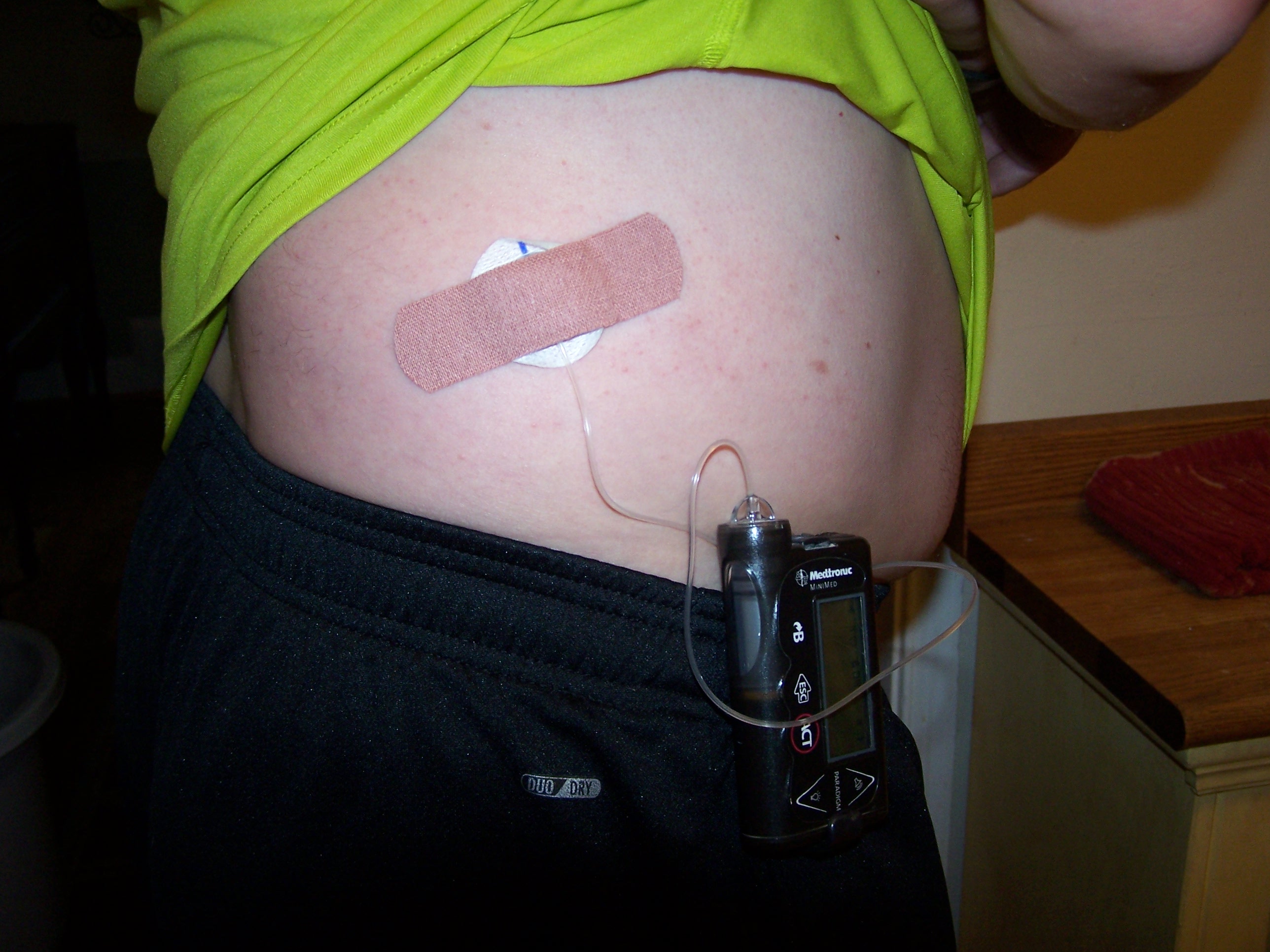
When your infusion set is on its 5th day, and you really want to keep it from working its way out before you squeeze the last few drops of d-fuel from your reservoir, you’ll do just about anything to keep it in.


I’m kind of embarrassed to show this photo, actually. But not enough to change out my set a day early.


Timing the Change.

This is shaping up to be a typical week for me. Only it isn’t. Sure, I have the typical work stuff, paying the bills, taking care of the dog and cat, etc., etc.

But there is one overriding thing invading my regular life this week. This weekend is the big ride that I’ve been training for most of this year. 150 miles over the weekend. 100 miles on Saturday, 50 miles on Sunday. It’s not a race, it’s just a ride. But let’s not kid ourselves. I’ll be trying to do as well as I can, at least for part of it.

Okay, let’s slow down. I have a lot to think about this week, and how fast I go is near the bottom of my list of priorities. One of the things I need to think about right now has to do with changing my infusion site. I’m nearing the end of the reservoir on my current set; I’ll need to change sometime in the next 12 hours or so.

At the same time, I know that I’ve been going about five days on each set. I know, that’s not within the FDA guidelines. I’ve talked about this before… I’m concerned about maintaining enough usable real estate on my body for as long as I can. One of the best ways I can think of to do that is to go longer on each infusion set & reservoir.

Anyway, here’s the rub: if I change tonight or tomorrow morning, and I go five days before changing, that puts me right in the middle of Saturday. And because my diabetes may vary, the middle of Saturday might be 10:00 p.m., or it might be 10:00 a.m. I do not want to have to change during my ride. So what do I do?

I think for tonight/tomorrow’s change I’ll have to fill the reservoir less so I’ll need to change on Thursday night or Friday morning. That way, I’ll be able to make my next change without the added pressure of the ride, and I should be able to keep that set in at least over the weekend. In addition, with the way I’m rotating my sites, I’ll be able to get that set in my leg, which has turned out to be a great place for when I’m on the bike. Way more comfortable than I had imagined it would be when I was strictly using my midsection.

How about you? Do you ever try to time out your changes so it will make things easier, or more comfortable, or for any other reason when you have something coming up? If so, let me know.

Me and my pump.

The pump has been with me for a little over 2 years now. Officially, it’s a Medtonic Minimed Paradigm® Revel 723 pump. Unofficially, I have a love-hate relationship with it. Actually, you can make that a like-hate relationship. But that’s not as bad as it sounds.

When you add up the score, it’s not all that bad:

Pros
First and foremost is the convenience factor. I can go just about anywhere (not the water) with it and get insulin when I need it. A good example for me is my too infrequent day trips to New York. Instead of injecting a great deal of Lantus and hoping that my BG stays in range all day, or taking along a flexpen with something fast-acting and then looking for a quiet place alone from time to time (try finding that in Manhattan), I have what I need resting on my belt. Love that convenience.

It does help me keep my numbers in line a little better, but my numbers were pretty good for about a year before going on the pump. What the pump does is make it easier to manage my numbers. When I was first diagnosed with type 1, I was put on a twice per day Humulin 70/30 product. Same dosage every day, no matter what. That lasted for about 14-15 years. Then after having a difficult time handling lows, I was introduced to Lantus. It changed my life. For about two years. After that, I started to have additional issues with lows in the morning and highs late in the day. So the answer to that was to cut down on the Lantus and use a fast-acting insulin (Apidra) for boluses prior to eating.

By the way, this was the first time I’d heard about the word “bolus”, or even the idea of adjusting insulin dosage based on my BG and my carb intake. About 18 years into my diabetes. Until then, it was the same dosage, same time, every day, no matter what.

The next part is my fault. I found the bolus idea to be too much of a nuisance during the day (crazy, I know). Particularly because I work in a conservative environment where appearing to be out of the norm has, in the past, sometimes been seen as weakness. So I only bolused with the fast-acting insulin at night, at home, where only my family would see it. At work I still check my BG before lunch in a separate room with no windows. People at work know about my diabetes. Some of them have freaked out about it at times. Or maybe I’m still a little unsure about giving them a reminder about it every workday.

I eventually started looking into insulin pumps about 3 years ago. I decided I wanted to check it out. I loved the idea of having continuous delivery, and the fact that I could program everything in, even variances to my routine (I’m talking temp basal adjustments). I finally got hooked up with the Minimed after I started with my super Endocrinologist, who has been great.

Cons
The hardest part about wearing a pump is that you are wearing a pump. It is attached to you, 24/7/365. You can’t understate that. But let me be clear in saying that you can get used to it. And if you’re not fond of giving yourself multiple injections per day (never a problem for me), I guess one stick every few days is not so bad.

I am not a CGM (continuous glucose monitor) wearer. I tried it for a while after going on the pump, but there were two big reasons why I gave it up. First was the annoyance of having another thing attached to me all the time. The other was that I’m very concerned about real estate (??). I’m starting to read about some of my fellow pump-wearing PWDs who are finding that some sites have scar tissue after being injected many times. I’m interested in preserving potential sites as long as I can, so while a CGM might help me get real-time BG info, it’s not yet worth me destroying extra real estate. Maybe later, but not now.

In the final analysis, I am happy to have the pump. I am very happy that I have an employer that cares enough (I’m being honest here) to cover my pump, and pump supplies, and strips, and lancets, etc. It makes me sick to see people lose their benefits and think, “what if they or their family has to deal with this disease on their own?”. And I’m looking forward to the improvements that technological advances will bring to the market. Maybe the real estate issue won’t be such a big deal in the future.

And one final thought: This is just my blog… it’s very much a personal journal of my life with diabetes. Every pump and CGM decision is a personal one. You must decide for yourself. If you’re thinking about whether to take the plunge, get advice, not opinion. Get the facts, not a viewpoint. I wish you the best of luck, and the most of happiness.