Category Archives: Healthcare

Better, not best.

For many people, living with diabetes means also living with depression and other mental health issues. That’s why this story in the New York Times this weekend caught my eye. It doesn’t have to do with diabetes and depression, but rather with what mental health care looks like today and what it will look like later in the year. Or next year. Or maybe later. What I read in the story is a prime example of one of my biggest frustrations with medical care of any kind. The two hallmarks of managed care in America: Confusion and Delay.

The story describes improvements (hopefully) in access to care for addiction and mental health for patients. Under the Patient Protection and Affordable Care Act, mental health care must be included in all insurance plans. No more leaving it out. And under recent updates to a separate law, the Mental Health Parity and Addiction Equity Act of 2008, plans are not allowed to charge more for co-pays or deductibles for mental health coverage than they charge for physical care. In addition, insurance plans will be required to show consistency when determining whether coverage for physical or mental care is medically necessary. They won’t be allowed to make getting prior approval for in-patient mental health treatment more difficult than the approval needed for admission to an acute care hospital. I like the idea of consistency in the law, and the recognition that care for mental hygiene should be considered on an equal footing with physical care.

What I don’t like is this: According to the NY Times story,

“The new parity rules apply to most health plans and are effective beginning July 1, although many plans will not have to comply until January of next year.”

The rules apply to most plans? What plans? Why not all plans? The piece mentions that some insurers have implemented the equity requirements into their plans already. For those who haven’t, why wait until July 1? What’s the deal with exempting some plans from compliance with the law until next year?

I’ve seen now several provisions of the PPACA and other laws over the last few years get delayed. It seems like it’s almost a given that the most contentious parts of these legislative efforts will always be delayed for one reason or another. Some of the reasoning for those decisions have to do with timing, and how fast insurers can react to change. I get that. But if we’re going to concede that point, we must also recognize that part of the reason for staggering compliance with the equity rules goes back to those ideas of Confusion and Delay. The more confusing insurers make things, and the more they delay, in their thinking, the more money they’ll save. Even when it’s been proven that early access to care of any kind almost always results in better outcomes, helps avoid complications in many cases, and often results in cost savings too.

So, I would ask of insurers: What are you afraid of? If someone needs coverage so they can see their psychiatrist or therapist, or to check into a treatment center for depression today, they need that coverage. Today. At some point, you will be covering that in tune with how you cover a broken arm anyway. Do you want to take a chance that someone could be irreperably harmed by denial of coverage, or by the constraints of cost? Are you okay with, can you visualize, someone being lost just so you can keep your plan the way it is for another six or eleven months? I can’t. I couldn’t live with myself knowing that.

So, insurer, if you can somehow turn off that fear, whatever it is, residing in your backbone somewhere, or if you can ignore it, you can begin the process of going from a bottleneck to being a conduit leading to positive outcomes, for people who are unquestionably worth it.

Stepping off of my soapbox now… How do you feel about this?


Holidays, Blah-lidays.

This post contains some raw, random thoughts hashed out over a couple of days. But please, please, please don’t leave an “I’m sorry for you” comment”. If anything, feel good for me. I’m not struggling, I’m just figuring my way through something I never experienced before a couple of years ago.

Okay… I thought I was good. I thought I was doing great. I thought that I was way over whatever had possessed me at this point last two years.

Apparently, that’s not the case. Don’t be alarmed (don’t you always hate when a sentence begins like that?)… I’m still much better than I was last year. But whatever got hold of me then has reared its ugly head a couple of times in the past week. I’m dealing with it, first by reminding myself how good I really have it and then by trying to recognize those moments when I feel bad, using some outside tool (not drugs) to try and snap myself out of it. Doing something, anything different really works for me.

I’m not a bah-humbug kind of guy. In fact, I used to be someone who very much looked forward to the holiday season, enjoying every tradition and celebration with enthusiasm and joy.

But the last couple of years I’ve been, well, I don’t know. I don’t know exactly, and that’s part of what’s frustrating about it. It’s like I’m looking through this clear glass door at a room full of holiday partiers. I know I can walk through the door and join the party any time I want, but I can’t bring myself to do it. Is that weird? It sounds weird.

It’s my own fault, really. It’s not because I don’t want to join the party. I think that I’m ready to join the party, but I want everything to be perfect before I walk in. Everything. Everything in my life must be perfect, according to my idea of perfection. Otherwise, I’m worried I’ll be rejected because I’m not ready, or not deserving, or whatever.

So my post today is an attempt to change that pattern. During the next month plus, I’m going to give myself permission to ease up on the things that are driving me crazy right now. I’m going to say it’s okay to join the party for a while, and then look again at the imperfect parts of my life to see if they’re still as important as they seem today.

I’m going to go out and take part in some holiday gatherings, among people who smile and laugh and share in the festiveness of it all. You’ll probably see a few extra pictures in the next month as proof that I actually did what I said I would do.

And if you encounter someone like me this year? No pity, please. Just talk to me. Strike up a conversation. Ask me about something. Anything to snap me out of my self-imposed malaise. Keep me engaged… don’t let me emotionally wander away, because I could be going off to a bad place. For absolutely no good reason.

The holidays are strange, aren’t they? I’m not in any immediate danger or anything. I just wish I felt more like celebrating. A lot of others want to celebrate too. Is that too much to ask for?


Just Words.

My company offered a great incentive recently. Answer a few questions, go through a health screening, get your blood pressure, cholesterol, and your glucose checked. At the end of it all, they put a few extra bucks into my flexible spending account, which I can use to pay for things my medical plan doesn’t cover (like the co-pay on test strips).

So I went for my scheduled screening about 20 minutes after my lunch. I informed the screener that I was Type 1 so he wouldn’t have a cow when he checked my BG. He went through all of the tests, including the glucose check (with a One Touch meter).

The result: 160 mg/dL

So I’m thinking
, “Hey, I’m at 160 only 20 minutes after lunch? Brilliant!”.

And that’s when the screener said: “Sir, of course you know this because you’re type 1, but you should always maintain a blood sugar below 140”.

Me: “But I just finished eating a little over twenty minutes ago”.

Screener: “Yes, but FDA guidelines suggest that you should keep your blood glucose at 140 or lower constantly”.

Me: “Okay, first of all, I’m pretty sure that’s incorrect, and second, I just ate… wait a minute… you just came back before I sat down right?”.

Screener: “That’s right”.

Me: “Did you just eat?”.

Screener: “Yes”.

Me: “Go ahead and test yourself. I’ll bet you’re at 160 or higher right now”.

Screener: “Sir, what my blood sugar is doing is not…”

I stopped him right there. I don’t usually like to interrupt people, but I had to do it right then. I stopped him mid-sentence, and said “My point is this: Everyone, every situation is different. When you paint everyone with a broad brush like that, you’re going to scare the crap out of some people who may not have diabetes, and you’re going to make some people with diabetes feel bad”.

Maybe I overreacted. He was just doing his job. Just repeating what he’s told to repeat. They are just words, after all. I was just thinking that I don’t want the next person who sits down after lunch to worry unnecessarily, or feel bad about themselves.

As I was finishing up, he handed me a flyer with some general health information. Among the other items in the 3-sided pamphlet was this nugget, near the bottom of the page:

Hey, it’s just words, right? And maybe I’m a little over-sensitive to these kind of things now. But last time I checked, there wasn’t anything I could do to prevent my diabetes. Or anyone else’s Type 1. And eliminating my diabetes? Sorry for the cliche, but that’s a little like reversing pregnancy.

I know it’s just words, but I did get the e-mail address from the vendor doing the screening, and I sent an e-mail telling them that they should rethink the way they’ve worded their little handout. Again, it could make people feel bad. People who develop diabetes, or have already developed diabetes, could think that they’ve failed somehow. When really, they didn’t have anything to do with it.

Hey, it’s just words. But words can hurt. Or they can heal. Your choice.


Just Wondering.

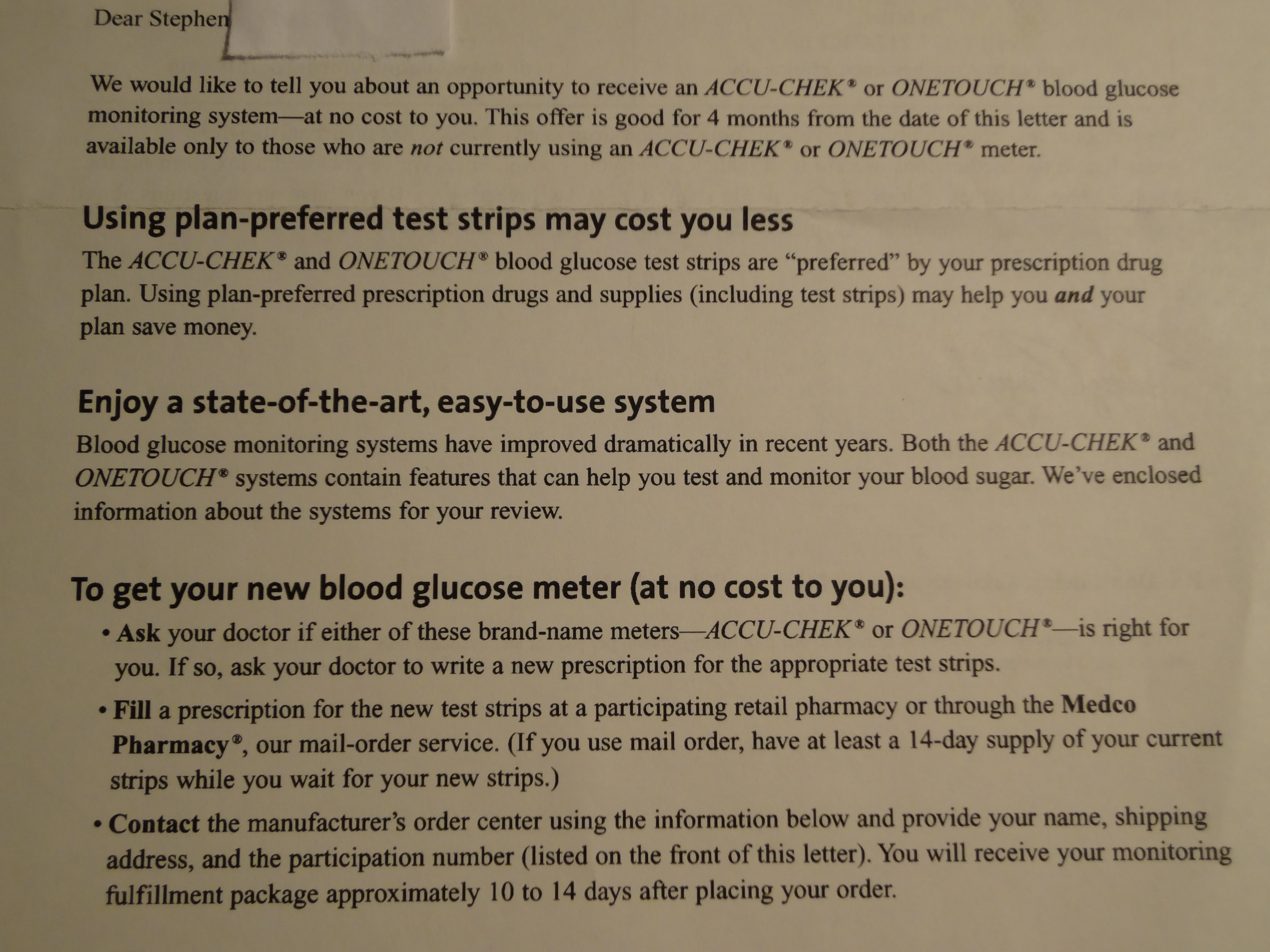
I received an incentive from my prescription plan this weekend. Go ahead and read it… I’ll still be here, humming America the Beautiful.

You’re back? Great.

So nice of the Medco/Express Scripts conglomeration to make this offer to me (by the way, I ordered another Accu-Chek Nano and received it last week– great timing). I’m sure they’re getting incentives of their own from Roche, makers of the Accu-Chek, and Johnson & Johnson, makers of the One Touch. That’s the way business works.

Maybe I’m overly sensitive these days (it’s possible), but I can’t help thinking about the millions out there to whom a free meter and lower-cost test strips might mean the difference between life and… well, you know. Some of those millions are right here in the United States. Others are living in third world squalor, where every day is a struggle for survival in so many ways.

Why are they less deserving than I am?

These companies have their own humanitarian efforts, of course:

Johnson & Johnson
http://www.jnj.com/connect/caring/corporate-giving/

Roche
http://www.roche.com/responsibility/society/humanitarian_aid.htm
For additional fun reading (NOT), click on the Drug Donation Policy link on this page.

I don’t want to be too critical of these companies. It’s always hard to say “Yes, we will give to this, but not to that”. Someone is going to be unhappy. As far as I can tell, both of these companies have resources dedicated to giving in a smart and measurable way to those who need help.

I guess all I’m saying is that if I have to pay 20 or 30 or 50 dollars to get my meter, and a portion of that money can then be used help get meters and test strips, or insulin and syringes, or whatever else to people who desperately need it, what’s wrong with that? And before you say “If you feel that way, why don’t you just donate the money directly”, I’m already doing that. I’m talking about doing something on top of that.

Speaking just for myself: If I have the choice between meter A with an offer like that above, or meter B that comes with a cost, but part of that cost is dedicated to helping others in need, I’m probably going to go with meter B. I’ll even seek out that meter in the vetting process because of the giving. But I’m funny that way.

I’m just wondering… would you make a choice like that? Do you wonder about fairness too?


Patient Protection and Affordable Care Act. Still Here.

You may have heard that the Patient Protection and Affordable Care Act was upheld by the Supreme Court of the United States yesterday.

That’s an understatement compared to the avalanche of media coverage on this subject just since the ruling was handed down. Let me add a couple of things, and then we can all breathe and relax for the weekend.


  • Despite how you may feel about the reach of our government, the law still has some provisions that mean a lot to People With Diabetes (PWDs) and parents of Children With Diabetes (CWDs). If you’re a parent, you can cover your child up to age 26, whether or not they live with you, whether or not they have other coverage available. So if your coverage is better than their coverage at work, they can stay on your plan up to age 26. For adults beyond 26, it means an end to insurance companies, employers, and labor unions denying coverage due to pre-existing conditions like diabetes (in 2014… let’s hope we don’t get sick before then). And yes, I have had to make a decision not to take a job because my pre-existing condition would not be covered.
  •  

  • The law stands today, thanks in part to the Supreme Court’s decision. But if the republicans take congress and the White House in the November elections, the law will be repealed. All of it. All of the good parts and bad parts of the legislation gone. Back to square one. I’m not making a political statement. I’m proud to be politically independent. I’ve voted for republicans and democrats over the years. I’m also repeating what I’ve heard many times from many republican candidates.
  •  

  • Assuming the law stays, don’t expect it to remain in its current state in perpetuity (like that big word?). Like almost all federal laws, it will change over time. Often with the political landscape. Provisions will be added, and new challenges will be brought before the court, and after those decisions, more tweaks will be made to the law. If it holds, this law will look different 10 years from now, and still different 20 years from now, and different again 30 years from now. So let’s not get so hyped up over what this means over the next four plus months until the election.
  •  
    I just hope I’m still around in 30 years. And regardless of whether the Patient Protection and Affordable Care Act (or Obamacare, if you like) is still here then or not, I really hope that our citizens can get the care they need, when they need it, without a lot of bickering and hatred. Just because it’s right. For everyone. No exceptions.
     
    I think that’s something we can all agree on.