Category Archives: Events

#StripSafely Is Opening Doors Again.

I just have a minute to get this down before running to catch a flight out of town… Monday is a big day for all of us who have been pounding the Strip Safely drum for nearly a year.

The best part is that you get to be part of it.

Bennet Dunlap and FDA expert Courtney Lias will head up a conversation with us. Yes, us too—we’re invited! You can register for this important call and listen to, and engage in, direct conversation between the Diabetes Community and the Food & Drug Administration (FDA).

Click here to register for this one-of-a-kind event.

Find out more about how the FDA regulates medical devices. Find out more about what the FDA is doing to ensure accuracy of blood glucose meters. This is your chance to hear the answers to any number of diabetes-related questions directly from the FDA.

I know many of you have expressed frustration, feeling like the FDA doesn’t listen to us. Well, in fact… lately, they are listening.

Monday’s conversation is a golden opportunity for the Diabetes Community to grab the ear of the government agency here in the USA that regulates our meters, our pumps, our CGMs, and more.

It promises to be a very important hour. Don’t miss it. Don’t miss sharing this with everyone you know. As Christel said yesterday, this is where all the cool kids will be on Monday.

The chat happens Monday, March 31st from 1:30p.m. to 2:30p.m. Eastern Time.

Click here to register for this meaningful event.

In case you didn’t know… This is a big deal. This kind of access is miles beyond what we could have imagined just a couple of years ago. Please take advantage of this unique opportunity, and don’t forget to share it with your DOC friends. Your voice is needed and appreciated. Be part of the conversation, or just listen in.


People are talking: #JDRFSummit Part Three.

Saturday I was one of the many at the extremely well-attended JDRF TypeOneNation DC Research Summit, in suburban Washington. Lots of updates on research all over the diabetes spectrum, and a chance to interact with some of the attendees. Including one I was able to meet for the first time. There was an awful lot packed into one day, so I’ve broken it out into three days of posts. Monday, I covered the morning’s presentations. Yesterday, I covered the afternoon talks. Today, my interactions with summit attendees and a DOC meetup!

——————————————————————–

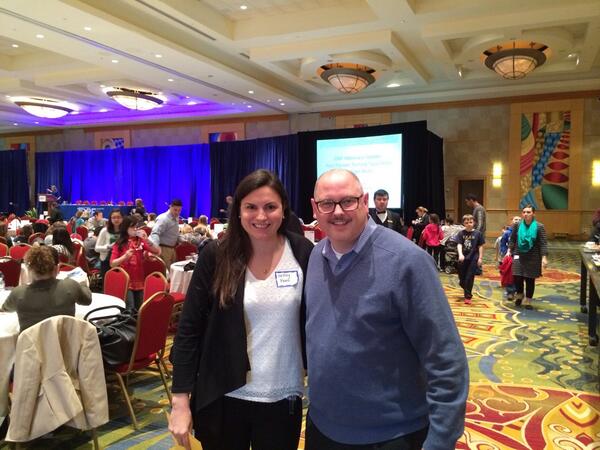
One of the great things about attending an event like this is being able to interact with others who share some of the same experiences in life. If you’re really lucky, you get to meet someone you know… you know, in a sort of “Hey, there’s a famous person! I read everything they write!” kind of way. I got to meet someone like that on Saturday:

Kelley-Summit

Kelley Kent writes over at Below-Seven.com. I got to meet her and her husband Chris. Kelley has a great story to tell, and she’s a beast of an athlete. In the last year alone she’s completed a 5K run, an 8K run, a 10K run, a 10 miler, a triathlon, and 2 half marathons. All while spending her 20th year living with diabetes. In fact, Kelley is our 9th Champion Athlete With Diabetes medal winner! Look for her story here soon.

You’ll often see Kelley on the Wednesday night #DSMA chats on Twitter, and she’s one of the most friendly and supportive members of the DOC (Diabetes Online Community) that I know of. If you don’t know her, you should reach out. You’ll be happy you did. I really wish that I had spent more time with Kelley and Chris. But that’s my problem, not yours.

There were a couple of conversations I had on Saturday, right at the table where I was sitting. To my right was a person, around Kelley’s age, living with Type 1 and planning a long, 5 day climb this year. Big trip. She expressed some worries about how to maintain a good balance with her BGs while working so hard on the climb. I turned my iPad toward her and pointed at Kelley on my Twitter feed.

“This person here?… This is Kelley. She’s here in the room today. She’s an amazing athlete. She’s completed a number of events in the past year, and I’ll bet she could give you some great advice”.

Then I downshifted into the “there are thousands of D-people online, and there’s always someone who’s gone through what you’re going through who could help you a lot” elevator speech. She quickly wrote down Kelley’s Twitter info and put it in her purse.

See what I did there? I just made the diabetes community bigger. Kelley, I hope she reaches out to you very soon, if she hasn’t already.

To my left Saturday was a family… Mom, Dad, and their daughter, in her early twenties. The daughter was sitting directly to my left. Unfortunately, Dad was a little too eager to give details about his daughter, and how she’s managing her diabetes. He couldn’t seem to understand why it was so hard for her.

I had to remind him that diabetes is always hard, even on the good days. And even if we do everything exactly the way we’re supposed to, we’re just one forgotten bolus, or one bad infusion set away from a high BG. I definitely had the “A1c is just a number, a reference point” discussion. I told him how the important thing is to use what you’ve experienced to help you in the future, but also to concentrate most on doing the best you can from this point forward.

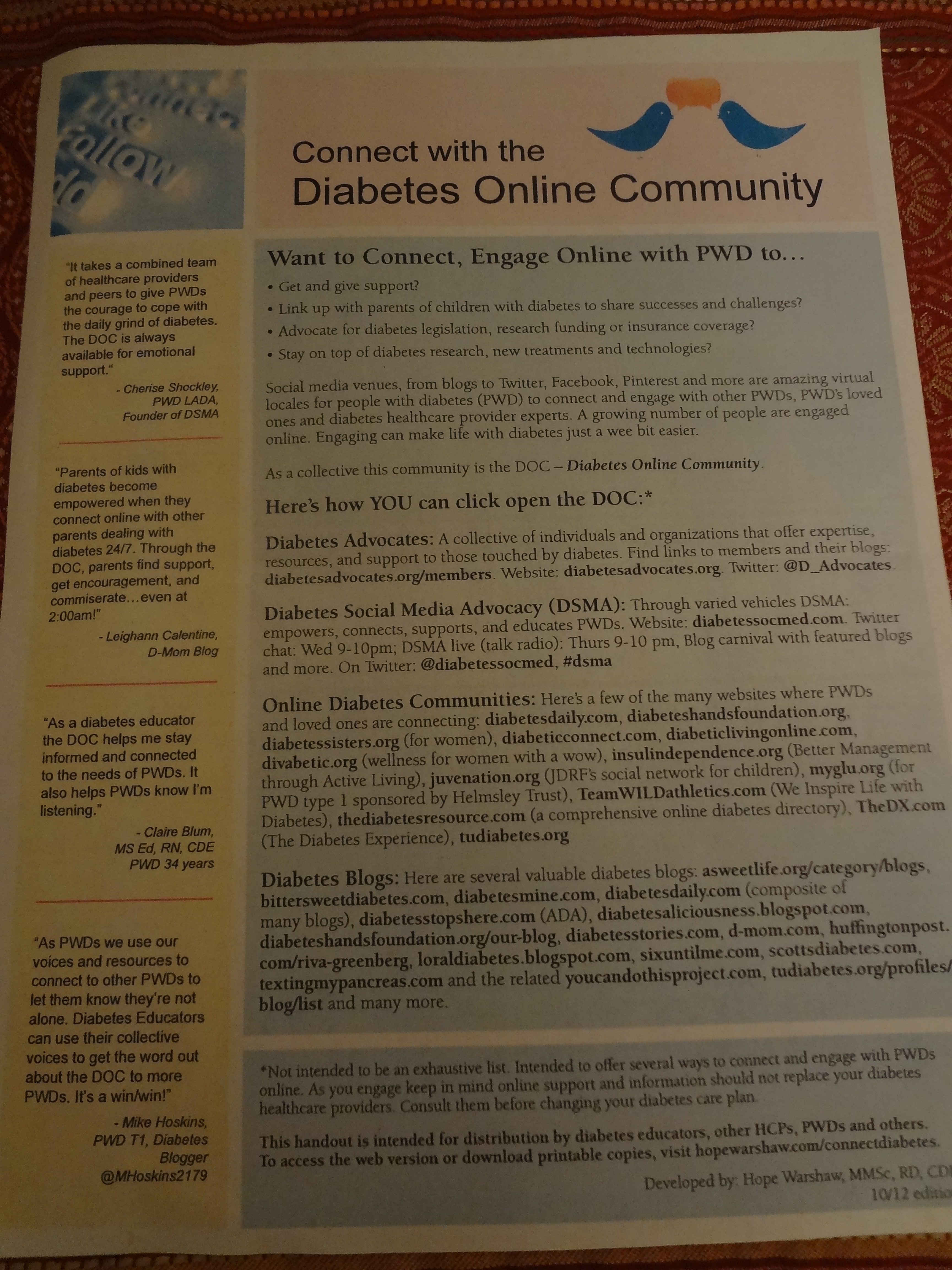
I got a little chance to talk to the daughter. She’s smart, I can tell. There was this amazing handout I picked up at one of the vendor tables that day (I don’t know which one—it was mobbed, so I just grabbed the flyer and moved on). It was put together by Hope Warshaw, and it looks like this:

DSC01405

At one point while we were talking, I pointed at the flyer she had with all of the other things she collected that day. I said, “Do you ever go online and visit any of the places on that handout?”. She had not. Hadn’t heard about any of it. As I looked at her, I could see myself a few years ago, feeling lost, feeling alone, feeling like whatever my life was like then was how it was going to be, and that’s that. Overwhelmed by the diabetesness of it all.

I mentioned some of the places I thought she might find useful, but I also remember telling her that just about anyplace mentioned on that flyer would be a great place to start. I told her to reach out… people will respond and support her, because there isn’t anyone online who hasn’t gone through what she goes through every day. And I told her how the Wednesday night #DSMA chat is often the highlight of my week. Hopefully, I didn’t come off as some sort of old guy nut going on about things she doesn’t care about. I hope she finds a place where she feels like she belongs. I know that place is out there for her in our community.

You know, I think that’s the first time I’ve ever had conversations like that with other PWDs. Every so often, you need to get out from behind your PC or mobile device and sit down with people who understand you, and who can remind you what’s important, and who can help you remember that you’re not the only one out there, and it’s okay to support and encourage. It’s been a cold winter in the Mid-Atlantic. I was glad to have found a bit of warmth on the first day of March.


People are talking: #JDRFSummit Part two.

Saturday I was one of the many at the extremely well-attended JDRF TypeOneNation DC Research Summit, in suburban Washington. Lots of updates on research all over the diabetes spectrum, and a chance to interact with some of the attendees. Including one I was able to meet for the first time. There was an awful lot packed into one day, so I’ve broken it out into three days of posts. Yesterday, I covered the morning’s presentations. Today, I’ll cover the afternoon talks. On Wednesday, my interactions with summit attendees and a DOC meetup!

——————————————————————–

As I said above, there were lots of presentations Saturday. Before the main talks of the afternoon, there was a passionate advocacy update from Cynthia Rice, Senior VP of Advocacy and Policy at JDRF. To this observer, it seems like JDRF is working hard to expand their advocacy. Children’s Congress, Promise meetings with legislators, multiple outreach efforts. JDRF is advocating for all of us living with diabetes. Want to get involved? It’s easier than ever. To sign up, visit the JDRF Advocacy website here. Also, you can get advocacy updates on your mobile phone by texting ACTION to 53731 (JDRF1). Simple, yes?

——————————————————————–

After that was one of the best presentations of the day. Dr. Linda Gonder-Frederick, Clinical Director of the Behavioral Medicine Center, part of the University of Virginia Health System. In her talk, she looked at diabetes from a psychological perspective. I remembered meeting her in the course of one of my clinical trials last year. She seemed smart then, and smarter Saturday. A couple of the things she had to say:

“It is well documented that diabetes is the most difficult condition for patients to manage.”

“Think of diabetics like a snowflake… no two are the same.”

According to Dr. Gonder-Frederick, there are four coping strategies that serve PWDs well: Information gathering, problem solving, empowerment, healthy acceptance, dealing with negative emotions, and social support and appropriate help seeking. It’s not a surprise that rates of depression in people with diabetes is almost twice that among non-PWDs. Critical periods for psychosocial risk in PWDs include diagnosis, any time there’s a real change in care or treatment, and the transition from a pediatric medical support system to adult medical support. In fact, she told us that this is the time when most patients get lost in the system. The transition from pediatric to adult care is that hard sometimes.

Honestly, I’m not doing her talk any justice. If you get a chance to hear Dr. Gonder-Frederick speak, I highly recommend it.

——————————————————————–

The next two presentations were very scientific, and to tell you the truth, there was a lot of information given in a short amount of time. Let me see if I can give you the highlights from talks by Dr. Eugene Brandon of Viacyte, and Dr. Stephen Miller from Northwestern University Medical School.

Dr. Brandon covered the things that Viacyte is working on in the field of beta cell encapsulation, and how their research is going. The good news is that encapsulation human trials are scheduled to start this year.

Dr. Miller spent some time going over important research into nanoscience and immunology. Specifically, the difference between immunosuppressants and tolerance therapy. The appeal is the hope that immune tolerance therapy could be used to treat autoimmune disease, so (possibly) Type 1 diabetes could be averted altogether.

——————————————————————–

Finally, we got to hear Kelly Close of Close Concerns and Diatribe fame. Kelly’s an amazing advocate, and she’s been involved in artificial pancreas trials in both Boston and Virginia. In fact, she was a participant in the study I got booted from in January. It was great listening to her talk about what closed-loop testing is like, and mostly, what it feels like. That’s really what I wanted to hear, and I wasn’t disappointed. It was fascinating listening to her talk about the dichotomy of being connected to medical devices, but feeling normal throughout the night. No lows or highs to sap her energy or make her feel hung over the next morning. She also gave a great roundup on where diabetes technology stands today all over the world. Which is pretty exciting to say the least.

——————————————————————–

If you’re thinking it was a full day, you’re right. And that was just what was on stage last Saturday. Wednesday, we’ll talk about my interactions with a couple of the summit attendees, and my meetup with one of my favorite writers.


People are talking: #JDRFSummit Part One.

Saturday I was one of the many at the extremely well-attended JDRF TypeOneNation DC Research Summit, in suburban Washington. Lots of updates on research all over the diabetes spectrum, and a chance to interact with some of the attendees. Including one I was able to meet for the first time. There was an awful lot packed into one day, so I’m going to break it out into three days of posts. Today, I’ll cover the morning’s presentations. Tomorrow, the afternoon talks. On Wednesday, my interactions with summit attendees and a DOC meetup!

——————————————————————–

The day began with a talk by Bethany Salmon, who is in charge of translational development for JDRF. What does that mean? I was wondering that when the talk started. What I found out was that it means the development and commercialization of therapies for people with diabetes. Those therapies include Artificial Pancreas, smart insulin, beta cell encapsulation, prevention, and restoration of functioning pancreatic beta cells. That last thing, Bethany reminded us, is JDRF’s definition of a cure. Any of the other therapies would be great developments, but they would also mean JDRF is still going to work for a cure.

Anyway, translational development basically means the JDRF team works to identify and accelerate projects. If they see something promising, they’ll provide matching funds for research. What happens then? They hold quarterly meetings with recipients of funding to make sure they’re on target. Recipients of JDRF research grants are held to specific performance milestones for their projects. It’s good to know JDRF is being responsible with the money they’ve raised over the years.

Ms. Salmon also shared a short JDRF video that spoke to me. To me, it’s the perfect video to show at gatherings like this, where some of the people in attendance may be feeling like the diabetes wheels are spinning in place, and they need a fresh pick-me-up. I’m happy to share it with you here:

——————————————————————–

Next was a great presentation from Dr. Trang Ly, who was filling in for an ill Dr. Bruce Buckingham, talking about closed-loop testing, and studies to try to help lower instances of hypoglycemia at night. Dr. Buckingham and Dr. Ly work in pediatric endocrinology at Stanford University. I’ve written before about the work they’re doing out there, and Dr. Ly gave us an update.

She talked about research on a low-glucose suspend system like the Medtronic 530g with Enlite. They found that LGS can prevent severe hypoglycemia in most cases, in both children and adults. Makes you wonder why Med-T didn’t try harder to get pediatric approval from the FDA for their device(s).

They’ve done a series of tests (in Australia, if I remember correctly) on predictive low-glucose suspend, where the system predicts a hypo, then shuts off the pump. They started testing with adults, then tested with teens, and progressively younger kids. They start testing with 3 to 6 year olds soon.

She also gave a recap of diabetes camp testing out in California. And she mentioned two studies starting soon: One with kids at Camp Jordan in Virginia, and bionic pancreas testing using a bi-hormonal pump up in Boston. Most moving to me was early on in her presentation though. She had handwritten answers from kids who were asked the question “What do you fear most about nighttime hypoglycemia?”. The answers: “Waking up in a coma and dying”, and “Not waking up”. Those are typical responses… but when you see them in the handwriting of children, who should never have to bear that kind of burden, it really hits you where you live.

And while I’m at it, let me pass along a great big thank you to children and their parents who agree to take part in this crucial testing of closed-loop systems.

——————————————————————–

Then it was Dr. Roland Tisch, who’s working out of the University of North Carolina, trying to see if there are options for reversing diabetes (other than, you know, cinnamon and okra). There was a lot covered in his short time on the podium, so you might want to check out his presentation when it gets posted online in a week or so. In short, according to Dr. Tisch, there are three keys to establishing remission in patients with diabetes: 1)Eliminating pathogenic T-cells in islets, 2)Increasing Treg cells to maintain long-term autoimmune protection, and 3)”Normal” immunity has to remain unaffected. In other words, fixing one part of our immune system doesn’t help if the therapy breaks another part of it.

Look for Dr. Tisch’s presentation later to learn more about pathogenic T-cells and Treg cells and why they’re important discoveries, and important parts of the research they’re doing.

——————————————————————–

All of this happened before lunch on Saturday. No wonder my head was spinning! Tomorrow, I’ll try to cover the afternoon speakers, and on Wednesday, more about the human interaction portion of this terrific event.


Living well is the best revenge.

So it’s Friday. End of January. Whenever the calendar comes around to the 30th and 31st, my mind starts going back to 1991.

On January 30th, I saw a new doctor (still my Mom’s doctor) for the first time. We went through a physical exam and I gave some blood and a urine sample. Later that afternoon, the office called to ask me if I could come back to see the doctor first thing the next day, January 31st. That’s when I received the news that I would be living with Type 1 Diabetes for the rest of my life. I was 28 years old.

There’s a lot more to that story, and my mind goes back to every detail when these two days come around again. When I mentioned this 23 year diaversary to Maureen she was like, “Oooh… should we get a cake and celebrate?”. I said no. I feel like it’s important for me to celebrate the fact that I’ve made it this far. It’s not quite so important that I devour something as a memento. Though a little peach pie would be nice. A little peach pie is always nice. But I digress.

After work I’ll head home via the liquor store, and I’ll enjoy some pizza and salad with my brother-in-law, who’s in town on his way to New York, where he’ll start soon at the Bronx Zoo. Our next door neighbor will join us, and probably a couple of others too. I’ll take a moment to check my BG and work out the special dual-wave bolus (known by me as the Karen pizza bolus). Come to think of it, a martini would be okay too.

And that’s the best thing about surviving 23 years with this bastard of a condition known as diabetes. I have to do what I have to do, but in the final analysis, if I’m still living a good life with great friends and greater family? That’s something to celebrate!

No doubt parents of kids with diabetes want a cure. No doubt all of us want a cure. But in the absence of that, I think D-parents, and all of us, just want to know that a good life is possible even with diabetes on board. You know what? It took me a lot of long years with bad numbers and rebelling against the daily grind of this disease, but I am living a good life. I’m not going to blow smoke and tell you that it’s a walk in the park. But whoever said “living well is the best revenge” really knew what they were talking about.