Category Archives: Diabetes

Make your Valentine’s Day meaningful – #sparearose

Spare_A_Rose_1

It’s official… I’m the last Diabetes blogger to post on this subject. But just in case you haven’t read about this yet, let me lay the groundwork for you. Because this is very important.

A number of Super Diaheroes (including Kelly Close, Manny Hernandez, Bennet Dunlap, Kerri Sparling, and Jeff Hitchcock) got together with Johnson and Johnson on an initiative to use social media to make a difference… right now.

Valentine’s Day is tomorrow. It’s a time when a lot of roses are given. Usually a dozen at a time. What we’re asking is that you buy one less rose this Valentine’s Day and share the value of that flower with a child with diabetes in the developing world.

How do you do that? You donate the value of that one rose to the Life for a Child program under the auspices of the International Diabetes Foundation. According to the IDF:

“Donations to the IDF Life for a Child Programme are carefully directed to key areas of diabetes care and management so that established paediatric diabetes centres and associations can provide the best possible care, given local circumstances, to all children and youth with diabetes in developing countries.”

What that means is that in places where diabetes has previously been a death sentence for a child, kids are provided with insulin; meters, test strips, and lancets; diabetes education; and even diabetes training for local medical staff.

So please, join the Diabetes Online Community by showing your support to the Life for a Child program. Click on the banner above or click on this link to make your donation: http://bit.ly/SpareRoseSaveChild

Give ’til it hurts, people. Because this is important. Lives are at stake. You can help to save lives today by making a donation… Tweeting about the initiative using the hashtag #sparearose… and if you haven’t already, blog about it too. For all the details, go to the Diabetes Advocates website: http://diabetesadvocates.org/c/spare-a-rose-save-a-child/


Time to get going.

Back in my first post this year, I talked about my defining ideals for 2013. One of them involves staying as healthy and active as possible. To that end, I’ve made the commitment for my first athletic event of the year.

TourdeCure

The Chesapeake Bay Tour de Cure is entering its second year. To be honest, the Maryland Tour de Cure is closer to home… I wouldn’t even have to stay in a hotel for that one. But it’s a couple of weeks earlier, and you never know what the weather will be like here in early May. Plus, it’s in Carroll County, which is west of here, which means it’s very, very hilly. As in uphilly. As in, even a 30 mile ride would take a lot of effort.

On the other hand, the Chesapeake Bay Tour de Cure is based in Easton, on the other side of the Chesapeake Bay. All of it is 100 feet or less above sea level. I’ve already done the Tour de Talbot there, which benefits JDRF and covers much of the same real estate. I know what I’m getting into. The 55 miler should be a great way to get started this year. If I can add the Tour de Talbot (in September) as a bookend to my events in 2013, I’ll be thrilled.

I’ll be honest… I would really love to participate in one of the big JDRF rides this year. But there’s a big reason why I don’t. You see, there’s a big difference between the ADA and the JDRF rides, and the difference is this:

1800 dollars.

If I want to participate in the Tour de Cure here in May, I have to raise 200 dollars before I’m allowed to ride in the event.

If I want to participate in one of the JDRF Ride to Cure Diabetes events, I have to raise at least 2,000 dollars. 1,999 dollars? No ride.

Granted, if I raise 3,000 dollars they’ll put me up in a hotel for three days, and if I raise four grand they’ll cover my airfare and ship my bike too. That would be fantastic, and I would sign up yesterday if I thought I could raise that much scratch.

I know it sounds like I’m hating on the JDRF rides, but I’m not. I greatly admire the people who can do this, and I will be contributing to as many of those efforts as I can myself. I encourage you to do the same.

But… even though almost everyone I know might contribute, almost everyone I know can only contribute 5 or 10 dollars at a time. I don’t know if I know 200 to 400 people. I’m not ruling it out, mind you. I really want to do one of those rides. But I’m going to have to wait another year at least.

In the meantime, ADA is still a great cause, and they do a tremendous thing organizing these rides all over the country. One suggestion: Please publish the ride route early. I hate having to wait until event day to find out where I’ll be going, and so does The Great Spousal Unit. She wants to be able to find me if I don’t check in by phone at the right time. You know what I mean.

This is getting a little long, so let me close by asking two things:

1. If you’re within driving distance, please consider participating. More information is available here:
http://main.diabetes.org/site/TR?fr_id=8614&pg=entry

2. If you can, please consider contributing. I feel kind of weird asking, but I know the cause is important. Here’s the link to my page:
http://tour.diabetes.org/site/TR?px=7322190&pg=personal&fr_id=8614&s_src=email_tour&s_subsrc=autoresponder-forward

In another month, if I’m lucky, I’ll be tuning up the bike, pumping up the tires, and getting out there on the road. In three months, I hope to see you at the Chesapeake Bay Tour de Cure.


#CWDTech 2013 Part Two.

This past weekend’s Children with Diabetes Focus on Technology conference in Washington, D.C. gave me a lot of insight on gathering information, staying motivated, and living a better life with diabetes.

Not all of that information came from the scheduled sessions.
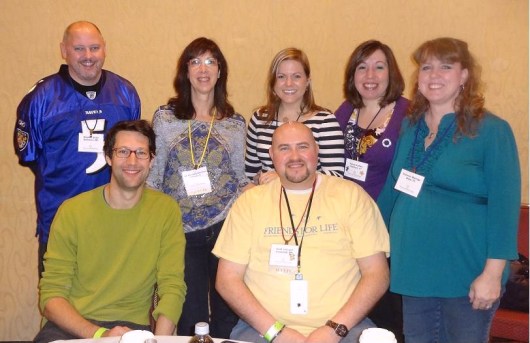
Standing:  Myself, Jill Weissberg-Benchell, Ph.D., C.D.E., Kerri Sparling, Karen Graffeo, Shannon Marengo.  Seated:  Christopher Angell and Scott Johnson

Standing: Myself, Jill Weissberg-Benchell, Ph.D., C.D.E., Kerri Sparling, Karen Graffeo, Shannon Marengo. Seated: Christopher Angell and Scott Johnson

I’m always a little wary of meeting someone in person that I’ve only seen, heard, or read about in another forum. Sometimes that’s because those kinds of meetings haven’t always gone well for me. But mostly, it’s because I’m really and truly worried about annoying someone, taking up their time with only my questions when a hundred others would like to do the same, and giving them the uncomfortable feeling that I’m immediately their best friend when really, they hardly know me.

Does that sound like I’m over-thinking it? Yeah, I know. I also know that I’m better at building relationships from the ground up, starting them at a place where the other person is most comfortable. I never want to assume anything about anyone. So when we went to sign in at the conference on Friday night, I didn’t turn around right away when I heard someone behind me calling my name. It was Karen of Bitter-Sweet Diabetes and Diabetes Blog Week. I got a big hug from her and Scott Johnson. Maureen didn’t show it, but she was shocked. At me. She probably thought I would pass out or something. My own family doesn’t hug like that, and she knows it’s out of the norm for me. Later she told me that after that, she wasn’t worried about me the rest of the weekend.

But let me back up a minute. This is about the conference after all, and I think it’s important to note (again) that a lot of support and information-sharing goes on in between all of the items on the official agenda.

First, let’s cover the exhibit space. This is where all of the vendors are set up peddling wares like the Animas pump, VerioIQ and iBGStar meters, Orbit infusion sets, and Glucolift glucose tabs. ADA and JDRF (hello Delia Whitfield) each had a table too, though, as you might expect, they were on opposite ends of the exhibit space.

Why is the exhibit hall a big deal? Oh, I so wish that I had attended a conference like this when I was thinking about starting on an insulin pump. It would have given me a chance to see products in person, hold them in my hands, and most of all, ask questions of the company pushing the device. Don’t know if it would have changed my mind. But I would’ve liked more information, even if I didn’t know all of the questions to ask at the time.

The attendees at the conference are there in the meeting rooms, exhibit space, and throughout the hotel for the duration of the conference. Getting just one tip on managing BGs, or getting the support and perspective of someone who’s gone through what you’re going through is worth the price of admission. And helping someone answer a question, or giving that support and perspective from your point of view really feels great.

The CWD staff and faculty appear to be very hands-on, helping to answer questions and also listening to concerns or suggestions. They’re very approachable, which is super. I love that I didn’t see a tie on anyone all weekend. And I’m a little jealous, ‘cause I don’t get to dress like that for my job. I also liked the buffet, with its nutritional information in front of every item, right down to the gluten free bread (yes, I’m still eating it – go figure).

So back to the individuals I met over the weekend that I have seen, heard, or read about before. Here’s a list, and I hope I didn’t leave anyone out:
Karen, Scott, Kerri, Shannon, Christopher Angell, Dayle and Chris. Also Tom Karlya, Ed Damiano, Harold Sanco, and Sebastien Sasseville.

I’ve seen a lot of posts over the last year and a half or so talking about meeting people in real life, and how great it was, and how special it is to be in the presence of such lovely people, all of whom “get it”.

What I really liked was how normal it was. I mean, it was cool that everyone did their testing and bolusing right out in the open, and that questions were asked and answered with candor and thoughtfulness. What I didn’t expect was how normal that felt. I can’t ever remember feeling like that when talking about my diabetes. I wouldn’t wish for this at all, but there was a point where it almost felt like most of the world has diabetes, and a select few were left with working pancreases. Weird, huh? I admit that I wasn’t expecting to feel that sense of… not having to be on stage with my diabetes all the time. That’s a pretty relaxing place to be. Thanks to everyone for making me feel normal.

So that’s my take. And that’s why I would recommend attending this conference in the future, or the Friends for Life conference in Orlando in July. Or one of the other conferences in the USA, Canada, or the UK. I wouldn’t have said this even six months ago. But I’m saying it now. Go and connect. Learn something. Find your normal.


#CWDTech 2013 Part One.

I’m a little late posting today… I stayed up late last night celebrating the Baltimore Ravens super bowl victory. Yay Ravens!

I didn’t get much sleep on Friday or Saturday either. The Great Spousal Unit and I were in Crystal City, Virginia (just across the river from Washington, D.C.) for the Children With Diabetes Focus on Technology conference. It was my first time at an event like this in at least a decade.

There is so much to talk about. I have to admit to suffering from a bit of information overload. Today, let me just talk about what I picked up from the sessions I attended. In part Two, I’ll try to cover interactions outside of the scheduled content.

—————————————————

So let’s start at the beginning. The opening keynote was a dynamic talk from Dr. Ken Moritsugu, a former Surgeon General and Deputy Surgeon General who is now serving Chairman of the Johnson and Johnson Diabetes Institute. Dr. Moritsugu explained in great detail the importance of being an informed health consumer. There’s a lot of misinformation out there, and we need to do our best to separate fact from fiction. According to Dr. Moritsugu, it’s important to “access, understand, and use health related information to make sound, thoughtful health decisions”. What does that mean? It helps to remember three things:

1. Consider the source – Are you reading something from the Centers for Disease Control or World Health Organization, or is it from the “latest dream cure” website that promises much and delivers nothing in the way of information?

2. Risk is relative – Sometimes, a headline can grab our attention. But there’s often more to a story than just the headline. So when you see something like “Scientists find a link between breastfeeding and Type 1 Diabetes”, do the research. Was the scientific study realistic? Was it done on a large, diverse sample size, or did the subjects of the story come from a smaller subset of data that really doesn’t apply in the real world? Sometimes, the answers will surprise you.

3. Don’t forget to communicate with healthcare professionals – This is great for me. Sometimes my endocrinologist has additional information on something I just read about quickly online. Sometimes, she can go back and check things out if I have a concern about something, and then we’ll discuss it either in an e-mail or at my next appointment. Hopefully, you can count on having a two-way conversation with your healthcare professionals to hash out the truth and deception in stories about diabetes.

—————————————————

Next we heard from Ed Damiano, PhD, who is Associate Professor of Biomedical Engineering at Boston University. He’s part of a large team working in Boston on bionic pancreas technology – known generally as the Artificial Pancreas. After visiting the University of Virginia’s Center for Diabetes Technology last year, I was interested in hearing the perspective of someone else working on the same technology. Let me tell you… it was no less fascinating. It was interesting to see the device they’re working with too. An iPhone (this is nothing new… UVA’s program uses an Android phone), with some cool characteristics. Among them are a bolus feature that doesn’t include a carbohydrate count. It simply asks you to say whether you’re eating a Typical Amount, Less Than a Typical Amount, or A Small Bite. The AP device does the rest. If something like this comes to market, carb counts could be a thing of the past. Is that crazy?

There’s more to this, of course. The team in Boston is still hoping for a better version of microdose glucagon to work in their dual-chamber device (which has already been approved for clinical testing). Tiny doses of insulin and glucagon are administered in the device to keep the patient in an appropriate range. Yes, there’s a lot more here that could probably take up an entire post, so I’m encouraging you to get more information on the work being done. When will something like this be available to all People With Diabetes? Right now, we’re looking at around 2017. And since that’s four years away, the timeline may still move a bit. But the progress so far is very encouraging.

—————————————————

Got a chance to sit in a great discussion with Kerri Sparling and Scott Johnson that delved into Diabetes Devices in the Real World. People talked about everything from social media to carrying cases for your diabetes supplies to how you carry and show (or don’t show) your diabetes devices in public. It was a lively talk involving a variety of PWDs and parents who had lots of questions, but also lots of super information to share. People were creating Twitter accounts on the spot and showing off their D-bags. I loved watching faces light up when they started to understand something that they didn’t quite understand before, or found sources of information that they weren’t aware of prior to this get-together.

—————————————————

Sunday morning’s closing keynote spoke volumes to myself and to Maureen. Sebastien Sasseville is the first Canadian with diabetes to summit Mount Everest. Not enough for you? Last year, he completed the self-supported Sahara Race in Africa, through the world’s largest non-polar desert, running 250km over seven days. He talked about both of these events and gave us some important insights. Most meaningful to me was when he talked about doing the Everest expedition. Over two months, their team had to start at base camp, then climb up to various camps before climbing back down again. They had to do this several times before making an attempt at the summit. The point was to acclimate the team to climbing at that altitude (can you really get acclimated to something like that?). The point is that while we have this constant “perfect diabetes management” goal in our minds, sometimes our path to that goal is filled with ups and downs that help us get used to what we need to make it all the way toward our ultimate goal. And what if we reach that goal: that perfect A1c, or perfect pregnancy with diabetes. What happens then? Sometimes, our goals change. Sometimes the bar gets moved. Both up and down. And that’s okay. And fear about the journey should not keep us from going after our goals.

—————————————————

It was an interesting 36 hours or so. Soaking up a lot of information and hearing from people living the lives that we’re all living. Sometimes inspiring, sometimes life-affirming, sometimes funny. I’m lucky this was close enough that I could attend.

In part Two, I’ll try to cover my experiences outside of the scheduled sessions.


I waited until today to write this post.

I don’t know the reason why, really.

We were all sitting around last night, The Great Spousal Unit and The Live-In Niece and I, discussing it. I remember I said that the same thing happened this year that happens a lot of years around this time. In the beginning of January, I start to think about it, and by the end of January it’s somehow slipped off of my radar. Only this year, I remembered again, a day in advance.

And Maureen, in her psychology-major voice asked, “Why do you think that is?”. I don’t know… I’m forgetful? Absent-minded?

“Yes, you are… but I think it’s more than that.” You mean like I’m avoiding it somehow?

“I don’t know. Maybe. You always seem to dislike dealing with things that are unpleasant.” Yeah, well, who doesn’t?

But she has a point. I don’t like reliving that day in my head. It’s probably not the worst day of my life, but it’s definitely in the top 3. Or top 2. Or maybe there’s 1 and 1a. But when I do relive that day, I get sad, and angry, and then mad at myself for making a big deal of it and letting it affect how I feel in that moment.

So how do I deal with it this year, in a semi-public forum? Do I celebrate, like I try to do for my birthday? Do I curse the course of events and go around with a scowl on my face all day? I think either, or both, would be appropriate.

Instead, I decided to sit down and pen a letter.
 
 
January 30, 2013
 
 
Dr. M____,

Twenty-two years ago today, you correctly diagnosed me with Type 1 diabetes. From that moment forward, my life has changed in ways I couldn’t have imagined then.

First of all, let me say thank you for taking the time to investigate what was obviously wrong with me during the two months leading up to that point. There were two other doctors who couldn’t be bothered to do a blood test or take a urine sample. If you couldn’t be bothered either, well… I don’t know how I would have ended up.

Second, thanks for staying on me those first few years. I think you could have been a little more forgiving about my dietary choices and my lack of BG logging diligence, but you did instill in me a feeling that this is my diabetes, and I live with it every day. I own it.

Finally, I want you to know that I’m doing well these days. My wife and I have had a good life in Baltimore for almost 19 years. Today, instead of twice-daily injections like when I was diagnosed, I’m hooked up to a Medtronic Revel™ insulin pump. My last A1c came in at 6.2. I’ve completed two triathlons, and hopefully a third this year. And I’m writing a blog about my diabetes, talking about my daily experiences, investigating diabetes-related issues from time to time, and advocating for others like me.

Every journey starts somewhere. My journey with this disease began in your office back in January, 1991. I can remember it like it was yesterday. But that’s only the beginning of the first chapter. Subsequent chapters have had their ups and downs, but there’s still a lot more of this story to tell. I think it will be a long time before the final chapter is written. I hope you’re well, and I hope you understand how lucky I was to have connected with you so many years ago.

All the best,
Stephen