Category Archives: Artificial Pancreas

Artificial Pancreas, part 3.

I was not given anything, or promised anything, in exchange for writing this post or others on this subject. I was given an invite, and I was happy to pay may way to be there. Really, it was only a 3 1/2 hour drive from home.

I’m a blogger, not a journalist. But I try to get the facts as accurate as possible. If I missed something somewhere, please let me know.

To find out more about others working on the Artificial Pancreas project, and what they’re working on, check out yesterday’s post.

The CDT at UVA is seeking volunteers for a clinical trial of the Artificial Pancreas, to test an algorithm specifically designed for pre-menopausal women. To find out more about that, click here.

The second part of last week’s visit at the Center for Diabetes Technology at the University of Virginia centered on the device itself. We were welcomed by Patrick Keith-Hynes, PhD, and Colleen Hughes-Karvetski, PhD.

Both of these individuals have been at this game for some time. After founding and co-founding two technology firms, Dr. Keith-Hynes has been working since 2010 on development of the mobile device itself (more on that in a minute).

Dr. Hughes-Karvetski has an interesting background. From her online bio: “Dr. Karvetski has taken on a role in the software and hardware implementation of devices and algorithms for clinical testing, and developing algorithms for improving the accuracy of glucose sensor signals.”

About the device itself:
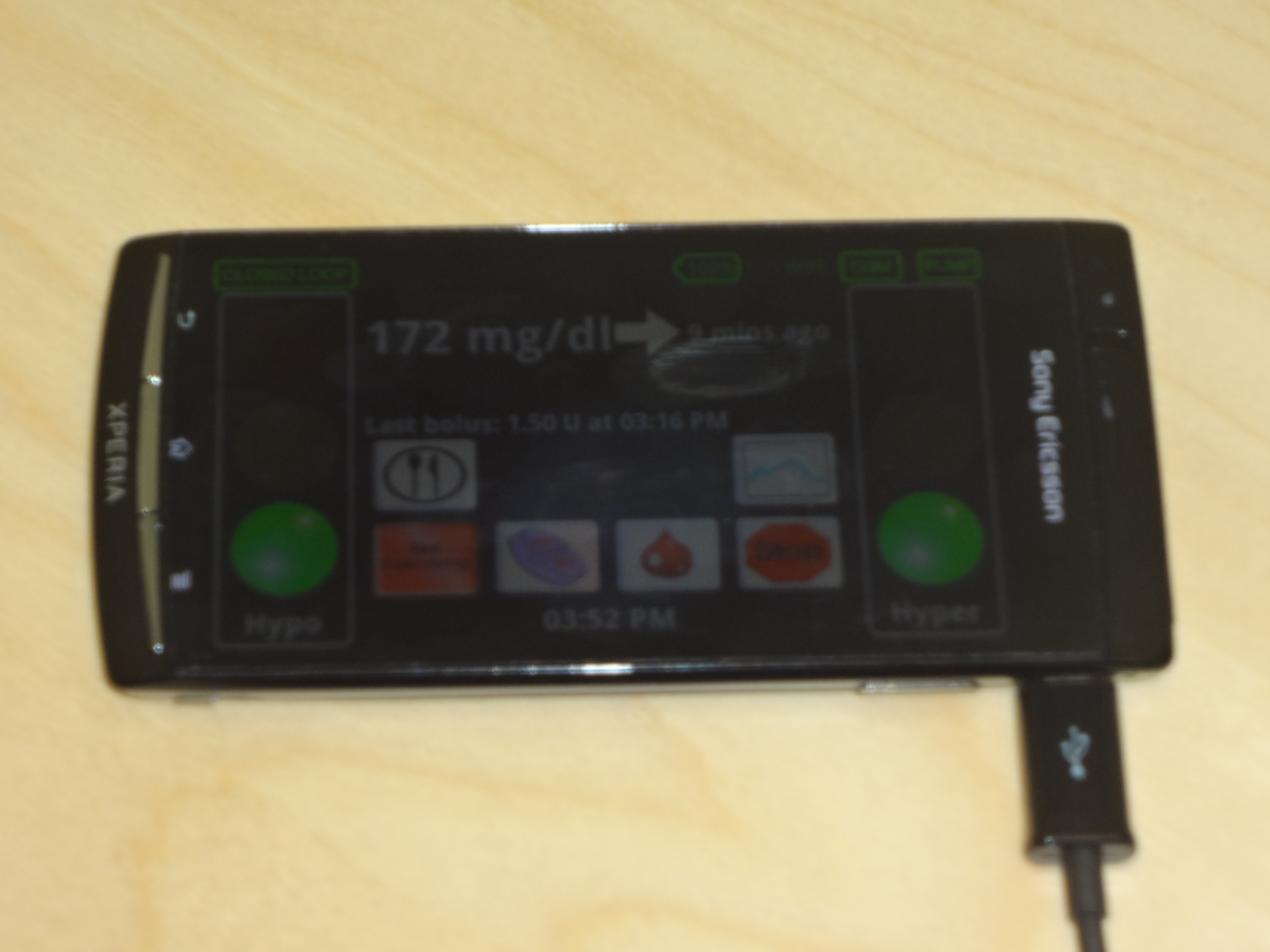
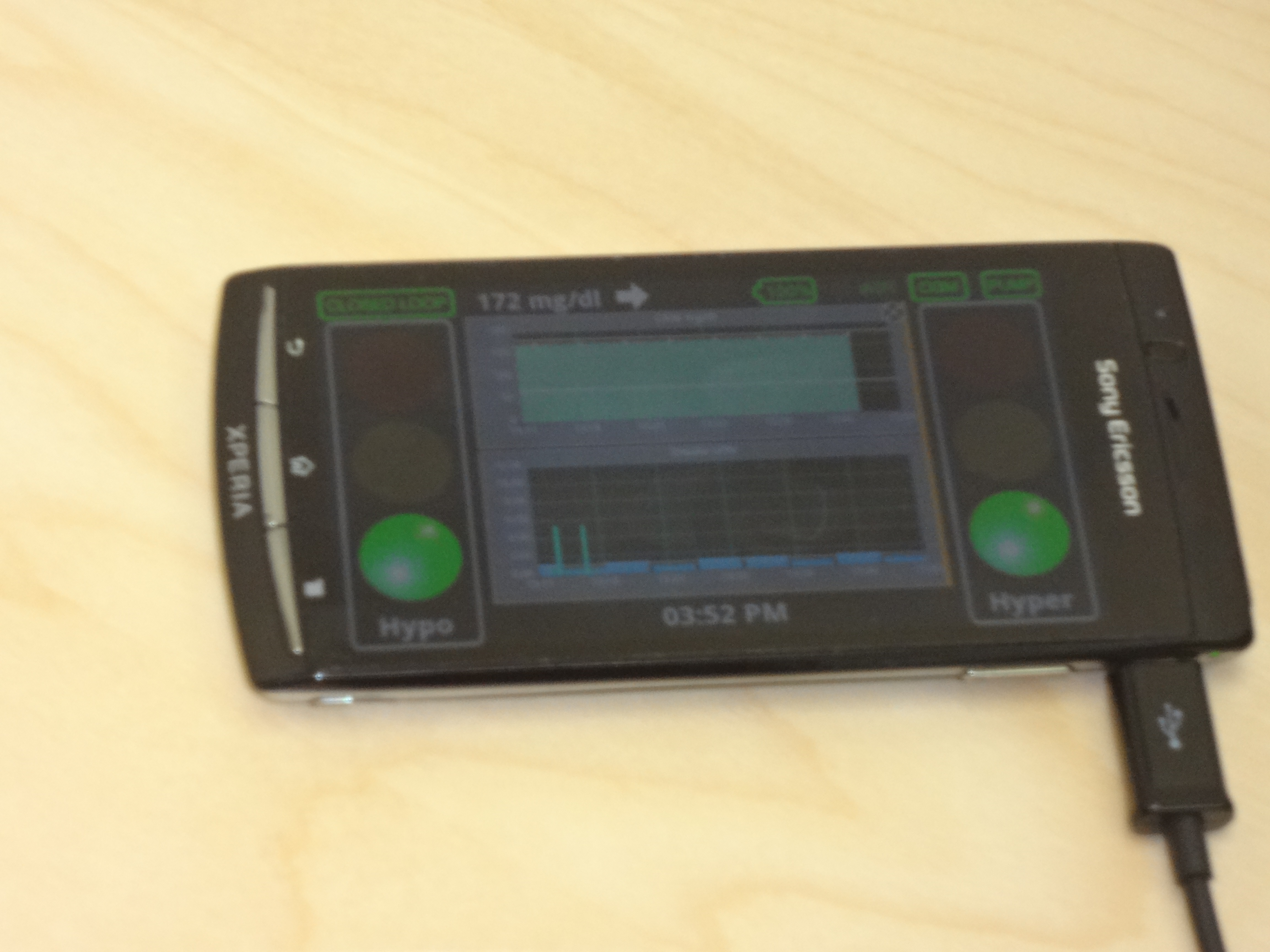
Sorry about the poor quality here… I missed my chance to get a photo until it was back on the desk and hooked up.

This device is an Android 3G phone. The software gets wiped off of the device, and the Artificial Pancreas platform, including the algorithm being used, is loaded on. So when you’re hooked up, you’re wearing your pump and a continuous glucose monitor, and you’re carrying the device. Right now, the device is also connected to the CGM because the latest CGM transmitters aren’t wireless-compatible with the phone yet. But… with the next generation of the Dexcom, there will be wireless capability. In the interim, they’re working on a Bluetooth solution.

Why an Android phone (an actual question asked by a participant)? Because compared to the iPhone, the Android allows for a lot greater flexibility in terms of what you can and can’t include, or even block, from the phone. The Android as Artificial Pancreas will not allow you to load additional apps or play games or make calls. Can’t program that using the iPhone. With the Android they’ve been able to program the low glucose alarm so you can’t lower the volume. Can’t do that with the iPhone either. Would the AP still work with all of this functionality? Maybe. But it would be a lot harder to gain FDA approval.

The touch screen has several buttons: One to access a graph of how your BGs are trending. One to administer a meal bolus. One to enter information when you’re about to exercise. I tried to write down what all of the buttons do (while holding the device), but I have to admit to being blinded by the technology, and I was unable to get them all down. To be honest, I caught myself imagining what my life would be like with one of these things in my pocket.

While we’re at it, clinical trials are currently being run using the idex combo (Omnipod & Dexcom). And there’s testing underway with the Animas Ping, and the new t:slim pump from Tandem Diabetes Care.

During the in-hotel testing I wrote about yesterday, the trial participant has all three pieces of the puzzle (pump, CGM, AP) stored in a fanny pack. In case you’re wondering, the team has come up with a plastic bag of sorts to put everything in that will allow the participant to shower. Once everything goes wireless, the participant will be far more mobile.

Now, where was I? Oh, I was going to talk about remote monitoring. Since it’s a smart phone, there’s a wi-fi component. That means there’s the ability to upload real time data to the internet. Remote monitoring already helps members ofthe team check on participants during trials without actually viewing the device itself. Once the Artificial Pancreas gets approved and out to the general public, Moms will be able to monitor their kids at school, or at night from another part of the house. Endocrinologists will be able to keep close watch on their patients, though I’m not sure how comfortable I am with that idea. My spouse would be able to see how I’m doing when I’m on the road for business.

A couple of additional questions that were asked: What’s the range of the device? Roughly the size of a normal room. Leave that space, and the device can’t get a glucose reading.

And my favorite: When this technology becomes universal, and there’s a roomful of PWDs with their APs all on the table… how will people be able to tell which device belongs to whom? Okay, well, they’re not there yet. But it’s a nice thought.

I want to mention a couple of others I was able to meet during my visit:

Dr. Stacey Anderson, Medical Director of the UVA Center for Diabetes Technology. She’s an endocrinologist who is clinician in charge of running Artificial Pancreas studies at UVA. She’s also published papers evaluating the accuracy of continuous glucose monitors.

Molly McElwee, RN. Molly is one of the Center’s clinical nurse trial coordinators. She coordinates inpatient and outpatient clinical trials focusing on new device technology. A T1D herself, Molly serves as a liaison between the Center for Diabetes Technology and the UVA Patent Foundation.

For more information on the center and to see staff bios of the people working on this cutting-edge technology, visit the center’s website.

Thanks again to the Center for Diabetes Technology at the University of Virginia for inviting me to last week’s event. If you have any questions, feel free to leave them in the comments section, or e-mail me using the link above.


Artificial Pancreas, part 2.

I was not given anything, or promised anything, in exchange for writing this post or others on this subject. I was given an invite, and I was happy to pay may way to be there. Really, it was only a 3 1/2 hour drive from home.

I’m a blogger, not a journalist. But I try to get the facts as accurate as possible. If I missed something somewhere, please let me know.

CHARLOTTESVILLE, VIRGINIA– In a small building in downtown Charlottesville, there’s a team of doctors, nurses, programmers, and mobile technology experts working on the Artificial Pancreas Project. I was able to meet some of these people last Thursday, and get a look into the work they’re doing, what kind of research has been done so far, and where things are heading for the artificial pancreas in the future.

There were about 20 visitors at the open house, including the first diabetes alert dog I’ve met (there’s a funny story there, but I don’t have time for it in this post). We were split into two groups… one group went to get up close and personal with the mobile device itself, and one group heard from a group of speakers about the project itself. I was in the second group.

Our first speaker was Boris Kovatchev, PhD. Among the long list of titles he holds is Director of the University of Virginia Center for Diabetes Technology. Dr. Kovatchev is the principal investigator of three large projects related to the design of the Artificial Pancreas. He gave us a brief history of diabetes technology over the decades, and then some great information about the Artificial Pancreas itself.

There are three parts to the technology that have been or will be developed. Kind of like three different platforms that will eventually live on the same device.

– One is a safety supervision mechanism. It’s there to keep your glucose level from going too high, and to keep it from going dangerously low. Have I mentioned that in all of the clinical trials in Europe and the USA, there have been zero nighttime lows?

– The second piece of the puzzle is designed to give post-meal corrections based on what you’re eating, where your glucose is trending, and how much insulin is on board already. Again, this is in conjunction with the safety supervision mechanism that’s already been developed.

– Finally, there’s a portion that’s yet to be tested. This platform deals with basal rate corrections and pre-meal bolus calculations. Once the development on this is complete and it’s fully tested along with the other two pieces, the device will hopefully be ready for FDA approval.

Our next speaker was Marc Breton, PhD. What makes Dr. Breton’s work interesting? Maybe it’s that he and Dr. Kovatchev participated in the design of the first (and to date only) simulation environment accepted by the FDA as replacement for animal studies in pre-clinical assessment of insulin treatment strategies. Dr. Breton is now in charge of its update and further development.

Let me break that down for you a bit. Part of why development and testing is progressing as quickly as it has is because Marc has developed a computer simulation of the human metabolic system. That means two things: first, it means that tests can be run on simulations instead of on animals; and second, it means that multiple testing can take place, at a very fast pace, before anything is tested on humans. How fast? One of the algorithms can be tested on a 24 hour computer simulation in about 1.5 seconds.

What kind of algorithms are being worked on? I’ve mentioned this before, but I’ll repeat it here. Algorithms based on young versus old and female versus male physiology. Everyone’s diabetes is different, and the staff there understands that. They’re working on bringing out something that will work for multiple individuals, rather than multiple individuals having to make something work for them.

Finally, we heard from Dr. Sue Brown. Dr. Brown is one of the endocrinologists working on inpatient studies and works closely with engineers and clinical researchers, helping to bridge the gap between technology and patient care and treatment. And she’s a bike rider too. Dr. Brown talked about clinical trials, how they’ve been conducted in the past, and what they’re like today.

There’s a three step approach in testing the device. There’s inpatient hospital testing, where everything is closely monitored in a special part of the UVA Medical Center set aside specifically for this testing. The second step, which has been taking place since last April, is testing in a hotel, where the patient spends a couple of nights in a hotel room with the device, leaving the room a couple of times per day. Again, always under close supervision, though not quite as close as in the hospital. In addition to the in-hotel testing, there have been a couple of other efforts, including testing just completed with kids at a diabetes camp in California. Finally, there will be (hopefully) at-home testing, where the patient will take the device home for a week or so and the team will remotely monitor the patient from Charlottesville (or closer– I didn’t catch every part of this description, so I might have gotten that wrong).

Dr. Brown also talked about the possible addition, in the future, of adding Amylin to the delivery system of this device. Right now, our pumps or syringes deliver insulin, to do what our pancreases don’t. But when our pancreases broke down, they also stopped producing Amylin, which helps with gastric emptying and helps us feel satiated, which could help us to prevent post-meal blood sugar spikes. I had to look it up before I wrote it. I’m glad to hear that someone is thinking about this. It may not come to pass, but we need to find out if it’s helpful, and doable, before we dismiss an idea like this completely.

After these presentations we were sent to another part of the center to see the mobile device itself and hold it in our hands.

More about that tomorrow.


Up close & personal with the Artificial Pancreas.

CHARLOTTESVILLE, VIRGINIA– I was fortunate enough to spend most of Thursday afternoon at the University of Virginia School of Medicine Center for Diabetes Technology, in the company of a number of individuals who are hard at work on the Artificial Pancreas Project.

I’ll get into more detail about the visit this weekend or early next week, but I wanted to take a moment for two things:

1) Thanks to everyone at the center for your hospitality and for helping me to fill in the blanks about what’s been accomplished so far, where the testing is today, and what’s still ahead in the process to gain FDA approval and bring this device to the wider diabetes community.

2) Toward the end of my visit I was asked to extend the center’s call for volunteers. Among other trials taking place around the country (they just finished testing with kids at a diabetes camp in California), they’re looking for volunteers to participate in clinical trials to help test algorithms specifically designed for pre-menopausal women. If you’re female and pre-menopausal, and you’re interested in participating, send an e-mail to
artificialpancreas@virginia.edu

To participate, you must:
– Be on pump therapy
– Be free of serious diabetes-related complications (there’s a screening process)
– Be able to come to Charlottesville, Virginia for 2-3 days at a time (Charlottesville is about a 2 1/2 hour drive from Washington, D.C., with a small airport and an Amtrak depot).

If you want to find out more about the Artificial Pancreas Project, here’s a link to my original post on the project, and a link to the center’s site:

JDRF and the Artificial Pancreas Project

UVA Center for Diabetes Technology

Disclosure: The Center for Diabetes Technology at the University of Virginia School of Medicine did not influence me in any way in writing this post. I got an invite, and I was happy to pay my own way to be here.

I’m a blogger, not a journalist. But I try to get the facts as accurate as possible. If I missed something somewhere, please let me know.


JDRF and the Artificial Pancreas Project.

A week ago Tuesday was the annual meeting of the Maryland JDRF. I was happy to get out to an actual JDRF event for the first time in a long time. It was a fun event and I got to meet some very nice people.

In addition to the normal business that gets done at the annual meeting (election of board members, officers, etc.), they handed out awards to many who did a fantastic job of organizing teams, raising money, and volunteering for the JDRF walk in Baltimore held back in April. The amazing amount of greatness that results from these grassroots efforts are immeasurable. I’m adding this to my calendar for next year everyone… count me in.

The final part of the evening was well worth waiting for. A member of the staff at the Center for Diabetes Technology at the University of Virginia School of Medicine talked about the Artificial Pancreas Project. I had heard the term Artificial Pancreas, and I had read an occasional post or two about it, and I knew that the FDA had approved the AP for outpatient clinical trials, but it wasn’t until this talk (and after catching up by phone with the speaker early this week) that I realized there is still much for me to learn about this fascinating technology.

Now, before you say it, I will: This is not a cure. I get that. And trust me… I want a cure as much as you do. I also have to admit to some skepticism when it comes to wealthy companies that spend a lot of money developing gadgets that can help to keep our conditions chronic, rather than searching for a way to make our conditions history.

That said, there’s no denying the fact that the Artificial Pancreas, or something like it, is something that could have a significant, life-altering (life-affirming?) impact on millions of us living with diabetes. Let me tell you why. I’m not blessed with total recall, but I’ll try to give you what I can from this interesting presentation.

First, a brief description: the Artificial Pancreas is a device that works with your insulin pump and continuous glucose monitor (CGM) to make adjustments in the delivery of insulin throughout the day, based on multiple factors, including: your glucose level and how it’s trending; what you just ate and how you bloused for it; whether you’re heading out to exercise, and more. The primary function is to keep your BGs in a safe range. And more importantly, to keep you out of the danger zones, both high and low.

It’s all done on a mobile device. That’s right… all the technology is loaded onto an Android phone. The device has had the software cleaned, then loaded with the AP platform. Software is loaded to the phone as Android apps.

It’s 3G, WiFi, and Bluetooth capable. Per FDA guidelines, it’s outbound only, so you won’t get any text messages or voicemail. Also, no phone or browser, and no third party apps… so you won’t be playing Words with Friends on the runway with this sucker.

Why the WiFi if there’s no browser? That’s where the remote monitoring comes in. It’s a way for a parent, or your endocrinologist, or your spouse to monitor your condition without having to make a million calls (are you listening honey?).
The algorithms developed (and still being worked on) are to account for unique things like exercise and pre-bolus and post-bolus conditions. Other algorithms are still being worked on to cover additional factors, like child versus adult or male versus female physiology. Hey, Your Diabetes May Vary, right?

The folks at UVA have also developed a watch-like device that can be used to monitor the AP device. Think about being on a road trip, and you’re unable to take the effort to check out your AP while driving (whether that would even be legal is yet to be determined). So you look at your wrist, and you can see how you’re doing. It means that potentially, if you’re the parent of a CWD who is out on the soccer field, your son or daughter could have the watch on while you monitor the AP from the sideline. Sweet.

That’s just some of what we learned during this fabulous talk.

So, what about the testing? The folks at UVA are conducting both inpatient and outpatient clinical trials on the Artificial Pancreas. The University of Virginia-developed AP was the first to get FDA approval to conduct outpatient clinical trials. And get this: In the entire testing of the UVA-developed Artificial Pancreas, in testing both in Europe and in the USA, patients have encountered zero nighttime lows. Let me say that again: Zero overnight hypoglycemic events.

And what is JDRF’s role in all of this? Most of you probably know already that JDRF has played an integral role in funding research for the Artificial Pancreas. In addition, JDRF has used its influence as an advocate for type 1s to inform lawmakers and urge them to continue funding research; to pester the FDA to accelerate testing on this game-changing technology; and even help with gathering volunteers for clinical trials on this and other exciting advancements in care and technology.

When someone raises another five dollars in a JDRF walk in Wichita, or participates in the Ride to Cure Diabetes in Death Valley, or includes JDRF in their will in upstate New York, they are helping to make this kind of effort possible. When I was diagnosed back in 1991, I was told how lucky I was that I didn’t develop diabetes a generation earlier. That drugs, technology, and overall care had improved so much. Now, 21 years later, we are on the cusp of another leap forward. JDRF is a huge part of that change in the landscape. Guess what, PWDs? The best is yet to come.

Let me finish by leaving you with a few links:

First, information about the Artificial Pancreas at the Center for Diabetes Technology at the University of Virginia School of Medicine. Check out the staff bios and you’ll be impressed at the creativity and knowledge of everyone working on this project:
http://www.medicine.virginia.edu/research/institutes-and-programs/cdt/artifical-pancreas-technology

Interested in becoming part of clinical trials for the Artificial Pancreas at UVA? Send an e-mail here:
artificialpancreas@virginia.edu

JDRF’s official website devoted to the Artificial Pancreas Project:
http://www.artificialpancreasproject.com/

You can also sign up via JDRF to participate in active diabetes clinical trials in the USA:
https://trials.jdrf.org/

Disclosure: Actually, there is no disclosure. Neither the Center for Diabetes Technology at the University of Virginia School of Medicine, nor JDRF influenced me in any way in writing this post. I’m a blogger, not a journalist. But I try to get the facts as accurate as possible. If I missed something somewhere, please let me know.