Category Archives: Advocacy

It’s time for our government to protect its citizens.

I’m so mad I could spit.

I watched an interview yesterday on CNBC with the CEO of Mylan, which is coming under fire for enormous price hikes on their Epipen product, which helps people suffering severe allergic reactions stay alive. Now it’s pay up or stay alive. Sound familiar?

CLICK HERE for the interview, then come back.

Well, it looks like common sense isn’t lacking for just male CEOs in this country. At first glance, you might think this is a woman who doesn’t get it. But she gets it, far more than she tries to show in this interview. Only what she gets is different from what the rest of us who depend on a drug to stay alive gets.

Don’t give me platitudes about how the entire healthcare system is failing us without giving us detailed examples of how your company is not part of the problem. And announcing a “rebate program” for patients doesn’t count. It’s a way to hold people at arm’s length, making them fill out more paperwork, make more phone calls, dangling the carrot just out of reach. It’s also probably a tax write-off for you, though probably not as big a tax write-off as moving your “headquarters” out of the USA was. Believe me, there are MANY people who are more frustrated by this than you are. “Facts are inconvenient to headlines”? Really?

This goes back to my post from last October. This CEO’s constant misdirection on the topic of drug overpricing shows that Mylan doesn’t really care if someone dies because they can’t afford an Epipen. Why should they care? If there are ten patients with severe allergies in a room, and one of them dies because they can’t afford an Epipen, what does that mean? If I’m Mylan, it means I have to ship less product, but since I’ve raised the price of my product 600 percent in the past few years, I’m still making more money than when I had ten patients paying the lower price. Win-win!

“Pharmacy Benefit Managers” (yes, I put quotes around that faux title) that work for prescription providers like CVS/Caremark and Express Scripts are to blame too. They’re trying to get as much money as they can, and they’re pretty successful, even if no one can think of a single reason why their jobs are needed in the first place.

Recently, Slate.com has weighed in on drug overpricing to note that this kind of practice is costing insulin-dependent diabetes patients dearly too. Welcome to the party, Slate… where have you been?

So the questions are the same as before. What can be done? How do we get Congress to act? How do we get companies to stop forcing patients to choose between rent or complications, keeping the lights on versus dying?

It is abundantly clear that companies don’t care about anything except revenue. They will not budge, nor will they stop this unethical and unpatriotic practice until they are forced to do so.

I just can’t go into another post about what the diabetes community needs to do to reverse this setback for patients. We’re all tired of this, we’ve seen more than enough examples of excessive greed, and it’s starting to wear on us. But I can tell you what is needed:

The United States Government must get involved to protect patients reliant on drugs to stay alive.

This means the three branches of our federal government… the Legislative, the Executive, and the Judicial, must work together to determine and support policy and pricing that protects patients from seeing these kinds of increases in the future. Our government actually does have the power to do something about this, and if they’re unwilling to act, they’re as much to blame for needless complications and deaths as the drug companies and the prescription providers.

Here are a couple of ideas. I’m just spitballing here, but what the heck, it’s my blog. Let me know what you think:

Limit price increases. Simply put, enact legislation that limits how much of an increase can be implemented for drugs. All drugs. Period. With no exceptions. This is the one item where people might cry “socialism”, to which I say no one ever said anything about no profits for companies. Mylan was already making a huge profit on Epipen before their recent increases. Lilly was already making a huge profit on Humalog. Novo was already making a huge profit on Novolog. And Express Scripts was already making a huge profit on all three.

Are your company’s headquarters outside of the USA? Then the U.S. Government should set the price. Mylan (and many, many other companies, including Medtronic) have gone through a process known as “inversion”, where most or all of a company’s execs and offices remain in the USA, but all their paperwork lists them in a lower tax country, like Ireland, for example. Fine. You want to do that? The federal government should now be allowed to set the price on all medications you sell inside our borders. Actually, let’s amend that to say the Feds should set the price on all items sold to patients in my country. You were making a profit already. Enough of a profit to buy a company in another country and then make that company’s “headquarters” your own so you could skip out on paying U.S. taxes. I don’t see why we can’t say, pay taxes in our country or you have no voice on pricing. American capitalism should only extend to American companies. I know, you’re probably worried that they wouldn’t release new drugs in the USA. Trust me: they’re not going to walk away from the biggest economy in the world, regardless of what they say.

Show some guts elected officials. It’s pretty much down to you now. You are going to have to step up and protect patients. Choose to support us through your words and your actions. This is an issue that affects every registered voter in America.

Show us you’re worth voting for. #PatientsoverProfit
It’s up to us.

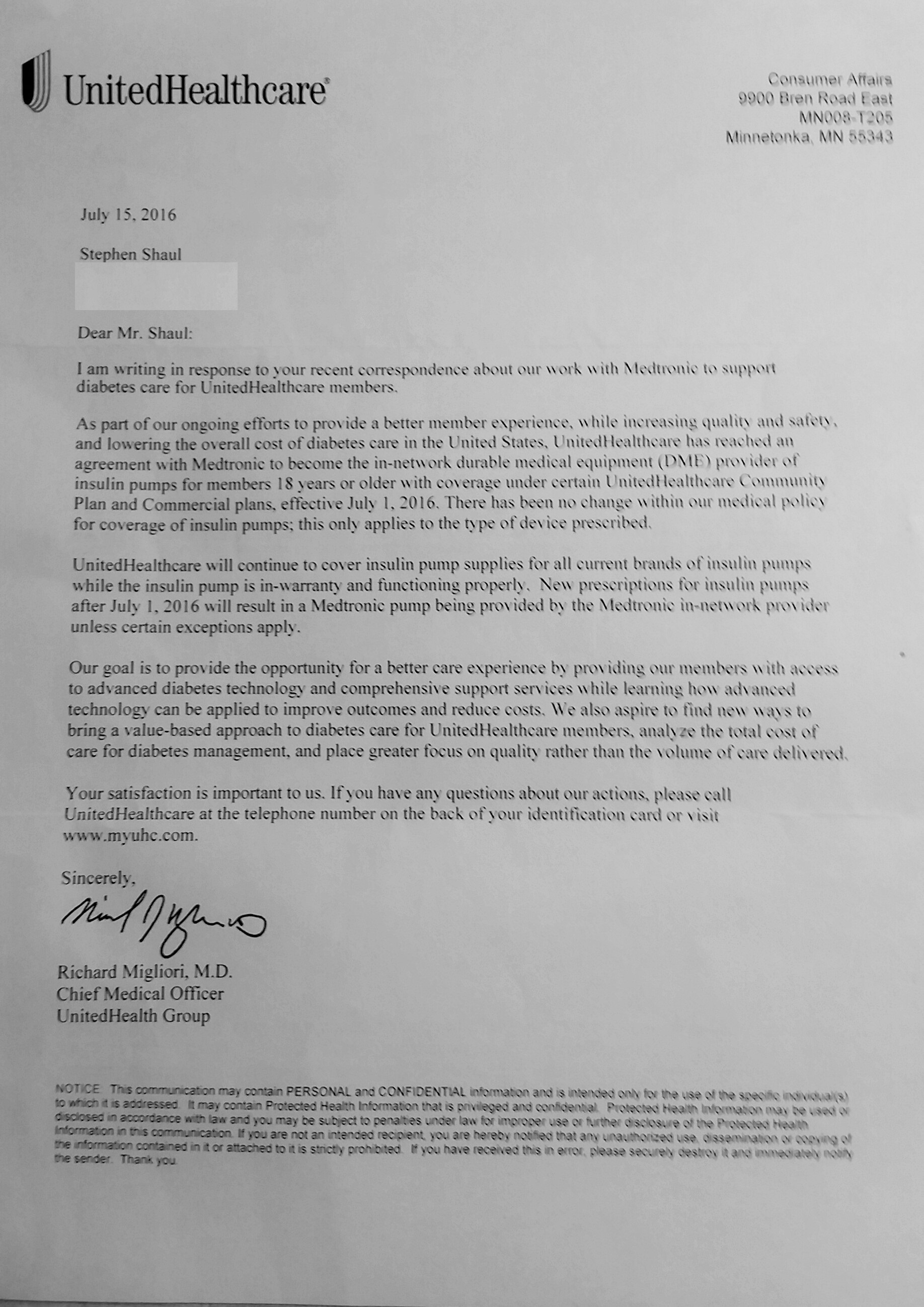
So a lot of people received letters like these in the mail recently:
UHCLetter
I’m not sure the letter has a purpose, other than to prove that the writer, Dr. Richard Migliori, Chief Medical Officer at UnitedHealth Group, can write an entire page full of words and still not say anything meaningful. I suspect that in this case, that was the point. Plus, in all fairness, it’s hard to be both a doctor and an administrator at the same time.

Now, you might think this letter would make me mad, because it doesn’t really address my concerns at all. But I view it positively. Despite the archaic nature of the correspondence, it is actually communication. From a real person.

Here’s the thing: As a result of the various #DiabetesAccessMatters campaigns, people know we exist now. And they feel like they need to respond to us. Look… UHC wasn’t going to get a bunch of letters and then immediately wake up and say, “Whoa, maybe we’re not doing the right thing here. Maybe we should change our minds”. But in raising our voices, we began a dialogue. It’s a dialogue that will probably have to continue for some time, but that’s my point.

Now that the dialogue has been opened, we need to keep the conversation going. Maybe that means responding to a letter like this directly. Maybe that means calling your state’s insurance commissioner to voice your concern. Maybe that means letting your employer know that UHC isn’t your favorite insurer right now. That’s what I did, and I think my state insurance commissioner is next.

Much of the answer to the #DiabetesAccessMatters issue is the same as it is for other issues before us as People With Diabetes or friends or family of PWDs. To win the day, we must apply pressure, and keep the pressure on. We need to overcome fear by standing in the knowledge that we are on the right side of history.

We’re not asking for anything more than what we deserve. UHC patients are not asking for anything less than what they had prior to July 1. Because it’s what they deserve. It’s what they’re paying for. And, oh by the way, it wouldn’t cost UHC one extra dime to allow the same choice that existed less than a month ago.

So don’t stop communicating. This conversation may be just beginning. It’s up to us to make sure it doesn’t end until choice is restored.

Sometimes, the Diabetes Community wins.

I need to take a moment to talk about last Thursday. A day like many other days, full of commutes, and workouts, and tasks to complete. Only this time, it wasn’t exactly a typical Thursday.

Sometimes, the diabetes community wins.

Four big announcements took our world by storm that day, and the news was, to me anyway, all positive.

The day began with an announcement from Type Zero Technologies and Tandem, announcing a working agreement to use Type Zero algorithms in future t:slim artificial pancreas solutions. For a pump agnostic group like Type Zero, it’s very cool to see them working with another partner in addition to CellNovo. I hope to provide more insight on this at a later date. For the official word on Type Zero and their work with Tandem, CLICK HERE.

But wait… that’s not all. There’s more!

Thursday was a big day at the U.S. Food and Drug Administration, as a hearing took place to discuss Dexcom and its latest continuous glucose monitor, the G5, to decide whether it could be officially approved for patients to make dosing decisions. That’s not the exact wording, but in simple terms, that’s it. In short, FDA approved the measure, and now we all have to decide what that means for us, individually.

For some, this decision isn’t a big deal, because they’re dosing off of the Dexcom readings they see already. For others, they’re thrilled that they see the okay from an official government agency to do this. For still others (Ally makes some points worthy of discussion here), there are questions like “Will I now be denied test strips because insurers will want me to dose off of the Dexcom?”. Again, many sides to the issue, so it will be interesting to see what the coming years bring.

Another, important side to this story: the fact that this disposition makes it so much easier to include CGM within existing Medicare framework in the future. It will probably still require Congress to act, which they haven’t wanted to do for a while, but there’s no question a major roadblock is out of the way.

This was a real success story for the Diabetes Community, as it rallied behind initiatives from Diabetes Patient Advocacy Coalitionand diaTribe to sign petitions that were seen by FDA as important influences. They really do listen to us, folks.

But wait… that’s not all. There’s more!

Bigfoot Biomedical also heard from FDA on Thursday, getting approval to move ahead with stage 1 clinical trials on their smartloop™ automated insulin delivery system. Bigfoot has been working hard, and there are so many visible, familiar, lovable faces associated with this company that it’s hard not to root for their success.

The stage 1 clinical trials will be starting shortly, in the San Francisco Bay area, in Santa Barbara, California, and in Denver, Colorado. If these trials are successful, they hope to move into stage 2 trials by the end of this year. Yay Bigfoot!

But wait… that’s not all. There’s more!

Ed Damiano, one of the main driving forces behind the iLet bionic pancreas solution, was named by Boston University as Innovator of the Year for his work on their unique dual-hormone system.

Many people have written about Dr. Damiano and his systems over the years, so there’s not much more I can add, except to say that this recognition is long overdue, and if I were to name the ten most important living scientists working on diabetes-related causes right now, his name would be very near the top. What he and his team have been doing has been influencing all of us, whether we know it right now or not.

Can you believe that all of this good news came out over a single 24 hour period? As my news feeds popped up with each new story Thursday, I could hardly contain my happiness.

Particularly gratifying to me were the many tweets and Facebook status updates from people in the Diabetes Community who feel like there’s a reason to hope again. And boy, do we need some hope. For that reason alone, Thursday was a very good day.

Sometimes, the Diabetes Community wins. Thursday was a great day. Thank you for doing your part to help make it happen.

**Note: the original draft of this post noted Bigfoot Biomedical as a non-profit. It was my mistake, which I am happy to correct.

A very busy week.

Wow, I am right in the middle of a very busy week. Sometimes, things just happen all at the same time. This is one of those times.

On Friday afternoon, I began a week long vacation, which, if you think about it, is really a nine day vacaton. At least for me it is. So… do you think I would rest up, take it easy, get a little extra sleep? Yeah, right.

On Friday afternoon, I came home from work and climbed into a rental truck. We moved our dining room furniture from Maryland to Ohio. So we drove part of the way Friday night before finding a hotel to crash in before driving the rest of the way on Saturday morning.

Saturday, we wound up on Maureen’s sister’s farm outside of Cincinnati, unloaded the furniture, and spent part of a wonderful day. We slept overnight, had breakfast on Sunday morning before dropping off the rental truck, and then headed back east. We drove all the way back Sunday, which means we covered nearly 1200 miles in a little more than 48 hours.

Wait… I’m not finished.

Monday was the 4th of July, America’s Independence Day, which is a national holiday, unless, of course, you have work tasks that no one else can do for you, so you spend part of said holiday actually working. On your vacation. Greeeaaaatttt….

Tuesday went by quickly. Oh, I should mention: bad, bad low in the middle of the night Monday night. Everything turned out okay in the end, but I got very little sleep again. This vacation thing is not working like it should. Anyway, on Tuesday morning, I ran my last training run before my upcoming 5K. More on that in a minute. I also had laundry to do, and I needed to pack. I made a super flatbread pizza for dinner. Too much information?

Wednesday begins the best part of the week. I’m headed to Orlando, where the annual Children With Diabetes Friends for Life event is taking place. I’ll be sitting in on part of MasterLab Wednesday. MasterLab is a place for diabetes advocates to come together in a one-day workshop to learn about how to amp up our efforts for better access, better drugs, and better costs for everyone living with our disease. Disclosure: Diabetes Hands Foundation has invited me to attend MasterLab. They are picking up the tab on my registration. All opinions are my own.

After MasterLab, it will be my honor to head to the exhibit hall, where I’ll be working the booth for Diabetes Patient Advocacy Coalition. If you’re in Florida, please come by and use the DPAC easy button to add your signature, send your e-mails, and up your diabetes advocacy in no time at all. If you’re not in Florida this week, it’s okay. Just go to diabetespac.org, and you can advance the cause right from your own home. Thanks!

I’ll be in Florida Wednesday, Thursday, Friday, and Saturday morning before heading back to Baltimore. But wait… that’s not all!

Sunday will be my 5K, the event I’ve wanted to get under my belt for two years. My comeback event, and even though I’ll be slow, I’m really looking forward to it. I may be tired, but I’m doing it.

Monday morning, I’ll be back at work again for the forseeable future.

Here’s how I look at it: I’m in the middle of a very busy week, and I’m not going to get much rest during my vacation. But I’m crossing a lot of things off of my list, so the next time I get some time off, hopefully, I can spend some time resting and relaxing.

And don’t feel sorry for me. I chose to do all of this, at this time. I could have said no to any or all of it. But I didn’t. Because I didn’t want to. My life is full of a lot more fun and adventure today than it was back when a week off meant a week at home sleeping late and watching TV until the wee hours of the morning. I’m happy to serve the community through DPAC, and I wouldn’t trade my life right now for anything. Except maybe a fully functioning pancreas.

I’ll catch up with you next week! In the meantime, you can follow the goings on in Orlando by following the hashtag #CWDFFL16.
 

What’s Next?

Like you probably did, I read Kerri Sparling’s blog post about how she’s still unhappy that nothing has happened since the United Healthcare/Medtronic Diabetes dustup. Like her, I can sense the dust settling at this point, and I wonder if anything meaningful will come of all our vitriol just a month ago.

I’ve thought about this from time to time since the announcement was made back in May, and I’ve come to the conclusion that there are some things I know, and some things I don’t know about all of this. While we know the issue, and what’s at stake, we all undoubtedly feel a sense of resignation, that “this is how business works and there’s not much we can do about it”.

Well, that may be true. Maybe there’s nothing we can do about it. I don’t think it’s that simple though. I do know that if we’re going to turn the tide of businesses trying to rule our access to tools designed to help us be as healthy as possible, certain things need to happen. In no certain order, here are just four of those things.

—————————————————————

Holes need to be poked in this arrangement. I’ll bet you can state one or two things that are wrong about this business deal right off the top of your head. We need to find more things that are wrong with this, and point them out, over and over again, to anyone who will listen. We need to find out things that are wrong about the businesses and the people running those businesses that are wrong. I’m not advocating personal attacks, of course. But is there a track record here that needs to be noted? Maybe an indicator of what’s to come based on similar tactics these companies/people have employed in the past? And we need to keep hammering those points home. In the current business climate in the USA, these people already know that they can get away with making arrangements that only suit themselves and not patients. We need to make it uncomfortable for them to do so. As uncomfortable as possible, even if it’s one blog post at a time, one insurance claim at a time, one protest at a time, one person standing up and stating what is right. We cannot let injustices go without standing up and pointing them out. Over and over again.

Tweak the message. Why do you think JDRF gets such big dollars for research? Let me ask you another question: do you ever see someone like me in JDRF literature? Of course you don’t. That’s because even though I have the same disease as a cute ten year old, time and again people will react positively to the message that a child doesn’t deserve to live with this, even if I’ve been living with it for at least fifteen years longer.

Okay, I’m a little off topic here, so let me bring it back to the issue at hand. Anger is good… it gets our blood flowing, it’s often the catalyst for developing platforms for change. But if you can’t tell a story, a compelling story, a heart wrenching story about why all patients need access to the best care and drugs and devices, people are going to question why they should care. This is where I’m at a disadvantage. I’m good at telling you what’s happened, but I’m not always good at making it overwhelmingly compelling. But I know I need to do that. We need to turn our outward message of anger into inward concern for actual people. And quickly.

These companies need to be hurt where it counts– in the financials. Sorry to be the one to tell it so bluntly. But let’s face it: by and large, as long as company execs are getting their bonuses, they really don’t care about you or I. This deal falls apart when it no longer makes financial sense, from either a corporate or a personal point of view, for it to continue. I don’t know if that means we find a legal way to keep them in court fighting for their stupid deal (and fund the fight), or if that means we encourage a boycott of United Healthcare and Medtronic for years to come, or if it means that we encourage patients to find ways to make United Healthcare pay more in claims under this agreement (which they would fight). But when the money is no longer there for this deal, there will be no reason for it to continue.

Relentlessness. Do you think The CEO of United Health Group, or the President of Medtronic Diabetes are actually thinking about any of this anymore? They’re not. Of course they’re not. They knew that there would probably be an initial reaction. They knew that the initial reaction would probably die down. Now they’re just going on with their lives like nothing ever happened. You’re just a dollar sign… you’re not a person to them.

I’m not a big believer in the fact that everything needs a coordinated effort to accomplish a big goal. But here’s one instance where a little coordination could come in handy. I’ll give you an example: sit-ins at lunch counters in the south back in the 60s. White authorities were sure that all that was needed was to arrest the African-Americans sitting at the segregated lunch counter, and it would all be over. But as soon as the initial protesters were arrested, new protesters immediately came forward and sat down in their place. Authorities only thought there were a few protesters… they didn’t count on many, showing up over and over again. That’s what we need.

As a community, our initial reaction to all of this was wonderful, and creative, and even inspiring. But now there’s nothing. A coordinated effort that has one person writing about it this week, another meeting with their elected officials the next week, bombarding state insurance commissioners the following week– that’s how we start to chip away at the wall that’s been built between business and patients. Little by little, over and over, never giving up, until we either force an end to this type of practice or make it unsatisfying for companies to engage in this kind of behavior in the first place.

—————————————————————

As U.S. citizens, we believe in our original Declaration of Independence and our Constitution, which promote the idea of choice as a basic right for all people. Those documents don’t say anything about the right to squeeze out as much profit as possible, or that doing so at any cost to patients is okay.

I don’t have a great plan, or anything nearing all the answers. But I do know that the one thing we can do, all of us, is continue to assert that our human right to choose is the most important message in this debate. You think this collaboration between UHC and Medtronic fosters innovation? I don’t care if it does… it destroys my right to choose (and it doesn’t foster innovation– quite the opposite). You think it gives patients a best-in-class platform to manage their diabetes? I don’t care… it destroys my right to choose, today and in the future, so if a better product becomes available, I might be unable to choose it. You think having a “clinical exception process” in place for people who want to choose a different option actually proves you’re still allowing choice? You’re wrong… it destroys my right to choose, and it gives other greedy businesses a template for denying choice, and I’m not okay with that.

This attitude needs to be here, on the faces of the Diabetes Community, in every interaction with these entities, until policies like this are a thing of the past. They’re only trying to get everything they can. I’m fighting for what I want too, and what I want is more important. And I am not ashamed to say so. Yesterday, today, and tomorrow.