Author Archives: StephenS

Hello… I’m Stephen. I live in Baltimore, Maryland, USA with The Great Spousal Unit, Maureen. I’ve been living with Type 1 Diabetes since January 1991. I’ve been a pump user since April 2010, and I’m currently wearing the Animas Vibe pump. Also wearing the Dexcom G5 continuous glucose monitor.

I found the Diabetes Online Community in the summer/fall of 2011, and that discovery has changed my life. I started this blog in April 2012, and since then, my diabetes advocacy has continued to grow. Among other achievements, I’ve attended and spoken up at FDA workshops and participated in clinical trials.

I’ve been thrilled to serve as a facilitator for the Diabetes UnConference. And I’ve been honored to volunteer for Diabetes Patient Advocacy Coalition. You should Google both of those.

I’m currently serving as a member of the State of Maryland’s Advisory Council on Health and Wellness, where I am co-chair of the Diabetes committee. In addition, I’m part of the 2018 Reader Panel at Diabetes Forecast magazine.

I’m always searching for the perfect balance between the highs and lows of my blood glucose level and my life… always searching for the Happy Medium.

Anything you’d like to share? Please let me know… I’d love to hear from you.

What makes us different?

Click here to save children – Donate to Spare A Rose, Save a Child

SAR2015
 
Okay, we know what makes us different.

You know what else makes us different?

We Care.

I mean, we care in a very big way. Would you like an example?
image

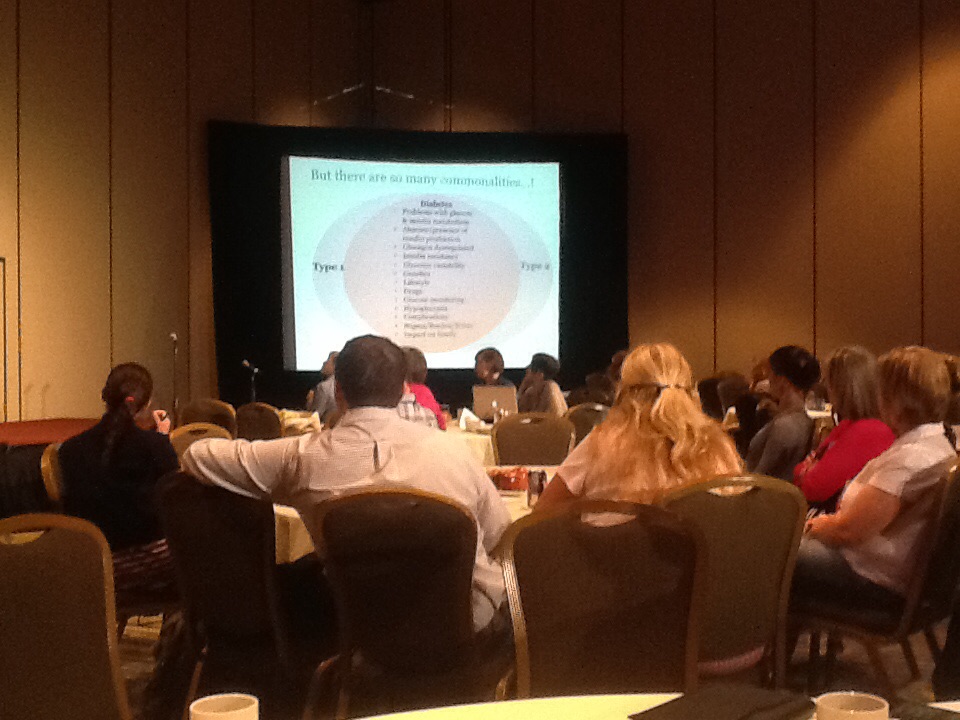
I was cleaning up some old photo files the other day when I came across this one from last year’s MasterLab in Orlando, Florida. It really made me notice something I hadn’t seen before. This was during the joint presentation given by Kelly Close and Adam Brown of diaTribe. First, let me ask you… What do you notice from this photo?

What I notice, other than the marvelous people appearing in it, is how everyone’s attention is either on the slide being presented or on the speaker presenting the slide. This was not in the early hours of the one day advocacy event sponsored by Diabetes Hands Foundation. This was about mid-afternoon, after we had already heard a few inspiring speakers, and after a nice lunch that, under other circumstances, might have made us very sleepy by then.

Yet we were still engaged, still interested in learning how to advocate effectively, how to be better at helping others living with diabetes while pushing the right buttons to amplify our voices.

That photo says to me that the people in that room (50-75 maybe?) were all in.

I’ve seen and heard a lot (including on that day) from people who have said that diabetes doesn’t have a movement yet. How we’ve not been bold enough. How, compared to advocates for better treatment of other diseases, we’re just not doing enough, or we’re not speaking with one voice, or we’re not something.

My opinion: We’re doing just fine. And I care a lot more about the future than I do about the past. Yes, it’s very true that diabetes doesn’t get enough attention from congress, and Big Pharma has us all caught up in that “Can’t live with the price, Can’t live without the medicine” paradigm. I freely admit that we could stand to have a brighter light shown on our disease. More people need to learn more about what we have to live with every day.

But we’re still making progress. We’re able to speak on bigger platforms and with bigger voices now, including crashing an FDA web conference, and being written up in the New York Daily News. Bigger audiences and more influential people are hearing our message.

And let’s not forget that all of us living with diabetes is living with an extremely unique condition. We have a disease that, if everything goes right, allows us to live an otherwise normal-looking life. For many of us, the complications that come with our condition like fries come with a Big Mac don’t show themselves until much later. In some cases, that means additional misguided judging by people who just can’t comprehend how doing a great job managing diabetes doesn’t always keep us safe from problems later. Or now.

When someone is diagnosed with cancer, or ALS, for example, the symptoms show themselves in a very visible way. When someone goes through chemotherapy, or starts to lose their muscle tone due to ALS, it’s very natural to want to help them as much as possible. We see the outward evidence of need. It is right that we do this.

When someone with diabetes goes through a difficult hypoglycemic episode, you know what we do? We treat and then we keep on going. Maybe it’s the idea of the word “normal”. We always want to be normal… when we’re high we want to be normal, when we’re low we want to be normal. When we’re normal? Not one living soul notices us.

So to get back to the photo, here’s the point: The people in that picture understand how absolutely sinister this condition can be. Whether we see the outward signs or not. Whether we see the outward signs now or later. They get it. What’s more, they care. And they are all doing something about it. Do you hear me? We are all doing what we can to make our voices heard.

We are all doing what we can. We have all made improvements and strengthened our advocacy, especially over the last few years. Our advocacy efforts and our fundraising efforts are sometimes dwarfed by those linked with other diseases. But we are not dormant. We are building. Things are happening. We are challenging decision-makers and we are saving lives. And it’s my opinion that most, if not all, of what we have achieved to this point has been due to the tireless efforts of people who, in addition to having diabetes in their lives every day, find time to raise children and work a regular job too.

After 24 years, I know where we’ve been. I know where we are now. What makes us different? Diabetes is as old as the ages. Large scale diabetes advocacy is just getting started. We have a lot to learn.

We have a lot to be proud of too.


Friday pep talk.

Click here to save children – Donate to Spare A Rose, Save a Child

SAR2015
 
As we all know, diabetes is a strange beast. Sometimes our BGs play nice, staying within range, and those of us who practice pre-bolusing actually remember to do so all day. Other times, we’re subject to wild swings, lows that just won’t come up, or highs that can’t be brought down no matter how much insulin we throw at them.

Likewise, we’re stuck with the constant requirements of managing (to the best of our ability) a condition that never plays fair. People not living with diabetes don’t always understand that this disease is not as simple as do a calculation, take a certain amount of insulin, eat perfectly, and our numbers will be awesome all the time. And there’s that little tiny voice in the back of our minds that we try to keep silent, warning us of possible complications. On top of that, let’s face it: We’re human. We’re bound to make a mistake or two (or three). Yuck.

Okay, so we know that things aren’t always perky, right? What do we do about it?

Far be it from me to give advice (famous last words). First, let me give an appreciative nod to this amazing post by Briley at inDependence. In addition, I’m hoping a few reminders here will help you in a moment of diabetes stress. Think of it as a Friday diabetes pep talk.

Yesterday may suck, but it’s yesterday.
That’s the best part of awful numbers, stupid people who think cinnamon will cure you, and CGMs that go kaput in the middle of the night. It’s over. I’m not saying forget about it… that’s impossible. What I am saying is be glad that the moment is over and you survived it. Whether you think you are now or not, you are stronger for it, and the future is unwritten. Carpe Diem, baby.

You count. Diabetes doesn’t.
This is one of those sayings where, sometimes, you have to keep repeating it to yourself over and over again before it sinks in. But like I said, if you’re surviving, it also means you’re living to see another day. For some people, and for some circumstances, that’s not just something… that’s everything. Particularly in America, it’s easy to hide what’s going on. We don’t like to show weakness. We like to pick ourselves up, dust ourselves off, move on. That can be good (see above). The reality, however, is that occasionally it’s good to stop, take a moment or two to compose ourselves (even if it takes all afternoon), and then move on. Doctors are learning more and more that our mental well-being is just as important as our physical well-being. Let’s prove to ourselves that we’ve received that message. Let’s remember that how we feel about things does matter. A lot.

We have more resources than ever before.
In the past month, we’ve seen advances in diabetes technology that many couldn’t see coming a year ago. Meanwhile, there are more diabetes organizations, conferences, and informal get-togethers where peers (you and me living with diabetes) can meet and commiserate. On top of that, there are more diabetes blogs where people like us are sharing our stories, and what was once a fun, quirky Twitter chat has now become a Wednesday night institution. Heck, in just the past week I’ve seen a number people get late night diabetes help and support via Twitter, myself included.

Diabetes takes a lot away from us. It also gifts us with perseverance and empathy. Perseverance to endure the tough times and continue on where non-pancreatically-challenged individuals might indeed falter. And empathy that allows us to recognize when someone needs help and then do something to lift them up. I almost never encounter others with these qualities. Yet they are almost universal in our world.

So why not use our unique qualities to make a great life for ourselves and our diabetes friends going forward? YouCanDoThis. Bring on the day.


Another year, another…

Click here to save children – Donate to Spare A Rose, Save a Child

SAR2015
 
 
Somewhere over the Atlantic Ocean, I realized that I had completed another year living with Type 1 Diabetes.

Often, when the day comes around, I think about how great it is that I’ve lived with this chronic condition for so long, without any significant issues. Sometimes I even celebrate a little.

But this year, I was so obsessed with getting ready for this business trip, I completely forgot about the diaversary.

That’s the way it goes sometimes. After 24 years with diabetes, I can’t expect every year to be the same.

What was your last diaversary like?


Show the love, save a life.

SAR2015
 
 
I’m headed out of the country for the next ten days, so depending on how my work and play schedule goes, you may or may not read more in this space over the next week and a half.

But before I depart, I want to remind you that it is always the season of…

Paying it forward.

Hope.

Life.

The Spare A Rose, Save A Child campaign begins February 1.

If you’re reading this, you’re probably one of the lucky people who have access to the life-giving insulin that keeps our blood glucose from skyrocketing, causing sickness and complications, and even death to People With Diabetes. You may pay a lot for it, but you have access to it. In fact, you may have a ready supply in your refrigerator at home right now. This morning, I counted 8 vials of this life-sustaining medicine in my fridge.

But you know, there are a lot of kids who do not have access to insulin, let alone a refrigerator, and for them, a diabetes diagnosis could be a death sentence. That’s where you and I come in.

Partnering for Diabetes Change and the International Diabetes Federation have teamed up once again to help raise money for the IDF’s Life for a Child program through Spare A Rose, Save A Child.

Really, what they’re doing is helping to save the lives of Children With Diabetes in 49 countries around the world who would be facing an extremely bleak future if you or I didn’t act, now. The idea is simple:

Have a special one in your life? Would you send roses to that person this Valentine’s Day? Going on the premise that one rose would cost about five dollars (US)… If, instead, you donated that five dollars, that cost of one rose, to the IDF’s Life for a Child program, you could help them purchase insulin for a child in a developing country for an entire month.

It’s that easy to see how your donation can make a difference. Five dollars saves the life of one child, for one month. But why stop there? By that math, the cost of one dozen roses could help a child live for an entire year! Last year, donations totaled enough to provide a year’s worth of insulin for 454 children while raising over $27,000. Can we do even better this year? With your help and my help, I think we can.

Click here or on the banner at the top of the page to be a lifesaver today.

This year, there’s even a way you can set up an automatic monthly donation via your bank card. Imagine looking at your bank statement each month and saying to yourself “Power bill, auto loan, Oh, look at that… there’s where I saved the life of a child (or two, or five, or ten) this month”. How freakin’ powerful is that?

And hey, can you do one more thing? Can you let the world know about it? I mean, why should you and I be the only ones out there saving lives? Let’s help others get in on the action too. Be sure to share the Spare A Rose campaign everywhere you have a social media footprint, and at work and school too. Share the giving link and the #SpareARose hashtag liberally. For more ideas on how you can help spread the message, go to SpareARose.org.

Five bucks, one child, one month of life. That’s a very measurable way to put a value to how you can make the difference– a life-sustaining difference– right now, today.


Because… Progress.

January is practically over, and you know what? It’s been a pretty good start to 2015.

Tandem has announced approval of their larger-capacity insulin pump.
The t:flex pump may not raise a lot of eyebrows, but it does provide something no pump has provided before: The ability to pack 480 units of insulin in the reservoir. I can’t name anyone off the top of my head who needs this right now, but I have been in support group discussions where People With Diabetes felt they couldn’t use an insulin pump because their daily insulin needs are higher, and they would have to change a set out too often, and it just wasn’t worth it to them to go through that. For many, this will solve that problem.

Not to be outdone, Medtronic obtained approval (outside of the USA) for their new 640g system.

This is the first system available to the public that will both suspend insulin delivery when a patient reaches a low point on their CGM, and resume insulin delivery when a patient’s CGM reading recovers. It also comes with additional hardware that looks to me like a PDM, and a seriously-needed upgrade to the CareLink software that, in images on Med-T’s website, look an awful lot like what you see with Dexcom’s downloads.

Speaking of Dexcom… The FDA announced approval of the Dexcom app software that allows CGM users to share their data with others in real time.

For people with hypo unawareness, sharing CGM readings with people close to you is life-changing, and potentially live-saving. Dexcom’s system will employ a new Dexcom Share receiver (the previous version was the Dexcom Cradle), and existing users will be able to upgrade at little or no cost. Of course, you and anyone you connect with (via the Dexcom Follow app) will have to have an iPhone or an iPad device to make this happen. But yay for the FDA allowing Dexcom to go through the de novo classification process, a regulatory pathway for low to moderate risk medical devices that are novel and not substantially equivalent to any legally marketed device, rather than making them go through the gauntlet of the full medical-device approval pathway.

I know, I know… all of these devices may have issues and fall short of what we are looking for from innovations in the diabetes device space. But who was talking about real-time CGM monitoring a year ago? Who was talking about pumps that suspended, then resumed insulin delivery based on CGM readings? Who was discussing larger pump capacities? Okay, well, people were talking about those things a year ago, but at least some of us didn’t expect any of these innovations to be rolled out to actual customers within a year’s time.

In the end, we can’t complain entirely that we don’t get everything we want right now, because… Progress. Things are moving forward, and I’m hoping that we’ll eventually reach a tipping point where the urge to both innovate and get those innovations to patients as soon as possible will cause device and drug makers to move at a pace that matches the rest of the world’s technological advancements.

Because… Necessary.