Author Archives: StephenS

Hello… I’m Stephen. I live in Baltimore, Maryland, USA with The Great Spousal Unit, Maureen. I’ve been living with Type 1 Diabetes since January 1991. I’ve been a pump user since April 2010, and I’m currently wearing the Animas Vibe pump. Also wearing the Dexcom G5 continuous glucose monitor.

I found the Diabetes Online Community in the summer/fall of 2011, and that discovery has changed my life. I started this blog in April 2012, and since then, my diabetes advocacy has continued to grow. Among other achievements, I’ve attended and spoken up at FDA workshops and participated in clinical trials.

I’ve been thrilled to serve as a facilitator for the Diabetes UnConference. And I’ve been honored to volunteer for Diabetes Patient Advocacy Coalition. You should Google both of those.

I’m currently serving as a member of the State of Maryland’s Advisory Council on Health and Wellness, where I am co-chair of the Diabetes committee. In addition, I’m part of the 2018 Reader Panel at Diabetes Forecast magazine.

I’m always searching for the perfect balance between the highs and lows of my blood glucose level and my life… always searching for the Happy Medium.

Anything you’d like to share? Please let me know… I’d love to hear from you.

Community.

I speak to you today in praise of the Diabetes Community.

Multi-faceted, multi-talented, multi-country, multi-cultural, it is the living embodiment of selflessness and inspiration. Its accomplishments are many, and its biggest challenges remain to be conquered. For every advancement, every success, failures of our healthcare systems and of our own endocrine systems means our efforts are not complete.

There is much to be excited about. We are connected as never before, through social media and patient-centric organizations. Blogging is still a thing (at least I hope it is), and this community can boast writers that are among the best around at telling their stories of living with a chronic condition. In the past year, podcasting about diabetes has taken off again, and that gives people a chance to hear the latest without actually having to read the latest.

And there are the athletes. Reaching the heights of their chosen sports, amateur or professional, climbing Mount Everest, winning auto races, playing in the National Hockey League. Riding 100 miles on a bicycle, for no other reason than to help raise money for research toward a cure. There are organizations that encourage and help get people moving so they can simply remain as healthy as possible, for as long as possible.

This community is full of passionate advocates, who see a need and try to fill it, or see a wrong and try to right it. Advocates who speak before Congress, who speak before regulatory bodies, who debunk long-established myth and self-serving stigma to anyone who will listen. God bless them. As we break down more barriers going forward, I hope we can find a way to turn our short-term advocacy efforts into sustained, long-term advocacy movements. In the end, a lot of advocacy is simply outlasting those who oppose us.

There are increasing numbers of healthcare professionals living with diabetes, and many who don’t live with diabetes but support us in ways we couldn’t have dreamed of a generation ago. I like how their profession allows them to have both a unique perspective on our disease, and an even bigger motivation to educate all of us about the importance of never giving up on our own self-care.

Yet, there remain difficulties. For every person running a marathon or leading a local support group or participating in a clinical trial, there is someone who lives with depression or burnout that they never counted on when they were diagnosed. There is someone who goes to a doctor once a month to get injections directly into their eyes to help reduce the ravages of diabetic macular edema. There is someone who works hard every single day to even out the roller coaster of glucose readings they see on a continuous glucose monitor. Their issues are not going away, so we should continue to show them the love and support they so richly deserve.

Being part of the Diabetes Community includes things like giving so that children living with diabetes in developing countries don’t also live with a death sentence. For many, it includes occasional happy gatherings full of laughter and hugs and bolus-worthy delights, living life to its fullest. It’s a unique language and an extra set of superpowers that none of us ever thought we would possess, but do anyway because it can literally mean the difference between life and death during tense moments for ourselves or our loved ones.

Diabetes isn’t something that happens to just us; it’s something that happens to all of us. All of us in this community are affected by the successes and frustrations that each of us experience every single day of life with a disease that is with us every single day. It is right that we commiserate in the sadness of a high A1c result or the passing of a close friend. It is equally right that we rejoice together in goals met, children raised, and new technology that makes us safer. Having to live with diabetes is the worst part about my life. Getting to live with diabetes people in my life makes me a better person.

“When I am with a group of human beings committed to hanging in there through both the agony and the joy of community, I have a dim sense that I am participating in a phenomenon for which there is only one word… glory.” – M. Scott Peck

“I have found the paradox that if I love until it hurts, then there is no hurt, but only more love.” – Mother Teresa

Communities are not buildings or monuments or parks. They’re made up of people. Our shared situation and our singular desire to compassionately relieve and delay and eliminate the burden of diabetes unite us as a community in a way few other things can. As each new day dawns, I take solace in the fact that even though my pancreas is faulty, my heart is full.
 

What’s Next?

Like you probably did, I read Kerri Sparling’s blog post about how she’s still unhappy that nothing has happened since the United Healthcare/Medtronic Diabetes dustup. Like her, I can sense the dust settling at this point, and I wonder if anything meaningful will come of all our vitriol just a month ago.

I’ve thought about this from time to time since the announcement was made back in May, and I’ve come to the conclusion that there are some things I know, and some things I don’t know about all of this. While we know the issue, and what’s at stake, we all undoubtedly feel a sense of resignation, that “this is how business works and there’s not much we can do about it”.

Well, that may be true. Maybe there’s nothing we can do about it. I don’t think it’s that simple though. I do know that if we’re going to turn the tide of businesses trying to rule our access to tools designed to help us be as healthy as possible, certain things need to happen. In no certain order, here are just four of those things.

—————————————————————

Holes need to be poked in this arrangement. I’ll bet you can state one or two things that are wrong about this business deal right off the top of your head. We need to find more things that are wrong with this, and point them out, over and over again, to anyone who will listen. We need to find out things that are wrong about the businesses and the people running those businesses that are wrong. I’m not advocating personal attacks, of course. But is there a track record here that needs to be noted? Maybe an indicator of what’s to come based on similar tactics these companies/people have employed in the past? And we need to keep hammering those points home. In the current business climate in the USA, these people already know that they can get away with making arrangements that only suit themselves and not patients. We need to make it uncomfortable for them to do so. As uncomfortable as possible, even if it’s one blog post at a time, one insurance claim at a time, one protest at a time, one person standing up and stating what is right. We cannot let injustices go without standing up and pointing them out. Over and over again.

Tweak the message. Why do you think JDRF gets such big dollars for research? Let me ask you another question: do you ever see someone like me in JDRF literature? Of course you don’t. That’s because even though I have the same disease as a cute ten year old, time and again people will react positively to the message that a child doesn’t deserve to live with this, even if I’ve been living with it for at least fifteen years longer.

Okay, I’m a little off topic here, so let me bring it back to the issue at hand. Anger is good… it gets our blood flowing, it’s often the catalyst for developing platforms for change. But if you can’t tell a story, a compelling story, a heart wrenching story about why all patients need access to the best care and drugs and devices, people are going to question why they should care. This is where I’m at a disadvantage. I’m good at telling you what’s happened, but I’m not always good at making it overwhelmingly compelling. But I know I need to do that. We need to turn our outward message of anger into inward concern for actual people. And quickly.

These companies need to be hurt where it counts– in the financials. Sorry to be the one to tell it so bluntly. But let’s face it: by and large, as long as company execs are getting their bonuses, they really don’t care about you or I. This deal falls apart when it no longer makes financial sense, from either a corporate or a personal point of view, for it to continue. I don’t know if that means we find a legal way to keep them in court fighting for their stupid deal (and fund the fight), or if that means we encourage a boycott of United Healthcare and Medtronic for years to come, or if it means that we encourage patients to find ways to make United Healthcare pay more in claims under this agreement (which they would fight). But when the money is no longer there for this deal, there will be no reason for it to continue.

Relentlessness. Do you think The CEO of United Health Group, or the President of Medtronic Diabetes are actually thinking about any of this anymore? They’re not. Of course they’re not. They knew that there would probably be an initial reaction. They knew that the initial reaction would probably die down. Now they’re just going on with their lives like nothing ever happened. You’re just a dollar sign… you’re not a person to them.

I’m not a big believer in the fact that everything needs a coordinated effort to accomplish a big goal. But here’s one instance where a little coordination could come in handy. I’ll give you an example: sit-ins at lunch counters in the south back in the 60s. White authorities were sure that all that was needed was to arrest the African-Americans sitting at the segregated lunch counter, and it would all be over. But as soon as the initial protesters were arrested, new protesters immediately came forward and sat down in their place. Authorities only thought there were a few protesters… they didn’t count on many, showing up over and over again. That’s what we need.

As a community, our initial reaction to all of this was wonderful, and creative, and even inspiring. But now there’s nothing. A coordinated effort that has one person writing about it this week, another meeting with their elected officials the next week, bombarding state insurance commissioners the following week– that’s how we start to chip away at the wall that’s been built between business and patients. Little by little, over and over, never giving up, until we either force an end to this type of practice or make it unsatisfying for companies to engage in this kind of behavior in the first place.

—————————————————————

As U.S. citizens, we believe in our original Declaration of Independence and our Constitution, which promote the idea of choice as a basic right for all people. Those documents don’t say anything about the right to squeeze out as much profit as possible, or that doing so at any cost to patients is okay.

I don’t have a great plan, or anything nearing all the answers. But I do know that the one thing we can do, all of us, is continue to assert that our human right to choose is the most important message in this debate. You think this collaboration between UHC and Medtronic fosters innovation? I don’t care if it does… it destroys my right to choose (and it doesn’t foster innovation– quite the opposite). You think it gives patients a best-in-class platform to manage their diabetes? I don’t care… it destroys my right to choose, today and in the future, so if a better product becomes available, I might be unable to choose it. You think having a “clinical exception process” in place for people who want to choose a different option actually proves you’re still allowing choice? You’re wrong… it destroys my right to choose, and it gives other greedy businesses a template for denying choice, and I’m not okay with that.

This attitude needs to be here, on the faces of the Diabetes Community, in every interaction with these entities, until policies like this are a thing of the past. They’re only trying to get everything they can. I’m fighting for what I want too, and what I want is more important. And I am not ashamed to say so. Yesterday, today, and tomorrow.
 

Congress, we need your RSVP. Today.

Hello again… it’s me, your friendly neighborhood internet town crier here to let you know that we need your help, by performing your own bit of (less than) 2 minute advocacy.

We (and by we, I mean the ENTIRE Diabetes Community) need your help, right now, this instant.

Over 285 members of the Congressional Diabetes Caucus and the Congressional Black Caucus have been invited to an important briefing on the impact that CMS competitive bidding has been having on senior citizens in my country.

Officially, these influential members of congress have been invited to “The Diabetes Access to Care Coalition for a briefing on ‘Impact of CMS Competitive Bidding Program on Diabetes Beneficiary Safety and Access to Diabetes Testing Supplies Analysis’“. I’ve written about the dangers of CMS competitive bidding, and I want all of my federal lawmakers to know what I know: that CMS competitive bidding costs money, and costs lives. It’s unsustainable.

Better yet, Christel Marchand Aprigliano is presenting to this esteemed group. That’s right… a patient, someone with skin in the game, as the politicians say, is going to spell it out for them. There is no one I would like to see there more.

Where do you come in? Listen… we need as many members of congress and their staff to be there in the room to hear the presentation! That’s where you come in.

Click here to invite your Congressional Representative to this gathering

It’s so easy to do this, and it does so much good. This is your chance to connect directly with your elected representative in Congress. Make sure they hear your voice, then hear Christel’s voice.

We need everyone in the room. But they must RSVP by June 10. Please help them get there by sending them a friendly message.

The whole exercise will take less than 2 minutes. Help save money for the federal government, and save a few lives in the process. CLICK HERE to perform your own Diabetes Advocacy right now… when we need you most.
 

Regular Maintenance.

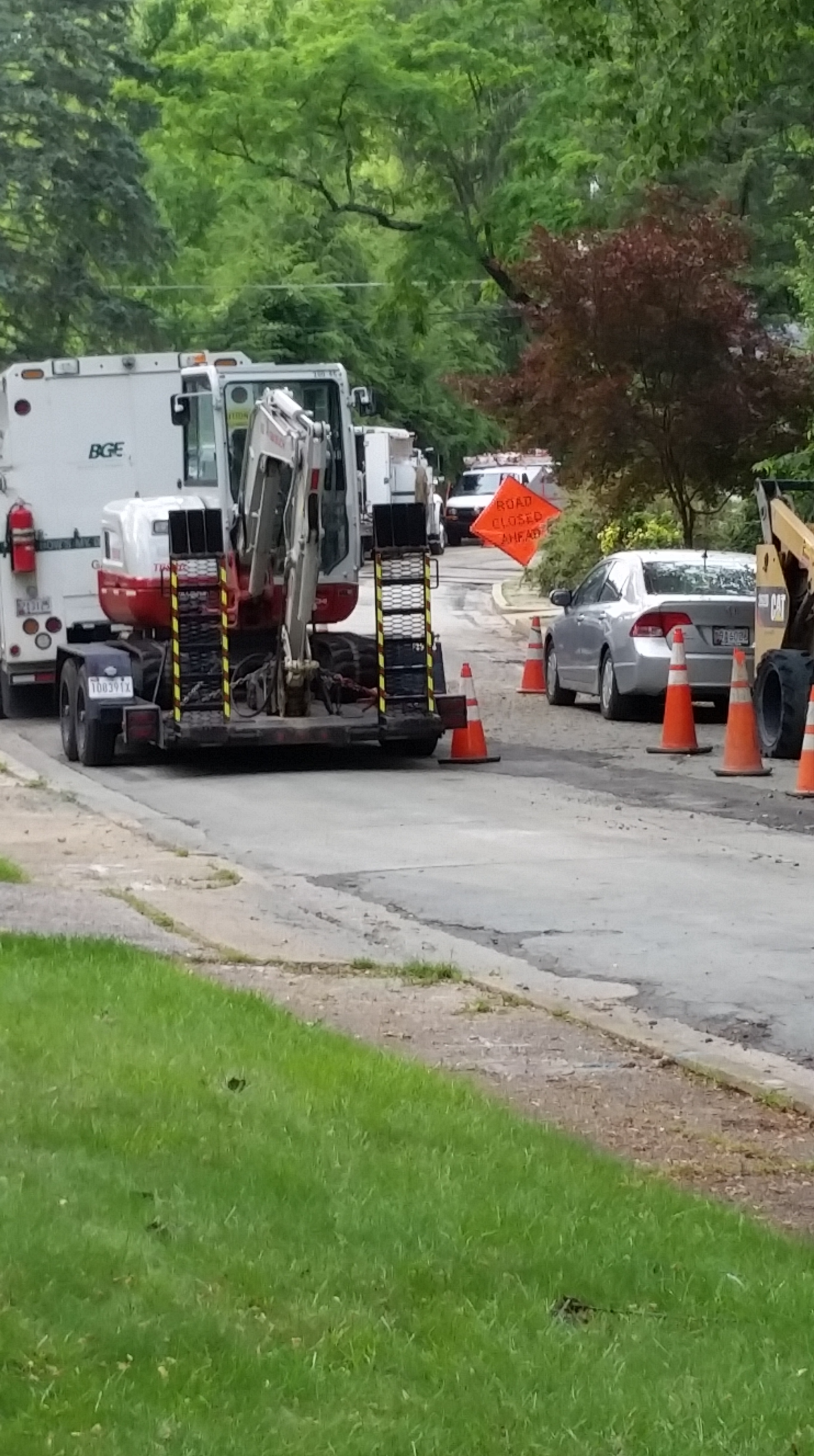
Baltimore County has been busy on my street in the past week.

The county is in the process of replacing water mains in our area, and they’ve been at work for about a week on our block.

Naturally, this made me think about my diabetes (because, why not?).

Occasionally, we need to step back from the everyday grind and consider what about our diabetes needs an upgrade. Or a change. Or a budget adjustment. I’ve got to admit… it’s time for me to do some diabetes maintenance.
image
I’ve been putting off doctor visits. Not because I hate going to doctors, but because I’ve been busy, and the daily grind of my life these days has made it easy to forget about scheduling an appointment once I get to work or to the gym or out in the yard. Funny how, even at my age, I can still let everything else be an excuse for not getting to the things that I know I need to do for me.

I missed the last appointment with my endocrinologist because I was traveling. I haven’t been to an ophthalmologist in about a year and a half. Finding a good one locally is really tough. And I can’t tell you how long it’s been since I’ve seen a podiatrist. Same reason. To make matters worse, I need to get in to see a gastroenterologist because… well, you know. I’ve been putting that off for a few years.

I also have to consider replacing my wonderful Accu-Chek Nano meter that I’ve been using for something near four years. But I like it so much, and I have four of them, and I just don’t want to get another one. But what am I missing by not finding a newer model?

Last Friday, the county workers must have done some real damage underground, because at the stroke of midnight, I heard pounding outside. It was Baltimore Gas and Electric performing emergency repairs on the natural gas line that runs right where the county was digging. They were working all night and all day Saturday.

I don’t want to get to where my casual attitude toward regular maintenance of my health results in missing something important that I need to address. Besides, the appointments I need to make are piling up.

This isn’t about burnout or anything like that. I’ve just let things go for far too long. It’s time for me to ignore ignoring my well-being and focus on getting the regular maintenance of my health addressed.
 

Diabetes + Cancer? No problem for this Champion Athlete.

It’s Friday, so how about something to make you feel good?

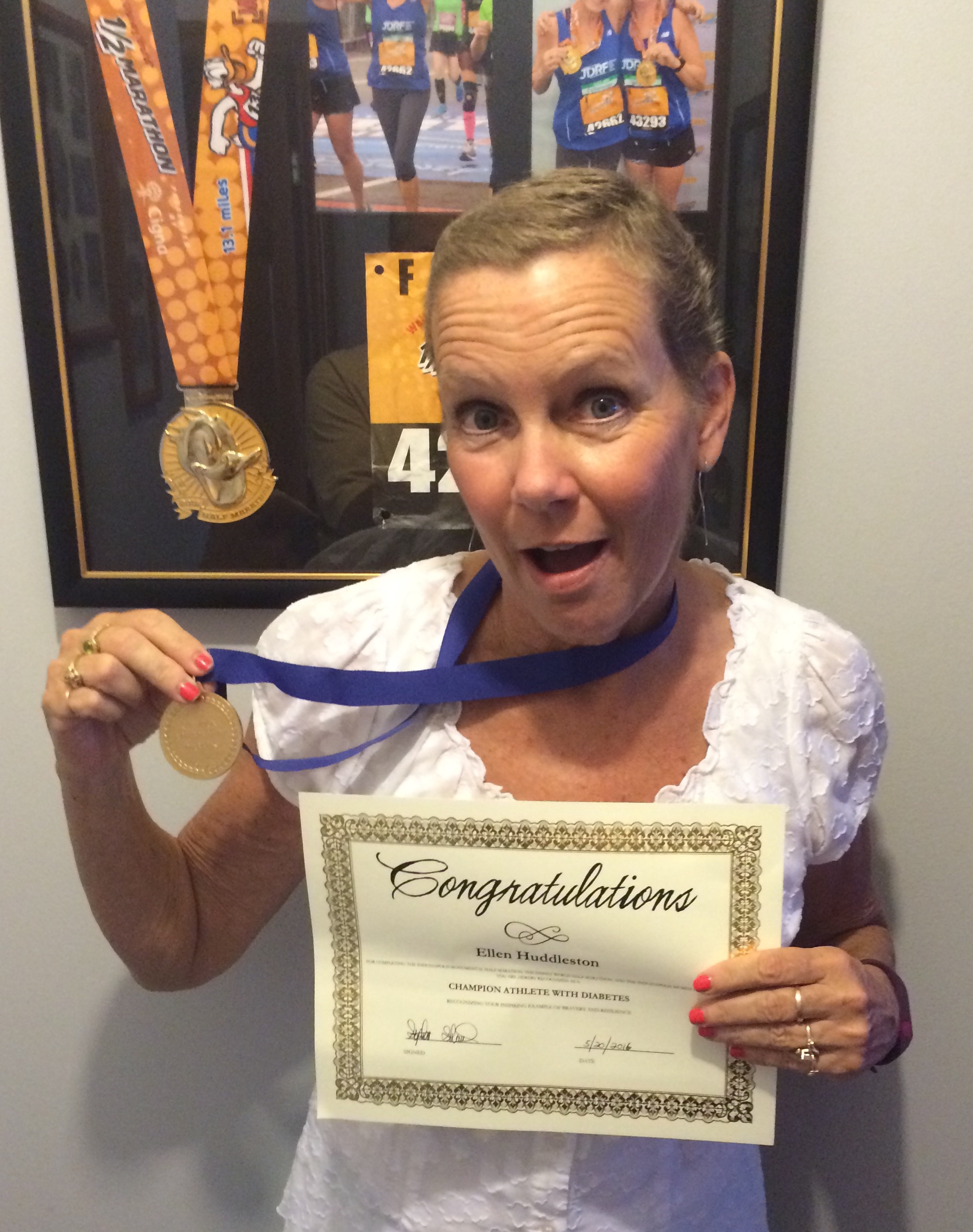
Today, I have another Champion Athletes With Diabetes story. But Ellen isn’t just a runner living with diabetes. She’s also living with cancer. Her sister Terri sent me an e-mail letting me know about her sister’s remarkable achievements, and I want to share part of them with you now.

“Ellen is a person with type 1 diabetes, who has completed three half marathons since November. That in itself I believe qualifies her. But I am more amazed and proud of her as she has done this while battling lung cancer.”

Last November, Ellen finished the Indianapolis Monumental half marathon:

“Her struggle to finish this run led her to the Dr., where she was told she ran it with walking pneumonia (and T1). A few weeks later, once the pneumonia cleared, they spotted tumors in her lung and diagnosed her with lung cancer.”

“Before Ellen was diagnosed with lung cancer, she had already joined Team JDRF to participate in the Walt Disney World Marathon Weekend. Ellen raised $2,700 + for JDRF and on January 9, after her initial round of chemo and while on radiation therapy, completed her second half marathon as part of Team JDRF.”

“Ellen is now done with all her treatments and doing everything possible to get stronger and also manage her T1 diabetes. She is back to regular exercise and in May, completed the Indianapolis 500 Festival – Mini-Marathon.”

“Her strength and attitude amaze me. I participated in both the Disney and 500 Festival half marathons with her. I witnessed her determination to prove to herself and others that her diseases will not stop her.”

Is that inspirational, or what? Knowing that Ellen did all that while living with diabetes and lung cancer makes it a little easier for me to want to get out of bed and get my exercise on.
image
We salute you Ellen… your story makes us smile, and we are honored to award you this medal. Keep running, and keep inspiring!
 
 
What about you? Are you conquering your athletic goals along with the difficulties of living with diabetes? Is there someone important in your life that meets this description? Then I have a medal for you.

Send me an e-mail at champswithdiabetes@gmail.com. Tell me your name, name of the athlete (it’s okay if it’s you), and your address (gotta know where to send the medal). Most important, tell me what athletic goal was accomplished, and when. Extra points if you tell me how you felt accomplishing the goal. Full disclosure: I reserve the right to use your testimonial here, on Twitter, and on Facebook. I will not use your name if you don’t want me to. As always, I will never share private information.

Join the over 80 Champion Athletes With Diabetes. Send me your story today!