Monthly Archives: September 2015

What has to happen?

I’ve wanted to ask this question, and know the answer to it, for a long time, even before I started blogging:

Why does the cost of insulin continue to skyrocket?

What I’ve found out so far is very little. At least very little that allows me to point my finger in a definite direction and say “this is why”. It’s complicated, and if I were to begin to point a finger in a particular direction, that’s where I would start. We can’t find the forest of cash for the trees.

The information on drug research, side effects, production costs, costs to file with regulatory authorities like the U.S. Food and Drug Administration, efforts to build marketing campaigns and pay sales reps to visit endocrinology practices is…. Non-existent. Nobody knows how much it costs to bring a new insulin onto the market (and keep it selling), and depending on how each phase of research, development, and rollout goes, the costs might vary.

Let’s not forget about the rest of the overhead. In Novo Nordisk’s latest financial results, 11.2 percent of their 4 billion dollars in revenue from January through June went to administrative costs, which includes things like pay and benefits, but not only pay and benefits. That’s 448 million dollars.

That seems excessive. And maybe it is. Maybe it’s not. The point is, we don’t know what’s excessive and what’s not in a financial statement for a company that grossed 4 billion dollars in the first six months of the year and published all of its financial line items in a one page document.

Eli Lilly did a much better job, I thought, of detailing their latest quarterly financial statement, but then again, they’re on the other end of the spectrum, and I had to search a little to find Humalog sales listed in the 28 page statement. In case you’re wondering, it was $1.3 billion year-to-date. For a drug that’s nearly 20 years old. Even if it cost a billion dollars or more to develop and produce these drugs, they have certainly more than paid for themselves by now.

But let me back off here. Maybe I shouldn’t point at Lilly and Novo. It’s not just about how much money is being made.

Actually, it’s about the right of a patient to get medication they need to survive, at a price that won’t have to make them have to choose between staying healthy and putting food on the table. Make no mistake: As insulin gets more expensive, this type of decision is already being forced upon a growing number of People With Diabetes here in the USA.

How companies (by companies, I mean drug makers, insurance, hospitals, etc.) reach the point where they charge as much as they do, and we get closer to the breaking point budget-wise, is a matter of great confusion. I really don’t know if this is by design, or if I just don’t have a good handle on the numbers. Here’s what I know:

Insulin should be more affordable.

When I’m tasked with solving a problem like this, I often think back to when The Great Spousal Unit and I bought our house. We knew we were ready to buy, but we didn’t even know if we could even get a mortgage, let alone whether we could afford one. So my solution was to find out what needed to be done to buy a home, and complete each step along the way, until we either moved into our house or knew where we didn’t qualify.

So in this case, I begin with the overarching statement: Insulin should be more affordable. Now the idea is, what needs to be done to make insulin more affordable? What are the steps? Can they all be accomplished? If they can’t all be done, what can’t be done? Why? How do we break down the barriers? What would have to happen to make insulin more affordable?

Why is a drug discovered nearly a century ago more expensive than ever?

Why is a drug approved in 1996 more expensive today than it was when it was approved?

I don’t know if I will get anywhere. But I really want to have a better working knowledge on this subject. I don’t know how long it will take, but I’m going to try to find out as much as I can.

In the meantime, feel free to give me your knowledge, if any, on why the cost of insulin is getting farther and farther out of reach. I’ll let you know if I find out anything.
 
 
There are programs dedicated to helping those who have difficulty meeting the cost of insulin and other diabetes drugs and supplies. Including programs run by Novo Nordisk and Eli Lilly & Co. Rather than re-inventing the wheel, I’ll refer you to this helpful post on the subject from Christel at The Perfect D:
Need Help with U.S. Diabetes Supplies and Medications?
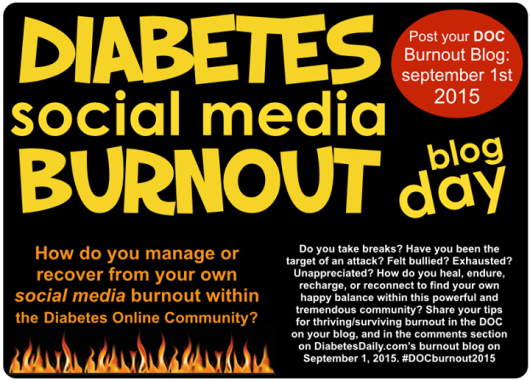
 

Diabetes Social Media Burnout?

Welcome to Tuesday. September 1st. Oh, and it’s my brother’s birthday. Happy Birthday Chuck!

Thanks to the people at Diabetes Daily, today is also Diabetes Social Media Burnout Blog Day. According to Diabetes Daily:

“… let’s talk about ways in which we can address and take care of our burnout! Let’s talk about ways in which we can step back for a bit and re-fuel or ways in which we can handle the situations where we feel like we’re being attacked or even where we might find ourselves attacking others for differences in opinion.”
DSMBD
Okay… there are a few things I should get straight with you right from the outset:

First, maybe I’m late to the party, or maybe I just like this all too much, but I haven’t really felt social media burnout to the extent suggested by this topic. I’ve been connected to the internet since the early 1990s, but never in a big way until I found the Diabetes Online Community (the DOC) four years ago. Also, I never owned a mobile phone until about four years ago, and I’ve only owned a smart phone for the past few months. So that probably has a lot to do with it.

Second, and I hope I’m not jinxing myself, but I haven’t ever really been attacked on the internet. I’ve encountered a few uncomfortable situations here and there, discussions where someone felt a certain way on a subject, and were ready to go toe to toe with me if I disagreed with them. But those moments were few, and by and large, unless that person was advocating for something dangerous or unquestionably wrong, I just let them vent. Didn’t cost me a thing to do so.

Third, my influence on the internet, and within the diabetes community, isn’t that big to begin with. If someone wants to attack me, they’ll have to hit a pretty small target. I’m a fierce target… but when it comes right down to it, nobody is going to feel a lot of pride trying to knock down someone like me. I’m not a big enough fish for most trolls.
 
—————————————————————————————————
 
That’s not to say I haven’t ever experienced social media burnout. Usually, it’s around the time when I am busier than usual already. What I try to do is think of my social media interactions as fun. If it’s not fun, if it seems like too much of a chore, then I back off a bit.

Also, when I get a vacation (which is rare these days, but still), I usually disconnect totally from social media for the week or so I’m away. Once I do that, I’m really ready to engage with others again. Also, it seems like something big always happens during those rare times when I’m not as active on social media. More impetus to jump back into the conversation.
 
—————————————————————————————————
 
As for being attacked? It’s only happened twice that I know of, but I’ve experienced situations where someone accused me of somehow being a shill for a large company, or being part of a select group of bloggers within the DOC that always gets to go to big events while others stay home. Here’s how I deal with something like that:

Look… I know who I am, and what I stand for. I’m not afraid to change my stance on something if I feel that my stance needs to be changed. When someone has something critical to say, I try to listen first and consider whether there is merit to what someone is unhappy about. I allow for the possibility that I may be wrong. That’s a difficult thing to do, and I do it. And sometimes, I’ve changed my point of view. Also, it should be noted, I’ve paid my own way to nearly everything I’ve attended.

I also know the difference between disappointment and bitterness.

I didn’t get to go to MasterLab this year, or Friends for Life (never been to Friends for Life, actually). I am really bummed about that; I’m incredibly disappointed that I didn’t get to make it this year, and it still affects me when I think about it.

Now, if I were to take to the internet and complain about the people who were there, accusing them of being part of an exclusive clique of bloggers who always get to go to big diabetes events and hang out with each other all the time, blah, blah, blah (we’ve heard this before, right?)… well, that’s just bitterness. Bitterness comes from someplace different from disappointment. Those people who went to MasterLab this year? It’s not their fault I didn’t get to go. I get a lot more emotional mileage from being happy that they are there, as opposed to criticizing them for my not being there.

Bitterness can come from disappointment. But disappointment is never an excuse for bitterness. When the only argument you have is to say, in effect, “I’m better than you because look how bad you are”, that’s bitterness. I’m not going to give you my time. You have to own your bitterness all by yourself.

Also, I will add this: When you attack people in the diabetes community, you are attacking my friends. People who have laughed with me, who have befriended me, people who have commiserated with me through my failures, and celebrated with me through my successes. You don’t mess with my friends.

If it weren’t for this community, I wouldn’t be where I am today, physically, emotionally, or just about any other way you can think of.
 
—————————————————————————————————
 
Finally, and I hope this doesn’t sound overly simplistic, but I try to think of the information superhighway just the way I think of an actual superhighway. Along the road, there are places to eat, places to lay your head at night, places to gather socially with one another, places to share experiences, places to ask questions and seek advice.

Along the superhighway, there are good, helpful, strong individuals who live in communities that protect one another and support and encourage one another. And there are terrible, awful people, who thrive on the misery of others, and try to pump up their own sense of self-worth at the expense of someone else. Unfortunately, there is nothing to bar the access of those people from the information superhighway. The best we can do is protect ourselves, and each other.

Well, those are a lot of words, and maybe not a lot of advice. But if I were giving advice on dealing with social media burnout? I’d say: Participate as long as it’s fun and/or meaningful to you. Encourage and support others. Learn the difference between disappointment and bitterness. And…

Do not let a bitter person steal your voice.