Monthly Archives: January 2014

Better, not best.

For many people, living with diabetes means also living with depression and other mental health issues. That’s why this story in the New York Times this weekend caught my eye. It doesn’t have to do with diabetes and depression, but rather with what mental health care looks like today and what it will look like later in the year. Or next year. Or maybe later. What I read in the story is a prime example of one of my biggest frustrations with medical care of any kind. The two hallmarks of managed care in America: Confusion and Delay.

The story describes improvements (hopefully) in access to care for addiction and mental health for patients. Under the Patient Protection and Affordable Care Act, mental health care must be included in all insurance plans. No more leaving it out. And under recent updates to a separate law, the Mental Health Parity and Addiction Equity Act of 2008, plans are not allowed to charge more for co-pays or deductibles for mental health coverage than they charge for physical care. In addition, insurance plans will be required to show consistency when determining whether coverage for physical or mental care is medically necessary. They won’t be allowed to make getting prior approval for in-patient mental health treatment more difficult than the approval needed for admission to an acute care hospital. I like the idea of consistency in the law, and the recognition that care for mental hygiene should be considered on an equal footing with physical care.

What I don’t like is this: According to the NY Times story,

“The new parity rules apply to most health plans and are effective beginning July 1, although many plans will not have to comply until January of next year.”

The rules apply to most plans? What plans? Why not all plans? The piece mentions that some insurers have implemented the equity requirements into their plans already. For those who haven’t, why wait until July 1? What’s the deal with exempting some plans from compliance with the law until next year?

I’ve seen now several provisions of the PPACA and other laws over the last few years get delayed. It seems like it’s almost a given that the most contentious parts of these legislative efforts will always be delayed for one reason or another. Some of the reasoning for those decisions have to do with timing, and how fast insurers can react to change. I get that. But if we’re going to concede that point, we must also recognize that part of the reason for staggering compliance with the equity rules goes back to those ideas of Confusion and Delay. The more confusing insurers make things, and the more they delay, in their thinking, the more money they’ll save. Even when it’s been proven that early access to care of any kind almost always results in better outcomes, helps avoid complications in many cases, and often results in cost savings too.

So, I would ask of insurers: What are you afraid of? If someone needs coverage so they can see their psychiatrist or therapist, or to check into a treatment center for depression today, they need that coverage. Today. At some point, you will be covering that in tune with how you cover a broken arm anyway. Do you want to take a chance that someone could be irreperably harmed by denial of coverage, or by the constraints of cost? Are you okay with, can you visualize, someone being lost just so you can keep your plan the way it is for another six or eleven months? I can’t. I couldn’t live with myself knowing that.

So, insurer, if you can somehow turn off that fear, whatever it is, residing in your backbone somewhere, or if you can ignore it, you can begin the process of going from a bottleneck to being a conduit leading to positive outcomes, for people who are unquestionably worth it.

Stepping off of my soapbox now… How do you feel about this?


Way off in the distance…

…I see a long bike ride, and a triathlon. Please bear with me as I spill out some thoughts today.

I made the commitment again this year to ride in the American Diabetes Association’s Chesapeake Bay Tour de Cure on May 17th.

TourdeCure14

Last year’s event was fantastic, and I’m looking forward to this year’s edition. This is not the closest Tour de Cure for me, but this ride has a few things that work well for an old guy like myself. Mostly, timing and location.

Mid-May should be late enough in the year that any chance of super-cold weather would be minimal. Then all we have to do is cross our fingers and hope it doesn’t rain. Also, the location is flat, on Maryland’s eastern shore (east of the Chesapeake Bay), mostly on roads that are lightly traveled. Last year, the ride was well staffed with volunteers and there was plenty of moral support from other riders and residents along the route.

If you’re in this region, or if you’d like to travel for a fun ride benefitting a good cause, I want to encourage you to consider the Chesapeake Bay Tour de Cure.

Now, about that triathlon…

I have a triathlon in mind, a repeat of the first one I completed three years ago. Registration isn’t open for this event yet, so I don’t want to mention it here except to say that it usually happens on Father’s Day in June. It’s a sprint triathlon, which means the distances are much shorter than those ironman events you hear about. In this case, it involves a 400 meter swim, followed by a 15 mile bike, then a 5K run. If I’m lucky and I train hard, I think I can still complete this in under two hours.

The triathlon is the real tough goal for me. I’m having trouble just mentally preparing for it right now. Even though the distances aren’t that lengthy, and I know I can do it, I also know that I can only do it if I train hard, for months, before the actual event. And I have to stay healthy. Over the next five months, many things could happen to sidetrack me. I had planned to do this one last year but had to withdraw because I encountered a series of illnesses over November, December, January, February, and March. They weren’t serious illnesses, but they sidetracked me enough that I couldn’t get my training ramped up to where I felt I could finish, or finish well. After that 100 mile bike ride back in June 2012, I’m very sensitive and a little scared about pushing myself.

But… I just need to put that in the memory banks and move on. I need to admit my fear, but push past it. My goal, I’m stating publicly here, is to complete that triathlon, perform well for a 50-something year old, or: Come as close as I possibly can to meeting this goal. Which would still be a big deal, even if it would leave me disappointed. The main thing I need to remember is one of the main tenets of living with diabetes:

Never give up. Never give up. Never give up.

So thanks for sticking with me here on this. Sometimes I just have to sit down and get all this off of my chest. As the training progresses, I’ll try to talk more about how exercise and my diabetes play with each other. Now that that’s out of the way… where did I leave that swimsuit?


Two more medal winners!

I’m so thrilled to tell you about our latest Champion Ahtletes With Diabetes.

One of these winners you probably don’t know at all (though you’ll recognize who sent us the request). The other winner you know quite well. What you’ll recognize about these stories though is that it’s the stories that matter in this medal quest.

Sue Rericha of RFamHere’s Ramblings sent me a request for a young person in Illinois. This athlete wanted to play 7th grade volleyball. Sue wrote:

My co-worker’s 7th grade daughter was diagnosed with Type 1 a week before school started at her sport physical. Tonight she found out she made the volleyball team (the whole reason for the physical that may have saved her life).

How can I not want to send a medal for that? So inspiring! Twelve days later, I received another e-mail:

It arrived yesterday! I gave the medal to Katie’s mom and she asked the volleyball coaches to give it to her at tonight’s practice. Perfect timing as tonight they were doing team building and motivation.

A story like that just melts me right down to butter. Congratulations Katie!

——————————————-

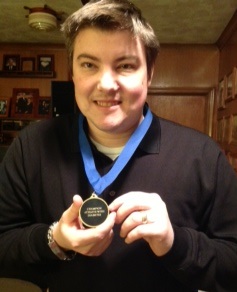
Our other medal winner this time is Mike Hoskins of Indianapolis. Mike writes at DiabetesMine, when he’s not writing at The Diabetic’s Corner Booth.

Mike-with-Medal

Mike has dealt with a lot of the issues we all face as People With Diabetes who strive for athletic achievements. It’s hard, and while the motivation to succeed is great, the motivation to give up is great too. Sometimes, perseverance is what gets you through, no matter how hard the road may be. That, and remembering people who inspire you, like I’m sure Mike inspires others. His road was literally a road, during the ADA’s Indiana Tour de Cure. Mike e-mail from early December says:

It was my first-ever Tour de Cure on June 8, 2013 (I’m just inside the six month mark!). Here in Indy, at the Indy Motor Speedway and around that central part of Indianapolis.

I’d signed up for a 50k because for some reason that was the shortest you could sign up for aside from the “family recreational” stretch just going around the 2.5-mile speedway track. I trained at least a few times a week in the couple months leading up to this event, around my neighborhood and the city on streets and bike paths. On the day of the tour, I made it a little more than 15 miles — about 25k which is half of the registered route. That was my limit, and at times it was very challenging for me, especially when it came to the non-level highways and streets around Indy that were very different from the smooth flat downtown streets and paths I’d been training on.

But I pressed on, in large part because of the people who were there cheering me on as they rode by and saw me struggling to just keep pedaling and offered a “Go Red Rider!” in support. At some of the toughest times, it was that support that kept me going. (support and empowerment… that’s what this is all about!)

This was the most I’ve ridden my bike as an adult, and I am very proud of pushing myself and going the distance that I did. It was never about making it to the very end or being first, because that just wasn’t me. But I wanted to prove that I could do it, that I could push myself to my limit and not stop when it seemed impossible, and that no matter what that diabetes wasn’t going to stop me from doing this.

Before the ride, and even during that time and afterward, it’s people like Scott Johnson, Mari Ruddy and George Simmons who I’ve seen accomplish their own athletic achievements that have really served as my biggest motivations and inspiration in believing I could do this, and pushing myself to make it happen.

Mike also took the time to write about his achievement at DiabetesMine last week. You can read it here. Congratulations Mike!

——————————————-

Okay, it’s your turn. Time to write in and request the medal you deserve for accomplishing athletic goals. Time to nominate someone who inspires you. For more information on the Champion Athletes With Diabetes initiative, click here or send me an e-mail at happymedium[dot]net[at]gmail[dot]com. And don’t forget to follow @ChampsWithD on Twitter and like our Facebook page too!


I have questions.

Even though we hear a lot about how Your Diabetes May Vary, there’s no denying the fact that many of us living with this chronic condition experience the same happenings. And those happenings make us ask things like:

– Why, when you have to do an emergency infusion set change, it’s when you’re ready to go to bed? This happened to me the other night, and it’s happened more than once… I sat on the bed and reached around for the TV remote so I could turn the set off. As I reached around, my thumb got stuck in just the right (or the wrong) place. In a flash, my set was ripped off and I needed a new one. I was already half asleep.

– While we’re at it, why do I always need a set change either first thing in the morning or last thing at night? Can’t these things be done in the middle of the afternoon on a weekend? All the time? Guess not.

– Why does a low make me stand in front of the refrigerator looking for the one item I love best? Should it be the orange juice or the cranberry? A granola bar or chocolate? Not “you’re low, just get the fast-acting carbs in”. More like, “what is the one perfect thing that I could have without feeling any guilt whatsoever?”.

– For those of us without a waterproof insulin pump, no worries… it’s easy to remember to disconnect before getting into the shower. Unless we really like having the pump and tubing dangling at our sides. But what can I do to remember to reconnect after the shower? ‘Cause I forget that a lot.

– Finally: How many more hours could I add to the end of my life if I didn’t have to run back into the house and get the meter I forgot when I walked out the door?

I know, I should just keep an extra meter in my truck all the time. Frankly, I’m just too cheap to buy another. So I find myself wondering why I don’t sometimes, as well as wondering why I can’t get a set change in at a convenient moment (like there is one), or why I rip out a site when I really want to sleep, and why I can’t remember to reconnect my pump right away after a shower or a swim. I’ll bet you ask one of these questions now and then too. Ask any others? Have any solutions? I’d love to hear them.


Like these links– Friday edition.

Happy Friday! I hope that somehow you’ve either avoided the terrible weather gripping the country right now, or that you’re safe and warm wherever you are.

I haven’t done this for a while, so I thought I would pass along these terrific posts from around the Diabetes Online Community. You’ve probably already seen a couple of these, but there are also links to a couple of items that you may have missed.

——————————————————————-

Christel at ThePerfectD has your initial lineup of diabetes conferences for 2014. Personally, I was glad to see this since there were a couple in my area that I didn’t know about. Look for conferences in your area here:
http://theperfectd.com/2014/01/01/your-2014-diabetes-conference-calendar/

Here are a couple of additional conferences for you:
I got an e-mail about a one-day event in Washington, D.C. in February. From The Gary and Mary West Health Institute (WHI) and the Office of the National Coordinator for Health Information Technology (ONC) the focus of the conference is “Igniting an Interoperable Health Care System”. It’s a public conference that will be held at the Omni Shoreham hotel on Feb. 6. The conference will convene stakeholders critical to driving interoperability – a cornerstone to improving patient care through safer and more cost-effective health care delivery. For more on the conference, and to register (it’s free),
Go here.

On February 28, there’s a symposium entitled “Challenging Current Diabetes Care: Strategies for Practice Improvement”. It’s taking place in Richmond, Virginia, and it’s coming from the University of Virginia’s Office of Continuing Medical Education. It looks to be primarily related to Type 2 diabetes care, and features a few notable speakers. I don’t have a web address for you, but if you’re interested, e-mail me at happymedium[dot]net[at]gmail[dot]com and I’ll send you the information.

Kim at Texting My Pancreas is looking for a little help test-driving a new source of diabetes information via the web. I won’t link you there directly. Instead, I’ll send you over to her post so you can get all of the information. Oh, and get this: If you help provide feedback, she’ll enter you for a chance to win a $100 Target gift card:
http://www.textingmypancreas.com/2014/01/profile-health.html

Finally, I want to turn you on to a blog from someone who’s outside of the normal diabetes-blogger profile. This writer graduated from college in the USA recently, then took off this fall for Kenya, where she’s working with people living there. Her story about managing diabetes on the African continent is the perfect example of “you can do anything with diabetes” (except make insulin, of course). The blog is Achieving Dreams While Acing the A1c:
http://t1worldtraveler.wordpress.com/

——————————————————————-

I hope your weekend is spent doing something fun and fulfilling. Life isn’t always about the diabetes, but when it is, make it worthwhile.